






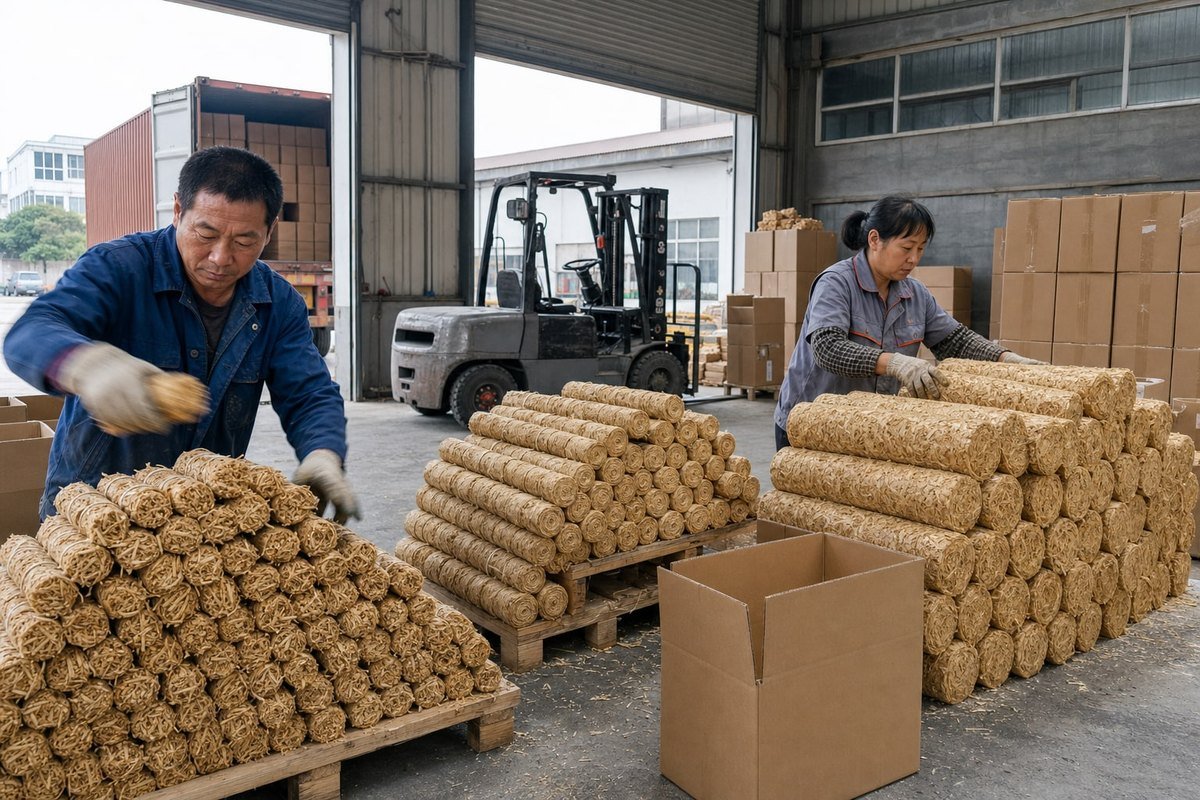
Getting the mix ratio of wood fire starter sizes wrong ties up cash in slow stock ISPM 15 1. I have watched buyers guess, over-order large rolls, and regret it. Our production floor sees this constantly — one bad ratio decision can freeze a season's margin. The fix is a data-backed assortment, not a guess.
For a first China container order of wood fire starters, start with roughly 50% small units, 35% medium, and 15% large by piece count. Adjust toward more small units for BBQ and camping markets, and more medium-large units for fireplace and wet-wood heating markets.
That number is a starting point, not a law. Below, I break down how to tune the ratio for your market, your MOQ, your freight cost, and your compliance file.
How Do I Determine the Right Size Mix for My Target Market's Demand?
A German fireplace distributor once asked us to flip his ratio mid-season. His first order copied a US grilling assortment, and it stalled on shelves. Market context decides everything.
Match the size mix to the dominant fire type in your market. BBQ and camping regions need 60–70% small fast-light units. Fireplace and stove-heating regions need 50% or more medium and large starters, because damp firewood demands longer burn times and higher heat output per piece.

Before you fix any ratio, define what "mix ratio" means in your purchase order. It can mean three different things: the ratio of starter sizes by unit count, the ratio of pack configurations in the container, or the wax-to-wood ratio inside each piece. Our export team always confirms all three in writing, because suppliers may quote by volume, by weight, or by piece — and those numbers diverge fast once sizes differ.
Map Size to Use Case First
Small wood wool firelighters 2, around 20x65mm, transfer flame quickly and suit charcoal grills and portable camping stoves. Medium wax-dipped rolls handle everyday household fireplaces. Large units burn longer and forgive damp kiln-dried kindling that absorbed moisture in storage. Each size solves a different customer problem, so your ratio should mirror how your end customers actually light fires.
Reference Ratios by Market Type
| Target Market | Small | Medium | Large | Notes |
|---|---|---|---|---|
| US BBQ / grilling retail | 60–70% | 25–30% | 5–10% | Q2 grilling season demand |
| EU fireplace / stove heating | 30–40% | 40% | 20–30% | Q4 winter heating peak |
| Camping / outdoor brands | 70% | 25% | 5% | Portability drives choice |
| Hospitality / bulk utility | 20% | 40% | 40% | Fewer pieces per fire matters |
Season also matters. Containers arriving before Q4 should lean toward larger units and fatwood sticks for winter heating. Containers landing before Q2 should favor small BBQ-centric wool rolls. In our 17+ years exporting to the US, Germany, and the UK, buyers who plan two seasonal ratios — not one — reorder far more consistently. Start with the 50/35/15 baseline, then let your first season's sell-through data correct it.
Can I Customize Size Ratios Without Increasing My MOQ or Unit Cost?
The trade-off we weigh most often at quotation stage is line changeover versus flexibility. Mixing sizes costs a real factory very little — if the buyer plans it correctly.
Yes, most established factories can mix sizes within one container MOQ at little or no cost premium, provided each size meets a minimum per-SKU run quantity. Cost rises only when you request non-standard dimensions, extra tooling, or many small-run pack configurations in one order.

Here is how the economics actually work on our lines in Ningbo. Wood wool rolls and wax-dipped starters share the same raw material stream — the sawdust, wood fiber, and paraffin bath do not change between sizes. What changes is the winding or forming setting and the dipping time. So a mixed order of standard sizes costs us almost the same labor as a single-size order. That is why we quote mixed containers at wholesale bulk pricing without penalty, as long as each size stays above a sensible per-SKU floor.
Where Costs Actually Increase
Costs climb in three specific situations. First, fully custom dimensions that need new forming tooling. Second, many different retail-ready display boxes in low quantities, because packaging changeovers slow the packing line. Third, split private label packaging runs, where each brand variant needs its own printed cartons, barcodes, and warning labels.
Negotiation Levers That Keep Unit Cost Flat
- Stick to the factory's standard size catalog for your first order.
- Consolidate pack formats — for example, 24-count retail boxes plus one 100-piece bulk bag, not five formats.
- Keep each size above the per-SKU minimum, typically a few thousand pieces.
- Order a Full Container Load 3 (FCL) so the factory amortizes setup across volume.
- Lock size and weight tolerances in the spec sheet so QC disputes never become cost disputes.
When a Dutch importer asked us for a 40/40/20 split across three sizes with two pack formats, the unit price moved by nothing. When he later added a fourth micro-size with custom tooling, that single SKU carried a tooling fee. Customization is cheap; invention is not.
How Does Mixing Multiple Sizes Affect Container Loading and Freight Efficiency?
Loading day at our Ningbo warehouse taught me a counterintuitive lesson years ago: a smartly mixed container often ships cheaper per unit than a single-size one.
Mixed sizes usually improve freight efficiency. Dense wax cubes and heavy bulk bags fill the container's weight allowance at the bottom, while lightweight wood wool firelighters fill the remaining volume on top. This density balancing lets you hit weight and cubic limits together instead of wasting one.
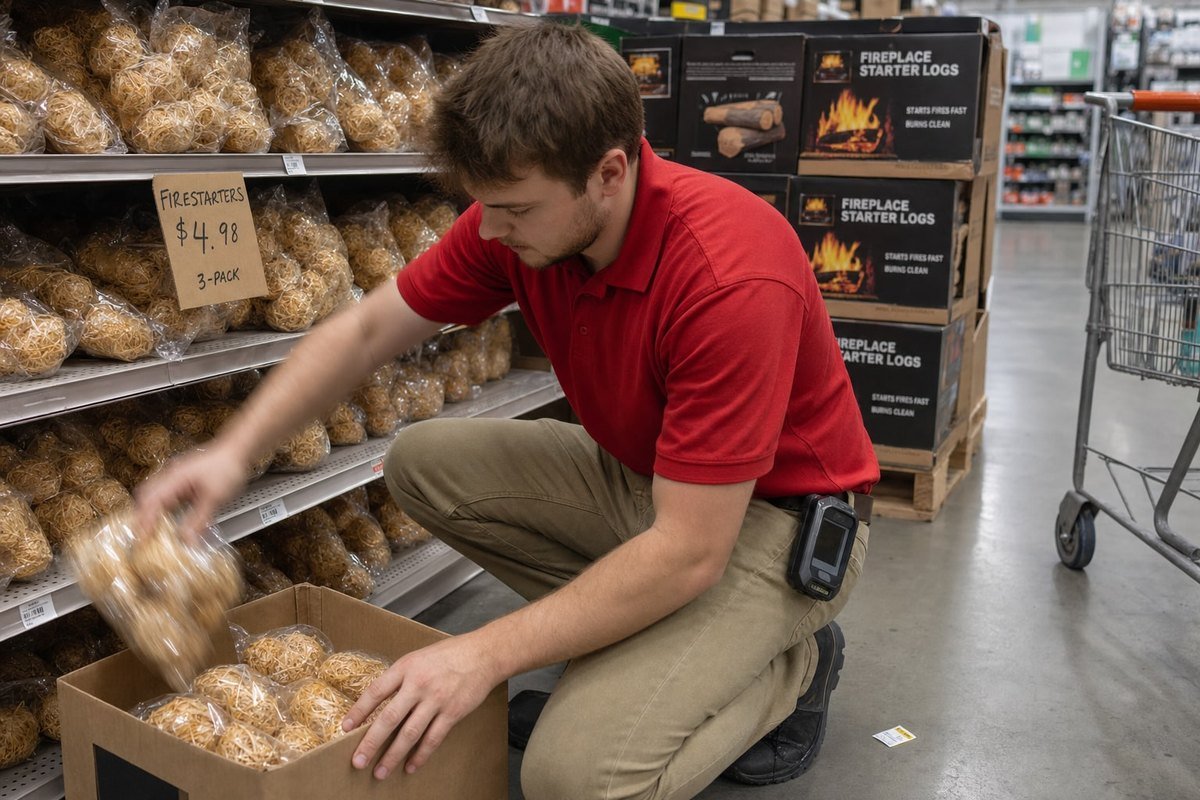
A sea container has two ceilings: payload weight and cubic capacity. Single-size orders almost always max out one and waste the other. Light wood wool rolls "cube out" a 40ft container long before reaching the weight limit. Dense wax-heavy starters "weigh out" with empty air above the cargo. Mixing sizes is the tool that closes that gap, and it is the core of cubic meter optimization for this product category.
Practical Loading Tactics We Use
Request master carton dimensions that align with standard pallet footprints so no dead space forms between rows. Then ask about nesting packaging — smaller retail boxes packed into the gaps around larger kindling bundles or fatwood stick cartons. On our loadings, nesting routinely recovers meaningful cubic space that would otherwise ship as air.
Density Balancing at a Glance
| Product Type | Relative Density | Loading Position | Container Constraint |
|---|---|---|---|
| Wax cubes / bulk bags | High | Bottom layers | Pushes toward weight limit |
| Medium wax-dipped rolls | Medium | Middle layers | Balanced |
| Wood wool firelighters | Low | Top layers | Fills volume cheaply |
| Retail display boxes | Low–medium | Gap nesting | Recovers dead space |
One more transit detail matters for a 30–45 day sea voyage: moisture. We specify a moisture content percentage 4 of 8–10% maximum for wood components and add silica gel desiccant packs in master cartons, because condensation inside a container crossing climate zones can trigger mold. Also confirm your pallets — heat-treated pallets with ISPM 15 5 fumigation marks prevent wood-packaging rejections at destination ports. A mixed load only saves money if it arrives dry, intact, and clearable.
Do All Size Variants Need Separate Compliance Testing and Certification?
Compliance questions land in my inbox more than pricing questions do, especially from US and German buyers. Their concern is fair — combustible goods get scrutinized.
No. If all size variants share the same formulation — for example, 50% wood fiber and 50% paraffin — one test report and MSDS typically covers the product family. Separate testing becomes necessary only when composition, wax type, or additives change between variants.

Regulators and testing labs assess the substance, not the shape. A small wool roll and a large wool roll with identical wood-to-paraffin ratios are chemically the same product. That is why our SGS and Intertek reports cover the formulation across the size range, and why our ISO 9001 6 batch controls exist — to guarantee the tested formulation is the shipped formulation, every run. Where buyers get burned is when a supplier quietly changes wax grade between sizes to cut cost. Then the test report no longer matches the goods, and a customs inspection can strand the container.
The Document Set Your Container Actually Needs
| Document | Covers | Size-Specific? |
|---|---|---|
| MSDS (Material Safety Data Sheet) | Formulation and handling | No — per formulation |
| SGS / Intertek test report | Composition, safety performance | No — per formulation |
| HS code classification (3606.90) | Customs tariff category | No — per product family |
| Phytosanitary certificate 7 | Untreated wood components, where required | Sometimes — check destination rules |
| Warning labels and barcodes | Retail packaging | Yes — per SKU and pack size |
Where Sizes Do Diverge
Packaging compliance is size-specific even when the product is not. Each retail SKU needs its own barcode, net weight declaration, and correctly sized warning label — something we handle in-house as part of one-stop OEM work. And if your kindling sticks or fatwood are minimally processed wood, some destinations may request a phytosanitary certificate on top of the standard file. Ask your supplier to list required documents per SKU before production, not after loading.
Conclusion
An unplanned size mix wastes shelf space, freight budget, and compliance effort. Start at 50/35/15, tune it to your market, balance container density, and confirm one formulation covers the family.
Footnotes
1. ISPM 15 wood packaging fumigation standard is referenced for port clearance compliance. ↩︎
2. Provides background on wood wool firelighter products referenced in the sizing discussion. ↩︎
3. Explains the shipping container concept underlying FCL freight economics discussed. ↩︎
4. EPA resource on moisture control relevant to preventing mold during container transit. ↩︎
5. IPPC standard defines wood-packaging fumigation marks referenced for preventing port rejections. ↩︎
6. ISO 9001 is cited as the batch control standard ensuring formulation consistency. ↩︎
7. FDA guidance on phytosanitary certificates relevant to wood product export compliance. ↩︎



Join the Conversation