







Buying wood fire starters looks simple until a container arrives with crumbling rolls, missing test reports, or packaging that fails retail inspection. I have seen it happen. After 17+ years running production lines for wax-dipped wood rolls and color-flame products, our team has rescued more than a few buyers who trusted the wrong supplier first. The stakes are real: a failed shipment means lost shelf space, angry retail partners, and months of wasted lead time. The good news is that almost every one of these disasters is avoidable if you know what to check before you sign.
The most common mistakes when buying wood fire starters are choosing suppliers without verified safety certifications, skipping pre-shipment quality control, underestimating MOQ and lead-time realities, ignoring moisture content and burn time consistency, and signing private-label contracts before confirming packaging compliance for the destination market.
Each of these mistakes has a clear fix. Below, I walk through the four biggest risk areas, in the order they usually appear in a real sourcing project.
How Do I Avoid Choosing a Supplier Without Proper Safety Certifications?
A German distributor once told me his previous supplier promised "full CE compliance" over email, then went silent when asked for the actual test report. That conversation shaped how we present our documentation today.
Avoid uncertified suppliers by requesting original ISO 9001, BSCI, CE, and SGS or Intertek reports before sampling, verifying certificate numbers directly with the issuing body, and confirming the tested product matches the exact fire starter formulation you plan to import.

Certification fraud in the fire-products category is more common than most buyers expect. The product touches open flame, so customs authorities, insurers, and large retailers all demand proof of safety. A supplier who cannot produce real documents will eventually cost you far more than a compliant one charges.
The Documents That Actually Matter
Not all paperwork carries equal weight. Here is how I rank the documents our own buyers ask for, and what each one actually proves.
| Document | What It Proves | Red Flag If Missing |
|---|---|---|
| ISO 9001 1 | Factory has a working quality management system | No repeatable process; batch quality will drift |
| BSCI audit | Ethical labor and social compliance | Retail chains in the EU and US may reject the vendor |
| CE marking 2 file | Product meets EU safety directives | Shipments can be seized at European ports |
| SGS / Intertek test report | Third-party verified composition and non-toxic ingredients | Claims like "safe" or "natural" are unverified |
Verify, Don't Trust
A PDF is easy to fake. Take three extra steps. First, check the certificate number on the issuing body's website. Second, confirm the report date is recent; a five-year-old test on a discontinued formulation proves nothing. Third, match the tested product description to your actual order. A test report covering paraffin wax 3 firelighters does not automatically cover a natural wood wool version, because composition, ignition speed, and emissions differ.
Indoor fireplace safety adds another layer. If your customers burn the product indoors, you should ask for emissions data showing no harmful VOCs volatile organic compounds 4. For BBQ or pizza-oven channels, ask whether the starter uses food-grade materials or at least a residue-free formulation, since chemical-tainted flavor is a common complaint that traces straight back to sourcing shortcuts.
What Quality Control Issues Should I Watch for Before Placing a Bulk Order?
There is a trade-off we weigh on every production run: wax coverage versus fiber exposure. Too much wax slows ignition speed; too little shortens burn time. That balance is exactly where cheap suppliers cut corners.
Watch for inconsistent wax-to-wood ratios, high moisture content in the wood core, burn time variation between pieces, crumbling or shedding fibers, and samples that outperform mass production. Always burn-test units pulled randomly from a trial batch, not hand-picked golden samples.
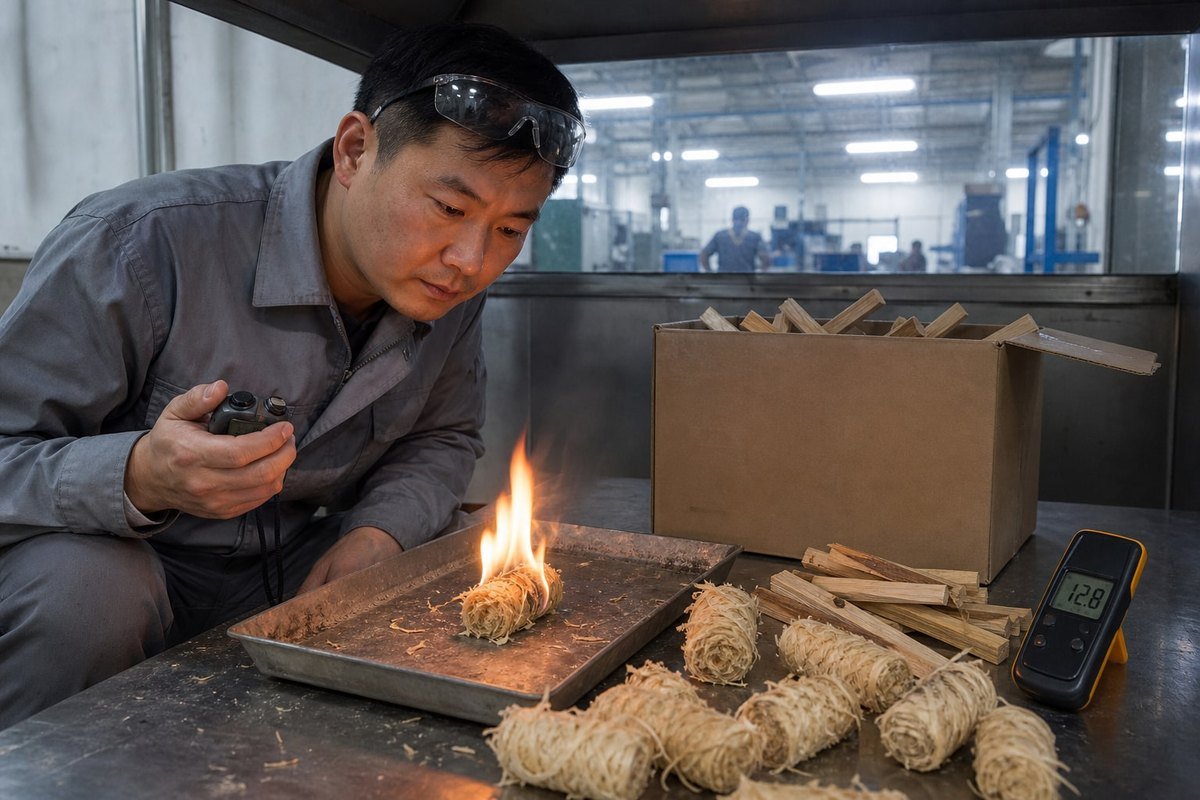
Quality problems in wood fire starters hide well. A pallet of wax-dipped rolls can look perfect and still fail in the customer's fireplace. The reason is that performance depends on internal variables you cannot see: moisture content in the natural wood shavings, wax penetration depth, and fiber density.
The Golden Sample Trap
The single most expensive QC mistake is judging a factory by its sample. Samples are often made slowly, by the best workers, with premium inputs. Mass production runs faster with different tolerances. On our lines, we deliberately pull QC units from every batch during full-speed production, because we want the first sample a buyer receives to reflect what a container will actually contain. Ask any potential supplier one direct question: how do you guarantee batch-to-batch consistency? A vague answer is your answer.
Performance Metrics You Should Test Yourself
Before committing to a bulk order, run your own bench test on at least 20 random pieces. Measure these:
| Metric | Acceptable Range for Quality Starters | Why It Matters |
|---|---|---|
| Ignition speed | Lights with one match in under 20 seconds | Slow ignition means customer complaints |
| Burn time duration | 8–12 minutes, consistent across pieces | Must outlast kindling ignition, not just flare |
| Moisture content | Low and stable; wax coating intact | Damp cores cause smoking and misfires |
| Residue | Minimal ash, no black smoke | Heavy residue accelerates chimney soot buildup |
| Piece integrity | No crumbling in packaging | Crumb-free formulation prevents mess and pest attraction |
Energy Density Beats Piece Count
Some buyers compare offers by piece count alone. That is a mistake. A box of 100 weak starters can deliver worse cost per ignition than 60 dense, well-saturated rolls, because customers use two or three weak pieces per fire. Compare weight per piece and burn time duration, then calculate the real cost per successful fire, not the price per unit.
How Can I Prevent MOQ and Lead Time Surprises When Sourcing Wood Fire Starters?
A Canadian buyer emailed us last autumn asking for delivery before the heating season. He had already lost eight weeks with a trading company that quoted a lead time it never controlled. That timing lesson is worth sharing.
Prevent MOQ and lead-time surprises by confirming whether your supplier is a real factory, getting MOQ terms in writing per SKU and packaging type, mapping production time against seasonal peaks and shipping windows, and negotiating a smaller trial order before committing to full container volumes.
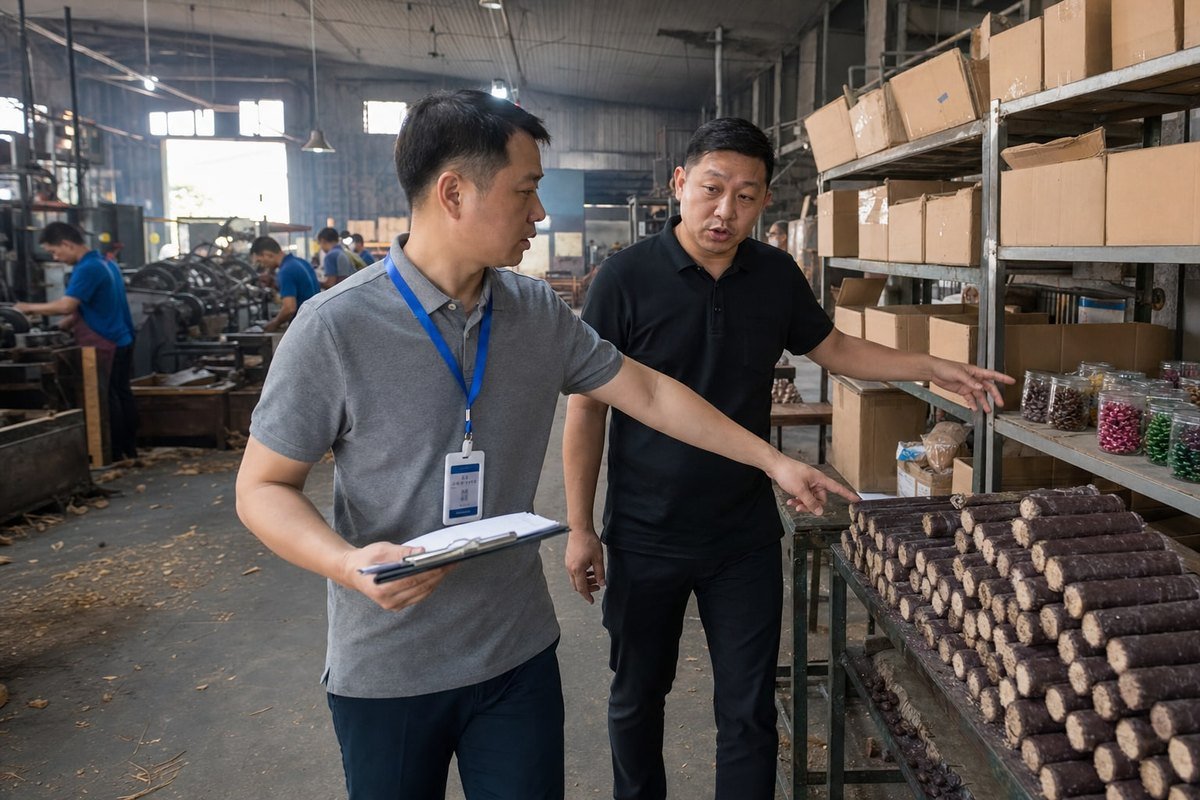
Lead time failures in this category almost always trace back to one root cause: the buyer never knew who actually made the product. Trading companies quote optimistic dates because they do not see the production schedule. A factory can tell you exactly which week your order enters the line. When we quote from our Ningbo production facility, the date reflects real machine capacity, not a guess.
Understand the Seasonal Squeeze
Wood fire starters are a seasonal product. Demand in the US and Europe peaks from September through January. Factories fill their Q3 schedules by early summer. If you place a first order in August expecting October delivery, you are competing with every established buyer who booked in May. Plan backward from your shelf date:
- Confirm final packaging artwork and labels.
- Add production time, typically 25–40 days depending on customization depth.
- Add ocean freight, usually 30–45 days to the US or Europe.
- Add customs clearance and inland delivery buffer.
- Add a two-week safety margin for peak-season port congestion.
Negotiate MOQ Like a Professional
MOQ is more flexible than most buyers assume, but only if you understand what drives it. Wax formulation changeovers, custom box printing plates, and label runs each have minimum economic quantities. A generic-packaging trial order can often ship at a fraction of the private-label MOQ. In our experience exporting to 30+ countries, buyers who ask for a small trial order with standard packaging, then scale to custom branding on the reorder, get the best of both worlds: low risk first, full customization second. Get every MOQ term in writing per SKU, because a verbal "we're flexible" evaporates when the purchase order arrives.
Also confirm storage guidance for transit and warehousing. Paraffin wax firelighters can soften in hot containers or summer warehouses, so ask your supplier about melt-point tolerance and recommended storage temperatures before the goods sit in a Texas distribution center in July.
What Should I Verify About Private Labeling and Packaging Before Signing a Contract?
Designing a retail-ready box taught our team more about compliance than any audit did. One early private-label project came back from a US retail review flagged for an incomplete warning label, and we rebuilt our packaging checklist from that experience.
Before signing, verify who owns the artwork files, confirm warning labels and barcodes meet destination-market regulations, request a physical pre-production packaging sample, define print-quality tolerances in the contract, and check that composition claims on the box match the actual test reports.
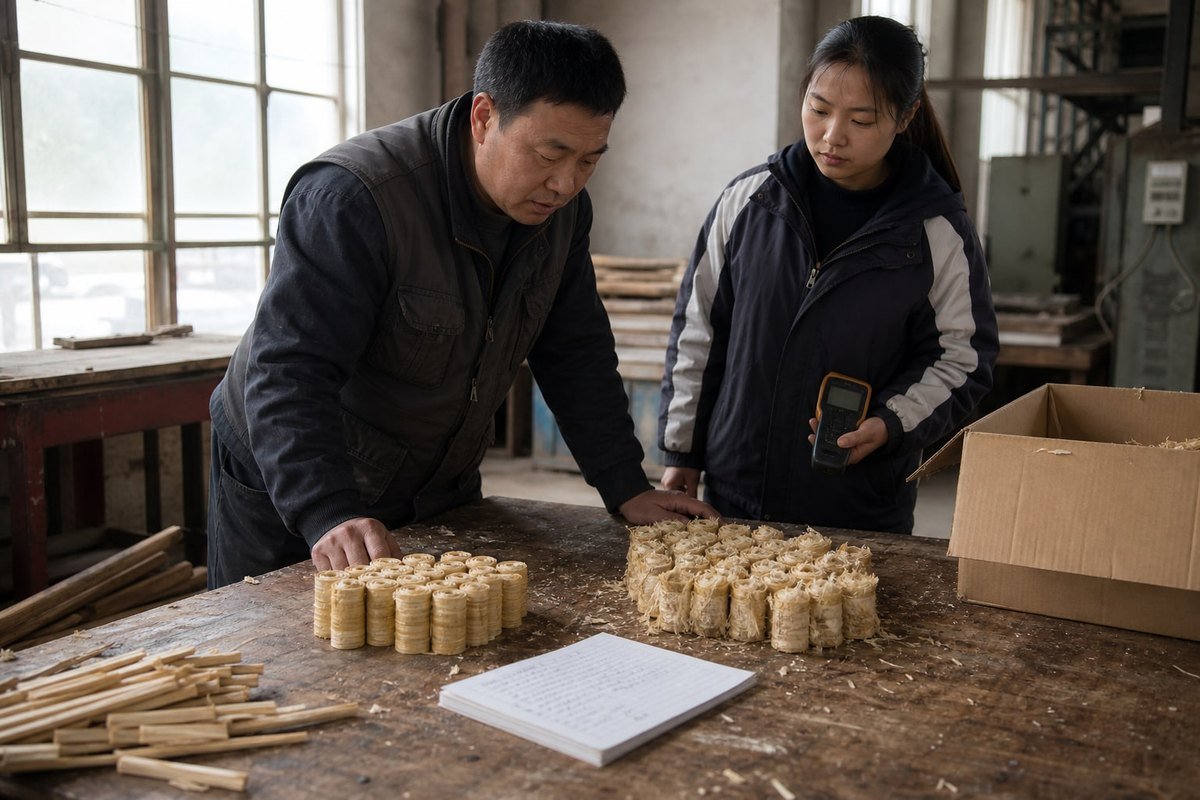
Private labeling is where a good product becomes a sellable brand, and also where contracts hide the most traps. The box is not decoration. In regulated markets, it is a legal document. Everything printed on it — composition percentages, usage instructions, safety warnings, origin marking — must be accurate and compliant, or the retailer will reject the shipment at receiving.
The Packaging Verification Checklist
Here is the checklist I walk our OEM buyers through before any contract signature:
| Item to Verify | What to Confirm | Common Failure |
|---|---|---|
| Warning labels | Match destination-country flammability regulations | EU and US wording requirements differ |
| Barcodes | GS1-registered 5, scan-tested on the physical box | Barcode printed too small or on curved surface |
| Composition text | Matches SGS/Intertek report exactly | Box says 100% natural; report shows 50% paraffin |
| Sustainability claims | FSC certified 6 wood claims backed by chain-of-custody documents | Unverifiable eco-claims trigger retailer audits |
| Artwork ownership | Contract states you own final design files | Supplier holds files hostage if you switch factories |
| Display packaging | Shelf-ready dimensions match retailer planogram | Boxes too tall for standard shelving |
Match the Claims to the Product
Composition honesty deserves special attention. If your box advertises non-toxic ingredients, natural wood wool, or fatwood sticks, the test report must support each claim. Mismatched claims are not just embarrassing; they create legal exposure in consumer-protection jurisdictions 7. We print composition details like wood fiber and wax percentages directly on our retail boxes because transparent labeling is now a purchasing criterion for the big-box channels our buyers sell into.
Finally, insist on a physical pre-production sample of the complete packaged unit: box, insert, label, barcode, and product together. A digital proof cannot show print color drift, box strength, or how the wax rolls sit inside during transit. One physical sample costs a week. A rejected container costs a season.
Conclusion
Every failed fire starter shipment I have seen traced back to a skipped verification step. The fix is discipline, not luck.
Sourcing wood fire starters well comes down to four habits: demand verifiable certifications, test random production units rather than golden samples, plan MOQ and lead times around the seasonal calendar, and treat packaging as a compliance document. Buyers who skip these steps pay twice — once for the failed order, and again for the rushed replacement. Buyers who follow them build supply chains that survive peak season supply chain management 8. If you take one thing from this article, let it be this: choose a partner whose factory floor, test reports, and contracts all tell the same story. That consistency is what separates a reliable long-term supplier from an expensive lesson.
Footnotes
1. Authoritative Wikipedia entry providing a comprehensive overview of the ISO 9001 quality management standard.



 English
  Spanish
  German
  French
  Arabic
  Portuguese
Join the Conversation