







Every week, our factory receives wood fire starter quote requests that say little more than "please send price." Those buyers wait longest and get the least useful numbers back.
To get accurate wood fire starter quotes, send suppliers a complete specification: product format, materials, dimensions, weight, burn time, moisture content, packaging design, certifications required, destination market, MOQ, and target volume. A detailed technical specification sheet lets suppliers price the exact product, not a guess.
In this guide, I will walk through each part of that specification ISPM 15 heat treatment records 1. I will show you what to write, why it matters, and which gaps cause inflated or misleading quotes.
What Product Details Do I Need to Include for an Accurate Wood Fire Starter Quote?
A buyer from Germany once asked us to quote "wood fire starters, 100 pieces per box." That single line could describe four different products on our line, each with a different cost structure warning label languages 2.
Include the exact product format, dimensions, unit weight, wood type, wax type, moisture content, burn time target, and intended use case. Suppliers price raw materials, labor, and tooling from these details, so vague briefs always produce padded or inaccurate quotes.
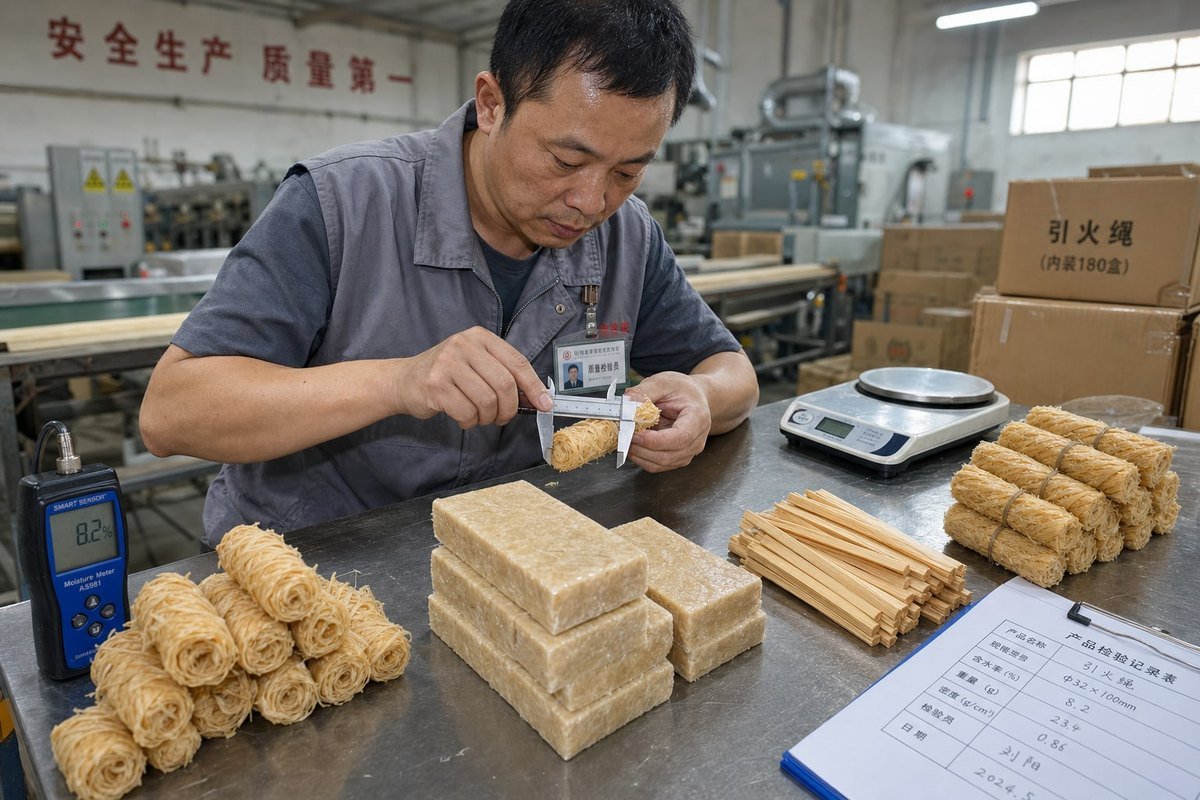
The phrase "wood fire starter" is not one product. It covers wood wool rolls 3, sawdust-and-wax blocks, fatwood sticks, and wax-dipped kindling. Each format uses different raw materials and different machinery. When we quote a wax-dipped wood roll versus a compressed sawdust puck, the paraffin ratio alone changes the material cost meaningfully. So the first thing your brief must do is name the format precisely.
Start With the Use Case
Tell the supplier where the product will be used. Indoor fireplace, wood stove, BBQ, camping, or emergency kits all carry different expectations. Outdoor starters may need moisture resistance and faster ignition in wind. BBQ starters may need clean-burning, odor-free formulations. In our experience exporting to the US and Europe, buyers who state the use case in one sentence save two or three rounds of clarification emails.
Define the Format and Physical Specs
Here is a quick comparison of common formats and what each one requires in a brief:
| Format | Key Materials | Critical Specs to State |
|---|---|---|
| Wax-dipped wood wool rolls | Kiln-dried wood wool, paraffin or soy wax | Roll diameter, length, wax coverage, burn time |
| Sawdust-and-wax blocks | Compressed sawdust, wax binder | Block dimensions, density, net weight |
| Fatwood sticks | Resin-rich pine | Stick length, thickness, resin content |
| Natural fiber nuggets | Wood fiber, wax | Nugget size, weight per piece, pieces per pack |
Make Performance Measurable
Avoid phrases like "burns well." Instead, write measurable targets: "ignites within 10 seconds with a single match," "burn time of 8–10 minutes per roll," "performs after brief moisture exposure." Also state the moisture content limit 4 — kiln-dried wood below roughly 20% moisture is the common benchmark for reliable lighting and mold-free storage. When we calibrate our wax-dipping line, burn time and ignition speed are tuned by wax ratio and fiber density, so these numbers directly shape the quote.
How Do I Communicate Certification and Compliance Requirements to Suppliers Upfront?
Compliance is where I see the most expensive surprises. One retail buyer came to us after a prior supplier's shipment was held at customs because the heat-treatment paperwork for the wooden components was missing.
State your destination market and required documents in the first message: SDS sheets, lab flammability test reports, ISPM 15 heat treatment records, and any retail-specific certifications. Ask the supplier to confirm which documents they already hold before you compare prices.

Fire starters sit close to regulated flammable goods in many jurisdictions. That means paperwork is not an afterthought — it is a cost driver and a supplier filter. At our factory, ISO 9001 5, BSCI, CE, and SGS/Intertek documentation is standard because our US and EU buyers treat it as a hard requirement. A supplier without these documents may quote a lower unit price, but you inherit the testing costs and the delay risk.
Name the Destination Market First
Regulations differ by country. A starter shipped to Germany, the UK, or the US may need different labeling language, warning statements, and test evidence. You do not need to know every standard yourself. Instead, write: "Destination market: USA, sold through big-box retail." A competent supplier will then map the correct document set. If they cannot, that tells you something important before money changes hands.
The Core Document Checklist
Request these items with your quote, not after it:
- Safety Data Sheet (SDS) in the correct format for your market.
- Flammability or burn test report from a recognized lab such as SGS or Intertek.
- ISPM 15 6 phytosanitary and heat treatment documentation for wooden products crossing borders.
- FSC certification 7 or equivalent chain-of-custody proof if you make sustainability claims.
- Factory audit reports (BSCI or similar) if you sell into major retail chains.
Define What "Eco-Friendly" Means to You
"Eco-friendly" is not a specification. Tell the supplier whether you mean FSC certification for the wood source, biobased wax instead of paraffin, recycled packaging, or all three. Each choice changes formulation, sourcing, and price. When buyers ask us for natural formulations, we confirm in writing exactly which claim will appear on the packaging, because the claim determines the proof required.
What Packaging and Private-Label Information Should I Provide Before Requesting a Quote?
Packaging design work is where our OEM team spends the most back-and-forth time with new buyers. A quote for bulk polybags and a quote for shelf-ready display boxes can differ by a wide margin on the same product.
Specify the packaging format, units per pack, master carton configuration, private label packaging artwork status, barcode requirements, warning label languages, and any retailer display standards. Packaging often drives a large share of unit cost, so it belongs in the first quote request.

Buyers sometimes treat packaging as a detail to finalize later. That is a mistake. Packaging affects material cost, labor, carton dimensions, freight volume, and even compliance labeling. When we prepare private-label programs for fireplace and BBQ distributors, the packaging brief is often longer than the product brief — and that is normal for retail channels.
Packaging Formats and Their Cost Impact
| Packaging Type | Typical Channel | Quote Impact |
|---|---|---|
| Bulk polybag or plain carton | Wholesale, refill programs | Lowest cost, minimal artwork |
| Printed retail box | E-commerce, specialty retail | Moderate cost, artwork and plates needed |
| Display-ready / shelf-ready carton | Big-box retail | Higher cost, structural design required |
| Kraft bag or jar with label | Gift and boutique channels | Label printing plus filling labor |
Private Label Details to Send
Tell the supplier whether artwork is ready, in progress, or needs design support. Include your barcode requirements — UPC for the US, EAN for Europe — and confirm who supplies the codes. List every language required on warning labels. For big-box programs, attach the retailer's packaging guide if you have it, including master carton durability standards and palletization rules such as maximum pallet height and zero-overhang requirements for automated distribution or Amazon FBA intake.
Confirm the Pack Hierarchy
Write out the full hierarchy: pieces per inner pack, inner packs per master carton, cartons per pallet. A "100 pcs" retail box like the ones we produce needs its inner arrangement defined before we can calculate box board, filling labor, and freight cube. Without this, any quote is an estimate at best.
How Can I Avoid Misunderstandings About MOQ, Lead Time, and Logistics When Requesting Quotes?
A lesson I learned early in our 17 years of exporting: most quote disputes are not about price. They are about volume assumptions and delivery timing that were never written down.
State your first order quantity, target annual volume, whether this is a pilot run or ongoing program, required delivery dates, shipping terms, and destination port. Suppliers set unit prices, minimum order quantity flexibility, and production slots based on these commitments.
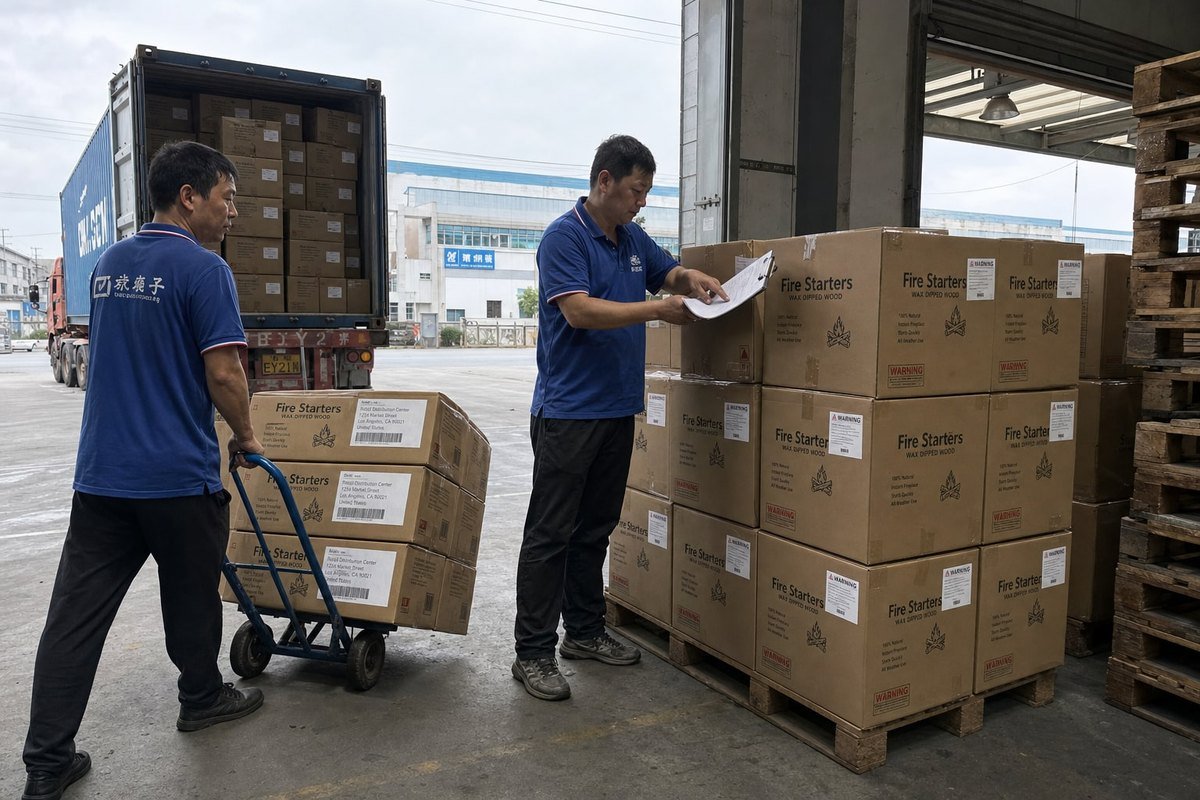
Unit price is not a fixed number. It is a function of volume, tooling, packaging setup, and timing. When a buyer tells us "trial order of 2,000 boxes now, forecast of 40,000 annually if the pilot succeeds," we quote differently than for a one-off purchase. We can justify lower setup costs and offer better bulk wholesale pricing on the scaled program because the relationship carries the investment.
Be Honest About Volume
Do not inflate forecasts to squeeze a lower price. Experienced suppliers spot this, and it damages trust. Instead, share three numbers: first order quantity, realistic annual volume, and reorder frequency. Then ask directly: "What is your minimum order quantity for custom packaging, and what price breaks exist at higher volumes?" This gets you a tiered quote you can actually plan around.
Nail Down the Timeline
Fire starters are seasonal. Winter fireplace demand and summer camping demand create production peaks. Shipping lead times from China to the US or Europe add four to six weeks of ocean transit on top of production. Work backward from your shelf date:
- Confirm your in-warehouse date.
- Subtract ocean transit and customs clearance time.
- Subtract production lead time, which the supplier must state in the quote.
- Subtract sample approval time — always request pre-production samples with defined acceptance criteria for size, color, moisture, and burn behavior.
Clarify Shipping Terms in Writing
| Term to Confirm | Why It Matters |
|---|---|
| Incoterm (FOB, CIF, DDP) | Defines who pays freight, insurance, and duties |
| Destination port | Changes freight cost and transit time |
| Pallet specs | Retailer intake rules affect loading plan |
| Partial shipment policy | Matters for seasonal replenishment |
| Payment terms | Deposit and balance timing affect cash flow |
Put every one of these in the quote request. A supplier who answers them clearly and quickly, in responsive English, is showing you how the whole relationship will run.
Conclusion
Vague briefs cost you time, money, and comparability. Send a complete specification — product, performance, compliance, packaging, and logistics — and suppliers like us can quote fast, accurately, and honestly.
Footnotes
1. Official international standard for treating wood packaging to prevent the global spread of pests. ↩︎
2. Provides context on regulatory requirements for safety warnings and labeling on consumer products. ↩︎
3. Defines the specific fire starter format and material composition used in manufacturing. ↩︎
4. Cites USDA Forest Products Laboratory research on wood moisture standards affecting combustion quality.



 English
  Spanish
  German
  French
  Arabic
  Portuguese
Join the Conversation