






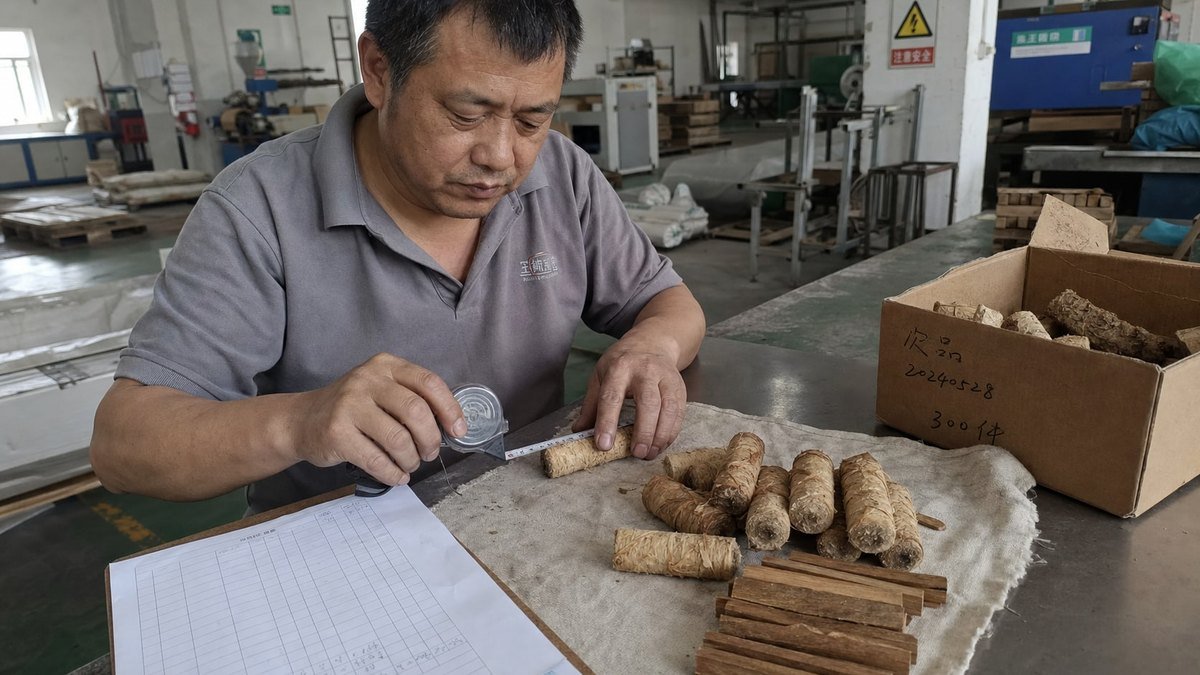
Defining product specifications 1 for wood fire starters sounds simple until a container arrives with crumbling rolls and weak flames. On our production line, we've seen vague RFQs cause exactly that. The fix is a measurable spec sheet.
To define product specifications for wood fire starters, specify material composition and wax ratio, minimum burn time (typically 8–12 minutes), unit size and weight, moisture content limits, required certifications (SGS, CE, REACH), private-label packaging details, and pass/fail quality control acceptance criteria for each batch.
Below, I break each of these areas down into practical questions 2 you can put directly into your RFQ. Let's start with the numbers that matter most: burn time and size.
What burn time and size specifications should I request for wood fire starters?
A German distributor once sent us a one-line spec: "standard fire starters, good quality." We sent back four samples with different burn times — and his answer changed his entire order plan.
Request a minimum burn time of 8–10 minutes for fireplace and BBQ use, and 10–12 minutes for damp outdoor conditions. Specify unit dimensions (typically 5–8 cm rolls), unit weight in grams, and a wax-to-wood-fiber ratio of roughly 40–50% to guarantee consistent energy output.
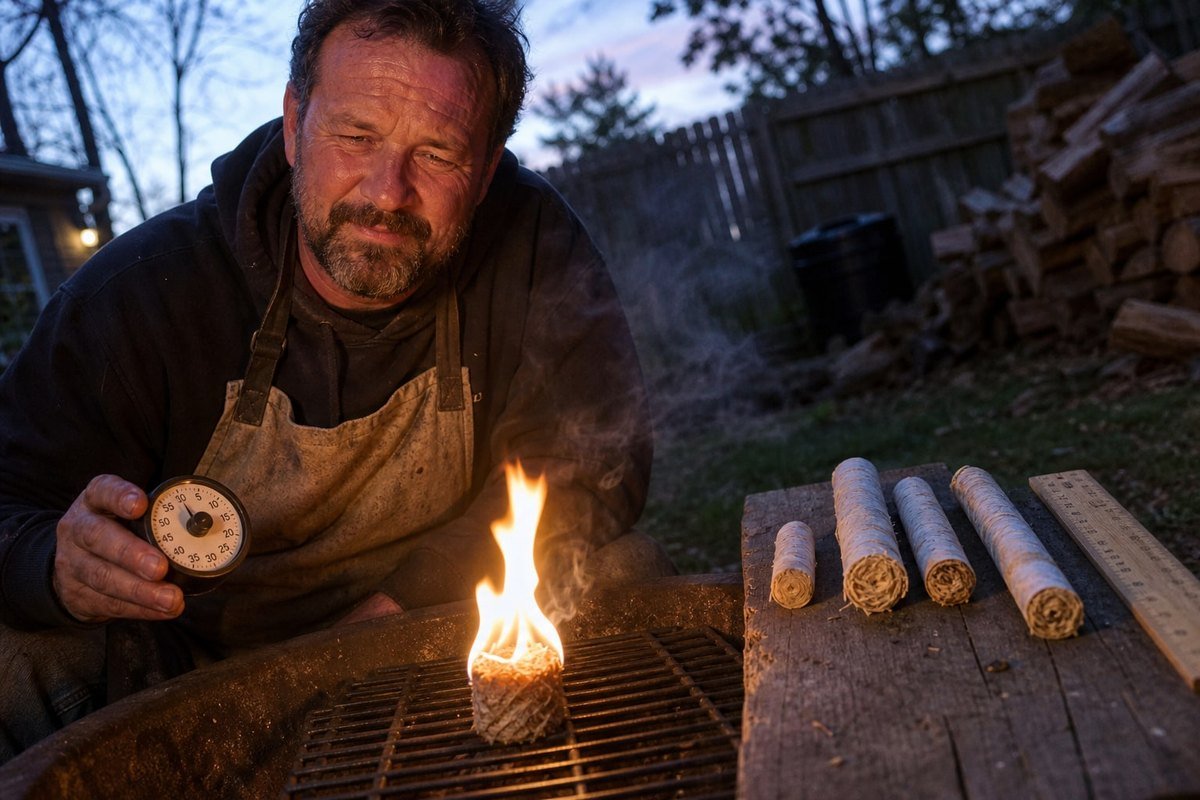
Burn time duration is the single most important performance number in your spec. But it only means something if you tie it to unit weight and composition. A heavier roll with more wax burns longer. A loosely wound wood wool roll ignites faster but burns out sooner. So never specify burn time alone — specify the combination.
Match burn time to the end use
Different applications need different flame profiles. Here is how we typically advise buyers to write this into their RFQ:
| End Use | Recommended Burn Time | Typical Unit Weight | Key Priority |
|---|---|---|---|
| Indoor fireplace / wood stove | 8–10 minutes | 10–14 g | Low smoke, clean odor |
| BBQ / charcoal grill | 8–12 minutes | 12–16 g | Non-toxic, food-safe burn |
| Camping / outdoor fire pit | 10–12+ minutes | 14–18 g | Moisture resistance |
| Emergency / survival kits | 12+ minutes | 16–20 g | Long shelf life, reliable ignition |
Specify size tolerances, not just averages
In our 17+ years of producing wax-dipped wood rolls 3, we've learned that size drift is what buyers notice first. If unit length varies by more than a few millimeters, retail boxes look sloppy and burn times scatter. Write tolerances into your spec: length ±5%, weight ±8%, and a defined wax saturation range. Also require a maximum moisture content for the wood wool itself — under 12% is a sensible target — because damp fiber raises the effective ignition temperature and causes slow, smoky starts.
Finally, define ignition behavior as a testable criterion: the unit must light with a single match within 5 seconds and sustain a stable flame without relighting. "Easy to light" is marketing language. "Single-match ignition in 5 seconds" is a specification.
Which certifications and test reports do I need to confirm compliance in my market?
Compliance is where we lose the fewest deals and win the most trust. When buyers from the US or EU audit our Ningbo facility, the certificate folder comes out before the product samples do.
Require ISO 9001 and BSCI factory certifications, SGS or Intertek product test reports, an SDS with full ingredient disclosure, and market-specific proof: REACH and CE-related documentation for the EU, Prop 65 review for California, and biobased-content evidence for institutional or government buyers.

A fire starter is a combustible consumer product. Even when it is classified as non-hazardous, retailers and customs authorities still expect documentation. In our experience exporting to 30+ countries, the paperwork requirements differ sharply by market, so your spec should name the exact documents you need.
Documents to request by market
| Market | Core Requirements | Common Extras |
|---|---|---|
| United States | SDS (OSHA HazCom format), SGS/Intertek test report | Prop 65 review for California-bound goods |
| European Union | REACH compliance, SDS, CE-related documentation | German/French language labeling |
| United Kingdom | UKCA-aligned documentation, SDS | Retailer-specific audits |
| Canada / Australia | SDS, flammability test data | Bilingual labels (Canada) |
| Government / institutional | Biobased content evidence (often 92%+) | Third-party composition verification |
Beyond certificates: ingredient disclosure
Ask for an exact composition breakdown 4, not phrases like "all natural." A proper SDS should list every component — wood wool and wax, plant oils, any binders — plus known allergens. This matters for labeling. If a formula contains soy wax 5, beeswax, or wheat-based binders, some users may have allergic reactions, and your retail label may need to say so. For BBQ-oriented products, insist on non-toxic fire starters with no petrochemical accelerants, because the flame touches food-adjacent surfaces.
Also verify sustainability claims. If your brand story includes responsibly sourced wood, ask whether FSC certified wood 6 or equivalent chain-of-custody documentation is available. Green claims written into your spec must be provable, or they become a compliance risk in your market rather than a selling point.
How do I specify packaging and private-label branding requirements for bulk orders?
Trade-offs come up constantly in packaging decisions. A Dutch importer wanted premium kraft boxes; his freight budget wanted dense master cartons. We redesigned the box height by one centimeter and fit 20% more units per pallet.
Specify unit count per pack, retail box artwork and dimensions, master carton size and pallet configuration, moisture-proof inner liners, barcode and lot-code placement, warning label language and format, and full private label packaging files (dielines, Pantone colors) with pre-production samples for approval.
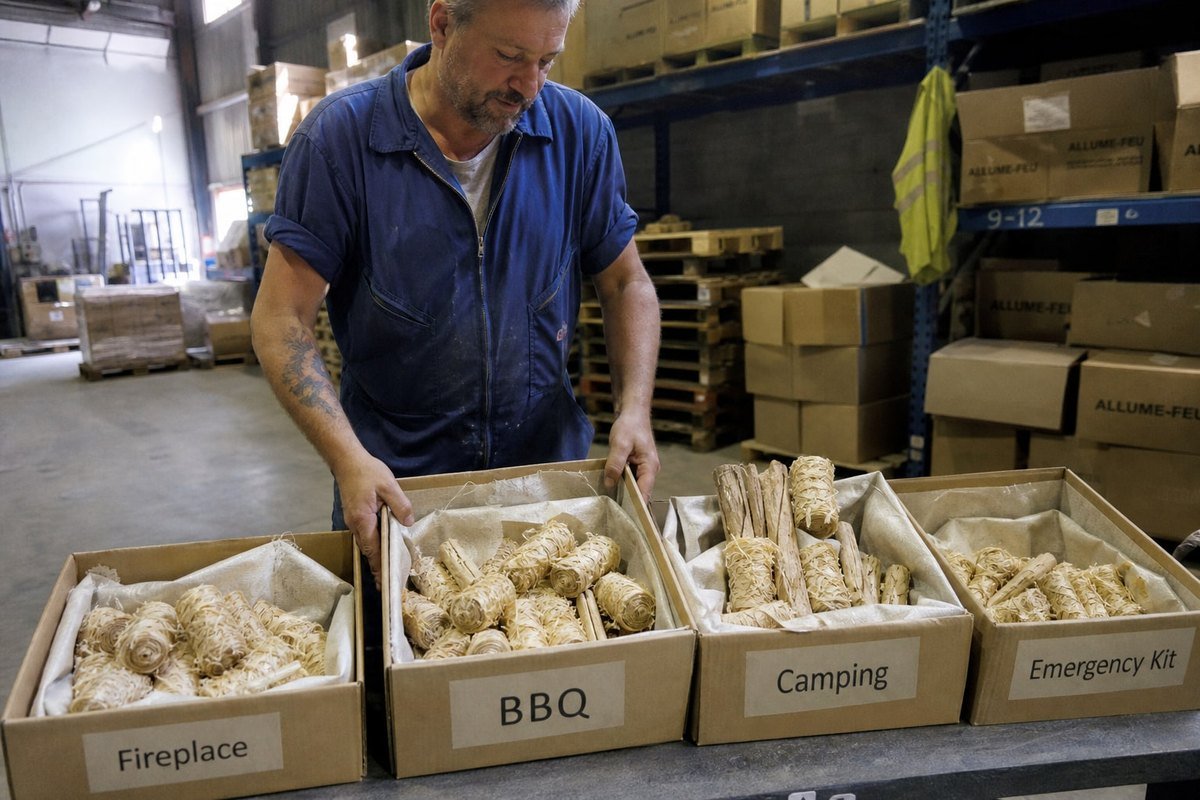
Packaging is not an afterthought in bulk wholesale sourcing — it decides whether your product survives an ocean crossing and sells off the shelf. Our OEM/ODM team handles custom boxes, display packaging, warning labels, and barcodes daily, and the smoothest projects are always the ones where the buyer specified everything up front.
The four layers of a packaging spec
- Inner protection. Wax-dipped wood rolls absorb humidity during a six-week sea voyage. Specify a moisture-proof liner or sealed inner bag, and set a storage temperature limit — wax with a low melt point can fuse units together in a hot container, so confirm a binder with adequate thermal stability.
- Retail unit. Define pack count (24, 50, or 100 pieces are common), box material, print finish, and mandatory label content: composition, warnings, usage instructions, and country of origin.
- Master carton. Specify carton dimensions, maximum gross weight, drop-test survival, and units per carton. This directly controls your landed cost per unit.
- Branding files. Provide print-ready artwork, dielines, and color standards. Then require a physical pre-production packaging sample — never approve packaging from a PDF alone.
Retail-readiness checklist
- Barcode (EAN/UPC) printed and scan-tested
- Lot code and production date for traceability
- Warning text in the languages your market requires
- Shelf-ready or display-box option if selling through big-box retail
- Eco-positioning consistent with actual materials (recyclable box, chemical-free ignition claims backed by the SDS)
When we run private-label projects, we treat the packaging spec with the same rigor as the product spec. Your brand is on the box; the factory's discipline determines how it looks in month twelve, not just month one.
What quality control standards should I set to ensure consistent batch-to-batch performance?
A lesson from our early years: a first sample means nothing if the factory cannot repeat it ten thousand times. That realization shaped how we built batch-to-batch QC into every line we run today.
Set a written QC plan covering incoming material checks (moisture content, wax grade), in-process controls (wax saturation ratio, unit weight), and finished-goods sampling per AQL standards. Define pass/fail acceptance tests for ignition, burn time, and packaging integrity before each shipment releases.

Consistency is the real product a B2B buyer purchases. Your customers will forgive a fire starter that burns 9 minutes instead of 10. They will not forgive one unit that lights instantly next to one that never catches. So your spec must define how conformance is verified, not just what the product is.
Build QC checkpoints into the spec
| Stage | What to Control | Acceptance Criterion |
|---|---|---|
| Incoming materials | Wood wool moisture content | ≤12% measured by moisture meter |
| Incoming materials | Wax grade and melt point | Melt point above 60°C / 140°F |
| In-process | Wax-to-fiber saturation ratio | Within agreed range, e.g., 40–50% by weight |
| In-process | Unit weight and dimensions | Weight ±8%, length ±5% |
| Finished goods | Ignition test (random sample) | Single-match light within 5 seconds |
| Finished goods | Burn time duration verification | Meets stated minimum, e.g., ≥8 minutes |
| Pre-shipment | Packaging and carton integrity | No fused units, passed drop test |
Make acceptance testing contractual
Write sampling levels into your purchase agreement — AQL 2.5 7 for major defects is a common baseline. Require the factory to keep retention samples from every batch, so any complaint can be traced to a specific lot code. If your product borrows performance ideas from fatwood, where natural fatwood resin content drives reliable lighting, apply the same logic to waxed rolls: the saturation ratio is the variable that guarantees uniform energy output, so it must be measured, recorded, and reportable.
We also encourage buyers to run their own real-world tests on golden samples: light units after 48 hours of humidity exposure, test in cold conditions, and burn several side by side to check uniformity. On our lines in Ningbo, every batch is tested against the approved golden sample, because we know that for our long-term partners, the first sample is a promise — and QC is how the promise gets kept.
Conclusion
Vague specs create expensive surprises; measurable specs prevent them. Define composition, burn time, compliance documents, packaging, and QC criteria — then partner with a factory that can prove every number.
Footnotes
1. Authoritative Wikipedia entry defining technical specifications and requirement sets in manufacturing. ↩︎
2. Explains the RFQ process used by businesses to invite suppliers to bid on specific products. ↩︎
3. General background on fire-starting tools and materials used in outdoor and domestic settings. ↩︎
4. OSHA standards for chemical composition disclosure and safety data sheets in the workplace. ↩︎
5. Authoritative Wikipedia entry detailing the properties and production of soy wax. ↩︎
6. Official site for the Forest Stewardship Council explaining certification for responsibly sourced wood. ↩︎
7. Official ISO standard for sampling procedures and acceptable quality levels in industrial inspection. ↩︎



 English
  Spanish
  German
  French
  Arabic
  Portuguese
Join the Conversation