






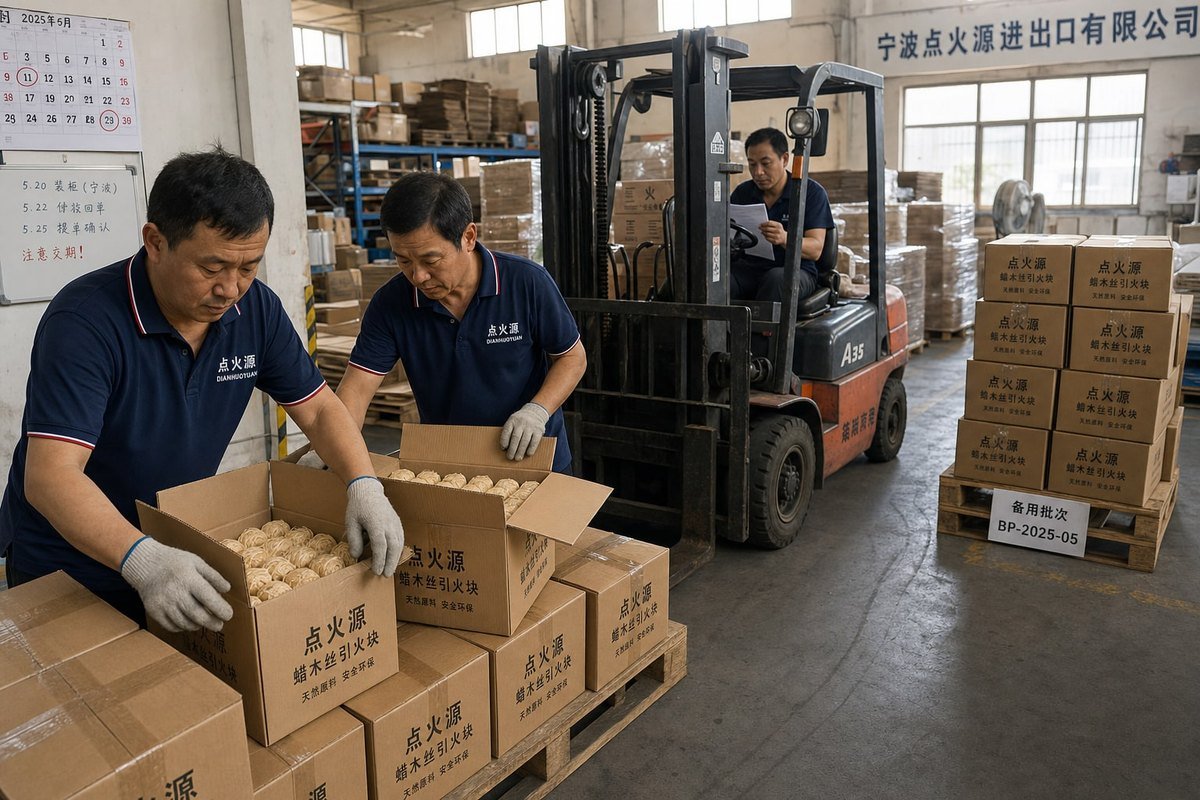
Single-supplier risk when sourcing wood fire starters is a problem I see buyers underestimate every year ISO 9001 quality management 1. On our production line in Ningbo, we onboard brands whose sole vendor just failed them. One missed container in October can wipe out an entire winter season. Retail shelves go empty, listings lose rank, and customers switch brands. The fix is a structured multi-sourcing strategy: qualify a second source before you need it, not after.
To reduce single-supplier risk when sourcing wood fire starters, qualify at least one certified backup supplier, verify quality with side-by-side burn testing, shift 10–20% of volume gradually, negotiate flexible MOQs and lead-time guarantees, and hold buffer inventory during the transition period.
That is the short answer. The rest of this guide breaks it down into four practical steps. Each step reflects what actually happens when a buyer qualifies a second wood fire starter factory.
What certifications should I check before adding a backup wood fire starter supplier?
A German distributor once asked me for our BSCI 2 audit report before he even requested pricing. His logic was simple: paperwork problems kill shipments faster than quality problems do.
Before adding a backup wood fire starter supplier, verify ISO 9001 quality management certification, a social compliance audit such as BSCI, third-party safety test reports from SGS or Intertek, CE conformity where required, and FSC certified wood documentation if your market demands sustainable sourcing claims.

Certifications are the first filter in any vendor risk assessment 3, because they are cheap to verify and expensive to fake convincingly. In our seventeen-plus years exporting fire-starting goods to more than thirty countries, we have watched buyers lose entire purchase orders at customs over missing test reports. A backup supplier without proper documentation is not a backup at all. It is a liability waiting for its moment.
The core documents to request
Ask for these before any commercial discussion gets serious:
| Certification / Document | What It Proves | Why It Matters for Fire Starters |
|---|---|---|
| ISO 9001 | Documented quality management system | Batch-to-batch consistency in wax coating and wood wool density |
| BSCI (or SMETA) | Social compliance and factory conditions | Required by most large EU and US retail sourcing channels |
| SGS / Intertek test reports | Independent safety and performance testing | Confirms burn time, ignition behavior, and material safety claims |
| CE conformity 4 | EU market access compliance | Needed for many European fireplace and BBQ retail channels |
| FSC certified wood 5 chain of custody | Sustainable timber sourcing | Supports eco-claims on packaging and protects against greenwashing accusations |
Verify, do not just collect
A PDF is not proof. Check the certificate number on the issuing body's database. Confirm the certificate names the actual factory, not a trading company address. When buyers audit our facilities, we encourage them to match the audit scope against the production site making their goods. A trading company holding someone else's certificates is one of the most common traps in this category. If the backup supplier hesitates to let you verify, treat that hesitation as your answer.
Also confirm the reports are recent. Test reports older than two or three years may not reflect current formulations, especially if wax or binder suppliers changed upstream.
How can I compare quality consistency between my current and new suppliers?
Consistency is the trade-off I weigh most carefully when we develop a new wax-dipped wood roll. A great sample means little if batch fifty drifts.
Compare quality consistency by defining measurable benchmarks — burn time, ignition speed, wax coating weight, moisture content, and dimensions — then testing multiple production batches from both suppliers against the same written specification, scoring each vendor on variance rather than on single-sample performance.
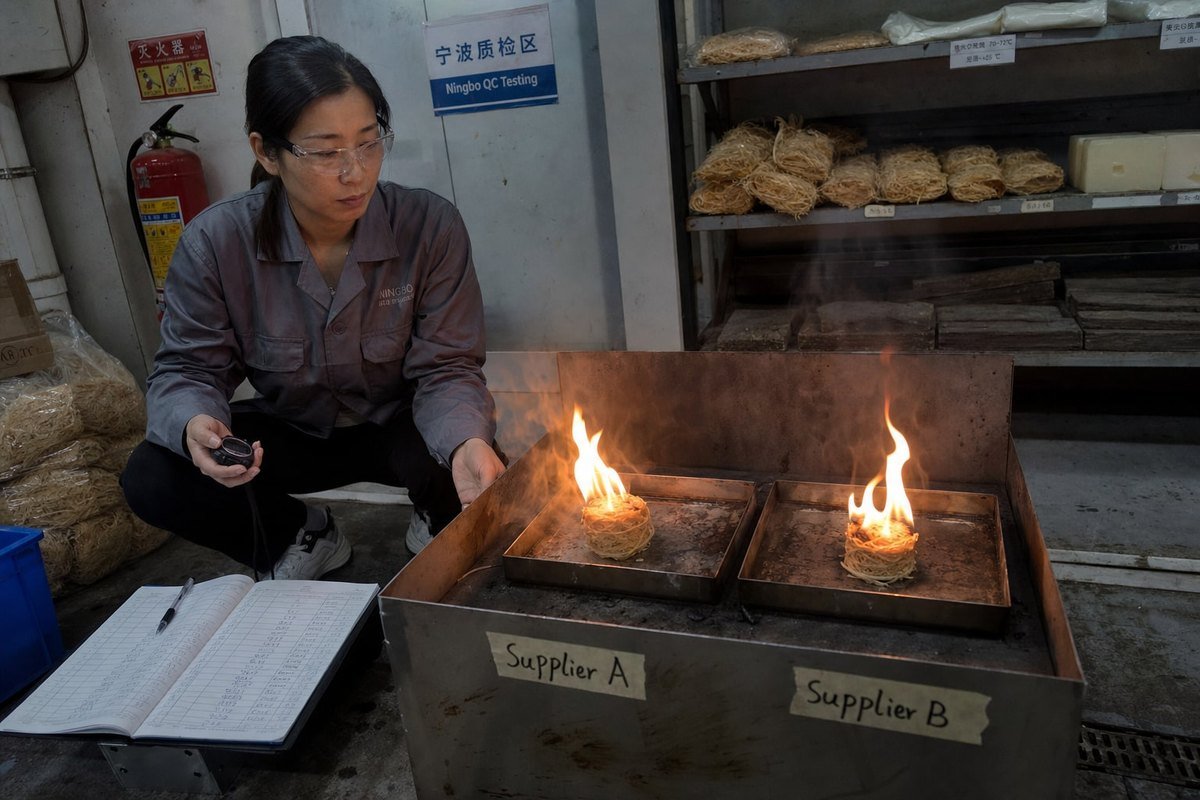
Wood fire starters look simple, but three variables drive most quality drift: the wood wool itself, the wax or paraffin coating, and moisture control during storage. Our quality assurance protocols check all three at incoming material, mid-production, and pre-shipment stages. When you compare two suppliers, you need to compare the same things, in the same way, across time.
Build a scorecard, not an impression
One sample tells you what a supplier can do once. Variance tells you what they will do every month. Ask each supplier for pieces pulled from at least three different production batches. Then measure:
| Benchmark | How to Measure | Acceptable Variance (Typical) |
|---|---|---|
| Total burn time | Stopwatch, controlled conditions, five-piece average | Within about 10% of spec |
| Ignition speed | Time from flame contact to self-sustaining burn | Within a few seconds across batches |
| Wax coating weight | Weigh piece before and after simulated coating removal, or compare unit weights | Tight unit-weight tolerance batch to batch |
| Moisture content 6 | Moisture meter on uncoated fiber ends | Low and stable; high moisture kills ignition |
| Dimensions and density | Calipers and scale | Consistent size so retail packaging fits |
Watch for lead time variability as a quality signal
Erratic delivery often predicts erratic quality. A factory that quotes twenty days one month and forty-five the next is likely juggling capacity or subcontracting quietly. In our experience exporting to the US and Germany, buyers who track both quality variance and lead time variability on one scorecard catch problems a full season earlier than buyers who track price alone.
Finally, ask how each supplier controls batch-to-batch drift internally. A real answer describes incoming material checks and retained samples. A vague answer describes hope.
What MOQ and lead time terms should I negotiate when qualifying a second source?
A UK importer recently told me his old supplier demanded a full-container MOQ just to test compatibility. That single term kept him locked into one vendor for three years.
When qualifying a second source, negotiate a reduced trial MOQ, written standard lead times with a delay-notification clause, seasonal capacity reservations for Q3–Q4 production, staged volume commitments that grow with proven performance, and price validity windows that protect you from mid-season increases.
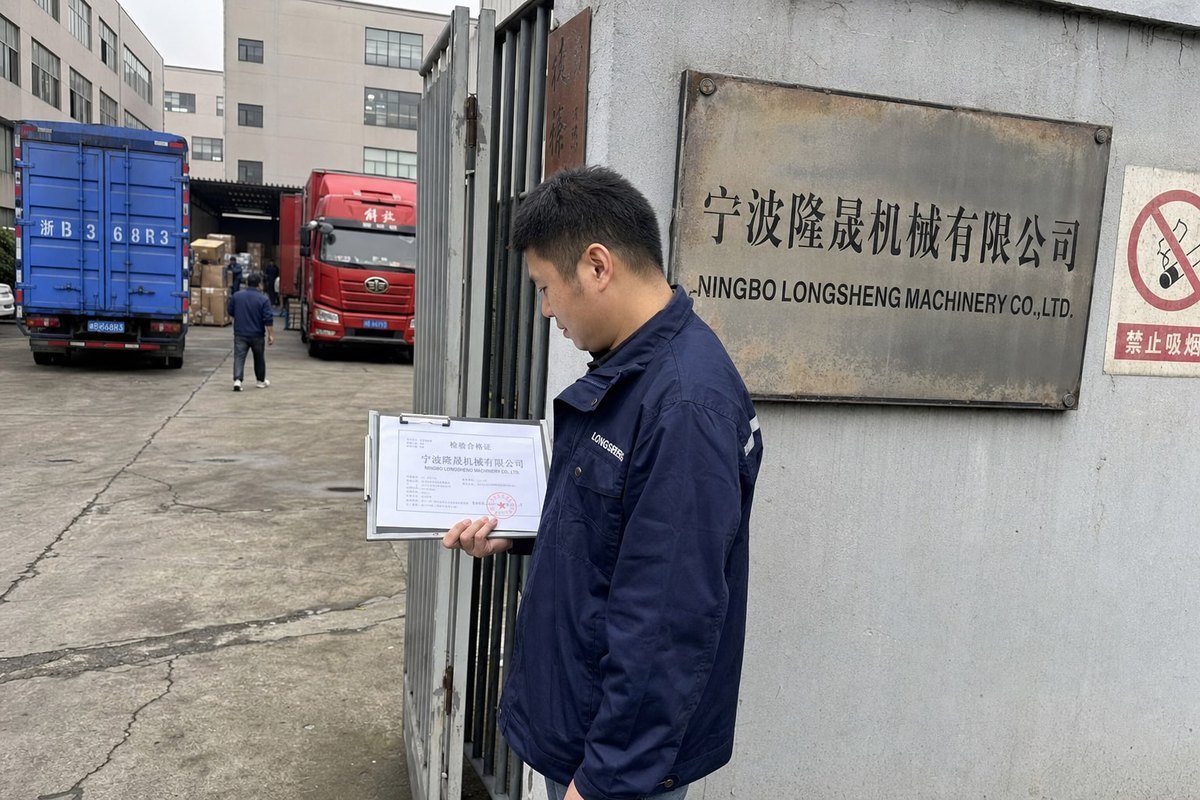
Terms decide whether dual sourcing is practical or just theoretical. If the backup supplier's MOQ forces you to buy a year of stock, you will never actually order from them, and your risk stays exactly where it was. At our factory, we deliberately keep trial MOQs flexible for first orders, because we know a second-source relationship starts small or it does not start at all.
The negotiation checklist
Work through these points in order:
- Trial MOQ. Push for a pilot quantity well below standard MOQ. Frame it honestly: you are qualifying them for larger contractual volume commitments later.
- Standard and peak lead times, in writing. Fire starters are seasonal. A factory quoting 25 days in April may need 50 in September. Get both numbers documented.
- Delay notification clause. Require written notice within a fixed number of days if production slips, so you can activate buffer stock or shift volume.
- Capacity reservation. Ask the supplier to reserve a monthly production slot during peak season, even if you do not fully use it at first.
- Price validity. Lock quoted pricing for a defined window so a raw material spike cannot ambush a confirmed program.
- Volume ramp schedule. Commit to shifting roughly 10–20% of category volume after a successful pilot, with clear triggers for increasing share.
Balance leverage with fairness
A second source that never receives real orders will deprioritize you. Keeping them warm with modest, regular volume protects your bulk procurement logistics far better than a dormant contract. Concentration guidance in procurement circles often suggests keeping any single supplier below roughly 30–40% of a critical category, but for most fire starter buyers, even a 80/20 split transforms their risk position. Pair the ramp plan with an inventory buffer stock covering one production cycle, and a single-factory disruption becomes an inconvenience instead of a crisis.
How do I test a new supplier's samples against my existing product specifications?
Years of running pre-shipment inspections taught our QC team one lesson: a spec that is not written down does not exist. Testing starts with documentation, not with matches.
Test new supplier samples by documenting your existing product specification first, then running blind side-by-side trials measuring ignition time, burn duration, flame height, smoke, residue, and packaging fit, followed by storage and humidity stress tests, and finally a small pilot purchase order to confirm production-scale results.
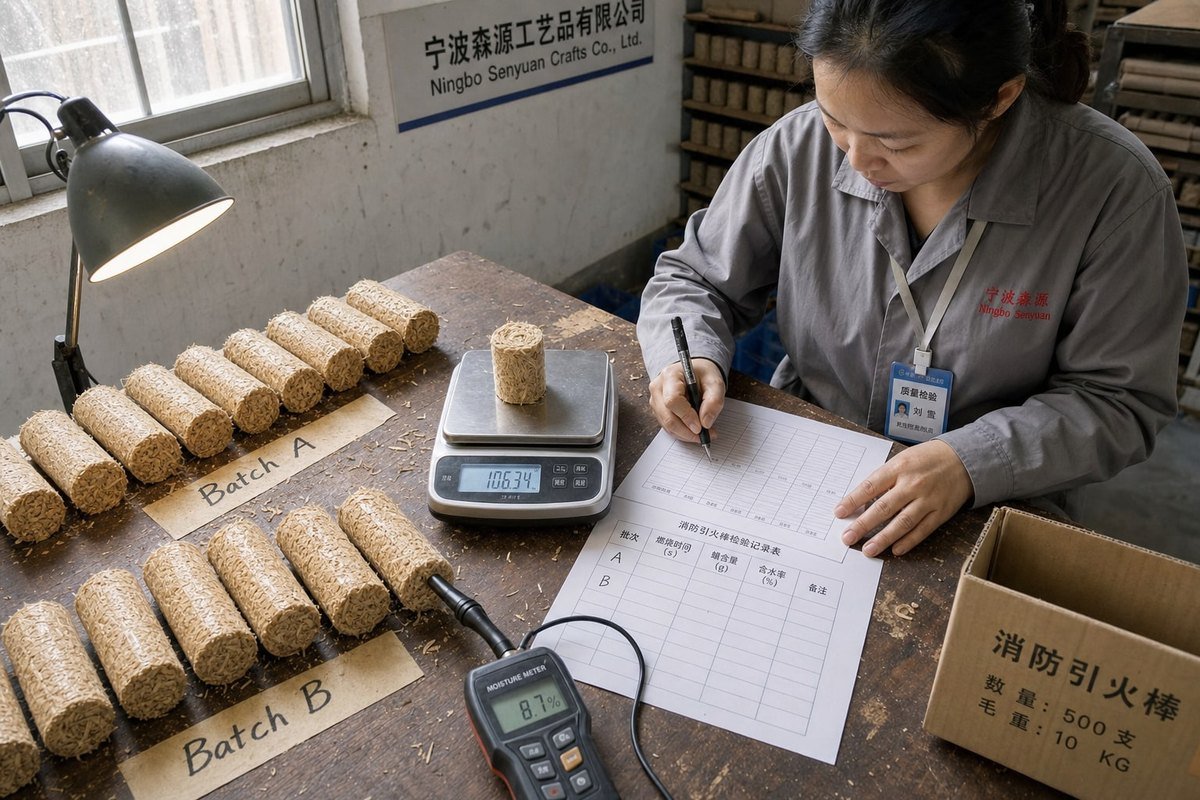
Supply chain diversification 7 only works if the second product is genuinely interchangeable with the first. Your customer should not notice which factory made the piece in their hand. That standard is achievable with wood fire starters because the product can be fully specified, but only if you test methodically.
Step one: write the spec from your current product
Before touching the new samples, reverse-document what you sell today. Record dimensions, unit weight, wax coating share of weight, fiber material, burn time range, ignition behavior, and packaging dimensions. This becomes the acceptance standard. When buyers send us a spec sheet like this, our engineers can usually confirm feasibility within days, and the whole manufacturing capacity audit that follows goes faster because everyone measures against the same numbers.
Step two: run structured comparison tests
| Test | Method | Pass Criteria |
|---|---|---|
| Blind burn test | Unmarked samples from both suppliers, same conditions, same firewood | Testers cannot reliably tell suppliers apart |
| Ignition test | Single match or lighter touch at fiber end | Self-sustaining flame within your spec window |
| Burn duration | Five-piece average per supplier | New supplier within tolerance of current spec |
| Humidity stress | Store samples in high humidity for one to two weeks, then re-test ignition | Performance degradation similar to or better than current product |
| Packaging fit | Load samples into your existing retail box | No crushing, rattling, or dimension conflicts |
| Residue and smoke | Observe ash, soot, and odor during burn | Comparable to current product; no chemical smell |
Step three: pilot before you scale
Samples pass; production still has to prove itself. Place a small pilot PO and inspect it against the same spec sheet. Check pieces from cartons at the front, middle, and back of the shipment. If the pilot matches the samples, begin the gradual volume shift. If it does not, you learned that lesson for the cost of one small order rather than one lost season.
Conclusion
Relying on one wood fire starter supplier feels efficient until the season it fails. Verify certifications, score consistency, negotiate flexible terms, test rigorously, and shift volume gradually. Structured dual sourcing turns supplier risk into a managed variable.
Footnotes
1. Authoritative ISO source explaining the quality management standard referenced repeatedly. ↩︎
2. Official source explaining the Business Social Compliance Initiative audit standard. ↩︎
3. ISO reference for structured supplier evaluation and risk management practices. ↩︎
4. Explains the EU compliance marking required for European market access. ↩︎
5. Background on the sustainable forestry certification mentioned for eco-claims. ↩︎
6. Government forestry resource relevant to wood moisture and material properties. ↩︎
7. Authoritative Wikipedia article covering supply chain resilience and diversification strategies to mitigate risk. ↩︎



Join the Conversation