






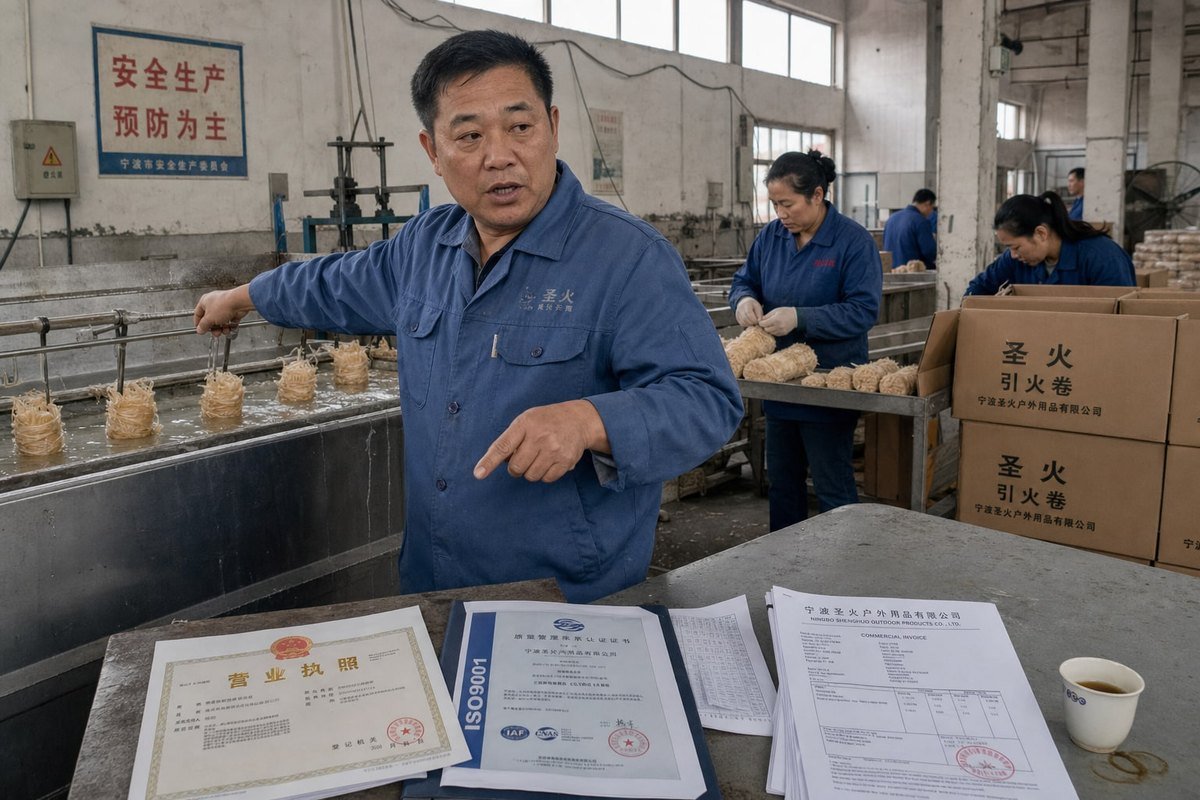
[Choosing a wood fire starters supplier](https://sunrichfire.com/how-find-reliable-wood-fire-starters-supplier-to/) feels risky when every website claims "we are a factory." I've watched buyers lose entire seasons to hidden middlemen. Our production floor in Ningbo tells a different, verifiable story.
To tell if a wood fire starters supplier is a factory or trading company, check the business license scope for manufacturing keywords, verify the registered address is in an industrial zone, review product specialization, request a live production video, and match names across certificates, invoices, and audit reports.
Each of these checks is simple on its own. Together, they form a reliable verification framework. Let me walk you through how to apply them before you wire a deposit.
How can I verify a supplier's factory certifications and audit reports before placing an order?
During a BSCI 1 renewal audit at our plant last year, the auditor spent two full days on-site. That experience taught me exactly what a real audit trail looks like — and what a fake one lacks.
Verify certifications by requesting the original ISO 9001, BSCI, and SGS or Intertek documents, then confirm the certificate holder's registered Chinese company name matches the business license, invoice, and shipping documents. Cross-check certificate numbers directly on the issuing body's official database.
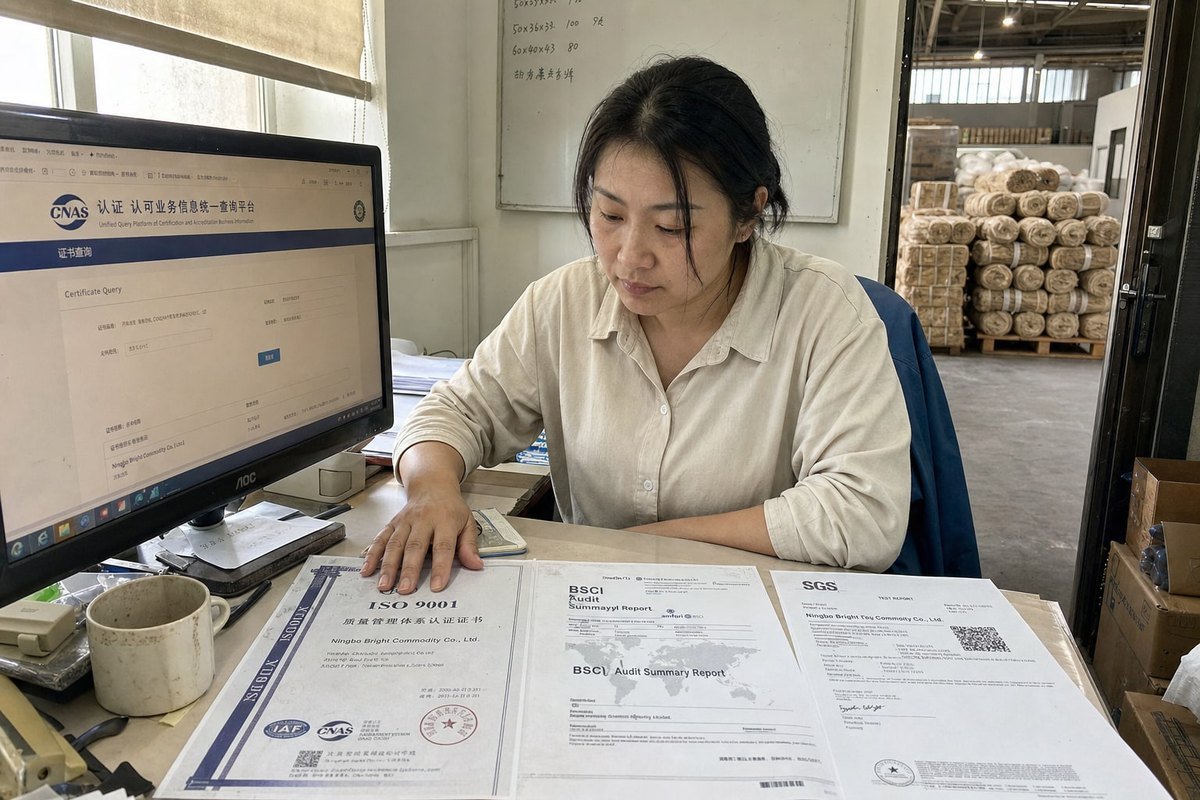
Documents are the backbone of supply chain transparency, but only if you read them correctly. In our experience exporting to 30+ countries, most buyers glance at a PDF and move on. That is a mistake. A trading company can borrow, buy, or edit certificates. What it cannot easily do is make every name match across every document.
The name-matching test
Here is the single most powerful check. Collect these four documents and compare the registered company names on each:
| Document | What to check | Red flag |
|---|---|---|
| Business license | Registered Chinese name and scope | Scope shows only 贸易 (trade) or 销售 (sales) |
| ISO 9001 2 / BSCI certificate | Certificate holder name and address | Name differs from the license |
| SGS / Intertek test report | The "manufacturer" field | A third company appears here |
| Commercial invoice | The seller entity | Yet another entity name |
If three different company names appear, you are almost certainly dealing with a reseller. When buyers run this check on us, the Sunrich entity name lines up on every page, because we hold our ISO 9001, BSCI, CE, and SGS/Intertek 3 reports directly.
Go to the source, not the PDF
Never accept a certificate at face value. Every serious certification body offers online verification. Enter the certificate number on the issuer's website and confirm the status is active. For a factory audit report like BSCI, ask for the audit ID and the audited site address. Then compare that address to where your goods will actually be produced. For wood-based products, also ask whether the supplier holds FSC certification 4 directly; a genuine wood processor must hold the Chain of Custody 5 itself to sell certified material legally. A trader cannot pass certified claims through without its own certificate.
What questions should I ask a wood fire starter supplier to confirm their manufacturing capabilities?
A German distributor once opened a call with us by asking about our wax-to-wood infusion ratio. I knew instantly he had been burned by a trader before — and I respected the question.
Ask technical questions only a producer can answer: wax-to-wood ratios for target burn times, kiln-drying and moisture content targets for wood wool, batch-level quality control standards, raw material sourcing, and daily production capacity. Then request a live video walkthrough of the actual line.

Technical depth is very hard to fake in real time. On our lines, we control the paraffin dip on each wood wool 6 roll because that ratio determines burn time — usually the exact spec a private-label buyer wants adjusted. A trading company relays your question to the plant and comes back a day later with a vague answer. A factory engineer answers on the spot, often with the tolerances included.
Questions that separate makers from middlemen
- What is your wax-to-wood ratio, and can you adjust it for a 10-minute versus 8-minute burn? A real producer treats this like a recipe it owns. We modify it routinely for OEM manufacturing projects.
- What moisture content do you target in the wood wool before dipping? Damp fiber wicks wax poorly and burns inconsistently. A maker knows its drying protocol cold.
- What is your daily and monthly production capacity for this SKU? Ask for numbers per line, per shift. Traders quote vague totals; factories quote line-level output.
- Where does your wood waste or raw fiber come from? Genuine wood fire starter plants often sit close to sawmills or wood processing clusters to capture material directly.
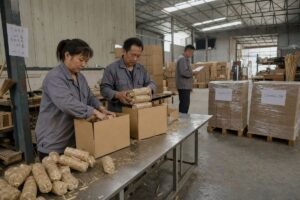
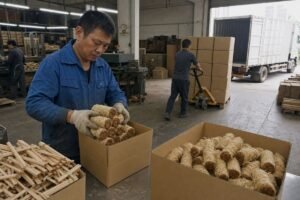
- Can we do a live, unedited video call on the production floor right now? This is the killer question. Ask to see raw wood fiber, the wax dipping station, packing tables, the QC room, and cartons with the company name visible. A polished marketing video proves nothing. A live walkthrough with your specific product on the line proves nearly everything.
- How do you control batch-to-batch consistency? Our answer covers incoming material checks, in-process wax weight sampling, and burn tests per batch. Listen for that level of process detail, not slogans.
If the answers arrive slowly, sound copied, or dodge specifics, you are likely talking to a sales layer, not the maker.
Why does it matter if my supplier is a real factory versus a trading company for private-label orders?
Private-label projects 7 are where we see the sharpest difference. When a US camping brand asked us to shorten burn time, redesign the display box, and add retail barcodes, every change happened under one roof — no telephone game.
For private-label orders, a real factory matters because it controls the recipe, quality control standards, packaging line, lead time, and confidentiality directly. A trading company adds a communication layer, cannot modify production specs itself, and may switch the actual maker between orders without telling you.
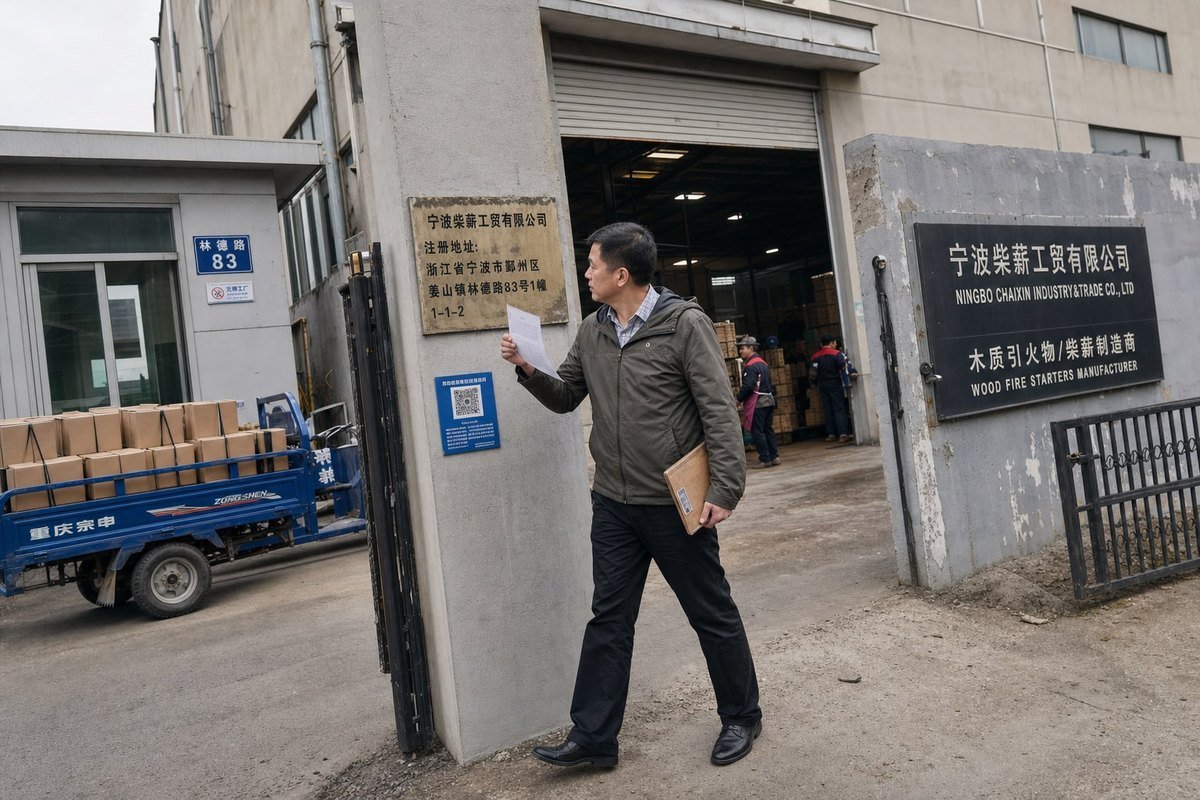
Let me be fair first: a trading company is not automatically bad. For small mixed-container wholesale sourcing across unrelated categories, a good trader adds real value — consolidation, multilingual support, and QC coordination. But private-label fire starters are a different game. Your brand name goes on that box. Consistency, compliance, and auditability become your problem the moment a customer complains.
The private-label risk comparison
| Factor | Real factory | Trading company |
|---|---|---|
| Custom burn time / wax recipe | Adjusts the line directly | Must request from an unknown plant |
| Sample vs. mass production match | Same line, same QC | Maker may change between orders |
| Pricing | Direct manufacturer pricing | Margin stacked on factory price |
| Compliance responsibility | Holds its own CE, SGS, BSCI | May present borrowed documents |
| Factory audit access | Opens the door | May resist or stage a "show plant" |
| Confidentiality of your design | One party knows your spec | Your artwork passes through multiple hands |
The sample-to-production gap is the risk I would underline twice. In 17+ years of doing this, the most painful complaint pattern we hear from new buyers is: the trial order was perfect, the second container was not. That usually means the trader moved production to a cheaper plant. When you buy from the actual maker, the first sample reliably reflects mass-production quality because the same line, materials, and quality control standards produce both.
There is one nuance worth adding. The real question is not only "factory or trader?" but "who actually makes my order?" Some self-declared factories outsource overflow production quietly. So even with a verified manufacturer, confirm in writing which site produces your goods, and reserve the right to a third-party inspection at that site.
How do production lead times and MOQs help me identify whether I'm dealing with a genuine manufacturer?
Weighing MOQ requests is a daily trade-off for us. We often accept smaller trial orders from serious distributors because we can slot them into an existing production run — something a trader simply cannot promise on its own authority.
Genuine manufacturers quote lead times tied to line scheduling and give consistent, explainable MOQs based on batch economics. Trading companies quote vague or suspiciously flexible terms because they depend on a third party's schedule, and their lead times often shift after the deposit is paid.
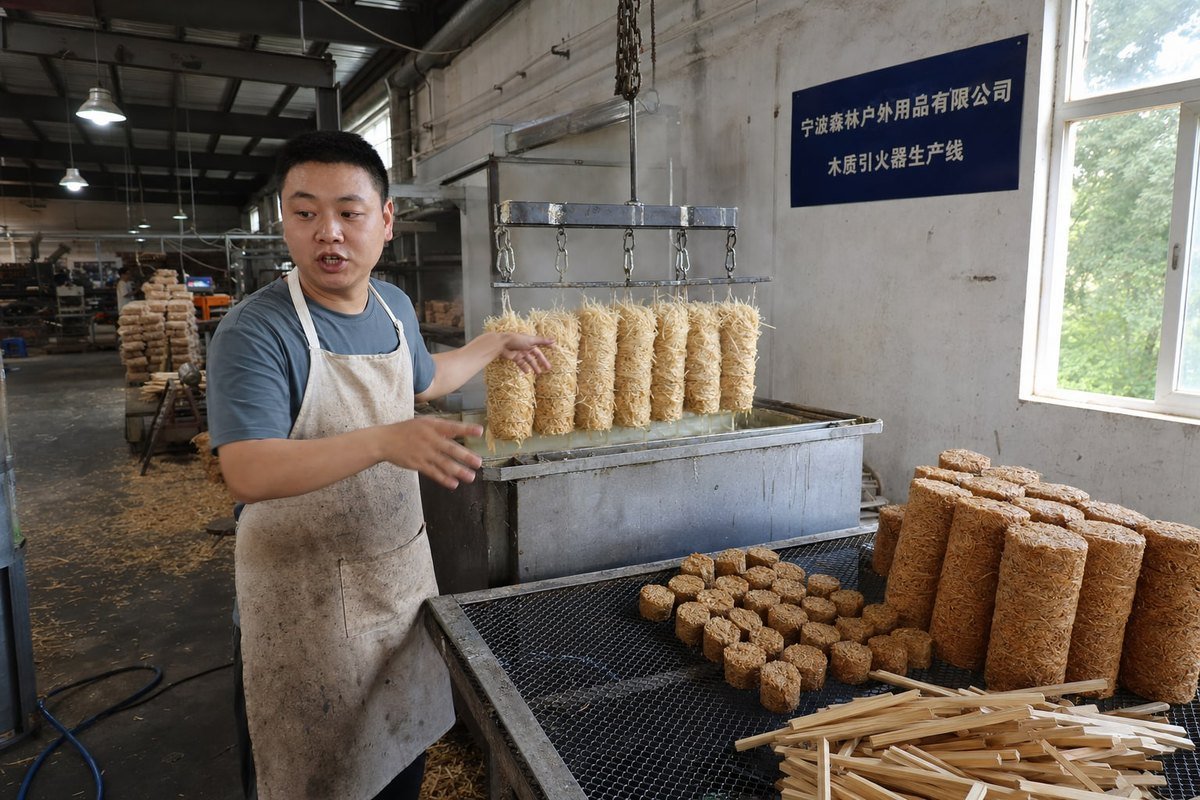
Lead times and MOQs are supporting signals, not standalone proof. But they reveal a lot when you probe the reasoning behind the numbers, not just the numbers themselves.
How to read the quotation behavior
A factory's lead time is built from real constraints: wood wool preparation, wax dipping and curing, drying, packing, and carton scheduling. When you ask us why an order takes a given number of weeks, we can break the answer down stage by stage. Ask a trader the same question and you typically get "the factory is busy" — because the trader genuinely does not know the schedule.
MOQs work the same way. A manufacturer's MOQ reflects batch economics: minimum wax melt volumes, packaging print runs, and changeover time on the line. That is why factory MOQs are consistent and explainable, and why we can flex them for trial orders by piggybacking on existing runs. A trader's MOQ is whatever its upstream plant demands plus negotiation room, so it moves around strangely.
| Signal | Likely a factory | Likely a trading company |
|---|---|---|
| Lead time explanation | Stage-by-stage breakdown | Vague, "depends on the factory" |
| MOQ logic | Tied to batch and print-run economics | Inconsistent, shifts during negotiation |
| Peak-season answers | Names its own line capacity limits | Cannot commit to dates |
| Spec-change impact | Quantifies added days precisely | Needs to "check and revert" |
| Export paperwork | Handles export license verification and documents in-house | Routes documents through third parties |
Combine this with a business license check
Pair quotation behavior with hard evidence. Run a business license check through Chinese corporate registry tools and read the business scope. Manufacturing verbs like 生产 (production), 制造 (manufacture), or 加工 (processing) point to a factory. Wording built around 贸易 (trade), 批发 (wholesale), or 进出口 (import-export) points to a trading entity. Then check the registered address: an industrial zone supports factory status; a downtown office tower does not. No single signal decides it. Three or four aligned signals do.
Conclusion
Misjudging a supplier costs you a season, a brand reputation, or worse. Verify the license scope, match every document name, demand live production proof, and probe technical depth. Real factories welcome scrutiny — we certainly do.
Footnotes
1. Official source explaining the social compliance audit program referenced repeatedly. ↩︎
2. Explains the international quality management standard suppliers claim to hold. ↩︎
3. Links to a leading inspection and testing body cited for verifying supplier documents. ↩︎
4. Official Forest Stewardship Council site clarifies certified wood sourcing requirements. ↩︎
5. Background on the traceability concept required for legally selling certified wood products. ↩︎
6. Updated Wikipedia link to the correct canonical page for wood wool material. ↩︎
7. Background on private-label manufacturing arrangements relevant to the sourcing risks discussed. ↩︎

 English
  Spanish
  German
  French
  Arabic
  Portuguese
Join the Conversation