






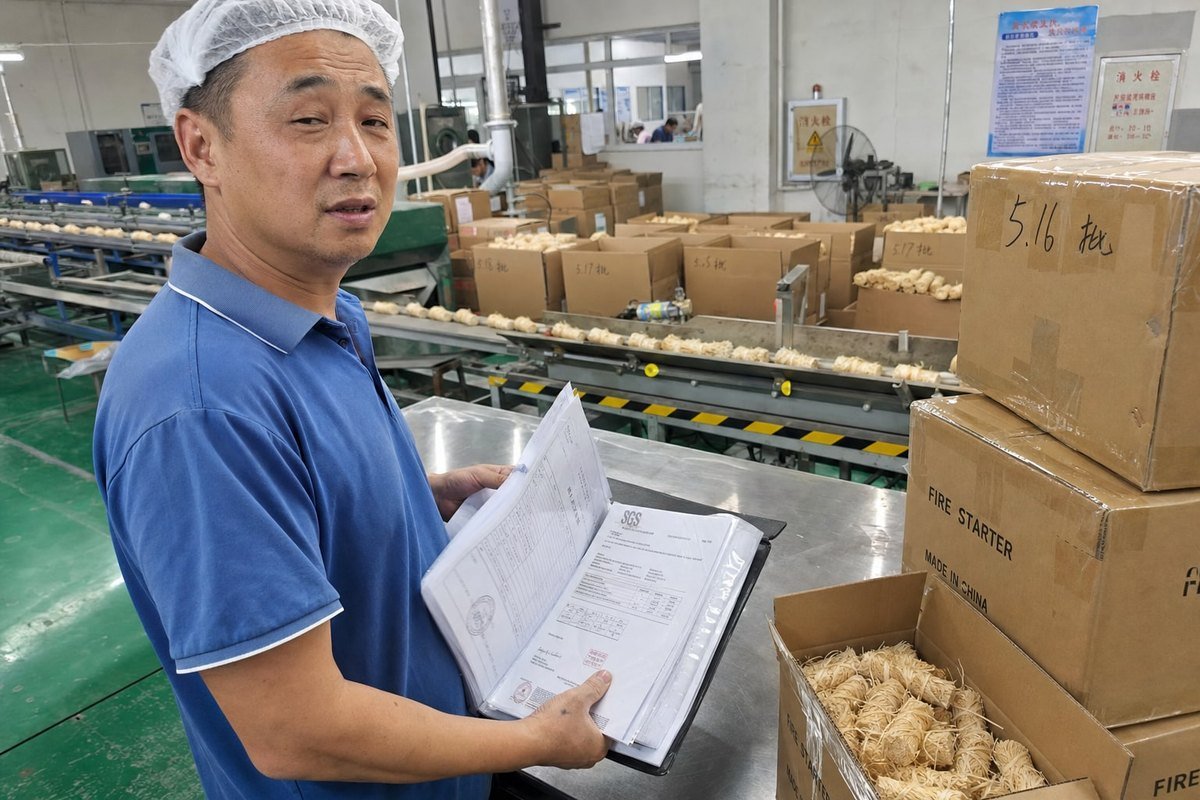
Verifying a supplier's production capacity for wood fire starters sounds simple — until a peak-season shipment arrives late, half-cured, and unsellable. I have seen it happen to buyers before they found our lines.
To verify a wood fire starter supplier, request ISO 9001, FSC, and SGS certificates, review 8–12 weeks of real production records, run a third-party factory audit or video inspection, and place a pilot order of 10–20% of target volume before scaling.
That is the short answer. Below, I break down each step so you can [separate real factories from polished sales decks](https://sunrichfire.com/how-find-reliable-wood-fire-starters-supplier-to/) — and protect your season.
What Certifications Should I Ask My Wood Fire Starter Supplier to Provide?
A buyer from Germany once opened our first video call with a single question: "Send me your test reports before we talk price." After 17 years exporting fire products to 30+ countries, I respect that approach — documents first, promises later.
Ask for ISO 9001 certification, a valid business license and export license, FSC chain of custody or PEFC documents, third-party test reports from SGS or Intertek, a Material Safety Data Sheet for wax coatings, and proof of EN 1860-3 compliance for barbecue markets.

Certifications are not decoration. They tell you whether a factory can legally manufacture, export, and sell into your market. In our experience shipping wax-dipped wood rolls to the US and EU, buyers who skip this step pay for it later — at customs, in retailer compliance reviews, or worse, in a product recall.
The core document checklist
Here is the document set I recommend every purchasing manager request before deeper negotiation:
| Document | What It Proves | How to Verify It |
|---|---|---|
| Business license + export license | Legal manufacturing and export status | Government enterprise credit systems |
| ISO 9001 certification 1 | A functioning quality management system | Check the certificate body's online registry |
| FSC chain of custody 2 / PEFC | Sustainable wood sourcing, legal harvest | Look up the license code on the FSC or PEFC database |
| SGS / Intertek test reports | Product safety and performance testing | Confirm the report number with the lab directly |
| EN 1860-3 compliance | Meets the EU igniter safety standard | Request the full test report, not a summary page |
| Material Safety Data Sheet | Wax and binder chemical safety | Cross-check ingredients against REACH compliance 3 lists |
| BSCI audit report | Ethical labor and social compliance | Ask for the audit ID and validity date |
Why verification beats collection
Collecting PDFs is easy. Verifying them takes ten extra minutes and saves you months of trouble. Every FSC certificate carries a unique license code you can check on the global database. Every ISO 9001 certification names an issuing body with a public registry. A trading company posing as a factory usually fails at this stage, because the certificates name a different legal entity than the one quoting you.
Also check chemical documentation. Wax-dipped fire starters use paraffin or vegetable wax 4 as a coating. For the EU, REACH compliance matters. For "natural" or "eco-friendly" claims, the binder purity must match the label. We keep MSDS files current for exactly this reason — our retail buyers audit them yearly.
How Can I Confirm a Supplier's Factory Actually Produces the Fire Starters I'm Ordering?
Early in our export history, a US importer told me he had been burned twice by "factories" that were really trading offices with a rented showroom. That conversation shaped how we present our own production lines in Ningbo today — with live video, not stock photos.
Cross-check the legal entity name on certificates against the quoting company, request live video of your product running on their lines, ask for recent batch testing records and shipment documents, and confirm the factory address matches export declarations and audit reports.
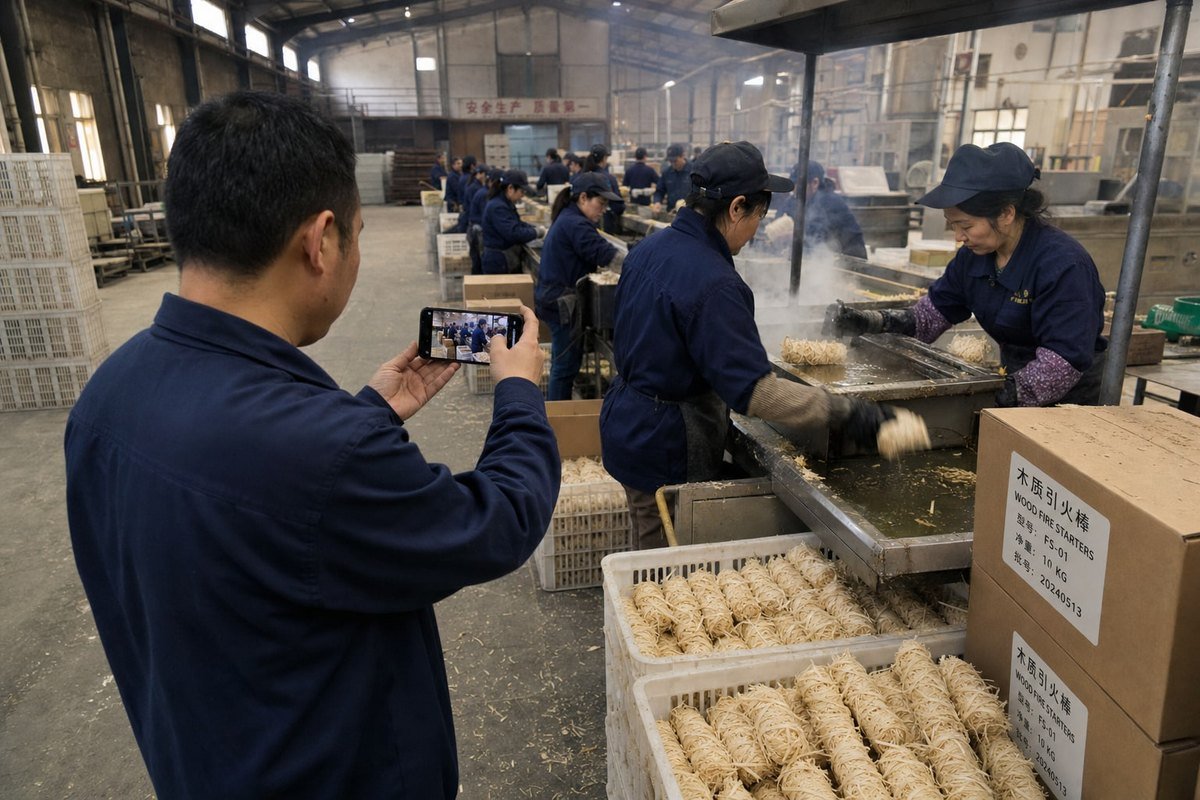
Trading companies are not evil. But if you believe you are buying factory-direct and you are not, you lose price transparency, quality control access 5, and speed when problems arise. Here is how to confirm the factory is real — and that it makes your specific product.
Match the paper trail to one legal entity
Start with names. The business license, the ISO 9001 certificate, the FSC chain of custody document, and the export declaration should all name the same legal entity. When a middleman borrows a factory's certificates, the names rarely align. Ask directly: "Is this certificate issued to your company or a partner factory?" An honest answer here tells you a lot.
Demand product-specific evidence
A factory that genuinely produces wood wool fire starters can show you, on short notice:
- Live video of wood wool being shredded, coiled, and wax-dipped — with today's date spoken on camera.
- Batch testing records for recent production runs, including burn time and ignition checks.
- Photos of finished-goods storage with your product category visible in volume.
- Recent bills of lading 6 or packing lists (client names redacted) for similar orders.
- References from buyers with comparable volume — ideally in your region.
A generalist trader will stall on most of these. A specialist factory can produce them within a day. When buyers ask us for this proof, we treat it as a good sign — serious buyers verify, and serious factories welcome it.
Watch for the specialist advantage
Specialists usually plan capacity more accurately than generalists. A factory that only makes fire-starting goods knows its drying times, its wax consumption per thousand units, and its packaging speed by heart. Ask a few technical questions — target kiln-dried moisture content 7, wax coating weight per roll, cartons per pallet. Fluent answers signal real production depth.
What Should I Look for During a Factory Audit or Video Inspection?
When we host third-party factory audit teams at our Ningbo facility, they never start with the machines. They start with the raw material warehouse — because for wood fire starters, that is where consistency begins or dies.
Inspect raw wood storage and moisture control, the shredding and coiling lines, wax-dipping stations, drying areas, quality control checkpoints, packaging speed, and finished-goods storage. Ask the supplier to name their bottleneck and quantify its daily throughput on the spot.
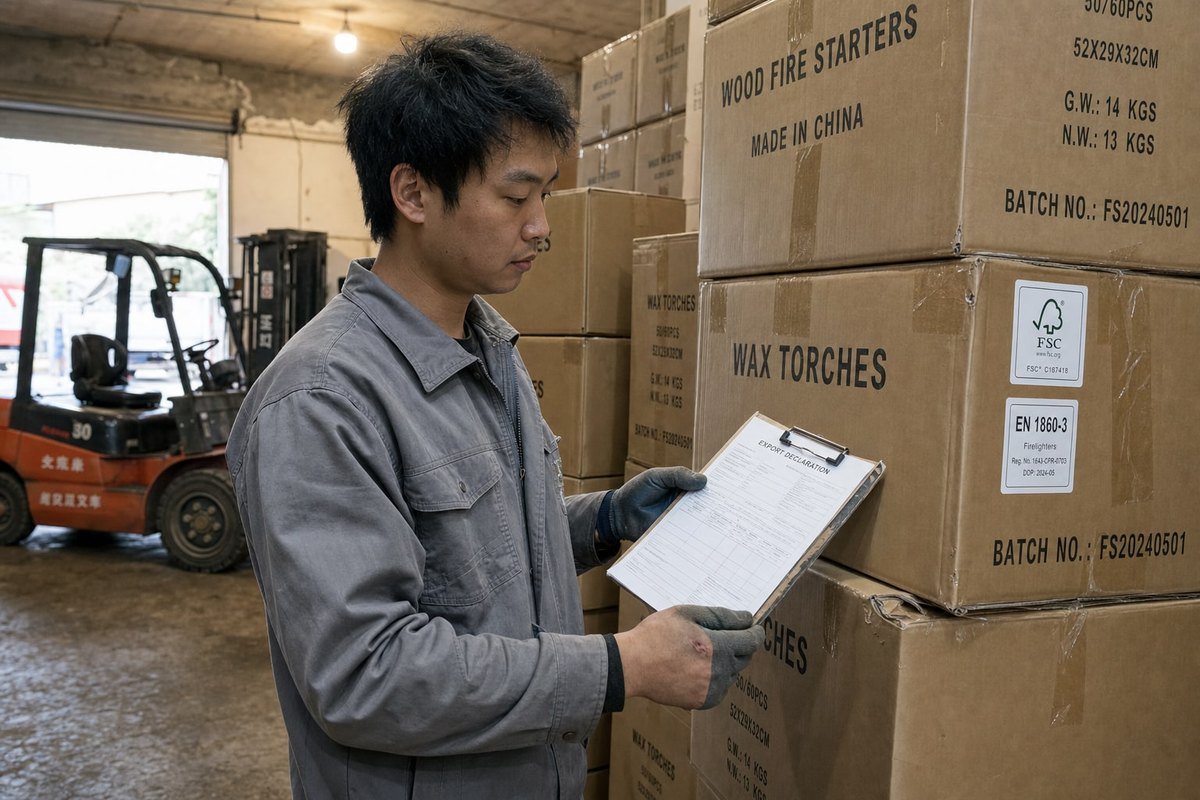
An audit — on-site or virtual — is your chance to compare claims against reality. I recommend a risk-based approach: remote video inspection first, then an on-site third-party factory audit for shortlisted suppliers. Here is what actually matters on the floor.
Follow the process flow, not the sales tour
Wood fire starter production follows a clear sequence. Walk it in order and check each stage:
| Process Stage | What to Inspect | Red Flag |
|---|---|---|
| Raw material intake | Wood storage, sourcing records, proximity to sawmills | Damp wood piled outdoors, no supplier records |
| Drying / kilning | Kiln capacity, moisture-monitoring tools | No moisture meters; wood above ~10% moisture |
| Shredding and coiling | Machine count, workers per line, cycle time | Fewer running lines than claimed capacity implies |
| Wax dipping | Wax type, MSDS on file, coating consistency | Unknown wax origin, no chemical documentation |
| Quality control checkpoints | Inspection stations, batch testing records, burn tests | QC exists on paper only; no test logs |
| Packaging | Automation level, bagging speed, label accuracy | Fully manual bagging on high-volume claims |
| Finished goods | Storage space, fire-safety measures | Combustibles stored near ignition sources |
Ask the bottleneck question
Every factory has one process that limits total output. Often, for fire starters, it is drying space or manual packaging — not machine count. Ask directly: "What is your bottleneck, and how many units pass through it daily?" A confident, specific answer signals a factory that understands its own operation. A vague answer means their capacity sheet is guesswork.
Verify moisture control seriously
Kiln-dried moisture content below 10% is what makes a fire starter light fast and burn predictably. Ask to see moisture readings taken live during your video call. Seasonal humidity swings can push moisture up in factories that air-dry only, which is why we invested in controlled drying — one wet batch can cost a buyer an entire retail season.
How Do I Know if a Supplier Can Consistently Meet My Order Volume and Deadlines?
The hardest lesson I learned in this business came from a Q4 rush years ago: installed capacity means nothing when the order book is already full. That season taught us to plan surge capacity for our fireplace and camping clients months ahead — and to tell buyers the truth about utilization.
Request 12 months of monthly output data and 8–12 weeks of recent production logs, confirm current utilization and order book load, verify production lead time history, then place a pilot order of 10–20% of target volume to test rate, quality, and delivery.
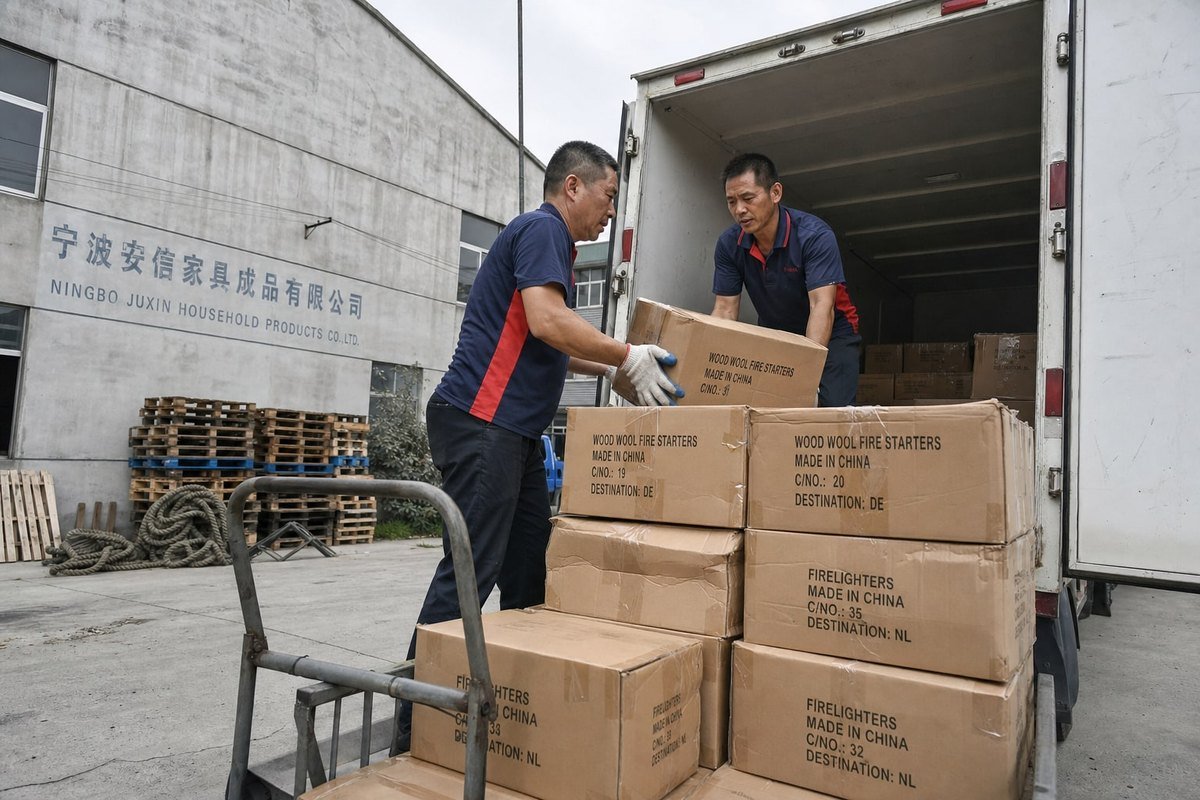
Most supplier failures trace back to one confusion: installed capacity versus usable capacity. A factory may own machines rated for 500,000 units a month. But rejects, rework, material shortages, and existing orders reduce what they can actually ship to you. Capacity must be measured in good units shipped, not units started.
Use simple capacity math
You do not need an engineering degree. Ask for three numbers and do the arithmetic:
- Units per shift at the bottleneck process.
- Shifts per day and working days per month.
- Current utilization — how much of that output is already committed.
Multiply the first two for theoretical monthly output. Subtract committed volume. What remains is what you can realistically buy. If a supplier runs near 95% utilization, treat them as constrained unless they can prove reserve capacity — extra shifts, standby lines, or a documented surge plan.
Compare claims against history
| Evidence to Request | Why It Matters |
|---|---|
| 12 months of monthly output | Shows if your volume falls inside their proven range |
| 8–12 weeks of production logs | Reveals real, repeatable weekly output — not summaries |
| Production lead time history | Promised vs. actual delivery dates on past orders |
| Raw material lead times | Wood and wax supply resilience during peak season |
| Peak-season plan | Extra shifts, buffer stock, or pre-built inventory |
Prove it with a pilot order
Documents narrow the field. A test order settles it. I always suggest a first order sized at 10–20% of your target volume — large enough to stress the real production line, small enough to limit risk. Set clear pass/fail criteria before you order: burn performance consistency across batches, packaging integrity, label accuracy, and on-time delivery. We keep our minimum order quantity 8 flexible for exactly this reason; a trial order that reflects mass-production quality is the strongest sales argument a real factory has. Seasonality matters too — camping, grilling, and holiday fireplace demand spike hard, so confirm the surge plan before Q3, not during it.
Conclusion
Unverified suppliers cost buyers whole seasons. Verify certificates, confirm the real factory, audit the process, and prove capacity with a pilot order — then scale with confidence.
Footnotes
1. Authoritative Wikipedia overview of the ISO 9001 quality management standard. ↩︎
2. FSC's official site lets buyers verify chain of custody license codes for sourcing claims. ↩︎
3. Official government guide on EU REACH compliance for international exporters. ↩︎
4. Background on paraffin wax properties commonly used as fire starter coating material. ↩︎
5. Background concept explaining why direct factory relationships preserve quality oversight for buyers. ↩︎
6. US trade authority resource on verifying export shipment documentation like bills of lading. ↩︎
7. Background on wood drying science explaining why moisture control affects ignition performance. ↩︎
8. Alibaba.com is a leading reference for standard minimum order quantity practices in sourcing. ↩︎



 English
  Spanish
  German
  French
  Arabic
  Portuguese
Join the Conversation