







Judging a supplier's quoted price for wood fire starters is tricky. I have watched buyers overpay for thin quotes — and reject fair ones — simply because our wax-dipped wood rolls looked "expensive" on paper. One bad guess can lock in a season of weak margins.
A quoted price for wood fire starters is reasonable if the normalized cost per piece falls within typical bulk wholesale rates of roughly $0.15–$0.65, and the quote clearly covers materials, certification, burn time per unit, packaging, and freight. Compare delivered cost per fire, not the sticker price.
That short answer hides a lot of detail. Below, I break down what actually drives cost, where compliance fits in, which hidden charges appear later, and how to compare quotes fairly.
What Factors Actually Drive the Per-Unit Cost of Wood Fire Starters?
Every winter, our production team in Ningbo recalculates raw material costs before we issue new quotes. Wood shavings, wax, and labor never sit still, and neither should your price expectations.
The per-unit cost of wood fire starters is driven by raw material type (wood wool, sawdust, fatwood), wax quality and coating thickness, moisture content percentage, burn time per unit, piece size and weight, order volume, packaging format, and seasonal manufacturing lead times.
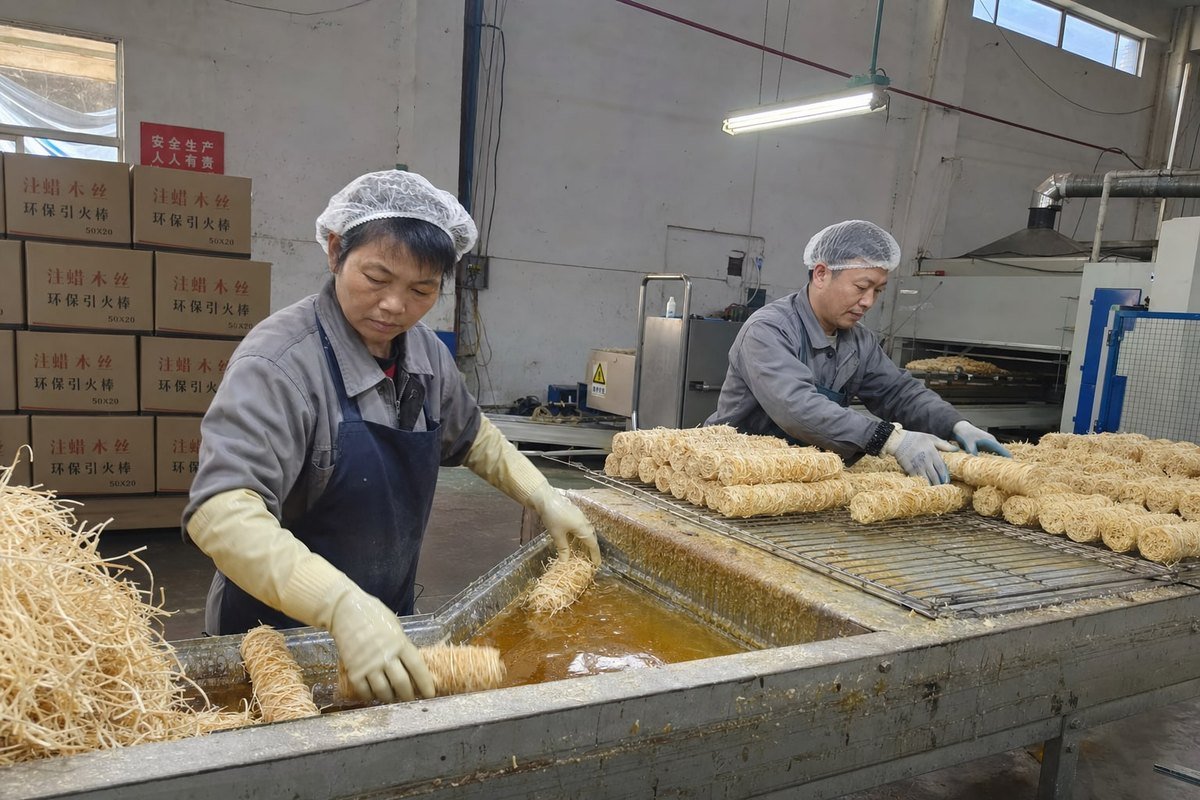
Start with the material. Wood wool fire starters — shredded excelsior rolled into cylinders and dipped in wax — cost more to produce than pressed sawdust squares because the shredding and rolling steps take more labor. Fatwood costs differently again, since it depends on resin-rich pine stumps rather than processed fiber. You can only make a fair unit price comparison within the same product class. A $0.20 sawdust square and a $0.40 wood wool roll are not the same product, even though both light a fire.
Next comes the wax. An eco-friendly wax coating with a consistent dip weight burns longer and lights more reliably than a thin, uneven coat. In our lines, we control dip time and wax temperature per batch, because a starter that promises a 10-minute burn time per unit must deliver it in every carton, not just in the sample.
The Cost Stack Behind One Piece
| Cost Component | Typical Share of Unit Cost | What Moves It |
|---|---|---|
| Wood fiber / wood wool | 25–35% | Regional timber prices, biomass waste supply |
| Wax coating | 20–30% | Wax type, coating thickness, paraffin vs. plant-based |
| Labor and processing | 15–25% | Rolling, dipping, drying, QC steps |
| Packaging | 10–20% | Bulk cartons vs. retail display boxes |
| Overhead and margin | 10–15% | Factory scale, certification upkeep |
Moisture matters too. A low moisture content percentage 1 means faster ignition and a stable shelf life, but it requires proper drying capacity — which costs money. Finally, timing shifts price: quotes issued in spring, before the autumn pre-heating rush, are often noticeably lower than peak-season quotes because manufacturing lead times are shorter and lines have spare capacity.
How Do Certification and Compliance Costs Affect a Fair Quote?
A German distributor once asked me why our quote sat above two competitors. When we compared paperwork, neither rival could supply SGS test reports or a BSCI 2 audit. His retail chain rejected both of them within a month.
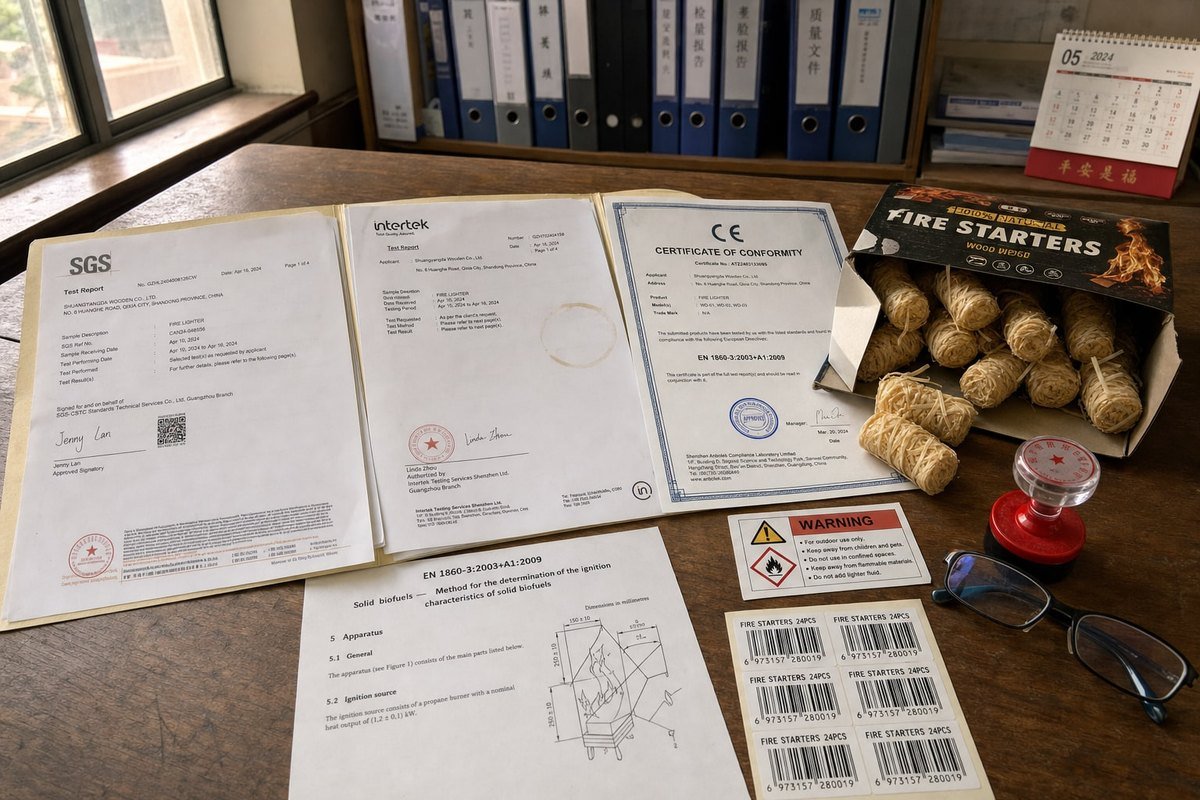
Certification and compliance typically add around 5% to manufacturing cost but are essential to a fair quote. A reasonable price includes verifiable test reports, safety standards such as EN 1860-3, audited factories, and correct warning labels — costs a compliant supplier must carry and an uncertified one skips.

Compliance is not a decorative line on a spec sheet. For fire products entering the US or EU, it is a hard gate. Our factory maintains ISO 9001 3, BSCI, CE, and SGS/Intertek certification because our buyers — camping brands, fireplace distributors, large retail sourcing channels — cannot list a fire product without documentation. Those audits, tests, and renewals cost real money every year, and that money sits inside every quote we issue.
So when a quote comes in dramatically below market, ask what is missing. Often it is one of these:
- No third-party test reports. The supplier has never paid for SGS or Intertek 4 testing, so their base cost is lower — and your import risk is higher.
- No safety standard compliance. Standards like EN 1860-3 for barbecue firelighters exist to control flash behavior and emissions. EN 1860-3 safety standard 5 Skipping them saves the factory roughly 5% and transfers all liability to you.
- Unverified material claims. FSC certified wood 6 and eco-friendly wax coating claims need chain-of-custody documents. Anyone can print a leaf logo.
- No social compliance audit. BSCI or similar audits matter to major retailers. A factory without one may be blocked from your biggest customers later.
Here is the practical test I give buyers: ask for the actual certificates and test reports before discussing price. A compliant supplier sends them the same day. A non-compliant one negotiates instead. That single request often explains a 10–15% quote gap better than any spreadsheet.
What Hidden Costs Should I Watch for Beyond the Unit Price?
Trade-offs sit at the center of every quote we build. When a buyer pushes hard on unit price, something else must flex — usually packaging, freight terms, or the minimum order quantity — and that is exactly where hidden costs breed.
Beyond the unit price, watch for freight and shipping costs, minimum order quantity requirements, retail packaging surcharges, palletization fees, sample and tooling charges, currency terms, and seasonal lead-time premiums. These can add 10–25% to the true landed cost of wood fire starters.

The quote you see is rarely the price you pay. Fire starters are bulky relative to their value, and wax-dipped wood rolls carry real weight. Freight and shipping costs can add 10–15% to the delivered price, more during port congestion or peak shipping season. Always ask whether the quote is EXW, FOB, or CIF — the same $0.35 piece can land at very different final costs under each term.
Common Hidden Costs and How to Neutralize Them
| Hidden Cost | Typical Impact | How to Protect Yourself |
|---|---|---|
| Freight and duties | +10–15% of quote | Request a landed-cost estimate to your port |
| Retail display packaging | +10–15% vs. bulk cartons | Quote both bulk and retail-ready versions |
| High minimum order quantity | Ties up cash, storage | Negotiate a trial MOQ before committing |
| Palletization and fumigation | Flat fees per shipment | Confirm they appear in the written quote |
| Peak-season lead times | +10% price, longer waits | Order in spring for autumn delivery |
| Private-label setup | One-time artwork/plate fees | Ask if setup fees are waived at volume |
Packaging deserves special attention. A plain bulk carton and a printed 100-piece display box hold the same product, but the packaging-to-product cost ratio differs sharply — moving to plain cardboard can trim a quote by around 15%. On our OEM lines, we run everything from bulk export cartons to full private-label boxes with barcodes and warning labels, so we quote them separately. If a supplier gives you one blended number, you cannot see what you are paying for.
Also check the minimum order quantity carefully. A rock-bottom unit price tied to a full container commitment is not cheap for a first order. A fair supplier offers a workable trial MOQ so the sample-to-mass-production quality claim can actually be tested.
How Can I Compare Quotes From Different Suppliers Fairly?
Over 17 years of exporting to 30-plus countries, I have learned that most quote disputes come from comparing unlike things. Two spreadsheets, two currencies, two Incoterms 7 — and suddenly the "cheap" supplier is not cheap at all.
Compare quotes fairly by normalizing every offer into delivered cost per successful fire: divide the landed cost by piece count, adjust for burn time per unit and pieces needed per ignition, then verify certifications, MOQ, and lead times match before ranking prices.
The single most useful move is normalization. Convert every quote into the same units before you judge anything. Retail benchmarks help anchor you: budget packs run about $2.79–$5.99, mid-range fatwood and branded starters sit around $6.99–$15.99, and bulk packs commonly run $20–$35. One well-known review pegs a good affordable option at roughly $0.31 per starter. Your wholesale quote should undercut those retail figures with room for your margin.
A Simple Four-Step Comparison Process
- Calculate landed cost. Add freight, duties, and fees to the quoted price for each supplier under identical Incoterms.
- Divide by usable pieces. Confirm the exact piece count and weight in writing — vague counts are a red flag.
- Adjust for performance. If a premium wood wool starter lights a fire with one piece while a budget square needs two, double the budget option's cost per fire before comparing.
- Verify the non-price terms. Certifications, moisture control, manufacturing lead times, private-label support, and trial MOQ must be equivalent, or the price comparison is meaningless.
Worked Example
| Factor | Supplier A | Supplier B |
|---|---|---|
| Quoted price per piece | $0.22 | $0.38 |
| Landed cost per piece | $0.27 | $0.43 |
| Pieces per successful fire | 2 | 1 |
| Cost per fire | $0.54 | $0.43 |
| Test reports provided | No | Yes (SGS) |
| Burn time per unit | ~5 min | ~10 min |
Supplier A looks 42% cheaper on paper. After normalization, Supplier B costs less per fire and carries compliance documents. That is the pattern I see constantly, and it is why bulk wholesale rates alone never tell the full story. Fire starters are a repeat-purchase, reputation-sensitive product: a starter that fails on a damp evening costs you a customer, not just a piece of waxed wood.
Conclusion
A fair wood fire starter quote is a math problem, not a guess: normalize to landed cost per fire, verify compliance, and expose hidden charges — then choose the partner, not just the price.
Footnotes
1. Wood moisture content affects ignition and drying, a topic studied by forestry research agencies. ↩︎
2. BSCI is a recognized social compliance audit framework referenced multiple times in the article. ↩︎
3. ISO 9001 is a widely recognized quality management certification referenced in the article. ↩︎
4. SGS is a major third-party testing and certification body mentioned as a compliance verifier. ↩︎
5. Authoritative Wikipedia reference for firelighter safety and the EN 1860-3 standard. ↩︎
6. FSC certification is a recognized chain-of-custody standard for sustainable wood sourcing. ↩︎
7. Incoterms define shipping responsibility terms like EXW, FOB, and CIF mentioned in the article. ↩︎



 English
  Spanish
  German
  French
  Arabic
  Portuguese
Join the Conversation