






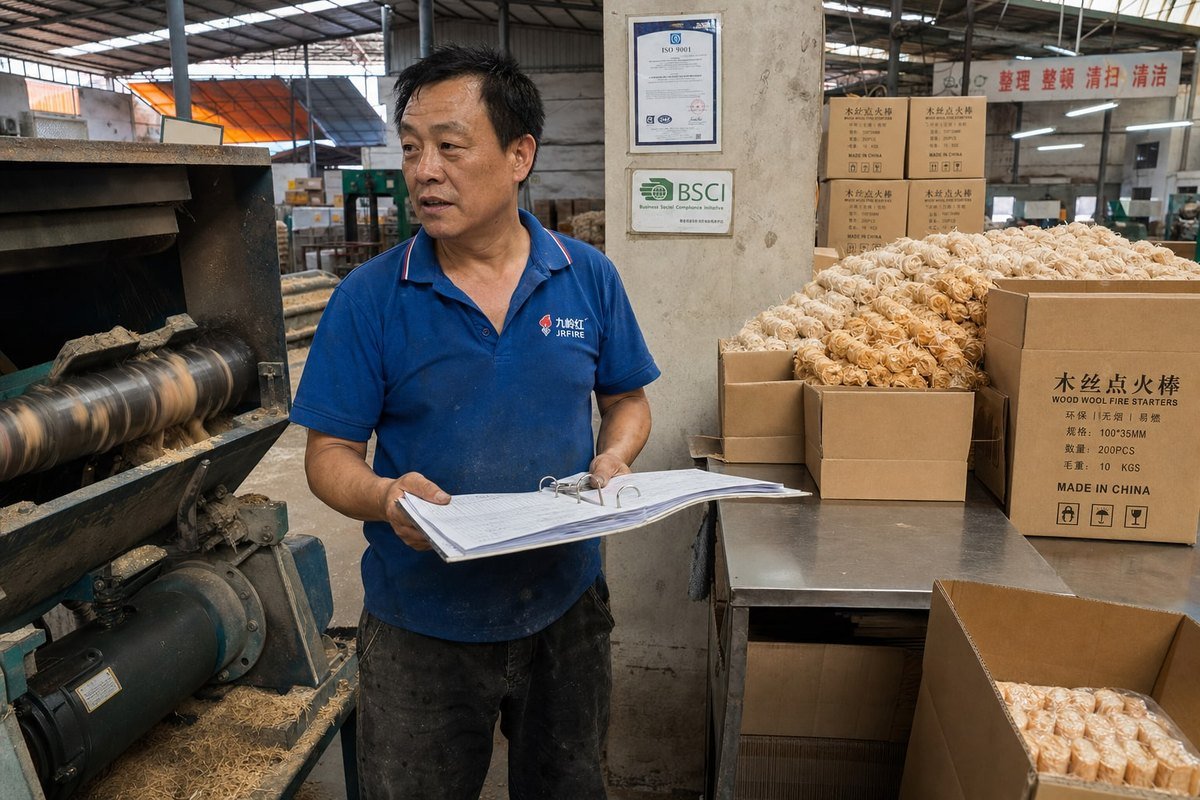
Verifying a supplier's production capacity for wood fire starters is the difference between a smooth Q4 and empty shelves. I've watched our factory rescue buyers burned by capacity promises.
To verify a supplier's production capacity for wood fire starters, request recent production logs, audit the factory line and drying capacity, check certifications like ISO 9001, run a pilot order of 10–20% of target volume, and measure good units shipped on time.
That is the short answer. The rest of this guide breaks each step down into practical actions you can take before signing a purchase order.
What documents can I request to confirm a factory's real production capacity?
A German distributor once asked our team in Ningbo for twelve months of output records before his first order. That request took him thirty minutes and saved him a season.
Request production logs from the last 8–12 weeks, monthly output data for the past 12 months, an equipment and machinery list, shift schedules, raw material purchase records, export records, and certifications such as ISO 9001, BSCI, and FSC certification.

Documents are your first filter. A real factory keeps native records because it needs them to run daily operations. A trading company or an overstretched workshop usually cannot produce them, or sends you rounded marketing numbers instead.
Here is the core document set I recommend requesting, and what each one actually proves:
| Document | What It Proves | Red Flag If Missing |
|---|---|---|
| Production logs (last 8–12 weeks) | Actual recent output, not theoretical claims | Only brochures or "monthly capacity" estimates |
| 12-month output history | Seasonal swings, highest and lowest months | One flat headline number all year |
| Machinery and line list | Theoretical maximum daily output | Vague answers about equipment count |
| Raw material purchase records | Stable raw material procurement for wood wool, paraffin wax, packaging | No visibility into upstream supply |
| Export and shipping records | Proven bulk order fulfillment at your scale | Only domestic or tiny orders on file |
| ISO 9001, BSCI 1, SGS/Intertek reports | Systematic quality assurance protocols | Expired or unverifiable certificates |
| FSC certification (if you need certified wood) | Legal, traceable timber input | Certified claims with no chain-of-custody paperwork |
Why 12 months matters more than one number
A supplier quoting "500,000 pieces per month" tells you almost nothing. Ask instead: what was your best month last year, and your worst? For wood fire starters, output often drops in humid months when drying slows, and spikes before Q4. Your projected demand should fit inside their proven historical range, not their optimistic ceiling.
Check current utilization, not just capacity
A factory running at 95% utilization has no room for your order, no matter how large its lines look. At our plant, we share order-book load openly during peak season because we would rather turn down a rush order than miss a committed date. Ask any supplier the same question. If they claim unlimited availability in September, be skeptical.
How do I know if a supplier can consistently meet my order volume and deadlines?
Consistency is the trait we work hardest to protect on our own lines. After 17 years shipping fire-starting goods to 30-plus countries, I can tell you that one good batch proves very little.
Confirm consistency by comparing quoted lead times against 12 months of delivery history, checking references from buyers with similar volumes, running a pilot order at 10–20% of target quantity, and tracking on-time delivery, defect rates, and good-output units — not gross production.
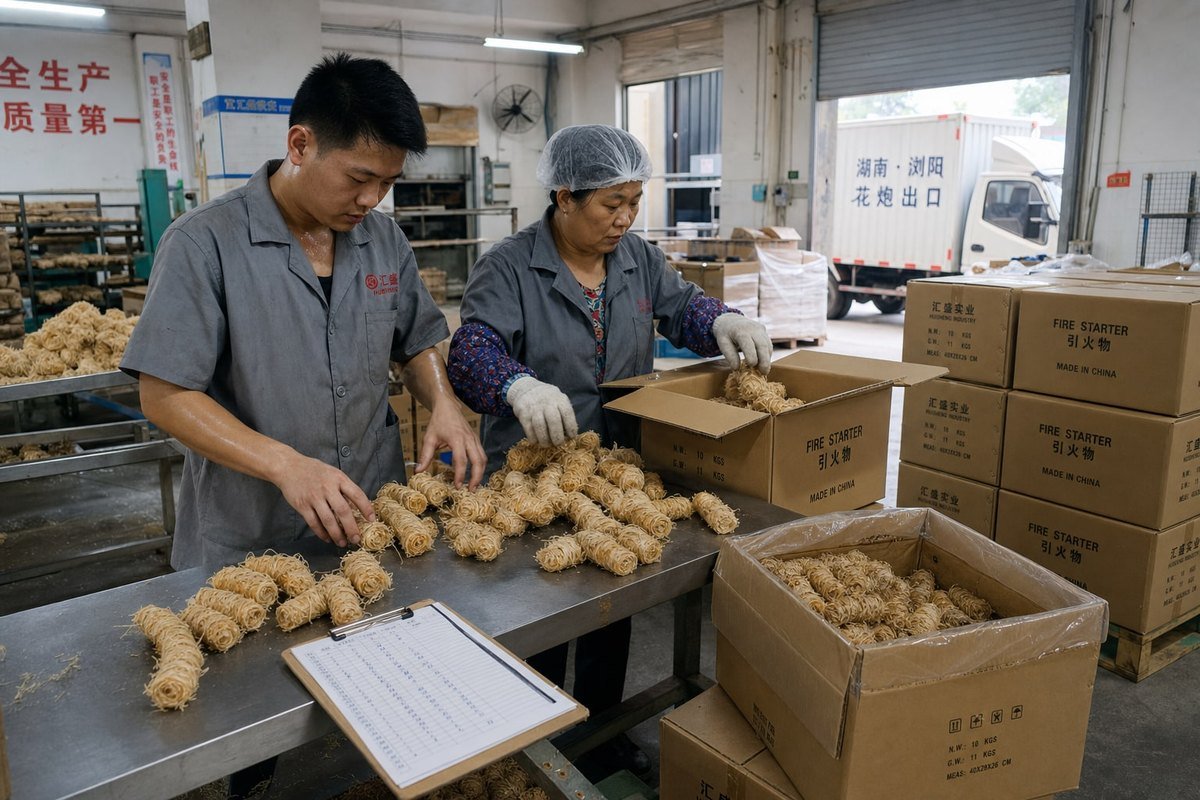
Capacity and consistency are different things. A factory may hit a big number once with overtime and rushed QC, then miss the next three deadlines. What you need is repeatable output at stable quality, especially during Q3 and Q4 when every fire-starter buyer in Europe and North America is ordering at once.
Measure good units shipped on time
Count capacity as good pieces delivered on the promised date. A supplier who produces 100,000 units but ships 15,000 defective or late ones has not delivered 100,000 units of capacity. When we quote manufacturing lead times, we quote them against shipped, inspected goods, because that is the only number your retail customer cares about.
Run a structured pilot order
A pilot order is the strongest single proof available. Structure it deliberately:
- Order 10–20% of your target annual volume in one production run.
- Define pass/fail thresholds in writing before production starts: maximum defect rate, moisture level, burn time tolerance, packaging damage rate.
- Track promised lead time versus actual ship date.
- Test transit durability, packaging integrity, and burn performance on arrival.
- Scale up gradually over two or three orders rather than jumping straight to full volume.
Watch surge capacity and seasonality
Ask directly: how do you handle Q4 demand? Do you add shifts, activate secondary packaging lines, or subcontract? Subcontracting is not automatically bad, but hidden subcontracting destroys supply chain transparency 3. We plan our peak-season shifts in June for exactly this reason, and a serious supplier should be able to show you a similar plan.
| Metric to Track During Pilot | Healthy Signal | Warning Signal |
|---|---|---|
| On-time delivery | Ships on or before promised date | Late with vague explanations |
| Defect rate | Within agreed threshold, documented | No inspection data provided |
| Batch consistency | Matches approved sample closely | Quality drifts from sample |
| Communication | Issues flagged early, in clear English | Silence until deadline passes |
What should I check during a factory audit or video call to verify true manufacturing capability?
When buyers visit our Ningbo production site, I always tell them the same thing: ignore the showroom and follow the material flow. The warehouse and the drying rooms tell the real story.
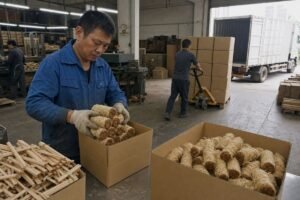
During a factory audit or video call, walk the full flow from raw material intake to finished cartons, time the bottleneck step, count active lines and workers, inspect drying room capacity, verify QC stations, and confirm your exact SKU is running on the line.
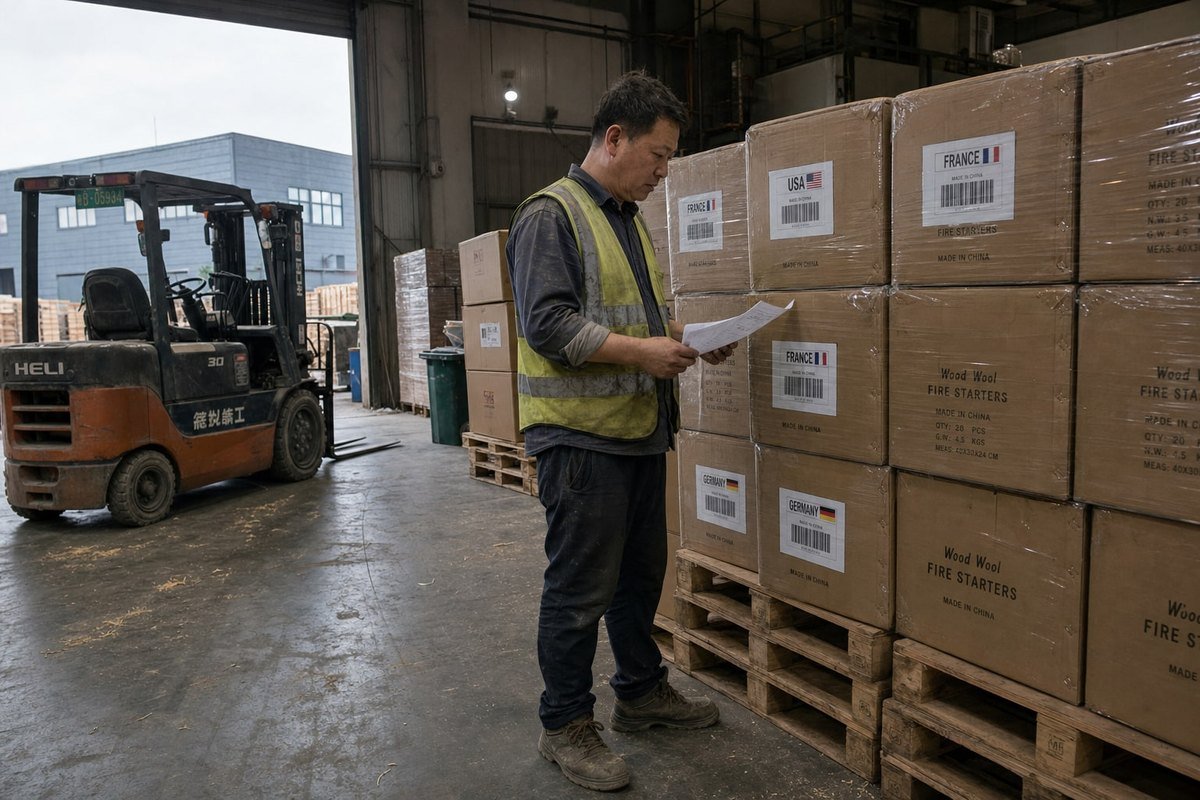
Wood fire starters look simple. They are not simple to produce at volume. Output can bottleneck at wood wool cutting, rolling, wax dipping, drying, or packaging — and the slowest of those steps defines the factory's true throughput, no matter how fast the other steps run.
Follow the bottleneck, not the demo
Every factory shows visitors its fastest, most impressive step. Ask to see the slowest one instead. For wood-based products, drying is often the hidden constraint. Measure or ask for the total cubic meter capacity of drying rooms and kilns 4, then do the math against the quoted daily output. If the numbers do not reconcile, the quoted capacity is theoretical, not real. On our own lines, wax-dipping and cooling throughput is what we plan around, and we schedule production line efficiency reviews against that step, not the rolling stations.
A practical audit checklist
| Audit Point | What to Verify |
|---|---|
| Raw material intake | Stock levels of wood wool, sawdust, paraffin wax; supplier invoices for raw material procurement |
| Active production lines | Lines actually running your product category, not a demo or a different product |
| Workforce | Operator headcount, shift patterns, ability to add shifts in peak season |
| Drying capacity | Kiln or drying room volume versus claimed daily output |
| QC stations | In-line inspection points, batch records, moisture testing, quality assurance protocols in use |
| Packaging area | Ratio of automated bagging and palletizing to manual labor; packaging throughput often limits high-volume orders |
| Finished goods storage | Real inventory consistent with claimed output and order book |
Video calls can work if you control the camera
If you cannot travel, run a live video audit. Direct the walk yourself: ask them to pan to specific machines, show production boards, open the drying rooms, and film finished goods storage. Recorded videos can be staged. A live, buyer-directed walkthrough is much harder to fake. You can also engage third-party inspection services such as SGS or Intertek to run the audit on your behalf, which is exactly why we keep our own SGS and Intertek reports current — serious buyers ask for them.
How can I tell if a supplier is a real manufacturer versus a trading company reselling wood fire starters?
This question comes up in almost every first call with a new US or European buyer, and I understand why. Our headquarters sits in Liuyang and our production runs in Ningbo, so we always invite buyers to verify both — because plenty of "factories" online are trading desks with borrowed photos.
Cross-check the business license scope against manufacturing activities, verify certifications like ISO 9001 and FSC are issued in the supplier's own name, ask deep technical questions about wax formulation and drying, request a live unscripted factory video, and match export records to the factory address.

Trading companies are not always a bad choice, but you should know what you are buying. A reseller adds margin, slows communication, and cannot control quality drift at the source. If a compliance issue or delay hits, they have no direct authority over the production line. For a seasonal, retail-facing product like wood fire starters, that gap can cost you the whole selling window.
Signals that separate factories from resellers
- License scope. A Chinese business license states the registered scope. "Manufacturing" and "trading" scopes read differently. Ask for the license and check the registered address against the factory address.
- Certificates in their own name. ISO 9001 compliance 5, BSCI, and FSC certification are issued to a specific legal entity at a specific site. If the name on the certificate does not match the company quoting you, they are reselling someone else's compliance.
- Technical depth. Ask about paraffin wax melt points 6, moisture targets before dipping, and how they adjust drying in humid months. A real production team answers instantly and specifically. A trader stalls or gives generic answers. When buyers grill our engineers on burn-time tolerances for our wax-dipped wood rolls, the depth of the answer is the proof.
- FSC mass balance. If certified wood matters to you, check that certified timber intake 7 roughly matches claimed output. A trader claiming FSC volumes far beyond its documented intake is a serious compliance risk.
- Customization flexibility. True manufacturers can adjust size, burn time, packaging, and private-label details because they control the line. Traders resist changes because every change requires renegotiating with their hidden factory.
- Unscripted access. Ask for a live video call from the production floor on short notice. Factories say yes. Traders schedule, delay, and stage.
None of these signals is conclusive alone. Combined, they are very hard to fake.
Conclusion
Verify documents, audit the bottleneck, pilot small, then scale. Capacity claims are cheap; proven, on-time, good-unit output is what protects your season and your shelf space.
Footnotes
1. amfori runs the BSCI social compliance program referenced for supplier auditing. ↩︎
2. Defines the trading company business model distinct from manufacturing operations. ↩︎
3. Explains the broader concept undermined by hidden subcontracting in manufacturing. ↩︎
4. USDA Forest Products Laboratory provides authoritative research on wood drying and kiln capacity. ↩︎
5. Official ISO page explaining the quality management standard suppliers must hold. ↩︎
6. Background on paraffin wax properties relevant to wax-dipping in fire starter production. ↩︎
7. FSC's own site defines chain-of-custody rules for verifying certified timber volumes. ↩︎

 English
  Spanish
  German
  French
  Arabic
  Portuguese
Join the Conversation