






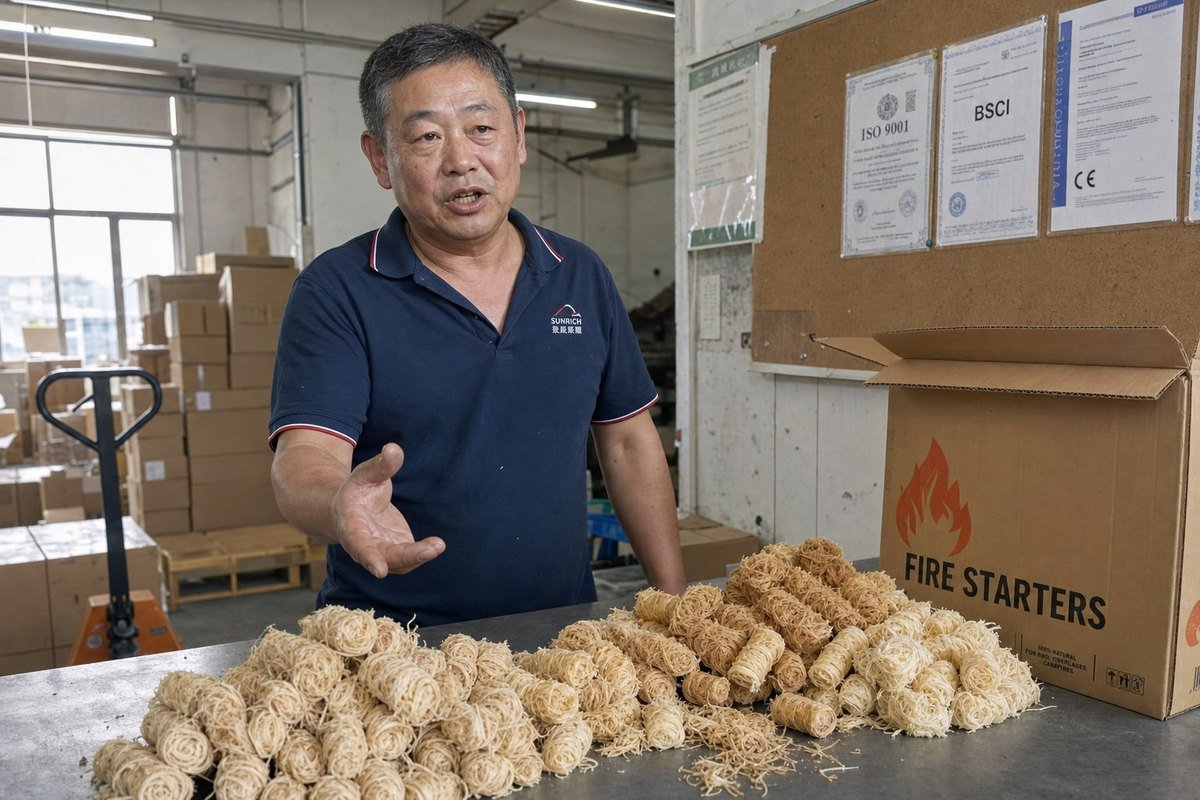
Finding a reliable wood fire starters supplier is harder than it looks. I have watched buyers lose whole retail seasons to one bad sourcing decision on our side of the industry.
A reliable wood fire starters supplier holds verifiable certifications (ISO 9001, BSCI, SGS/Intertek), owns real production lines, offers flexible MOQ with OEM/ODM support, and proves consistency through documented quality control, stable lead times, and responsive communication before you ever place a bulk order.
That answer sounds simple. Putting it into practice is not. Below, I break the process into four checks any purchasing manager can run in a week.
What certifications should I check before choosing a wood fire starters supplier?
A German distributor 1 once told me his previous shipment was held at customs for missing test reports. That single delay cost him his best-selling October window, and it taught me how much paperwork matters.
Before choosing a wood fire starters supplier, verify ISO 9001 for quality management, BSCI for ethical labor, CE marking for European market access, and third-party test reports from SGS or Intertek. Also request MSDS documents for transport safety and material declarations proving non-toxic, natural composition.
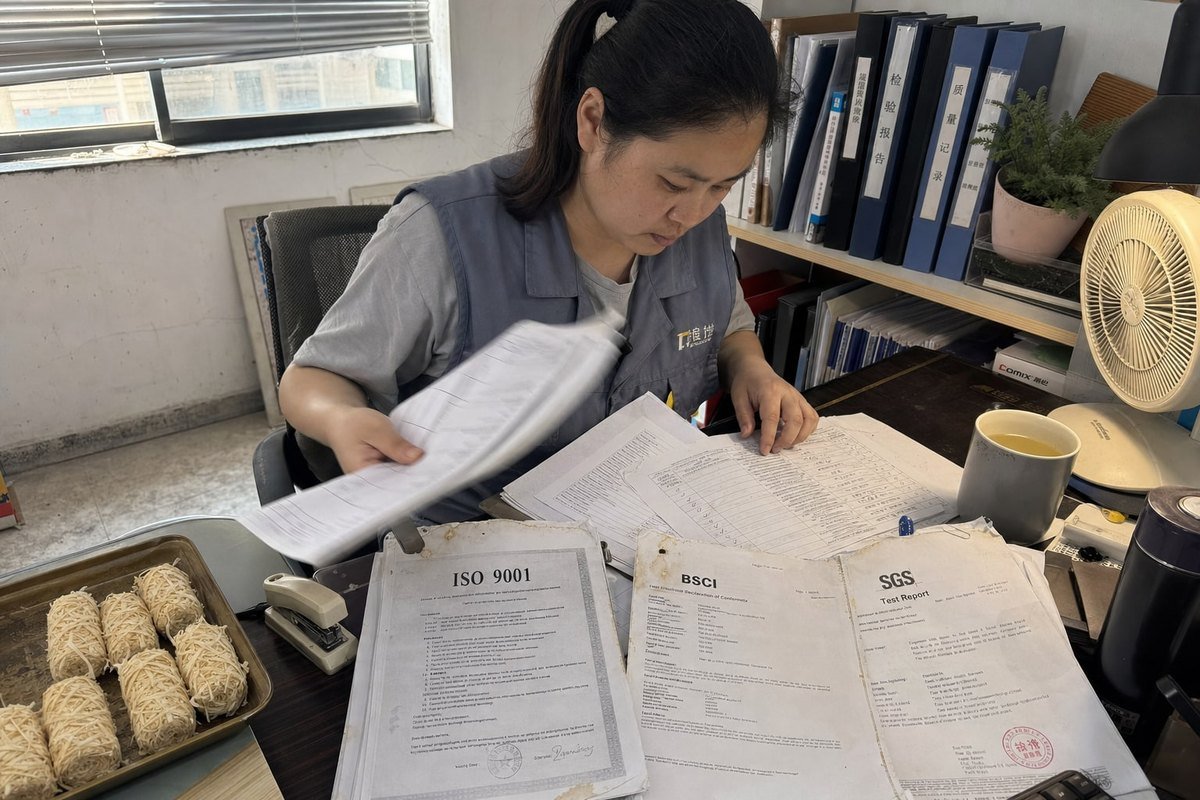
Certifications are not decoration. They are the only fast way to separate a genuine factory from a middleman with a nice website. At our plant in Ningbo, buyers from the US and Europe treat compliance documents as a hard gate, not a bonus. If a supplier hesitates when you ask for a certificate number, walk away.
The core documents and what each one proves
| Document | What it proves | Why it matters for you |
|---|---|---|
| ISO 9001 | A working quality management system | Batch-to-batch consistency, not luck |
| BSCI audit | Ethical and social compliance | Required by many large retail sourcing channels |
| CE marking 2 | EU product safety conformity | Legal access to European shelves |
| SGS / Intertek reports | Independent third-party testing | Neutral proof of burn safety and materials |
| MSDS | Transport and handling safety | Smooth sea and air freight clearance |
Beyond the certificates themselves, check three things. First, verify the certificate is current. Audits expire, and some suppliers keep showing documents from years ago. Second, confirm the name on the certificate matches the factory you are dealing with. Trading companies often borrow paperwork from partner plants. Third, ask for material-level evidence. For wholesale firelighters, that means declarations on the wax used, VOC emission data 3 for indoor stove use, and sourcing proof for the wood, ideally FSC certified timber 4 or an equivalent responsibly sourced claim. Odorless ignition products should have testing behind the "odorless" label, not just marketing copy. A supplier who can produce all of this within a day or two of your request has done it many times before. That responsiveness is itself a reliability signal.
How can I verify a supplier's manufacturing capabilities and quality control process?
Our QC team once rejected an entire batch of wax-dipped wood rolls because the moisture reading on the wood wool ran slightly above our internal limit. Decisions like that are invisible to buyers unless you know what to ask.
Verify manufacturing capability by requesting a live video factory tour, batch QC records, and moisture content standards documentation. A real factory can show wood wool production lines, wax-dipping stations, in-process inspection points, and defect-rate data. A trading company cannot show any of this on demand.
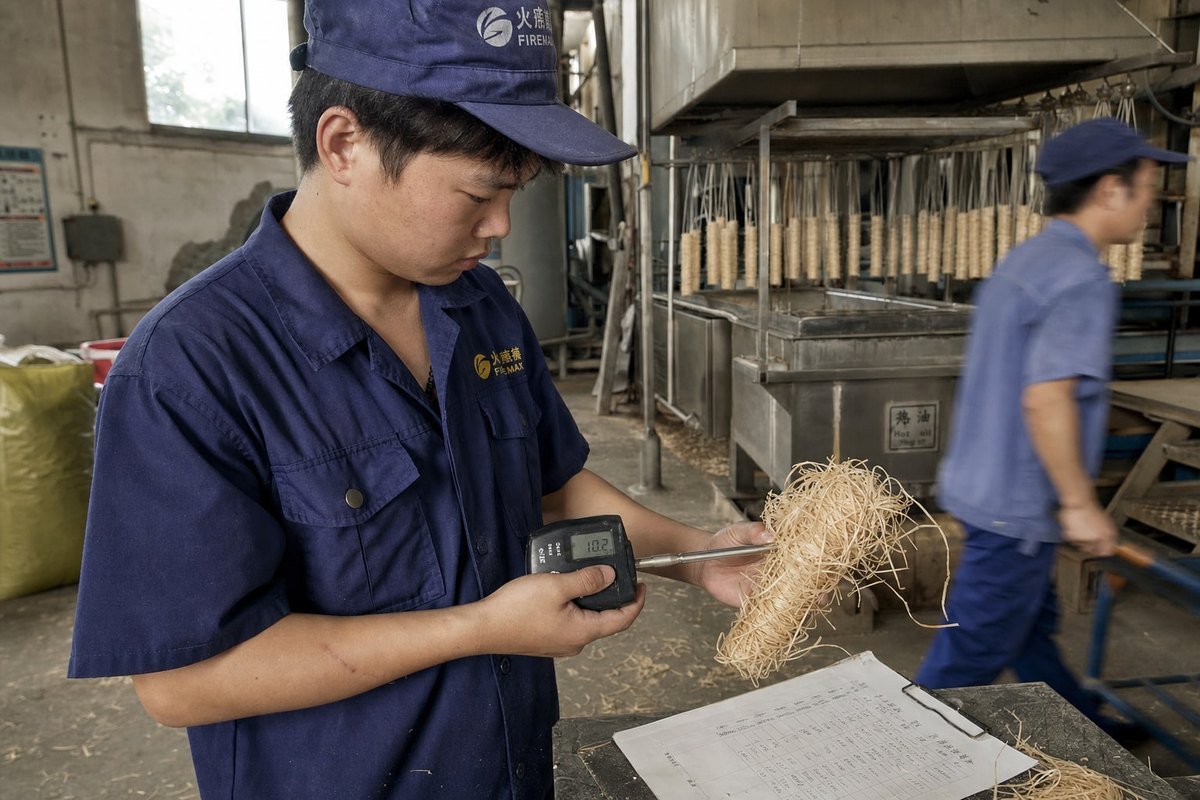
The gap between a sample and a container load is where most sourcing relationships die. A supplier can hand-pick ten perfect pieces for a sample box. Only a disciplined production system 5 delivers the same quality across 100,000 pieces. After 17+ years running fire-product lines, I can tell you the difference always shows up in the process, not the pitch.
A five-step verification process
- Ask for a live video tour. Not a pre-recorded promo. Walk the line in real time and ask them to zoom in on the wax-dipping and drying stations.
- Request moisture data. Wood components should stay below roughly 10% moisture. Ask how they measure it and how often per batch. Consistent moisture content standards are the backbone of guaranteed ignition.
- Review in-process QC checkpoints. Good factories inspect at raw material intake, mid-production, and pre-packing. Ask to see the actual checklists.
- Test burn performance yourself. Time ignition speed and total burn. A quality wood wool starter should burn 10 to 15 minutes or longer, enough to catch full logs without extra kindling. Test in wind and damp conditions too.
- Check packaging protection. Sealed or well-protected packaging prevents wax degradation 6 and resin loss during long warehousing. This matters if you stock hearth and BBQ accessories year-round but sell seasonally.
One more practical tip. Ask the supplier what they do when a batch fails. A vague answer means they have no real system. A specific answer, with rework or scrap procedures, means quality control actually happens on their floor.
What MOQ and OEM/ODM options should I look for when placing a trial order?
The trade-off we weigh most often at our Liuyang headquarters is trial-order size versus setup cost. Push MOQ too high and good buyers walk. Push it too low and custom packaging becomes uneconomical. The right partner explains this math openly.
Look for a supplier offering a flexible minimum order quantity for trial orders, typically one pallet to a partial container, plus true OEM/ODM support: custom size, burn time, private-label packaging, warning labels, barcodes, and display boxes. Rigid high MOQs on first orders signal inflexibility ahead.
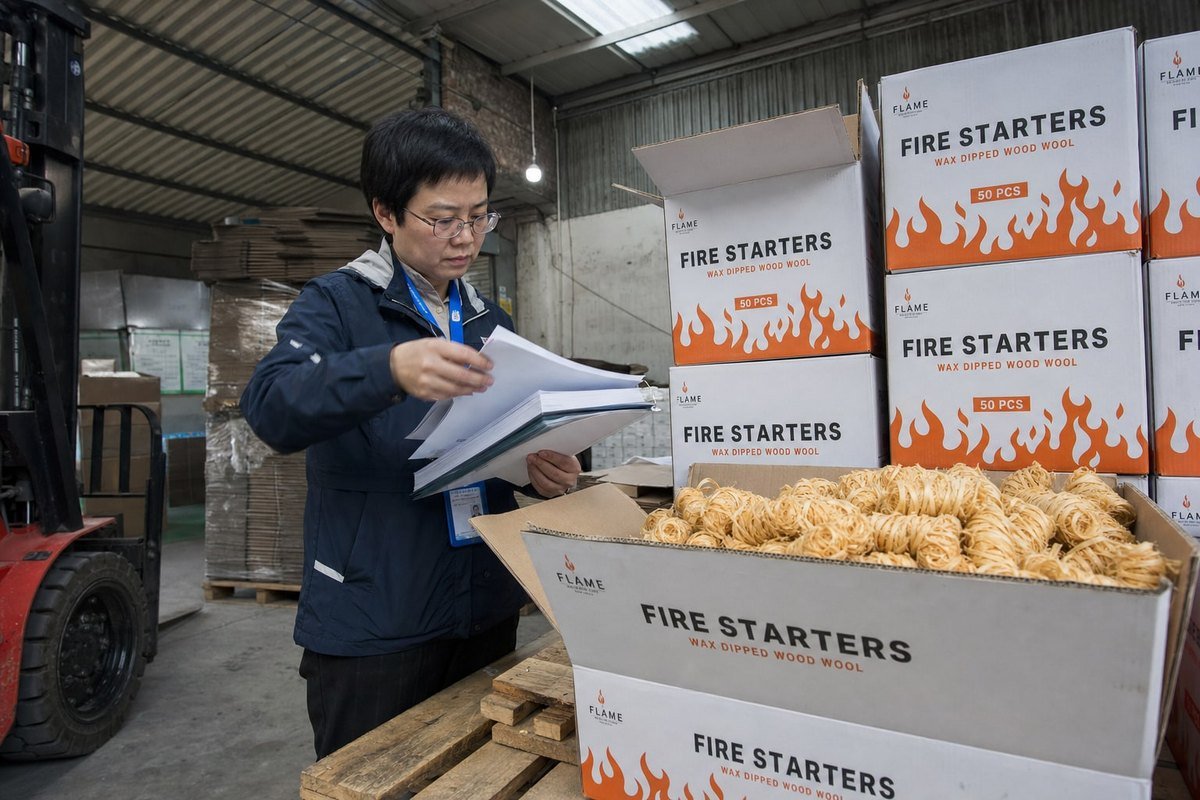
A trial order is really a test of the relationship, not just the product. In our experience exporting to 30+ countries, the buyers who scale fastest are the ones who used a small first order to check three things at once: product quality, customization capability, and how the supplier behaves under real deadlines.
What genuine OEM/ODM support includes
Private label manufacturing should go deeper than slapping your logo on a stock box. Ask specifically about each layer below.
| Customization layer | Stock supplier | True OEM/ODM partner |
|---|---|---|
| Product size and burn time | Fixed specs only | Adjustable to your market's needs |
| Packaging format | Standard boxes | Custom retail boxes, jars, kraft bags, display units |
| Branding | Logo sticker at best | Full private-label artwork, printed packaging |
| Compliance labeling | Generic or missing | Market-specific warning labels and barcodes |
| Logistics | Ex-works only | Optimized global shipping support |
Structuring a smart trial order
Keep the first order small but complete. Include your final retail packaging, not plain export cartons, so you test the whole shelf-ready product. Ask for tiered pricing at the same time, so you know your total cost of ownership at 1x, 5x, and 10x volume before you commit. Factor in shipping and duties, not just unit price. And confirm in writing that trial-order quality is produced on the same line, with the same QC, as full production runs. When we quote a trial order, we treat it as the first batch of a long relationship, because that is exactly what a good buyer is testing for.
How do I evaluate a supplier's reliability for long-term lead times and communication?
Every autumn, our production schedule fills with replenishment orders from fireplace distributors in the US, Germany, and the UK. Watching that seasonal wave for years has taught me that reliability is mostly a calendar problem, not a quality problem.
Evaluate long-term reliability by checking quoted versus actual lead times on your trial order, peak-season capacity plans, English response speed within 24 hours, proactive updates on delays, and a sustainable supply chain for raw materials. Consistent behavior over two or three orders reveals more than any promise.
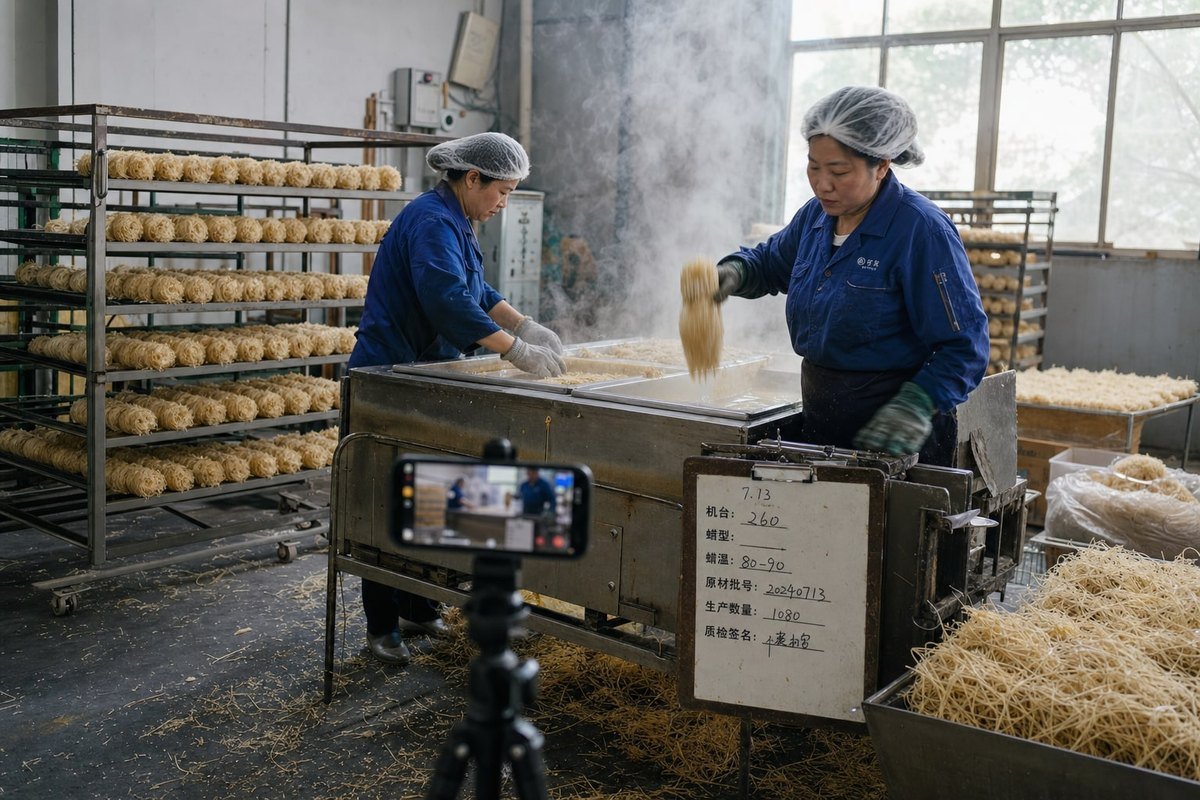
Fire starters are brutally seasonal. Demand spikes from late summer through winter, and a supplier who runs fine in April can collapse in September. So the real question is not "what is your lead time?" but "what is your lead time in your busiest month, and how do you protect it?"
Reliability signals worth tracking
| Signal | Green flag | Red flag |
|---|---|---|
| Lead time accuracy | Delivers on or before quoted dates | Quotes short, delivers late |
| Peak-season planning | Offers early booking and buffer stock | "We will see" answers about Q4 |
| Communication | Replies within 24 hours in clear English | Days of silence, vague answers |
| Problem handling | Flags issues before you ask | You discover delays at the port |
| Raw material security | Stable sources for wood wool, wax, natural fatwood resin | Frequent material substitutions |
Test communication before it matters
Send a technical question before you order anything. Ask about VOC handling for indoor stoves, or how they secure FSC certified timber 7 supply during peak months. The speed and precision of the answer predicts how they will behave when a container is delayed. Also ask how they source secondary materials like wax and binders. A supplier managing a sustainable supply chain at the raw-material tier rarely gets caught short mid-season. Finally, keep a simple scorecard across your first three orders: promised date, actual date, defect rate, response times. Numbers beat impressions. When we onboard a new distributor, we actually encourage this tracking, because a supplier confident in its own operations has nothing to hide from a scorecard.
Conclusion
Choosing wrong costs you a season. Choosing right compounds for years. Verify certifications, audit real production, run a smart trial order, then track lead-time behavior — reliability is proven, never promised.
Footnotes
1. Authoritative trade guide regarding regulations and customs requirements for distributors in the German market. ↩︎
2. Official EU source explains CE marking requirements for legal market access. ↩︎
3. Technical EPA overview of volatile organic compounds and their relevance to indoor air safety standards. ↩︎
4. Official source defining global standards for responsibly sourced wood and forest management certification. ↩︎
5. Technical definition of the structural requirements of a manufacturing system to ensure consistent product output. ↩︎
6. Scientific overview of paraffin wax properties, including thermal stability and degradation factors. ↩︎
7. FSC verifies responsibly sourced wood, supporting sustainable supply chain claims. ↩︎

 English
  Spanish
  German
  French
  Arabic
  Portuguese
Join the Conversation