






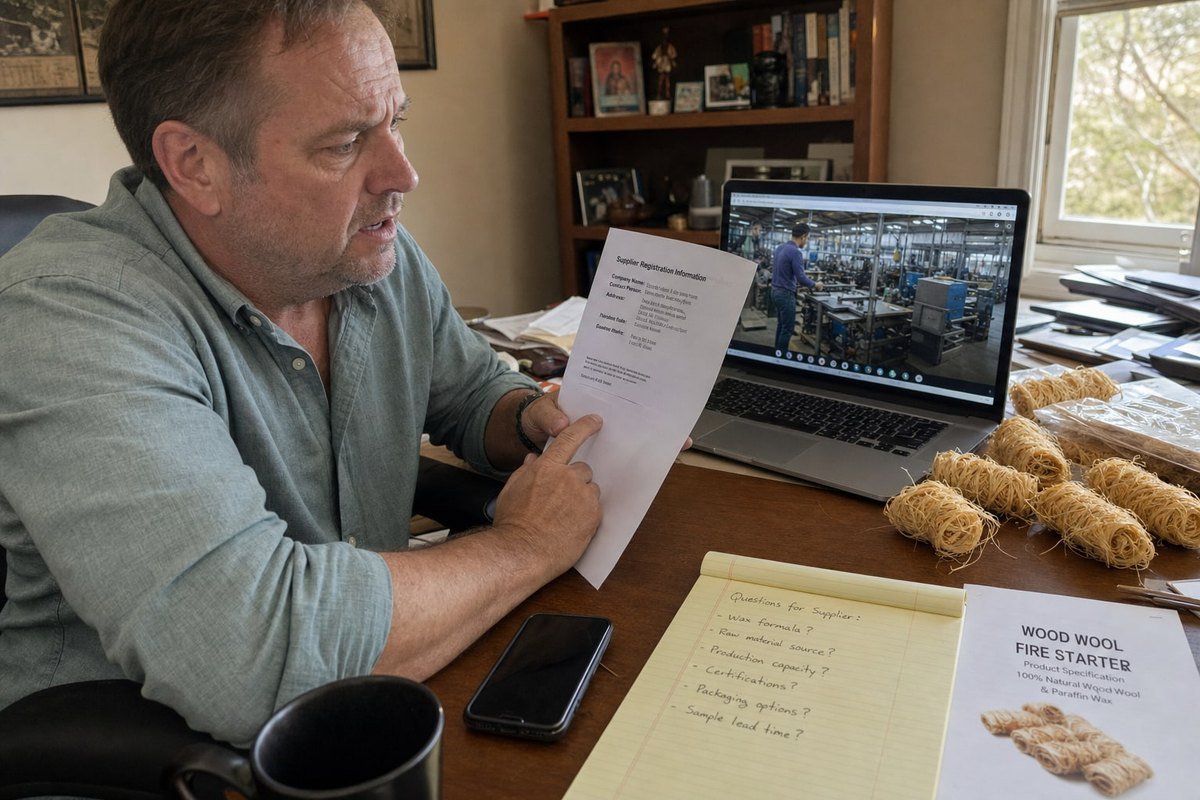
Sourcing wood fire starters 1 looks simple until a "supplier" vanishes after payment. Over 17 years running our own production lines 2, I've watched shell companies burn too many good buyers.
To avoid shell companies when sourcing wood fire starters, verify the supplier's corporate registry record, confirm a real physical factory through live video and address checks, demand certifications like ISO 9001 and SGS test reports, and start with a small trial order before scaling.
The rest of this article breaks that process into four practical steps. Each one is something you can do this week, without flying to China.
How can I verify a wood fire starter supplier actually owns its factory?
A buyer from Germany once told me he had wired a deposit to a "factory" whose only real asset was a website. That story is why we film live tours from our Ningbo production floor on request.
Verify factory ownership by running a corporate registry check on the exact legal entity name, matching the registered address to the claimed factory location, requesting a live video tour of the production floor, and cross-checking business scope, registration date, and export records against the supplier's claims.
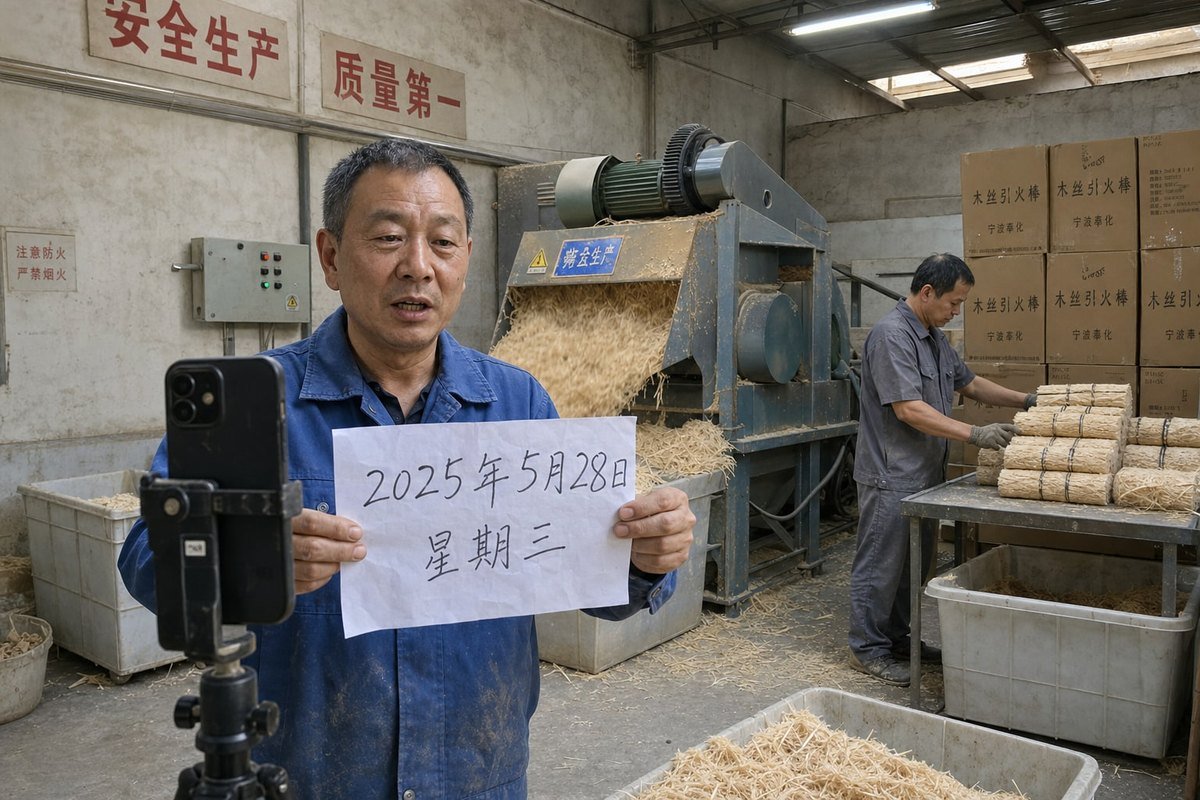
Start with the paperwork, then move to the physical world. A shell company can fake a website in an afternoon. It cannot fake a decade of registry history, a real lease, and machinery that shreds wood wool.
Start with the corporate registry
Every legitimate Chinese factory has a record in the national enterprise registry. Ask the supplier for their full legal company name 3 in Chinese, not just the English trading name. Then check three things. First, does the registration date match the "17 years of experience" claim? A company registered eight months ago claiming a long track record is a serious red flag. Second, does the business scope include manufacturing, or only "trade" and "consulting"? Third, who is the legal representative? Where possible, look at ultimate beneficial ownership. Shell companies often hide behind layered entities or a director who holds dozens of unrelated roles at the same address. That "mass registration" pattern is a classic warning sign.
Match the address to reality
Next, confirm the manufacturing origin physically. Use satellite imagery and street-level maps to look at the registered address. A fire starter factory needs space for wood processing, wax dipping, drying, and packing. If the address turns out to be a downtown office tower or a mail-forwarding service, ask hard questions.
| Verification step | What a real factory shows | What a shell company shows |
|---|---|---|
| Registry record | Manufacturing in business scope, stable history | Recent registration, trade-only scope |
| Address check | Industrial zone, warehouse footprint | Virtual office or residential unit |
| Live video tour | Production lines, raw materials, workers | Office only, excuses, prerecorded clips |
| Photos online | Consistent, original facility images | Stock photos found via reverse image search |
Finally, request a live video call. Ask the person to walk from the office to the production floor in real time and hold up a piece of paper with today's date. This "proof of life" test takes ten minutes and filters out most paper-only entities. In our experience exporting to 30+ countries, serious factories never refuse this request.
What certifications should I request to confirm compliance before placing an order?
Compliance paperwork is the first thing our European distributors ask for, often before pricing. We learned early that ISO 9001, BSCI, CE, and SGS/Intertek reports are not optional extras in this category; they are the entry ticket.
Request the business license, ISO 9001 quality certification, BSCI social audit, CE marking where applicable, third-party lab reports from SGS or Intertek, a product specification sheet, a safety data sheet, and a certificate of origin, then verify each document directly with the issuing body.
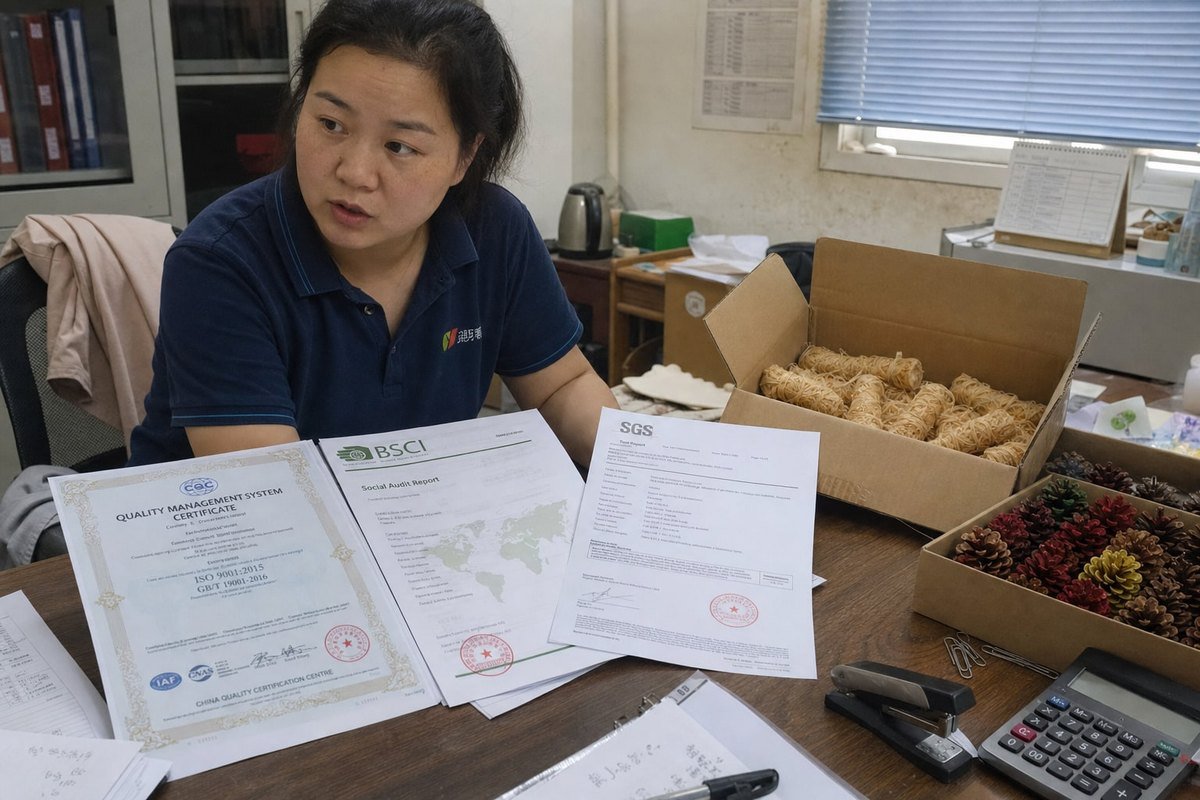
Certificates are only useful if they are real, current, and tied to the actual product. Shell companies routinely recycle expired documents or borrow certificates from other factories. So your business verification process needs two layers: collect the documents, then independently confirm them.
The core document set for fire starters
Here is the checklist I recommend to every purchasing manager before a first order:
| Document | What it proves | How to verify it |
|---|---|---|
| Business license | Legal existence and business scope | Corporate registry check |
| ISO 9001 | Quality management system | Certificate number via the certification body |
| BSCI audit | Ethical sourcing standards and labor conditions | Audit ID on the Amfori platform |
| SGS / Intertek report | Burn performance and material safety | Report number directly with the lab |
| SDS (safety data sheet) | Wax, additives, combustion byproducts | Cross-check against the spec sheet |
| Certificate of origin | Manufacturing origin for customs | Chamber of commerce records |
| FSC certification 4 (if claimed) | Sustainable forestry practices | FSC public certificate database |
Verify with the issuer, not the supplier
Never accept a PDF at face value. If a supplier claims FSC certification, look up the certificate code in the FSC database yourself. Paper-only entities often hold no valid chain-of-custody link, which breaks supply chain transparency 5 for the timber. The same logic applies to lab reports: SGS and Intertek both confirm report authenticity 6 if you contact them with the report number. Also check that the company name on every certificate matches the legal entity you are paying. A mismatch usually means you are dealing with an intermediary hiding behind someone else's compliance. For wax-dipped wood rolls specifically, insist on an SDS covering the wax coating and any treatments, plus a spec sheet stating materials, dimensions, burn time, and packaging. These documents matter as much for trade fraud prevention as for product safety.
Which questions can I ask during a factory audit or video call to spot a trading company?
There is a trade-off I always explain to new buyers: a transparent trading company can be a fine partner, but a trader pretending to be a factory is dangerous. When prospects video-call our Ningbo site, we deliberately walk them past the wax-dipping stations first, because that station is hard to fake.
Ask process-specific questions a middleman cannot answer: which wood species you use, your wax dipping temperature, daily output per line, how you handle a failed batch, and request a real-time walk to the raw material storage. Hesitation, deflection, or an office-only tour signals a trading company.
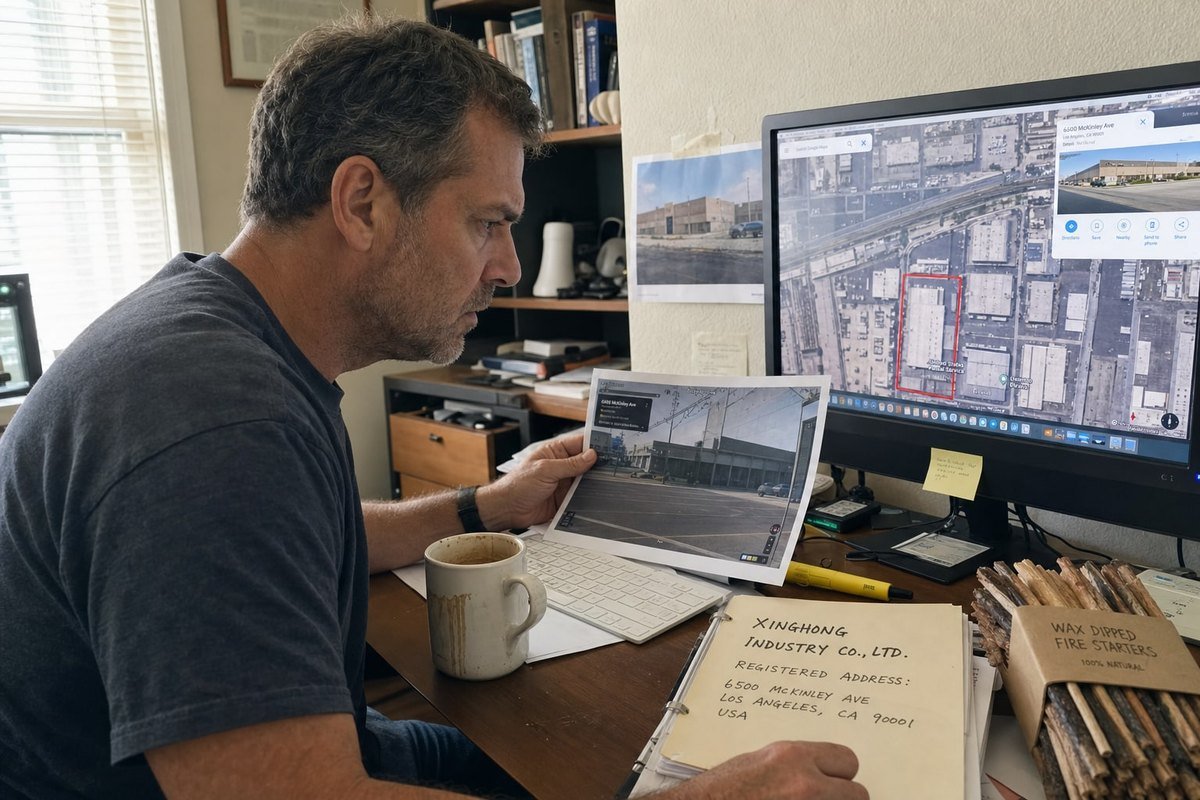
The goal is not to trick anyone. The goal is to test whether the person on the call has genuine production knowledge or is relaying answers from a hidden third party. Real factory staff answer instantly. Middlemen say "let me check with my colleague."
Questions that expose a paper supplier
- What wood species do you use for the wood wool, and why? A real producer explains resin content, moisture, and how the species affects burn time.
- What is your wax formulation and dipping temperature? Traders rarely know this, yet it directly controls ignition performance and shelf life.
- Can you show me raw material inventory right now? Ask them to walk to the log or wood-wool storage on camera and show today's date on a phone screen.
- What happens when a batch fails QC? Listen for a concrete process: rework, quarantine, root-cause review. Vague answers reveal no real QC exists.
- Which machines run the shredding line, and what is your daily capacity? Cross-check the number later against their claimed export volume.
- Can I speak with the production manager directly? In a genuine factory, this takes minutes. In a shell setup, that person does not exist.
Read behavior, not just answers
Watch how the tour flows. A real facility has noise, dust, wood shavings, and workers in motion. A staged tour is quiet, brief, and avoids close-ups. Also ask for two customer references in your region. Direct manufacturer sourcing works best when you can hear from buyers who already receive containers from that exact site. Note the nuance: if someone openly says "we are a sourcing agent with these partner factories," that honesty is acceptable. The danger is deception, not the business model itself.
How do I check a supplier's production capacity and quality control history before ordering?
A lesson we learned years ago shaped our whole QC philosophy: a buyer's first sample must reflect mass production, or you lose them forever. That is why we run batch-to-batch controls instead of polishing "golden samples."
Check capacity by comparing claimed monthly output against machinery, staffing, and export records, then review QC history through batch records, past third-party inspection reports, and defect-handling procedures. Confirm everything with a small trial order and an independent pre-shipment inspection before committing to volume.
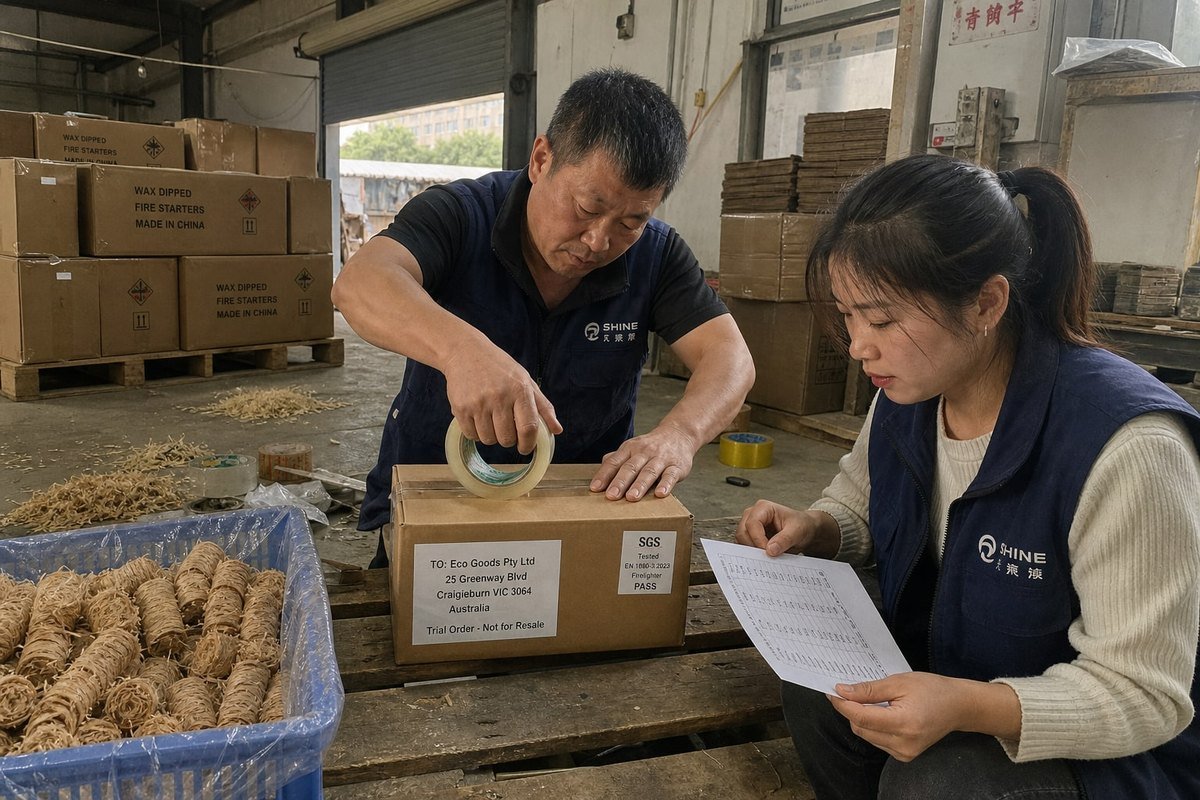
Capacity and QC history are where shell companies fall apart under scrutiny. A paper entity can forge one certificate. It cannot forge a coherent operational story where machinery, headcount, energy use, and shipping records all point to the same production volume.
Cross-check the capacity math
Wholesale procurement due diligence here is mostly arithmetic. Ask for the number of production lines, workers per shift, and output per line per day. Then compare that figure with three external data points: customs export records 7, the physical size of the facility on satellite imagery, and lead times quoted for your order size. If a supplier claims 40 containers a month from a site the size of a small warehouse, something is wrong. Analysts even use industrial energy consumption and port data to catch suppliers whose exports exceed their region's known processing capacity. You do not need that depth for a first order, but the principle stands: real output leaves multiple traces.
| Signal to check | Healthy pattern | Warning pattern |
|---|---|---|
| Quoted lead time | Scales realistically with order size | Any quantity, always "15 days" |
| Machinery on tour | Matches claimed output | Few machines, big volume claims |
| Export records | Steady shipments over years | Sudden spikes, port-to-port anomalies |
| QC documentation | Batch records, inspection reports | "Trust us, quality is good" |
| Invoicing | Itemized, consistent bank account | Round numbers, third-party beneficiaries |
Test QC history in practice
Ask for anonymized batch inspection records from the past year and copies of previous third-party pre-shipment inspection reports. Then run the real test: place a trial order. We deliberately keep MOQs flexible for first orders because a trial shipment proves more than any brochure. Have an independent QC firm 8 inspect before shipment, checking burn time, wax coating consistency, packaging, and warning labels against your written spec. Also watch the money. Payments routed to an unrelated third-party account in another jurisdiction are a classic shell-company pattern and a payment you may never recover. Put quality standards, tolerances, and remedies in the contract, and keep every document. This paper trail supports supply chain transparency and protects you if a dispute ever arises.
Conclusion
Shell companies thrive on buyers who skip verification. One bad wire transfer can erase a season's margin and your retail reputation with it.
The fix is a repeatable workflow: run a corporate registry check, confirm the address and factory through live video, verify every certificate with its issuer, request the spec sheet, SDS, and certificate of origin, then validate capacity with a trial order and independent inspection. In our 17+ years shipping wax-dipped wood fire starters to buyers across the US, Europe, and beyond, the honest suppliers have always welcomed this scrutiny. Apply the same checklist to every vendor, and the shell companies will filter themselves out long before your deposit leaves the bank.
Footnotes
1. Wikipedia entry explaining the materials and methods used to start fires safely. ↩︎
2. Definition and history of manufacturing processes where parts are added sequentially. ↩︎
3. Overview of official systems maintained by governments to record and verify corporate entities. ↩︎
4. Official Forest Stewardship Council page describing the standards for responsible forest management. ↩︎
5. UN Global Compact resource on maintaining ethical standards and visibility throughout global supply chains. ↩︎
6. Official SGS tool allowing buyers to verify the authenticity of inspection reports and product certifications. ↩︎
7. Official US Customs and Border Protection page regarding automated systems for tracking trade and export data. ↩︎
8. Professional resource from the American Society for Quality regarding the standards and processes for product inspection. ↩︎



 English
  Spanish
  German
  French
  Arabic
  Portuguese
Join the Conversation