







Every autumn, our factory phones ring with buyers who planned their advance stocking timing for wood fire starters too late — and now face empty shelves during peak heating season.
Plan advance stocking timing for wood fire starters by ordering 4–6 months before peak heating season, ideally between May and July. Add 60–90 days for production and ocean freight from China, hold 10% safety stock, and complete all deliveries at least three weeks before your first frost date.
That answer covers the basics. But the details behind each number matter. Let me walk you through how I advise our distribution partners to plan, step by step.
How far in advance should I place my wood fire starter orders before peak season demand hits?
Last spring, a German fireplace distributor asked me why his competitor's shelves were always full in October while his arrived in December BSCI documentation 1. The answer was simple: his competitor ordered in May.
Place wood fire starter orders 4–6 months before peak season, ideally May through July. This window secures off-season purchasing discounts, guarantees production slots before factories fill up, and leaves buffer time for ocean freight delays, customs clearance, and pre-season distribution to your retail channels.

Seasonal demand fluctuations drive everything in this category European customs 2. Fire starter sales in the US and Europe spike hard from late September through February. Yet most retail buyers only start thinking about stock in August. By then, they are competing with everyone else for the same production capacity and the same shipping containers.
In our experience exporting to 30+ countries, the buyers who win the season follow a clear calendar. They lock in orders during the low-demand months. They receive goods before freight congestion begins. And they hit shelves the moment temperatures drop.
The seasonal buying calendar
| Period | Market condition | What smart buyers do |
|---|---|---|
| March–April | Post-season lull, factories quiet | Review last season's sell-through, request samples |
| May–July | Lowest demand, best pricing | Place main bulk orders, negotiate off-season purchasing discounts |
| August | Order volume rising fast | Final top-up orders, confirm shipping schedules |
| September–October | Freight congestion begins | Receive and distribute stock to retail |
| November–February | Peak heating season | Sell, track burn rate, plan next year |
| Late February | Sellers clearing inventory | Optional discounted top-ups if stock runs short |
There is a real tension here worth naming. Some buyers argue for late-season purchasing because clearance prices can be attractive. That works for opportunistic top-ups. But it fails as a core strategy, because availability is never guaranteed when demand surges. My advice: prioritize certainty of supply for your main volume, and treat late-season deals as a bonus, not a plan.
One more timing anchor: aim to have all stock landed and distributed at least three weeks before your region's historical first frost. The first major cold snap triggers a panic-buying spike, and you cannot restock from China in three weeks.
What lead times can I expect when importing wood fire starters from a Chinese manufacturer?
A US camping brand once emailed us in a panic: their previous supplier quoted 30 days but delivered in 75. The lesson I shared with them applies to every buyer in this category.
Expect 60–90 days total lead time when importing wood fire starters from China: 15–30 days for production, 25–40 days for ocean freight to the US or Europe, and 7–20 days for customs clearance and inland delivery. Add a 21-day buffer for autumn shipments.

Supply chain lead times are not one number. They are a chain of stages, and each stage can stretch. When we quote production time from our Ningbo facility, we break it down honestly, because a purchasing manager cannot plan around a vague promise.
The lead time chain, stage by stage
| Stage | Typical duration | What can extend it |
|---|---|---|
| Sample approval | 5–10 days | Custom packaging or private-label revisions |
| Production | 15–30 days | Peak-season order backlog, custom burn-time specs |
| Wax dipping & curing | Included above | Humidity affecting drying time |
| QC and loading | 3–5 days | Third-party inspection scheduling |
| Ocean freight | 25–40 days | Port congestion, pre-holiday trucking shortages |
| Customs & inland | 7–20 days | Documentation gaps, random inspections |
A few points deserve emphasis. First, custom orders take longer than stock designs. If you want private-label boxes, custom warning labels, or barcodes — which most of our OEM clients do — add 7–14 days for artwork approval and packaging printing. Second, compliance documentation matters for clearance speed. Shipments backed by SGS or Intertek test reports 3 and CE documentation clear European customs with far fewer delays. We learned this over 17 years of shipping to Germany, France, and the Netherlands, where customs scrutiny on fire products is strict.
Third, autumn freight is its own problem. From September onward, pre-holiday cargo floods the trans-Pacific and Asia-Europe lanes. Booking a container can take an extra two weeks. That is why I tell buyers to incorporate a 21-day logistics buffer into any order shipping after August. Wholesale distribution cycles on your end need that margin too — goods sitting at your warehouse still need to reach retail shelves.
How do I calculate the right order quantity to avoid overstocking or running out mid-season?
Quantity planning is where I see the widest gap between experienced importers and first-time buyers. The experienced ones bring data. The first-timers bring guesses.
Calculate order quantity by multiplying last season's weekly sell-through rate by your season length in weeks, then adding 10% safety stock. First-time buyers without sales history should order conservatively for 60–70% of projected demand and plan one mid-season top-up.

The math itself is simple. The discipline is what most buyers lack. Here is the process I walk our distribution partners through every spring.
A five-step quantity calculation
- Establish your baseline. Pull last season's sales data. Find your average weekly unit sales during peak heating season, not the annual average.
- Define your season length. For most US and European markets, the core selling window runs 20–26 weeks, from late September to early March.
- Multiply and adjust. Weekly rate × season weeks = base quantity. Then adjust for growth: new retail doors, new SKUs, or expanded marketing.
- Add safety stock. Hold 10% of total seasonal requirement as a buffer against cold snaps and mid-winter supply disruptions. A prolonged freeze can triple weekly sell-through overnight.
- Check your storage reality. Wood wool firelighters 4 are bulky relative to their value. Confirm you have dry, ventilated warehouse space before committing to volume.
Your inventory turnover rate 5 is the health check on this whole calculation. If last season's stock turned over fewer than three times, you over-ordered. If you sold out by January, you left money on the table during the most profitable weeks.
Moisture content management also shapes quantity decisions. Wax-dipped wood rolls store well because the paraffin coating 6 seals the fiber, but uncoated kindling and loose wood wool absorb ambient humidity. If your warehouse is damp, order in two tranches rather than one, and keep stock elevated off concrete floors. Remember that customers buy the whole fire-start chain — starters plus kindling — so plan the number of fire starts your market will make, not just units of one SKU.
One nuance on bulk procurement strategy: consolidating into one large order lowers your per-unit landed cost. But two staged deliveries reduce storage burden and let you react to actual sell-through. The right split depends on your warehouse capacity and your cash flow, and there is no shame in choosing flexibility over the last few points of margin.
Should I place a trial order first, or commit to a full container to secure my seasonal stock?
This question comes up in almost every first conversation I have with a new buyer, and my answer sometimes surprises them — even though a full container would earn us more.
Place a trial order first if you are new to the product or supplier; it validates quality, packaging, and market fit with low risk. Commit to a full container only when you have verified samples, confirmed compliance documents, and reliable sell-through data from your market.
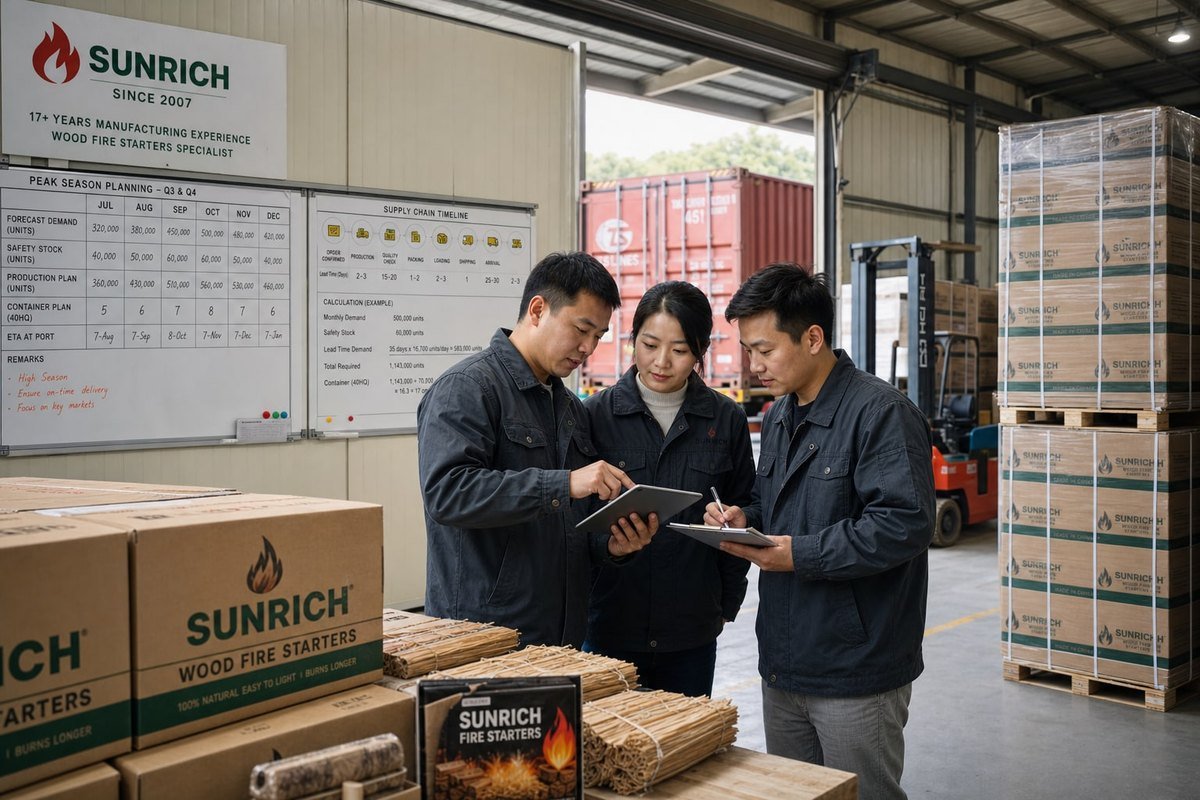
The honest trade-off looks like this. A full 20-foot container of wood fire starters gives you the best freight economics and locks in your seasonal stock in one move. A trial order — a pallet or a small LCL shipment — costs more per unit but protects you from three expensive mistakes: a product that does not match your market's expectations, packaging that fails retail requirements, and a supplier whose mass production does not match their samples.
Trial order vs. full container comparison
| Factor | Trial order | Full container |
|---|---|---|
| Per-unit landed cost | Higher (LCL freight surcharge) | Lowest possible |
| Risk exposure | Low — small capital commitment | High if quality or demand disappoints |
| Speed to test market | Fast, can validate in one season | Full season commitment upfront |
| Private-label options | Often limited at low MOQ | Full customization economical |
| Best for | New buyers, new SKUs, new markets | Proven products with sales history |
That third risk — sample-versus-production gaps — is the one buyers underestimate most. It is exactly why we run strict batch-to-batch quality control at our facility: the first sample a buyer approves must reliably reflect what a full container delivers. Ask any prospective supplier how they guarantee this, and ask for their ISO 9001 7 and BSCI documentation before you commit serious volume. If the answers are vague, a trial order is not optional. It is essential.
There is also a hybrid path I often recommend, and it fits the seasonal calendar neatly. Place a trial order in spring, when factories have open capacity and can accommodate flexible MOQs. Test sell-through with a soft launch or with your key retail accounts. Then convert to a container order by early July, still inside the safe window for pre-season delivery. This sequence gives you data-backed confidence without sacrificing the season. For wax-impregnated starters specifically, avoid holding stock across more than one full annual cycle; long storage through temperature swings can cause wax to migrate within the fibers, so buy to sell within the season rather than warehousing multi-year inventory.
Conclusion
Late orders mean empty shelves in December — the season's costliest failure. Order by July, buffer your lead times, size stock to real sell-through, and validate suppliers before committing containers.
Footnotes
1. Current official amfori page for the Business Social Compliance Initiative (BSCI) monitoring system. ↩︎
2. WTO customs valuation rules explain why documentation speeds clearance across borders. ↩︎
3. Intertek is a leading testing and inspection body referenced for product compliance documentation. ↩︎
4. Wikipedia article for wood wool (excelsior), the primary material used in these firelighters. ↩︎
5. Background concept explaining how turnover metrics indicate stocking efficiency. ↩︎
6. Explains the wax material used to seal wood fire starters against moisture. ↩︎
7. ISO 9001 certification verifies supplier quality management systems referenced for compliance checks. ↩︎



 English
  Spanish
  German
  French
  Arabic
  Portuguese
Join the Conversation