







Pricing gaps for wood fire starters quietly drain category revenue. On our production line, I see buyers order strong entry SKUs, skip the middle, and lose shoppers to competitors.
Identify pricing gaps for wood fire starters by mapping every SKU by price per unit, pack size, material, and burn performance, then flagging missing rungs between entry, core, and premium tiers, oversized price jumps, near-duplicate price points, and absent use-case coverage across fireplace, BBQ, and camping.
That answer sounds simple. In practice, most SKU matrices hide gaps in plain sight. Let me walk you through how I help buyers find them, tier by tier.
What Price Points Are Missing Between My Entry-Level and Premium Fire Starter SKUs?
A distributor in Poland once sent me his full fire starter lineup for review. He had a $3 pack and a $15 pack. Nothing lived in between, and shoppers noticed.
Most hardware and garden assortments miss the $6–$12 mid-tier: natural firelighters in 30–50 count packs, fatwood sticks in small bundles, and eco-certified wood wool rolls. This bridge tier converts entry-level buyers who want better burn performance but reject premium prices.
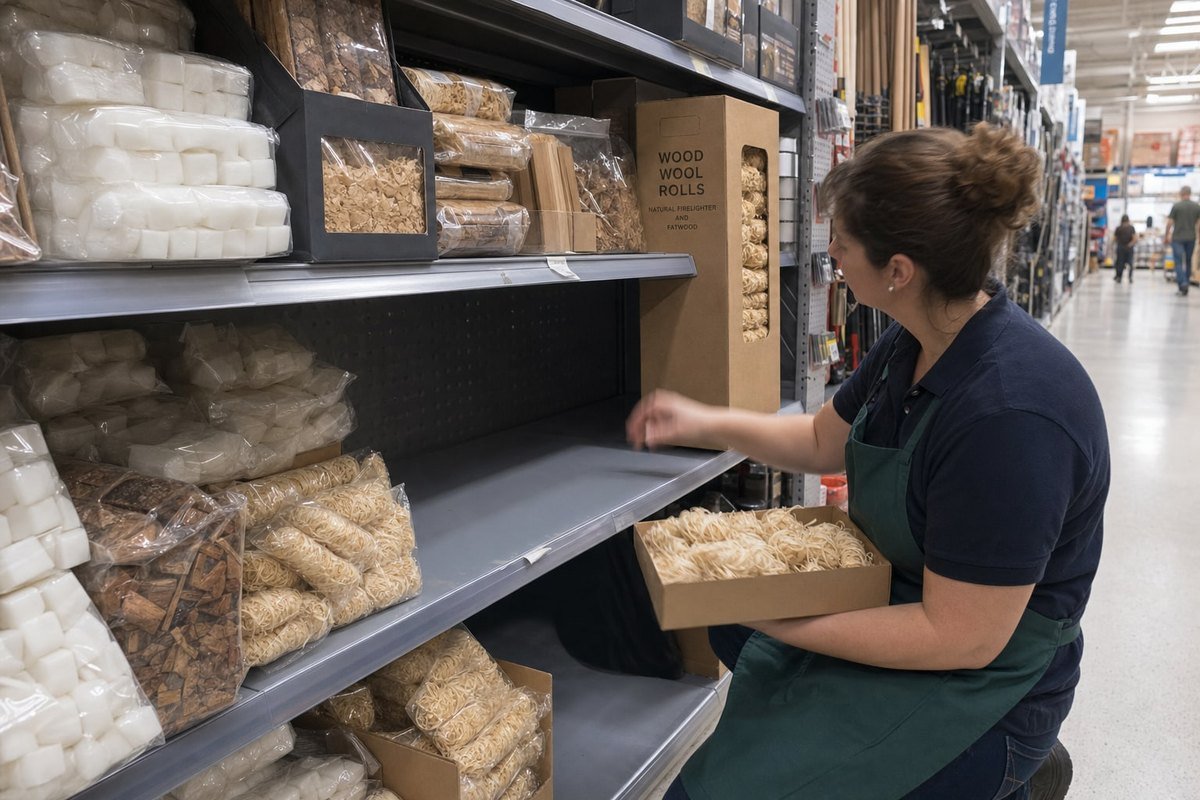
The fastest way to see missing rungs is to lay out your ladder as a table. Price laddering only works when each step gives the shopper a clear reason to trade up. When I review a buyer's category, I plot every SKU by retail price and price per unit. Then I look for two failure patterns. First, big jumps. If your ladder goes from $3.49 to $14.48 with nothing between, you have a dead zone. Second, crowding. Two SKUs within a dollar of each other usually cannibalize instead of adding choice.
A Typical Ladder With Visible Gaps
| Tier | Example SKU | Retail Price | Price Per Unit | Gap Signal |
|---|---|---|---|---|
| Entry | Paraffin cube 20-pack | $3.49 | $0.17 | Anchor SKU, fine |
| Entry | Natural firelighters 32-pack | $3.38 | $0.11 | Too close to the cube pack |
| Missing | Wood wool rolls 1 30–40 pack | $6–$9 | ~$0.20 | No bridge SKU |
| Core | Fatwood natural firestarter | $6.99 | varies | Only one mid option |
| Missing | Certified eco starter 50-pack | $10–$13 | ~$0.22 | Premium step-up absent |
| Premium | Firestarter cubes 20-pack | $14.48 | $0.72 | Big jump, weak justification |
Notice the shape of the problem. The bottom is crowded, and the middle is empty. That is the most common pattern I see in hardware and garden category management. The step-up logic breaks because nothing tells the shopper why $14.48 is worth four times the entry price. A mid-tier natural firelighter with longer burn time fixes the story and lifts blended margin.
Also check use-case coverage, not just price. Indoor fireplace shoppers want low-odor, low-soot starters. BBQ users want fast, reliable ignition. Campers want weather resistance. A gap in any of those jobs is a pricing gap, even if the dollar ladder looks full.
How Do I Benchmark My Wood Fire Starter Pricing Against Competing Hardware & Garden Retailers?
Before we quote any private-label project, my team pulls shelf prices from the buyer's home market. Exporting to 30+ countries taught us that the same wood wool roll sits at very different price points in Germany versus the US.
Benchmark by collecting competitor prices across big-box, garden, and online channels, normalizing every SKU to price per unit and price per burn minute, then comparing your entry-level Key Value Items for parity and your premium SKUs for attribute-based justification.

Competitive benchmarking for fire starters works best when you compare like with like. A 20-piece cube pack at one retailer is not comparable to a 100-piece box at another until you normalize the numbers. So here is the process I recommend to buyers.
A Four-Step Benchmarking Process
- Collect the spread. Pull prices from at least three channel types: big-box hardware, garden centers, and online marketplaces. Marketplaces reveal the widest spread and expose where your shelf assortment is thin.
- Normalize. Convert everything to price per unit. Where you have data, add cost per burn minute. A $0.25 starter that burns ten minutes beats a $0.15 starter that burns four.
- Check your KVIs. Your entry-level 20–32 packs are Key Value Items 2. Shoppers know these prices. You need rough parity here, because these SKUs drive category foot traffic.
- Audit the premium end. Higher-priced SKUs must earn their premium through longer burn, weather resistance, low-odor indoor safety, or eco certification. If they do not, competitors will undercut you.
Real Market Reference Points
| Retailer Channel | Example SKU | Price | What It Tells You |
|---|---|---|---|
| Hardware big-box | Broil King Fire Starters, 20 pc | $3.49 | Entry KVI benchmark |
| Hardware big-box | ZIP Firestarter Cubes, 20-pack | $14.48 | Premium cube ceiling |
| Garden/DIY | Samba Natural Firelighters, 100-pack | $12.50 | Bulk value tier |
| Mass retail | Fatwood, 10 lb box | $24.90 | Bulk fatwood anchor |
| Mass retail | Fatwood, 25 lb box | $49.95 | Oversized tier, mid-pack gap likely |
Read the last two rows carefully. When bulk formats jump from 10 lb to 25 lb, a 15 lb mid-pack is often an open lane. This kind of price point analysis turns raw shelf data into an actionable retail merchandising strategy. Do it twice a year, because seasonal resets shift competitor ladders more than most buyers expect.
Which Margin Opportunities Am I Missing by Not Offering Private-Label Fire Starters at Multiple Tiers?
The trade-off I discuss most often with importers is this: one private-label SKU 3 is easy to manage, but it leaves the trade-up margin on the table. Our OEM line in Ningbo runs three tiers for several European distributors for exactly this reason.
Single-tier private-label programs miss three margin pools: the mid-tier trade-up where natural materials justify 20–30% premiums, the eco-certified top tier with the strongest margin percentage, and grab-and-go convenience packs that carry high per-unit margins on impulse purchases.

Margin analysis across tiers usually surprises buyers. The entry tier moves the most volume but earns the least per unit. The premium tier moves less but funds the category. When you only run one private-label SKU, you capture one margin pool and donate the others to national brands.
Where the Missed Margin Hides
The trade-up tier. Wood wool rolls with natural wax cost more to produce than basic paraffin cubes, but shoppers accept a meaningful step-up for cleaner burn and one-match ignition. Ignition reliability 4 is a non-linear pricing lever. A starter that lights every time can command a disproportionate premium over a utility-grade SKU, and the cost difference at the factory is modest.
The certified eco tier. Clean-burn, non-toxic positioning supports the strongest percentage margins in this category. We hold ISO 9001 5, BSCI, CE, and SGS/Intertek documentation precisely because our buyers use compliance as a shelf-facing value claim, not just an import requirement. An eco-certified private-label starter typically supports a 20–30% premium over standard paraffin formats.
The convenience tier. Small grab-and-go packs near checkouts or grill displays carry high per-unit margins. Most retailers skip them entirely, which is a classic convenience gap.
The safety-positioned indoor tier. Low-odor, low-soot starters for fireplaces and wood stoves justify a premium over high-smoke outdoor utility formats. Pricing them identically wastes the differentiation.
A three-tier private-label program also strengthens SKU rationalization 6. When you own the good-better-best story, you can delist weak national-brand duplicates and simplify the shelf. That is product assortment optimization working for your margin, not against it. In our experience, the first sample must match mass-production quality batch after batch, or the premium tier collapses on returns. That consistency is a manufacturing discipline, not a pricing tactic.
How Can I Use Bulk MOQ Pricing from My Manufacturer to Fill Gaps in My SKU Matrix?
A US buyer once asked us to quote a single 40-foot container of one SKU. I suggested splitting it across three pack formats instead. Same container, same freight, but suddenly his ladder had a bridge tier and a bulk tier.
Use manufacturer MOQ tiers to fill gaps by mixing pack formats within one order: negotiate a combined MOQ across sizes, use falling per-unit costs at volume to fund a new mid-pack SKU, and reserve part of each order for seasonal and trial formats.

Wholesale cost structure is the raw material for a tiered pricing model. Directionally, basic wax and sawdust cubes run around $0.05–$0.08 per unit at very high volumes, wood wool with natural wax runs roughly $0.10–$0.20, and premium eco-certified formats sit above $0.25. Treat those bands as context, not gospel, because landed cost, packaging, and compliance testing shift the math. But the pattern is clear: unit costs fall fast with volume, and that saving can fund an entirely new SKU instead of just a slightly better margin on an existing one.
Turning MOQ Tiers Into Ladder Rungs
| MOQ Strategy | How It Fills a Gap | Practical Note |
|---|---|---|
| Combined MOQ across pack sizes | Adds a 10–12 pack bridge between your 6-pack and 20-pack | Ask if your factory pools volume across formats; we do |
| Volume-funded mid-tier | Lower unit cost pays for a new $8–$10 natural firelighter SKU | Keep retail margin flat, add a rung |
| Split-run private label | One production run, two retail brands or tiers | Different boxes, barcodes, and warning labels per tier |
| Trial-order carve-out | Small quantity of a premium or seasonal format inside a core order | Flexible MOQs de-risk new price points |
Two more levers matter here. First, seasonal inventory planning 7. Fire starter demand spikes in autumn and winter for fireplaces and again in summer for camping and BBQ. Time your bulk orders so the new tier lands before the spike, not during it, because stockouts in peak season hand your new price point to a competitor. Second, packaging architecture. The same wood wool roll can ship as a 6-pack impulse box, a 30-pack core carton, and a 100-piece bulk box. One product, three ladder rungs, one production run. When we build these programs, we handle the display packaging, barcodes, and warning labels in-house so each tier arrives shelf-ready. That is how a gap gets filled without adding sourcing complexity.
Conclusion
Pricing gaps cost you shoppers who wanted to trade up but found no rung. Map your ladder, benchmark by unit value, tier your private label, and let MOQ structure fund the missing SKUs.
Footnotes
1. Explains the material referenced as a mid-tier fire starter product. ↩︎
2. Background concept explaining how retailers benchmark known-price entry SKUs. ↩︎
3. Major sourcing marketplace relevant to private-label manufacturing decisions discussed. ↩︎
4. Fire safety authority relevant to reliable ignition performance claims for fire starters. ↩︎
5. Authoritative Wikipedia entry providing a stable, comprehensive overview of the ISO 9001 standard. ↩︎
6. Defines SKU concept underlying the assortment simplification strategy discussed. ↩︎
7. Business data source supporting seasonal demand patterns cited for fire starters. ↩︎



Join the Conversation