






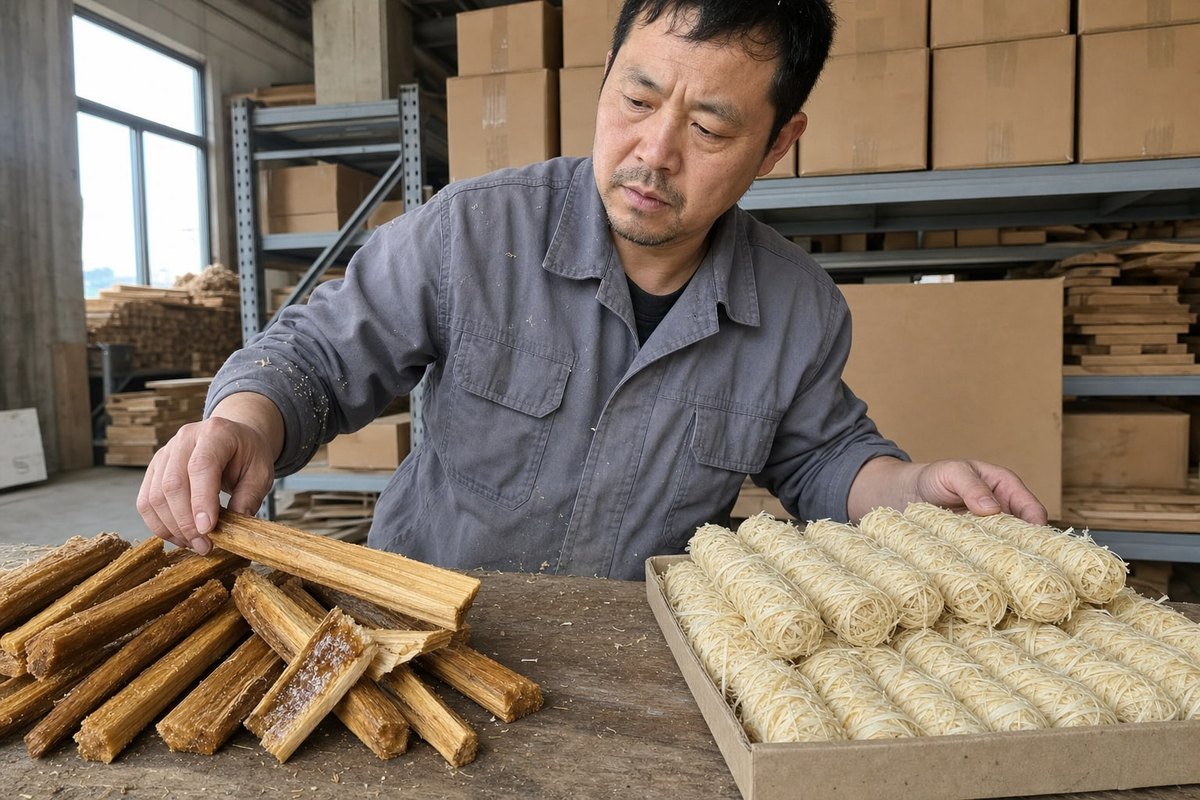
Choosing between fatwood vs compressed wood fiber fire starters stalls many buyers. I have watched importers lose entire seasons debating it, while our production lines in Ningbo kept both options moving to 30+ countries.
Fatwood is natural pine heartwood saturated with resin that ignites fast and burns hot, while compressed wood fiber fire starters are manufactured from wood wool or sawdust bound with paraffin wax for a steadier, more predictable 8–12 minute burn.
Both products light fires. But they behave very differently. Let me walk you through the real differences, and what they mean for your product line.
How do fatwood and compressed wood fiber fire starters actually compare in burn time and performance?
During a burn-test session at our factory last year, we ran wax-dipped wood rolls against resin-rich fatwood sticks side by side. The difference in flame behavior surprised even our senior QC team.
Fatwood ignites quickly and burns hotter with an intense flame driven by natural pine resin, while compressed wood fiber starters deliver a controlled, consistent burn of roughly 8–12 minutes, giving kindling and logs more time to catch reliably.
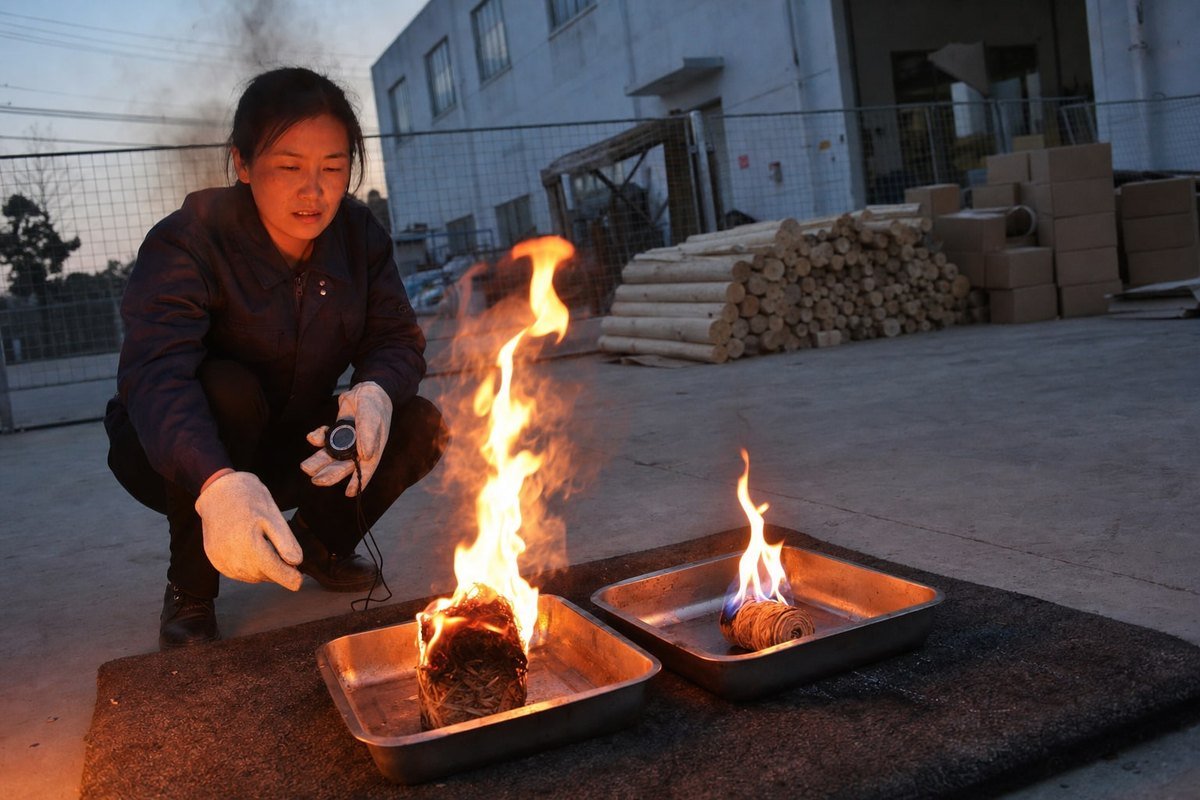
The core difference comes down to fuel chemistry. Fatwood relies on concentrated pine resin inside the heartwood. That resin has a high terpene content 1, so it flashes into a hot, vigorous flame almost instantly. Compressed wood fiber starters work differently. They use a paraffin wax binder 2 wrapped around shredded wood wool. The wax melts slowly and feeds the flame at a steady rate.
Here is how the two compare on the metrics buyers ask us about most:
| Factor | Fatwood | Compressed Wood Fiber |
|---|---|---|
| Ignition speed | Very fast, resin flashes quickly | Fast, wax coating catches easily |
| Average burn time | 3–5 minutes per stick | 8–12 minutes per roll |
| Flame temperature | Hotter, more intense | Moderate, very steady |
| Burn consistency | Varies with resin content | Uniform, batch after batch |
| Moisture resistance | Naturally water-resistant resin | Wax-coated, but core can absorb damp |
| Smoke and soot | Can produce black soot | Cleaner burn with quality wax |
Why burn consistency matters more than peak heat
In our experience, peak flame temperature sells well on packaging. But consistency is what earns repeat orders. Fatwood is a natural product, so resin saturation varies from stick to stick. One piece may roar; another may sputter. Compressed starters are engineered. When we press wood wool and dip it in a controlled paraffin bath, the average burn time stays within a tight window across the whole batch.
Real-world reliability in damp conditions
Fatwood's resin repels water, so it lights even after rain exposure. Waxed wood fiber rolls resist moisture on the surface, but a cracked coating lets damp reach the fiber core. For wet-weather campers, fatwood often wins. For dry indoor fireplaces, the longer, calmer burn of compressed fiber usually performs better. Many survival kits even pair a compressed starter with a ferrocerium rod, because the fluffy wood wool catches sparks easily.
Which option should I choose as a private-label product for my market?
A German distributor once asked us to quote both products for the same fireplace line. We ended up mapping his customer segments together, and the answer became obvious within an hour.
Choose fatwood for outdoor, survival, and premium natural-product positioning; choose compressed wood fiber starters for everyday fireplace, BBQ, and mass-retail markets where consistent burn time, uniform sizing, and stable pricing matter most to end consumers.

The right choice depends on your channel, not on which product is objectively better. We have shipped both types across the US, Germany, the UK, and Australia, and the buying patterns are remarkably consistent.
Match the product to the buyer persona
| Market Segment | Better Fit | Why |
|---|---|---|
| Camping and bushcraft brands | Fatwood | Natural story, works wet, pairs with a ferrocerium rod |
| Fireplace and stove distributors | Compressed fiber | Predictable burn, clean handling, uniform shape |
| BBQ and grilling retailers | Compressed fiber | Non-toxic fumes 3 with food-safe wax, no resin taste transfer |
| Survival and emergency kits | Fatwood | Durable, moisture resistance built into the wood itself |
| Big-box retail (Home Depot-type) | Compressed fiber | Consistent specs, easy compliance documentation, stable supply |
| Gift and festival traders | Either | Depends on packaging concept and price point |
The supply-side reality buyers often miss
Fatwood depends on harvesting resin-rich pine stumps. Supply fluctuates with forestry cycles, and quality varies by region. Compressed wood fiber starters use recycled biomass fiber from mills, so raw material is abundant year-round. For a retailer planning promotions twelve months ahead, that supply stability is a genuine commercial advantage. Our Ningbo lines can scale wax-dipped wood wool rolls quickly because the inputs never bottleneck.
Sustainability stories sell differently
Both products carry a credible eco angle. Fatwood is a byproduct of sustainable forestry 4, recovered from stumps rather than felled trees. Compressed starters repurpose sawdust and shavings that would otherwise be waste. European buyers, especially in Germany and the Netherlands, respond strongly to the recycled-waste narrative. US outdoor brands lean toward the natural heartwood story. Pick the story that matches your shelf.
What certifications and compliance standards should I require from my fatwood or wood fiber supplier?
Compliance paperwork has killed more import deals than pricing ever has. We learned this early in our 17+ years exporting fire products, which is why our factory holds ISO 9001 5, BSCI, CE, and SGS/Intertek certifications as standard.
Require ISO 9001 for quality management, BSCI for social compliance, CE marking for European markets, and third-party test reports from SGS or Intertek verifying burn performance, material composition, and the absence of harmful chemical accelerants before placing any order.

Fire starters sit in a sensitive product category. Customs officials, retailers, and insurers all scrutinize them. A supplier who cannot produce current certificates is a risk you should not carry, no matter how attractive the quote looks.
The four-layer compliance check we recommend
- Factory-level certification. ISO 9001 proves a documented quality system exists. BSCI audits confirm ethical labor practices, which large European retailers now demand contractually.
- Product-level testing. SGS or Intertek 6 reports should confirm material composition. For compressed starters, verify the mix is genuinely wood fiber and paraffin wax, with no petroleum accelerants and no synthetic tackifiers that leave residue in ash.
- Market-entry marks. CE marking 7 matters for EU distribution. Check that warning labels, usage instructions, and language requirements match your destination country.
- Batch-level consistency. Ask how the supplier verifies each production run. At our facility, we burn-test samples from every batch so the average burn time on your packaging stays honest.
Red flags worth walking away from
Be cautious if a supplier refuses to name their wax source, cannot explain their wood fiber origin, or offers only expired test reports. For fatwood, ask about harvesting documentation tied to sustainable forestry practices. For indoor-use products, insist on verification of non-toxic fumes, because a single consumer complaint about odor or air quality can trigger a retailer delisting. Trading companies often cannot answer these questions. A real factory can walk you through the production line, the wax bath, and the QC bench on a video call the same week you ask.
How can I customize packaging and branding for either fire starter type when sourcing from a manufacturer?
One of our longest-standing UK clients started with a 100-piece black retail box and a simple flame graphic. Three years later, that same design anchors a full fireside range across two retail chains.
A capable OEM/ODM manufacturer can customize starter size, burn time, wax formulation, retail box design, display packaging, private-label branding, warning labels in local languages, and barcodes, then optimize carton sizes and logistics for your destination market.

Packaging is where private-label fire starters win or lose at the shelf. The product inside may be excellent, but buyers at retail chains judge the box first. Our one-stop OEM/ODM process was built around this reality.
What can actually be customized
| Customization Area | Compressed Wood Fiber | Fatwood |
|---|---|---|
| Product size and shape | Fully adjustable roll length and diameter | Limited by natural stick dimensions |
| Burn time tuning | Adjustable via wax ratio and fiber density | Fixed by natural terpene content |
| Piece count per pack | Flexible (20, 50, 100 pcs common) | Flexible, usually by weight |
| Retail packaging | Boxes, kraft bags, jars, display trays | Boxes, crates, bundled with twine |
| Branding | Full private label, custom artwork | Full private label, custom artwork |
| Compliance elements | Warning labels, barcodes, language variants | Warning labels, barcodes, language variants |
Notice the difference in the first two rows. Compressed wood fiber is an engineered product, so we can tune it. If your market wants a 10-minute burn instead of 8, we adjust the paraffin wax binder ratio and fiber compression. Fatwood is what nature made it. You can sort it by grade and cut it to length, but you cannot change its chemistry. One storage note we always share: keep fatwood in sealed packaging, because its volatile terpenes slowly evaporate in open air and reduce ignition performance over years.
A practical development timeline
A typical private-label project with us runs in four steps. First, we align on specs: size, burn time, piece count, and packaging concept. Second, we produce samples, and because our batch controls are strict, the first sample genuinely reflects mass production. Third, we finalize artwork, warning text, and barcodes for your market. Fourth, we optimize carton dimensions for container loading to cut your freight cost per unit. Flexible MOQs for trial orders let you test the market before committing to full retail volume.
Conclusion
Fatwood is the natural high-heat specialist; compressed wood fiber is the engineered consistency choice. Match the product to your market, demand real certifications, and partner with a factory that customizes both.
Footnotes
1. Explains terpenes, the resin compounds responsible for fatwood's rapid ignition. ↩︎
2. Background on paraffin wax, the binder that governs compressed fiber burn behavior. ↩︎
3. EPA indoor air quality guidance relevant to verifying non-toxic combustion fumes indoors. ↩︎
4. FAO forestry resource supports claim about sustainable harvesting practices for fatwood. ↩︎
5. Authoritative Wikipedia entry providing a comprehensive overview of the ISO 9001 quality management standard. ↩︎
6. Official site of SGS, a leading third-party inspection and testing firm mentioned. ↩︎
7. Background on CE marking requirement for European market compliance. ↩︎



Join the Conversation