






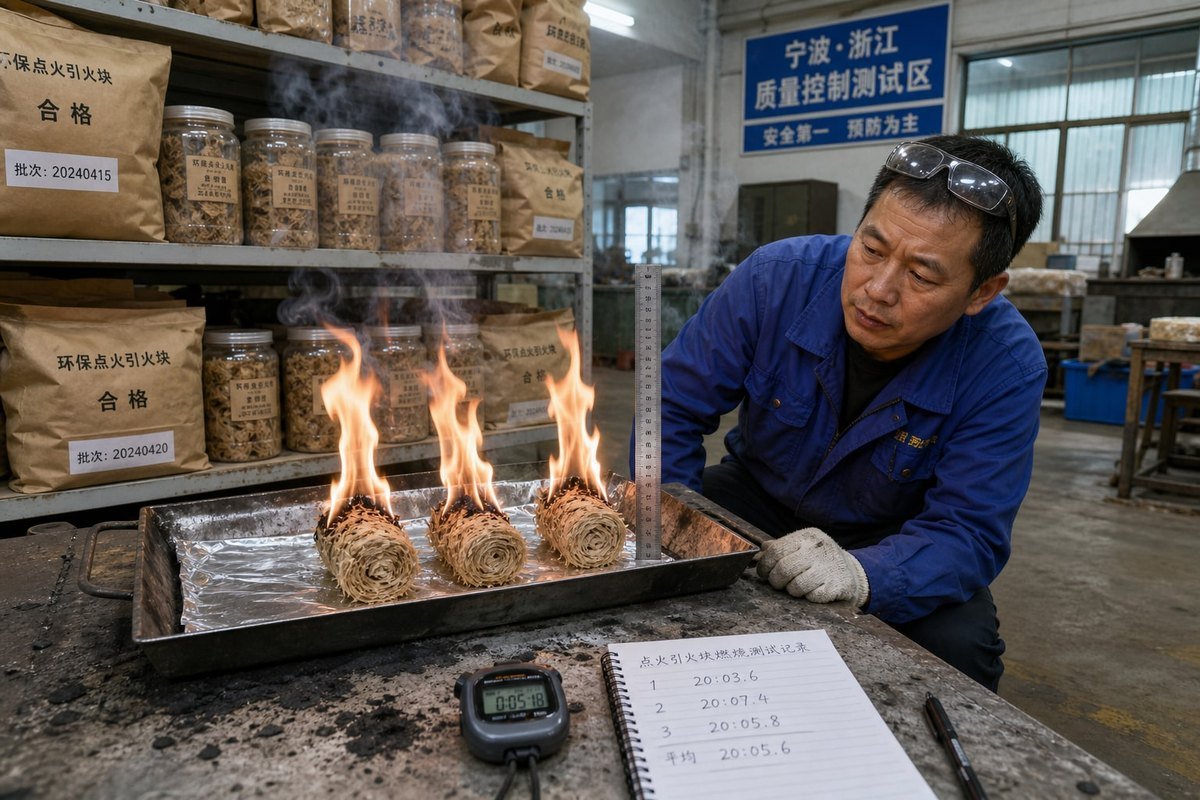
Testing wood fire starter samples properly is where most buyers stumble. I have watched importers [approve samples by eye alone](https://sunrichfire.com/how-request-evaluate-wood-fire-starter-samples-suppliers/), then face returns when bulk goods burned inconsistently. On our production line, we test differently.
To test wood fire starter samples, run a controlled bench burn measuring ignition speed, burn time duration, flame height consistency, smoke, and residue across at least three replicates. Then run a kindling-transfer test, verify non-toxic chemical composition through SGS or Intertek reports, and compare batches statistically.
That is the short answer. Now let me walk you through the full testing framework, step by step, the same way we validate every batch before it leaves our factory.
What burning performance metrics should I check before approving a wood fire starter sample?
During a QC session last year, our team burned forty wood wool firelighters 1 side by side to calibrate a new wax-dipping line. That exercise taught us which numbers actually predict field performance.
Check five core metrics: ignition speed from a single match, total burn time duration of 8–12 minutes minimum, flame height consistency, heat transfer to kindling, and residue and ash production. A starter that scores well on all five will perform reliably in real fireplaces and fire pits.
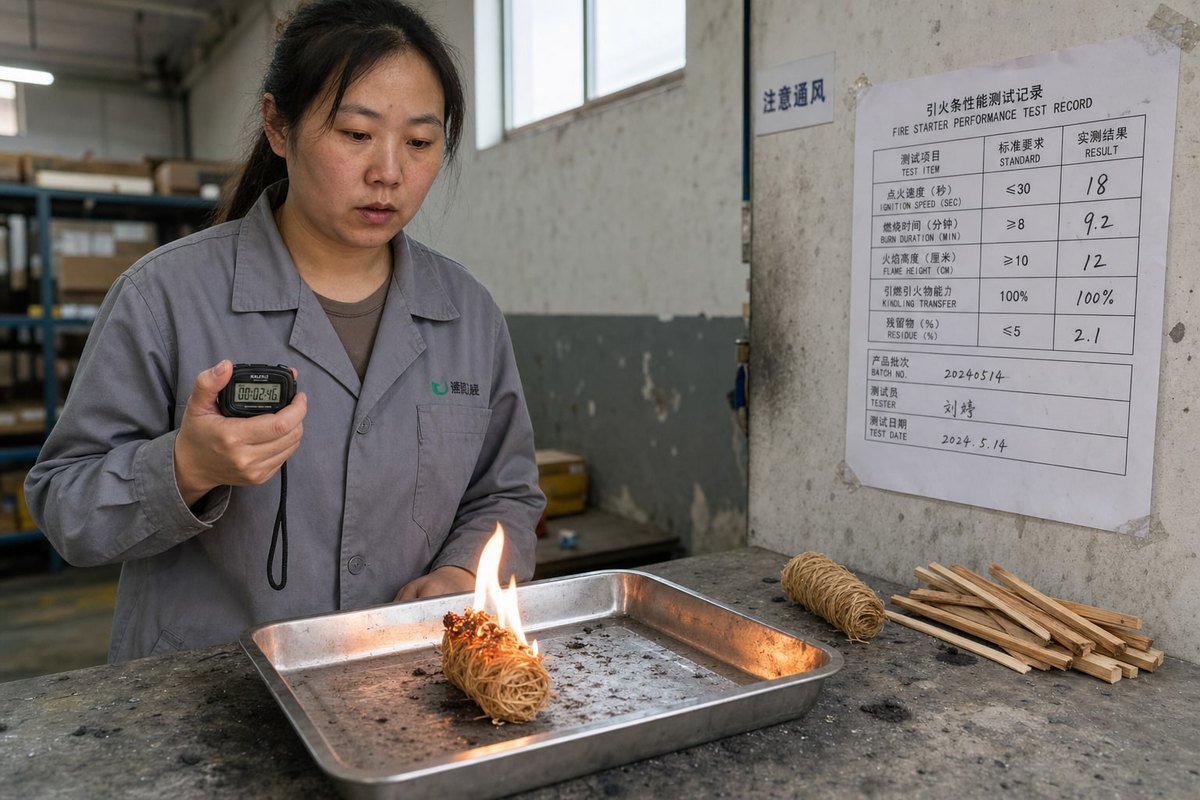
Visual impressions lie. A sample can flare dramatically for two minutes and still fail to light a single piece of oak. So we measure instead of guessing. Here are the metrics we track on every sample burn at our facility, and what each one tells you.
The five metrics that matter
| Metric | How to Measure | Acceptable Range |
|---|---|---|
| Ignition speed | Time from match contact to self-sustaining flame | Under 10 seconds |
| Burn time duration | Total minutes of active flame | 8–12+ minutes |
| Flame height consistency | Peak and average flame height over the burn | Steady, no violent flaring |
| Kindling transfer | Time until kindling holds its own flame | Under 4 minutes |
| Residue and ash production | Weight and character of leftover material | Fine ash, no sticky tar |
Ignition speed matters first. A quality wax-dipped wood roll 2 should catch from one match, at the frayed fiber end, without prodding. If you need three attempts, the wax coating is too thick or the wood wool is too dense.
Burn time duration is the second gatekeeper. Hardwoods need sustained heat to reach their gasification point. In our experience, anything under eight minutes forces the user to add a second starter, which doubles their cost per fire. We tune our wax-to-wool ratio specifically to hit a stable burn window.
Flame height consistency is a proxy for formulation quality. A starter that surges and dies is usually unevenly coated. Watch the middle third of the burn. That is where cheap samples fall apart.
Finally, weigh the residue. Excessive char or unburned wax means wasted material. Good starters leave almost nothing behind.
Which safety and compliance tests confirm my supplier's fire starters are free of harmful chemicals?
A German distributor once asked us a blunt question before signing: "Can I burn this in my own living room?" That question is exactly the right standard, and it is why we build every formulation around eco-friendly materials from the start.
Request third-party lab reports from SGS or Intertek confirming non-toxic chemical composition, no petroleum accelerants, and no heavy metals in the ash. Then verify smoke opacity visually, check for burning drips, and confirm the supplier holds ISO 9001, BSCI, and CE certification.
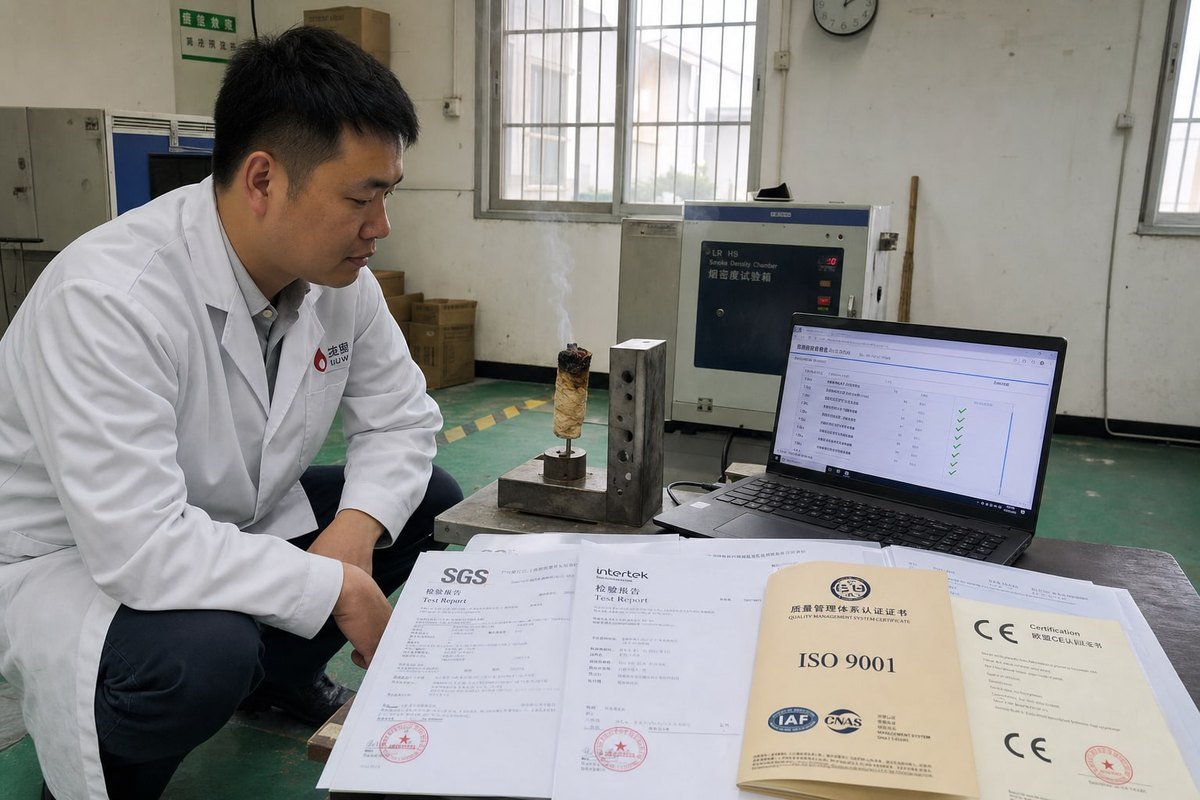
Safety testing splits into two layers: what you can observe yourself, and what only a lab can confirm. You need both. Skipping either one is how contaminated products end up on retail shelves.
Tests you can run yourself
Start with a smoke opacity check. Burn the sample in still air and watch the smoke color. Clean wood wool and food-grade paraffin 3 produce thin, pale smoke. Thick black soot signals petroleum-based accelerants 4 or synthetic binders. That matters enormously for indoor air quality safety, because your end customers will use these in fireplaces and wood stoves.
Next, watch for dripping. Wax-based starters should soften, not shed burning droplets. Drips are a fire-spread hazard on wooden decks and inside stoves.
Then do a post-burn ash inspection. Rub the ash between gloved fingers. Sticky, oily, or oddly colored residue suggests unknown additives. Contaminated ash can taint grill cooking surfaces and degrade catalytic converters in modern high-efficiency stoves.
Tests that require a lab
| Lab Test | What It Detects | Why It Matters |
|---|---|---|
| Chemical composition analysis | Petroleum solvents, formaldehyde, synthetic binders | Indoor use and food-adjacent grilling safety |
| Heavy metal screening | Lead, cadmium, arsenic in ash | Contamination of cooking surfaces and soil |
| Emissions testing | Toxic combustion byproducts | Compliance for EU and US retail channels |
At our factory, every export batch ships with current SGS or Intertek test reports, and our CE marking 5 covers the EU market. In our experience exporting to 30+ countries, major retailers will not even review a fire product without this paper trail. Treat missing reports as a disqualifier, not a negotiation point.
How do I compare burn time and ignition consistency across different sample batches?
Batch-to-batch drift is the silent killer of fire starter programs. Early in our 17+ years, we learned that a single beautiful sample means nothing unless batch two, ten, and fifty match it. That lesson reshaped our entire QC process.
Test at least three replicates from each batch under identical conditions: equal sample mass, same ignition source, controlled airflow, and stable humidity. Record ignition speed and burn time for each, then compare averages and variation. Batches differing by more than 15 percent warrant rejection or investigation.
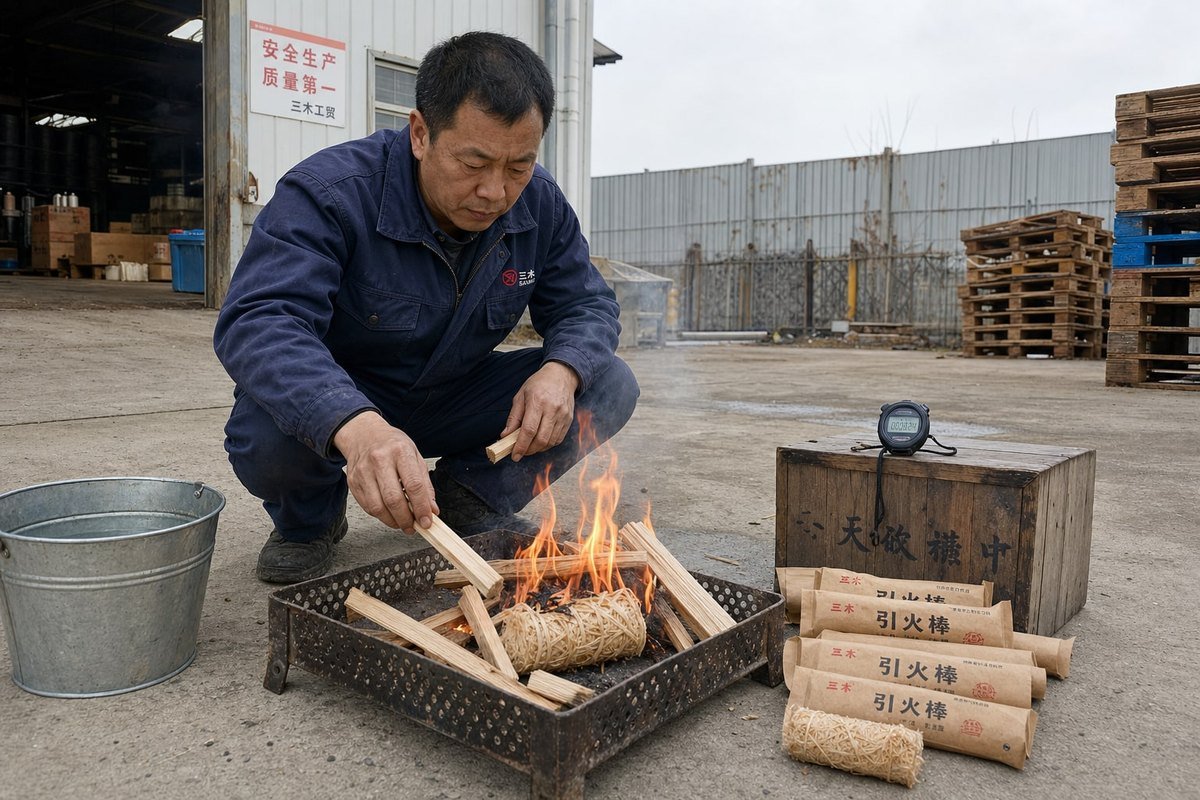
Comparison only works when conditions are fair. Uncontrolled airflow and moisture are the two most common reasons buyer tests become meaningless. So control your variables first, then measure.
Step-by-step batch comparison protocol
- Weigh every sample. Burn time scales with mass, so compare only equal-mass pieces. A few grams of difference distorts results badly.
- Fix the ignition source. Use the same match or lighter type, applied to the same spot, for the same duration, every time.
- Control the environment. Test indoors or in a wind-shielded area. Note ambient temperature and humidity. Damp air slows ignition and shortens burns.
- Run three or more replicates per batch. One burn is an anecdote. Three burns are data.
- Time with the same method. One observer, one stopwatch, consistent definitions of "ignited" and "extinguished."
- Log everything in a simple table. Averages and spreads reveal what single burns hide.
What the numbers should look like
| Result Pattern | What It Means | Action |
|---|---|---|
| Tight cluster, all batches similar | Stable production process | Approve with confidence |
| One batch drifts high or low | Raw material or process change | Ask the supplier what changed |
| Wide scatter within one batch | Poor internal quality control | Reject or demand corrective action |
Moisture deserves special attention. Ask for moisture content analysis 6 data on the wood wool itself, because fiber dryness directly drives ignition reliability. If the samples will face outdoor use, add wind resistance testing: repeat the ignition test with a fan producing light, steady airflow. A good starter still catches; a marginal one exposes itself immediately. For fatwood-style products, note that fatwood resin content varies naturally between logs, so expect slightly wider tolerances there than with engineered wood wool rolls.
What documentation should I request to verify test results before placing a bulk order?
Purchasing managers who visit our Ningbo production site usually leave with a folder, not just samples. That folder is the point. Paperwork is what turns a promising sample into a defensible sourcing decision your compliance team can sign off on.
Request current SGS or Intertek test reports, ISO 9001 and BSCI certificates, CE documentation for EU markets, an MSDS or SDS sheet, batch-level QC burn records, and a written specification sheet covering burn time, dimensions, and materials. All documents should be dated within the last 12–24 months.
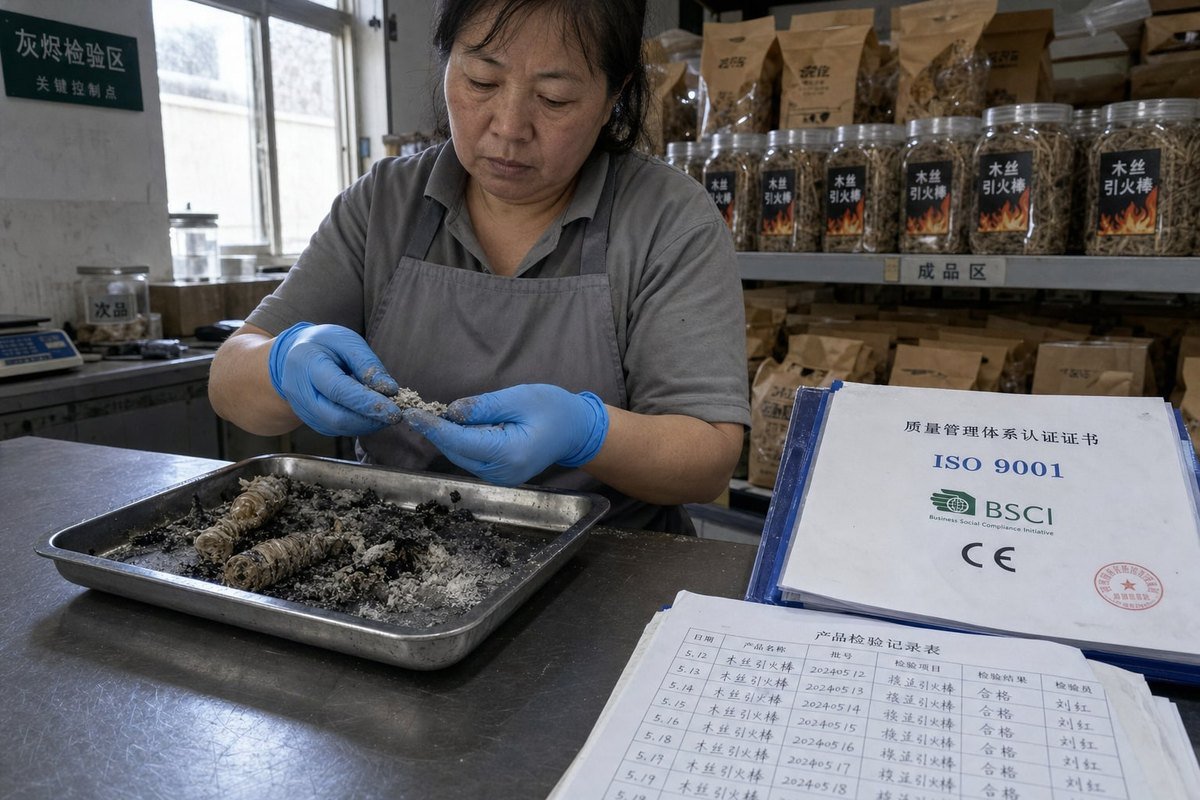
Documents do two jobs. First, they verify that the sample you tested reflects what mass production will deliver. Second, they protect you if a retailer, customs officer, or insurer ever asks questions. Here is how I would prioritize the paper trail.
The essential document checklist
Start with third-party lab reports. These should name the exact product, list the tested parameters, and carry a recent date. A report from three years ago, or one covering a different SKU, tells you nothing about today's batch. When buyers ask us, we issue reports tied to current production, because certification is a hard requirement for our clients, not a marketing decoration.
Second, ask for factory-level certificates. ISO 9001 shows a documented quality system exists. BSCI covers social compliance 7, which large retail sourcing channels increasingly demand. CE marking is non-negotiable for European shelves.
Third, request internal QC records. A serious factory logs ignition speed, burn time duration, and weight tolerances for every production batch. If a supplier cannot show batch records, their "consistency" is hope, not process. Our own batch logs are what let us promise that the first sample reliably reflects mass-production quality.
Fourth, get a signed specification sheet. It should define dimensions, weight, wax type, wood fiber source, minimum burn time, and packaging details. This document becomes your quality benchmark for inspecting bulk shipments.
Finally, for private-label programs, confirm warning label content, barcode formats, and any market-specific labeling rules in writing before production starts. We handle this as part of our OEM/ODM service, and sorting it early prevents costly relabeling at the port.
Conclusion
Untested samples become expensive mistakes. Test wood fire starter samples with controlled burns, replicated batches, and verified lab documentation, and your bulk order will perform exactly as promised.
Footnotes
1. Wikipedia entry for wood wool, the primary material in these fire starters. ↩︎
2. Wikipedia overview of firelighters, explaining their function and common compositions. ↩︎
3. FDA regulation confirming the safety standards for petroleum wax used in food-contact applications. ↩︎
4. Intertek's testing services for identifying accelerants and hazardous chemicals in consumer products. ↩︎
5. Official European Commission page explaining the legal requirements for products bearing the CE mark. ↩︎
6. Academic guide on measuring wood moisture content and its impact on material performance. ↩︎
7. Official amfori page detailing the BSCI framework for monitoring social performance in global supply chains. ↩︎


 English
  Spanish
  German
  French
  Arabic
  Portuguese
Join the Conversation