







Fireplace colored pine cones look simple, but our production line taught us otherwise. One bad batch — wrong colorant ratio, damp cones — can wreck a whole holiday season. So should you dual-source?
Yes, develop a second supplier for fireplace colored pine cones if you sell at seasonal scale, run private-label programs, or face stockout risk — but only if you can standardize specifications, verify certifications, and test both sources. Without strict quality control standards, a second supplier adds variation, not protection.
The answer depends on your volume, your channels, and your current supplier's transparency. Let me walk you through the real risks, the evaluation process, and a practical way to split orders.
What risks am I actually exposed to with only one fireplace pine cone supplier?
A German distributor once told me his previous vendor simply stopped answering emails in October. His shelves went empty by Thanksgiving. That conversation shaped how we think about vendor redundancy in our own supply agreements.
With a single supplier, you carry five stacked risks: supply continuity failures during seasonal peaks, quality drift in flame colorant chemicals and drying, safety and compliance gaps, reputation damage from one bad batch, and zero pricing leverage. Colored pine cones concentrate all five because they are chemistry-dependent, not a commodity.
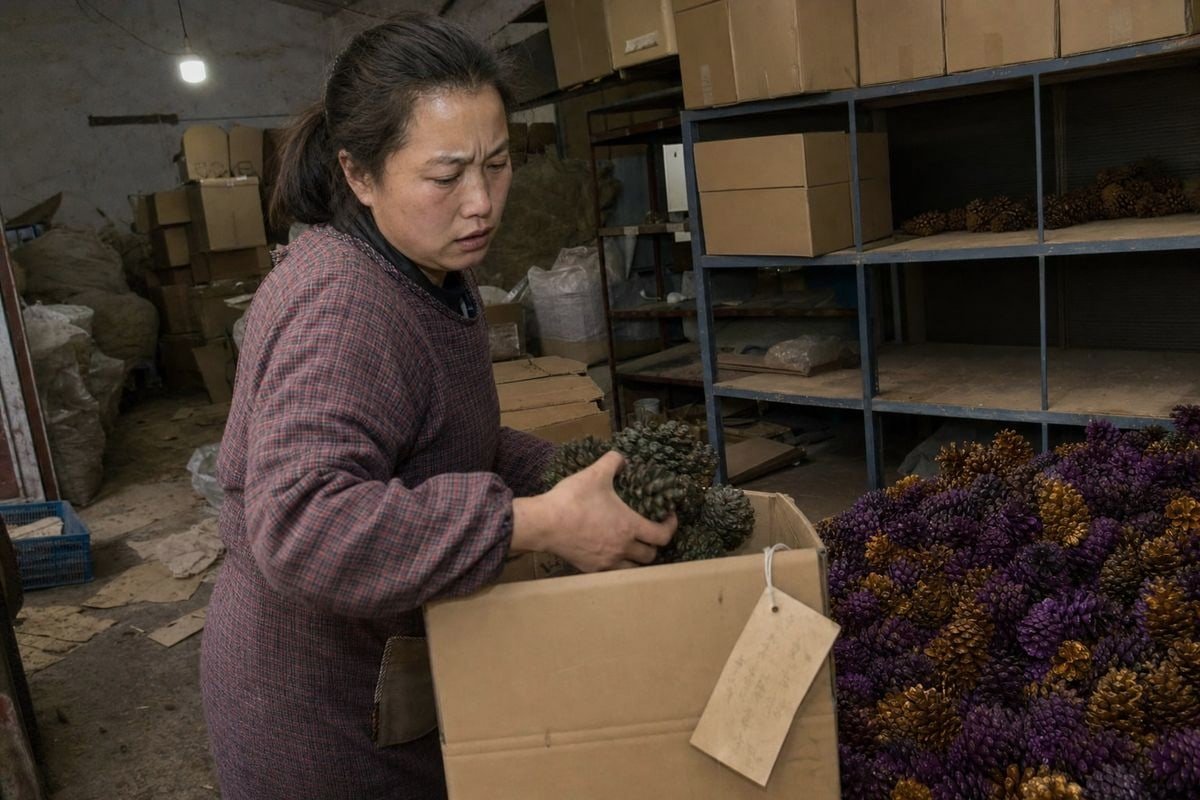
Colored pine cones are not plain firewood. The flame color comes from mineral salt treatment 1 — the cones are soaked or coated, then dried under controlled conditions. That process is where risk hides. If your one supplier changes their formulation, skips a drying cycle, or sources damp cones during a wet harvest, you may not find out until customer reviews start mentioning excessive smoke, weak color, or residue in fireplaces.
The five risk categories, ranked
| Risk category | What triggers it | Business impact |
|---|---|---|
| Supply continuity | Port delays, labor issues, vendor outages, regional cone shortages | Inventory stockouts during Q4 peak |
| Quality drift | Inconsistent chemical concentration, poor drying, cone size variation | Weak flame color, smoke complaints, returns |
| Safety and compliance | Missing SDS, wrong warning labels, non-compliant colorants safety data sheet 2 | Marketplace delisting, legal liability |
| Reputation | One contaminated or under-dried batch reaching customers | Review damage that outlasts the season |
| Commercial leverage | No alternative quote to negotiate against | Rising MOQs and prices with no recourse |
Why seasonality multiplies everything
Fireplace pine cones are wholesale seasonal decor. Roughly 70–80% of annual demand lands in a short Q4 window for most of our buyers. A single-source failure in September cannot be fixed by January — the season is simply gone. There is also a biological angle: pine cone harvests fluctuate regionally, and a poor harvest year in your supplier's sourcing area can tighten raw material availability exactly when you need surge capacity. Geographic separation between suppliers hedges that. A serious procurement risk assessment 3 should treat your current supplier as a potential single point of failure 4 for quality, safety, and continuity all at once — not just as a capacity question.
How do I evaluate a second supplier's certifications and quality before switching production over?
The hardest trade-off we weigh when onboarding a new colorant formulation is speed versus verification. Our factory in Ningbo runs every candidate batch through burn testing before it ships, because paperwork alone never caught a moisture problem.
Evaluate a second supplier in four stages: verify certifications (ISO 9001, BSCI, SGS or Intertek test reports) with the issuing body, request full material specifications and safety documentation, burn-test samples for color, smoke, odor, and residue, then audit consistency across at least three separate production batches.

Certificates are the entry ticket, not the finish line. In our experience exporting to the US and Europe, buyers who skip verification get burned by two things: expired or borrowed certificates, and samples that do not match mass production. Your supplier evaluation criteria need to test both the documents and the physical product.
Stage 1: Documentation you should demand
Ask for ISO 9001 5 for quality management, BSCI for social compliance, and third-party test reports 6 from labs like SGS or Intertek covering the finished product. Then verify certificate numbers directly with the issuer. A factory with genuine compliance will hand these over within a day. A trading company posing as a factory will stall, and that hesitation tells you everything. Also request the chemical specification for the flame colorant chemicals used. Reputable makers use eco-friendly mineral salts; you must confirm the formulation avoids compounds like permanganates, nitrates, and chlorates, which can produce harmful byproducts when burned.
Stage 2: Physical sample testing
Burn samples yourself, in the actual appliance type your customers use. Score each lot on a simple sheet:
| Test point | Pass standard | Common failure |
|---|---|---|
| Flame color | Vivid, sustained color for stated burn time | Color fades after 2–3 minutes |
| Smoke output | Minimal, no acrid odor | Excess smoke from under-dried cones |
| Moisture content | Fully dried, consistent weight per cone | Damp cones that sputter or won't ignite |
| Residue | Normal ash only | Sticky residue or staining |
| Labeling | Correct warnings, gas-fireplace exclusion, not-for-cooking notice | Missing or vague safety language |
Stage 3: Batch-to-batch consistency
One good sample proves nothing. When we set up production for a new private-label client, we validate three consecutive batches against the approved sample before green-lighting volume. Ask your candidate supplier to do the same, and compare lots side by side. Consistency is the whole game with this product.
Will adding a backup supplier delay my lead times or complicate my private-label packaging?
Early in our OEM work, a UK fireplace brand asked us to match packaging their previous vendor had produced — burlap sacks, kraft pouches, the works. We learned then that packaging continuity, not production speed, is where dual sourcing usually stumbles.
A second supplier will not delay lead times if you qualify them before peak season and hold shared packaging specifications. The real complication is private-label consistency — dielines, print colors, warning labels, and barcodes must be centrally controlled so both suppliers produce identical shelf-ready units.

Let's separate the two concerns, because they behave differently.
Lead times: the timing question
Lead time variability actually drops with two qualified suppliers, not rises. If one factory hits a bottleneck — a port strike, a raw material delay, a wet cone harvest — you shift volume instead of waiting. The delays people fear come from qualifying a supplier during peak season. Onboarding, sample approval, and packaging setup take eight to twelve weeks done properly. Do it in spring, when factories have capacity, and your Q4 bulk sourcing logistics get smoother, not slower. We tell our own clients to lock second-source validation by June for a Christmas program.
Packaging: the real work
Private-label packaging across two suppliers only works if you own the specification, not the suppliers. That means:
- You control the master dieline files, Pantone references, and artwork — and issue identical files to both factories.
- Warning labels, usage instructions (including the gas-fireplace exclusion and not-for-cooking notice), and barcodes are your documents, version-controlled by you.
- Both suppliers produce a pre-production packaging sample that you approve against a physical golden sample.
- Inner packaging — drawstring burlap sacks, resealable kraft stand-up pouches, jars — must match in material weight and print method, not just appearance.
Our one-stop OEM setup handles custom boxes, display packaging, warning labels, and barcodes in-house, and that is exactly why we push buyers to keep a master spec file on their side too. If your artwork lives only in one supplier's system, you are single-sourced on branding even if you dual-source the product. One more practical note: moisture protection in transit matters as much as the packaging graphics. Both suppliers should use the same humidity-barrier standard, because a beautifully printed pouch full of damp cones is still a failed shipment.
What's the smartest way to split orders between two suppliers without raising my costs?
A Canadian buyer once asked me why his backup supplier ignored his emergency order in November. The answer was blunt: he had given them one trial order in two years. That lesson defines how we advise clients on order allocation.
Split orders roughly 70/30 or 60/40, giving your secondary supplier 20–40% of annual spend year-round. This keeps both factories invested, preserves pricing leverage, and guarantees the backup will prioritize you during peak season. A dormant backup supplier is not a backup at all.

Supply chain diversification 7 only works if both suppliers treat you as a real customer. Here is how to structure it without inflating costs.
The allocation math
| Split model | How it works | Best for |
|---|---|---|
| 70/30 anchor split | Primary gets core volume; secondary gets steady 30% | Established programs with proven primary |
| 60/40 competitive split | Near-equal volume keeps both sharp on price and lead time | High-volume, multi-channel sellers |
| Seasonal surge split | Secondary absorbs Q4 overflow only, plus small off-season orders | Buyers with extreme holiday concentration |
| SKU split | One supplier per product line (fireplace vs campfire packaging) | Brands with distinct channel packaging |
Keeping costs flat
Splitting volume can raise per-unit cost if you fall below MOQ tiers at both factories. Three ways around that. First, negotiate annual volume commitments rather than per-order pricing, so both suppliers quote economies of scale 8 against your total yearly spend. Second, consolidate shipments — combine colored pine cones with related lines like color-flame packets or wax firestarters into shared containers to keep freight efficient. Third, use the competitive quote from each supplier as leverage with the other. Buyers with two active sources consistently negotiate better than single-sourced buyers, and that saving typically offsets the modest cost of dual testing and audits.
Guarding against variation
The strongest argument against dual sourcing is real: two chemical treatment processes can mean two flame colors, two burn times, two smoke profiles. Resolve it by holding both suppliers to one written specification — colorant type, moisture threshold, cone size range, burn duration — and burn-testing every batch against your golden sample. If a supplier cannot hit the spec, they are not a second source; they are a second problem. Standardization is what converts redundancy from a liability into insurance.
Conclusion
One supplier means one point of failure for a chemistry-dependent, safety-sensitive, seasonal product. That gamble rarely pays off when a single bad batch can erase a season.
Our position after 17+ years of making color-flame products is clear: develop a second supplier for fireplace colored pine cones if you sell at scale, run private-label programs, or depend on the Q4 window — but do it right. Verify certifications and test reports, burn-test multiple batches, own your packaging specifications centrally, and give your secondary source a real 20–40% share of spend. Dual sourcing without standardization creates variation; dual sourcing with strict quality control standards creates resilience. If your current supplier is opaque about their chemicals, drying process, or labeling, that alone is your answer. Start qualifying your second source in the off-season, and you will enter next winter with leverage, continuity, and a brand your retail partners can trust.
Footnotes
1. EPA safer chemical guidance relevant to eco-friendly mineral salts used in colorant formulations. ↩︎
2. SDS documentation is referenced as required safety paperwork suppliers must provide. ↩︎
3. Background concept for evaluating vendor risk across continuity, quality, and compliance categories. ↩︎
4. Core risk management concept directly discussed regarding relying on one supplier. ↩︎
5. Authoritative Wikipedia overview of the international quality management standard, avoiding 403 errors on the official site. ↩︎
6. SGS is named as a third-party testing lab used to verify supplier product compliance. ↩︎
7. Background concept explaining why dual sourcing reduces single-point-of-failure risk. ↩︎
<span id="footnote



 English
  Spanish
  German
  French
  Arabic
  Portuguese
Join the Conversation