







Assessing a supplier's production capacity 1 for colored pine cones is where most bulk orders go wrong. On our production line, we've seen buyers burned by suppliers who overpromised and missed Christmas.
To assess a supplier's production capacity for colored pine cones, verify certifications, request 8–12 weeks of real production records, identify the bottleneck step in good pieces per day, confirm raw cone inventory, review defect rates, and run a pilot order before committing to bulk volume.
Stated capacity and demonstrated capacity are two different things. In this guide, I will walk you through how to tell them apart, step by step.
What certifications should I check to confirm a supplier's production quality is reliable?
Last spring, a German distributor asked us for our full audit file before even discussing price. That request was smart. Certifications are the fastest first filter for quality control standards.
Check for ISO 9001 for quality management, BSCI for social compliance, CE marking for European market access, and third-party test reports from SGS or Intertek. For colored or color-flame pine cones, also verify non-toxic, REACH-compliant pigments and chemical safety documentation.

Certificates are not decoration. They tell you whether a factory has documented processes, or whether it improvises batch by batch. In our 17-plus years exporting fire-themed products to more than 30 countries, we have never seen a serious retail buyer 2 waive compliance. It is a hard requirement, not a nice-to-have.
The core documents to request
Ask for the actual certificates, not screenshots. Then verify the certificate numbers with the issuing body. A surprising number of "certified" trading companies borrow paperwork from the real factory behind them.
| Certification / Report | What It Proves | Why It Matters for Colored Pine Cones |
|---|---|---|
| ISO 9001 | Documented quality management system | Consistent coloring, drying, and inspection processes |
| BSCI | Ethical labor and working conditions | Required by most EU and US retail chains |
| CE marking | European product safety conformity | Mandatory for many decorative and fire-related goods in the EU |
| SGS / Intertek test reports | Independent lab verification | Confirms non-toxic, lead-free, REACH-compliant pigments |
Go beyond the paper
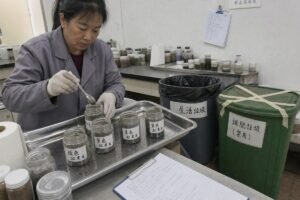
A certificate proves a system existed on audit day. You also need evidence the system runs daily. Ask how often internal audits 3 happen, who signs off on each batch, and whether test reports are renewed for new pigment lots. When we develop a new color-flame formula at our Ningbo facility, we send it for fresh third-party testing before it ever ships. Any supplier with genuine manufacturing depth should describe a similar routine without hesitation. If the answers are vague, the paperwork is probably the whole story.
How can I verify a factory can consistently deliver batch-to-batch quality for large orders?
There is a trade-off we weigh constantly on our own lines: run faster and risk color drift, or hold the pace and protect consistency. How a supplier answers that question tells you everything.
Verify batch-to-batch consistency by requesting 8–12 weeks of native production records, reviewing defect and rework rates per batch, comparing retained samples against fresh output, checking documented factory inspection protocols, and placing a pilot order to test real-world manufacturing throughput.

Consistency is harder than capacity. Almost any workshop can produce one beautiful sample. Producing pallet after pallet that matches it is a different discipline. Colored pine cones make this harder because you are combining a natural, variable raw material with a coloring process, curing time, and manual packing.
Ask for records, not assurances
Request the last 8–12 weeks of daily production data in its native format. You want daily good output, reject counts, rework counts, and the reasons logged. If a supplier cannot produce these records, they are not tracking them, and untracked processes drift.
The numbers that expose inconsistency
| Metric | What to Look For | Red Flag |
|---|---|---|
| Daily good output | Stable output across weeks | Wild swings between days |
| Defect / scrap rate | Tracked per batch with causes | "We have almost no defects" |
| Rework rate | Documented and declining | Rework not recorded at all |
| On-time delivery % | Verified against past orders | No delivery history available |
| Retained samples | Golden samples kept per batch | No reference samples exist |
Walk the line, then test it
Do a walkthrough, on-site or by live video. Watch where work-in-process 4 piles up. Queues reveal the bottleneck faster than any spreadsheet. Then place a pilot order. On our lines, we tell buyers plainly: the first sample must reflect mass-production quality, and strict batch-to-batch quality control is what makes that promise possible. A pilot run proves whether a supplier's throughput, finish quality, and packing integrity hold under real conditions, not showroom conditions. Some procurement teams skip this step to save time. In our experience, the buyers who skip it pay for it in returned containers.
What questions should I ask about lead times and capacity before placing a bulk pinecone order?
A Canadian buyer once told me his previous supplier quoted "30 days, no problem" in July, then collapsed in October. The lesson stuck with me: lead time estimation without capacity math is just optimism.
Ask about bottleneck capacity in good pieces per day, raw cone inventory in days of supply, normal versus peak-season lead times, shift and labor coverage, changeover time between color runs, and how rush orders and holiday spikes are handled.

Colored pine cones are not a standard factory product. The supply chain starts in a forest, not on a machine line. Raw material availability depends on species, geography, and a harvest window that can be as short as two to four weeks. So your questions must cover both upstream cone supply and downstream conversion capacity.
The bottleneck question comes first
Do not ask "What is your maximum capacity?" Every supplier will give you an inflated number. Ask instead: "Which step is your bottleneck today, and how many good pieces pass through it per day?" For colored cones, the bottleneck is often not the harvest. It is the post-coloring drying and curing stage, which needs floor space, racks or kilns, and time that cannot be compressed without causing mold or damaged finishes.
A practical question set
| Area | Question to Ask | What a Strong Answer Sounds Like |
|---|---|---|
| Raw supply | How many days of raw cone inventory do you hold? | A specific number, plus seasonal buffer stock plans |
| Bottleneck | What limits you from raising output 20–30%? | Names a concrete step, like curing space or sorting labor |
| Lead time | What are normal and peak-season lead times? | Two different numbers, with reasons for the gap |
| Labor | Workers per shift, and coverage during harvest peaks? | Trained seasonal crews already identified |
| Agility | Changeover time between color runs? | Documented cleaning and switch procedure |
| Spikes | How do you handle holiday programs and rush orders? | Reserved capacity terms, not vague promises |
Match answers to your forecast
Then do simple math. Compare the bottleneck's daily good output against your required volume and delivery date, including seasonal demand fluctuations 5 and promotional spikes. If the capacity gap is negative, negotiate reserved capacity in the contract, split the order across production windows, or keep looking. At our factory, we build holiday programs into the schedule months ahead, because production scalability during Q4 is planned in Q2, never improvised in October.
How do I know if a supplier can support custom packaging and private labeling at scale?
When we set up our own OEM lines for color-flame pinecones, packaging taught us a humbling lesson: printing a logo is easy, but shelf-ready packaging at volume is a second production line with its own bottlenecks.
Confirm the supplier offers in-house design support, multiple packaging formats, private-label printing with barcodes and warning labels, retail-compliant materials, and documented packing throughput. Ask for past private-label examples and verify packaging capacity separately from production capacity.

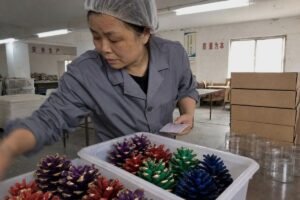
Packaging is where niche natural products often stall. Pine cones are delicate and irregular. They usually need manual packing, protective inserts, and moisture control. If a supplier's packing station handles fewer units per day than the coloring line produces, packaging becomes your real capacity ceiling, and your bulk order fulfillment schedule slips even though "production" finished on time.
What true one-stop OEM/ODM looks like
In our own program, buyers can customize the product itself, the burn time 6 for color-flame cones, and the full packaging system: kraft stand-up pouches with clear windows, drawstring burlap sacks, jars, retail display boxes, private-label branding, warning labels 7, and barcodes. That range matters because different markets demand different formats. A camping brand wants a rugged resealable pouch; a home décor retailer wants a giftable box; a fireplace distributor may want a counter display.
Verify packaging capacity like production capacity
Apply the same discipline. Ask how many finished, packed, labeled units leave the packing station per day. Ask who prints the packaging, in-house or subcontracted, and what the lead time is for artwork approval, printing plates, and first packaging samples. Request photos or samples of previous private-label projects for other markets. Check that warning labels and compliance text meet your destination country's rules, because a compliant product in non-compliant packaging still gets rejected at retail. Finally, confirm cartonization and logistics support. A supplier with genuine supply chain reliability will optimize carton sizes and container loading for your route, which quietly saves real freight money on every shipment.
Conclusion
Verify certifications, demand real records, find the bottleneck, respect seasonality, and pilot before you commit. That is how you turn colored pine cone sourcing from a gamble into a plan.
Footnotes
1. Defines the core concept of managing production limits to meet demand. ↩︎
2. Describes the role of professional buyers in selecting and vetting suppliers. ↩︎
3. Explains the process of evaluating a company's internal controls and processes. ↩︎
4. Authoritative Wikipedia entry defining work-in-process inventory and its role in manufacturing and supply chain management. ↩︎
5. Authoritative reference explaining the concept of seasonality and its impact on demand and production cycles. ↩︎
6. Authoritative source for fire safety and combustion standards. ↩︎
7. Official US government guidance on mandatory product labeling requirements. ↩︎

 English
  Spanish
  German
  French
  Arabic
  Portuguese
Join the Conversation