






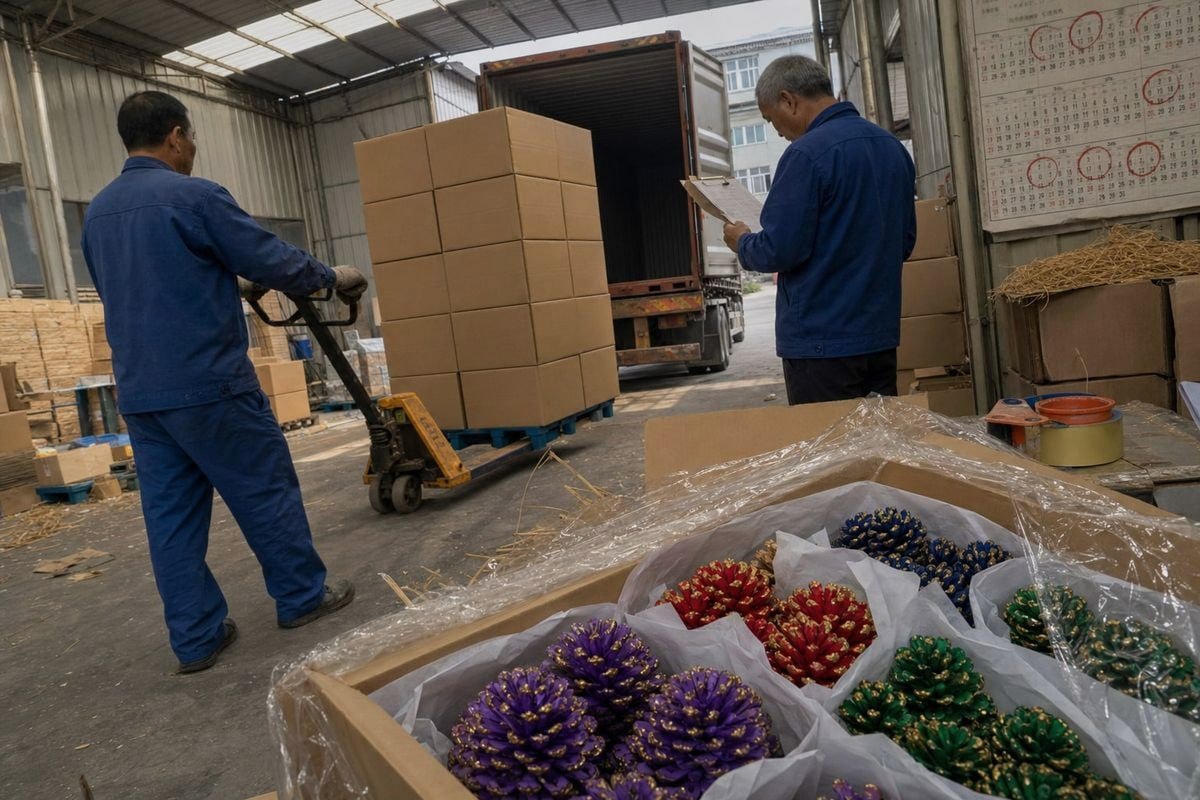
Every autumn, our factory phones ring with panicked buyers who ordered fireplace colored pine cones too late strontium chloride 1. Their shelves sit empty while competitors sell out. Timing, not price, decides who wins this season.
Order fireplace colored pine cones by late June to early August. Production takes 30–45 days, ocean freight adds 30–40 days, so inventory lands by September–October. That timing captures early cold-weather buyers and the full October–December holiday demand peak without stockouts.
That is the short answer. But the details matter. Below, I break down the full timeline, real lead times, stockout prevention, and how to test the product with a low-risk trial order first.
How far in advance should I place my order to hit peak season shelves on time?
A German distributor once asked us to rush a container in early November SGS and Intertek test reports 2. We shipped it, but his goods cleared customs on December 20th. He missed the season entirely. That lesson shaped how we advise every buyer now.
Place your purchase order 4–6 months before your target shelf date. For a September retail launch, confirm orders between April and June. This buffer covers raw cone sourcing, coloring, drying, packaging, ocean freight, customs clearance, and distribution to stores or fulfillment centers.

The key insight is that raw material timing 3 and sales timing are not the same thing. Pine cones fall naturally from September through December in most regions. But your commercial launch must happen earlier than peak fireplace season. If you wait until the holidays to start, you miss the early buyers who stock up as soon as cold weather begins.
Work backward from your launch date
We recommend a backward planning framework. Start from the month you want product on shelves. Then count back through every step of the supply chain logistics.
| Month | Action | Who owns it |
|---|---|---|
| April–June | Confirm PO, lock specs, approve samples | Buyer + factory |
| June–July | Raw cone sourcing, flame colorant chemicals procured | Factory |
| July–August | Coloring, drying, QC, private-label packaging | Factory |
| August–September | Ocean freight 4 and customs clearance | Freight forwarder |
| September–October | Warehouse receiving, listing, early marketing | Buyer |
| October–December | Peak selling window, gift bundles, reorders | Buyer |
Why early procurement also protects margin
Buyers who commit early often get better pricing. Bulk pine cone suppliers and flame colorant chemicals both get more expensive as autumn approaches, because demand rises across the industry. Early POs also get priority slots on our production lines. Late POs queue behind them. In our experience exporting to the US and Europe for 17+ years, the buyers who order in Q2 consistently enjoy smoother seasonal decor lead times than those who order in Q3.
What lead times can I expect from a certified color-flame pinecone manufacturer like Sunrich?
The trade-off we weigh on every order is speed versus consistency. We could rush drying and skip a QC gate to save a week. We never do, because batch-to-batch color consistency is the reason buyers reorder.
Expect 30–45 days production lead time for standard color-flame pinecone orders, and 45–60 days for fully customized private-label programs. Add 30–40 days for ocean freight to the US or Europe. Certified factories with ISO 9001 and BSCI systems keep these timelines predictable.

Lead time is not one number. It is a chain of steps, and each step has its own clock. When we walk buyers through our production line in Ningbo, they are usually surprised by how much time goes into drying and curing alone. Cones must be fully dry and fully open before treatment. Wet or partially closed cones smoke more, burn poorly, and fail QC. There is no shortcut here.
What happens inside the lead time
| Production stage | Typical duration | What can extend it |
|---|---|---|
| Raw cone sourcing and inspection | 5–7 days | Off-season sourcing, species availability |
| Heat treatment and drying | 5–10 days | High humidity, cone moisture content |
| Colorant treatment and soaking | 3–5 days | Custom flame color formulas |
| Post-soak air drying | 3–7 days | Weather; a 48–72 hour minimum is mandatory |
| QC, burn testing, packaging | 7–10 days | Custom boxes, barcodes, warning labels |
| Booking and export documentation | 3–5 days | Peak-season container shortages |
Our formulations use safe, eco-friendly mineral salts rather than hazardous additives. The chemistry behind rainbow fire pinecones is well understood — compounds in the family of copper sulfate 5 for fire produce blue-green tones, while strontium chloride fire color chemistry produces reds. Our advantage is not the chemistry itself. It is the compliance stack around it: CE marking 6, SGS and Intertek test reports, and BSCI-audited production. For US and EU importers, those documents are what actually clear customs and satisfy retail sourcing teams. A cheap uncertified supplier can quote a shorter lead time, then lose you three weeks at port inspection.
Custom programs need more runway
Private-label programs add time for packaging design approval, printed kraft pouches or burlap sacks, display cartons, and label compliance review. Budget two extra weeks for the first custom run. Repeat runs are faster because tooling and artwork already exist.
How do I avoid stockouts during holiday and winter demand spikes?
One lesson we learned the hard way: demand for hearth products does not rise smoothly. It jumps. A UK client saw weekly sales triple within days of the first regional cold snap, and his single pre-season order was gone by late November.
Prevent stockouts by splitting your buy into two orders: a main shipment landing in September and a pre-committed replenishment shipping in October. Set reorder triggers on early-October sell-through data, and reserve factory capacity in advance so the second run starts without delay.

Holiday inventory planning for this category is really demand-curve management. Winter hearth product trends follow weather and gifting calendars, not steady monthly averages. Interest builds in late September, accelerates through October and November, and peaks between Black Friday and mid-December. Then gift-shipping cutoffs slam the door. Any stockout in that window is revenue you never recover, because the customer buys a competitor's product or skips the purchase entirely.
A two-wave ordering strategy
Here is the structure we set up with our repeat wholesale fireplace accessories buyers:
- Wave one (main order): 60–70% of forecast volume, landing in your warehouse by mid-September.
- Capacity reservation: a signed intent for a second run, with our factory holding materials and a production slot.
- Decision gate: review sell-through in the first two weeks of October.
- Wave two (replenishment): confirm final quantity; goods ship by late October and land before December.
This structure works because the expensive, slow part — sourcing raw cones and flame colorant chemicals — is already done for wave two. We pre-buy those inputs in summer. Your risk drops, and your reaction time shrinks from months to weeks.
Match marketing triggers to inventory
Stockouts also happen when marketing outruns supply. Weather-triggered "first frost" ad campaigns and late-September cottagecore and hygge 7 visual content can spike orders overnight. Align those campaigns with confirmed inventory positions, not hopes. If wave two slips, throttle ad spend rather than overselling.
| Risk signal | What it means | Action |
|---|---|---|
| October sell-through above 40% of wave one | Demand outpacing forecast | Confirm wave two at maximum quantity immediately |
| Early cold snap in key markets | Demand spike incoming within days | Activate replenishment and pause deep discounts |
| Container delays at origin port | Wave two timing at risk | Split shipment; air-freight a partial bridge quantity |
| Flat September sales | Season starting late | Hold wave two decision one extra week, boost content marketing |
Can I get a trial order with flexible MOQ before committing to a full peak-season shipment?
A Canadian buyer emailed us last spring, honest about his doubts: he loved the concept but would not gamble a full container on an unproven SKU. We started him with a small mixed trial. He confirmed a full seasonal program eight weeks later.
Yes. Sunrich offers flexible low MOQs for trial orders, so you can test colored pine cones in your market before peak season. Trial batches use the same production line and QC standards as mass production, so the sample accurately predicts full-order quality.

A trial order is not just a smaller purchase. It is a de-risking tool, and timing it correctly matters as much as timing the main order. The right window for a trial is spring to early summer. That gives you time to burn-test the product, photograph it, run a soft listing or a "Christmas in July" early-bird offer to wholesale contacts, and still confirm your full peak-season PO by June or July.
What a well-designed trial should validate
Use the trial to answer commercial questions, not just quality questions:
- Product performance: flame color intensity, burn duration, smoke behavior, and consistency across the batch.
- Compliance fit: review our SGS/Intertek test reports and CE documentation against your market's import requirements before scaling.
- Packaging format: compare formats — kraft stand-up pouches with a clear window, burlap gift sacks, or jarred sets — against your channel. Zero-waste and plastic-free packaging angles resonate strongly with eco-conscious buyers at a September launch.
- Positioning: decide whether you sell it as a fireplace accessory, camping novelty, seasonal décor, or gift bundle. Each has a different shelf date and price point.
- Customer education: confirm your labeling tells buyers these cones are for wood-burning fireplaces, stoves, fire pits, and campfires — not gas fireplaces, where residue can clog components. Getting this warning right in the trial phase prevents returns at scale.
Because our trial batches run on the same lines with the same batch-to-batch controls as full production, the sample you approve in May is the product that ships in August. That continuity is exactly why the trial-then-scale path works. It converts an unknown SKU into a planned program — and it slots neatly into the April–June ordering window I outlined at the start.
Conclusion
Order fireplace colored pine cones by early summer, land inventory by September, split your buy into two waves, and start with a flexible trial. Timing wins the season.
Footnotes
1. PubChem entry for strontium chloride, the chemical compound used to create red flames in fireplace products.



 English
  Spanish
  German
  French
  Arabic
  Portuguese
Join the Conversation