







Sample, packaging, and misc fees in pine cone quotes confuse buyers constantly. I see it weekly when our factory sends quotations, and unexplained line items quietly kill promising deals.
Sample fees in pine cone quotes cover producing and shipping approval samples before mass production. Packaging fees cover inner bags, retail pouches, cartons, and palletizing. Misc fees are a catch-all for smaller costs like labels, barcodes, documentation, or handling that fall outside the base unit price.
Those three lines are where most quote confusion lives. Let me break each one down, then show you how to compare quotes fairly.
How Much Should I Expect to Pay for Pine Cone Product Samples?
Last spring, a German fireplace distributor asked me why our sample invoice listed three separate charges. His previous supplier had quoted "free samples" — then buried the cost elsewhere. That conversation shaped how we quote today.
Expect to pay a modest sample fee covering small-batch production plus courier shipping, typically the largest part of the cost. Most reputable pine cone manufacturers, including us, credit the sample fee back against your first bulk order, so the real long-term cost is often just freight.
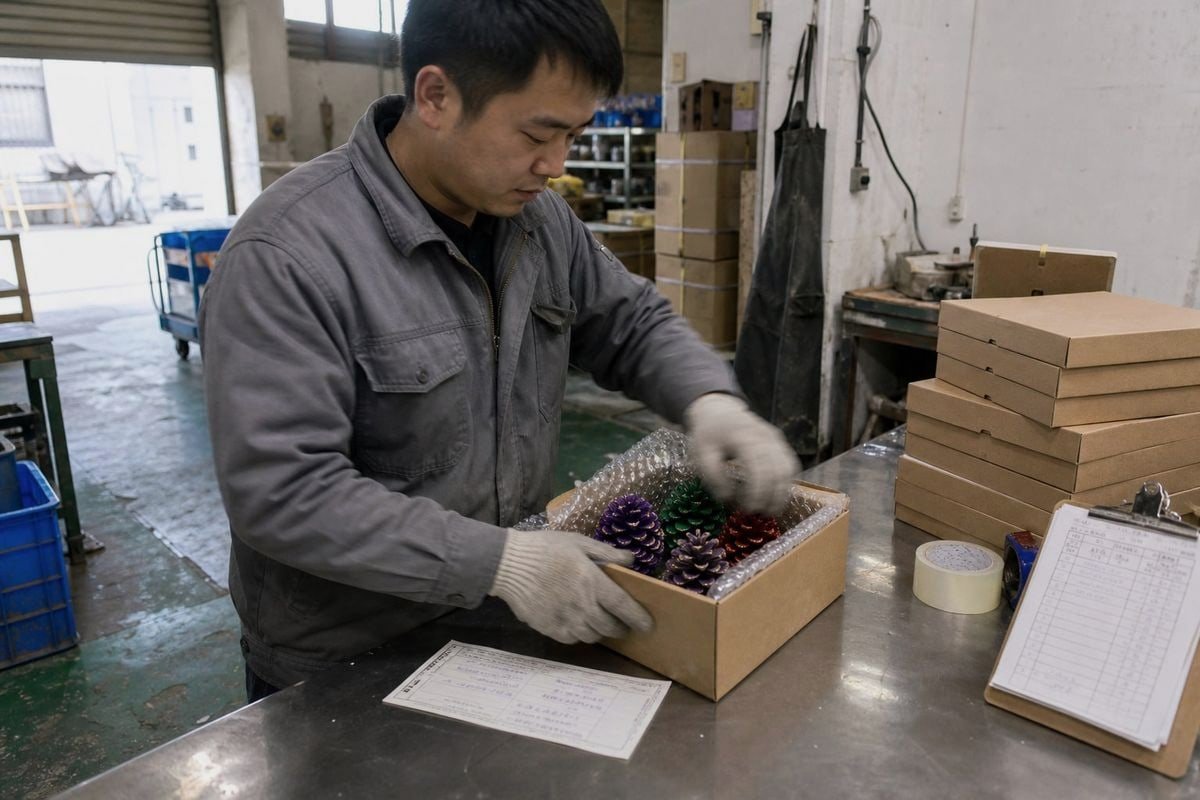
Samples cost more per unit than mass production. That is not the supplier padding the invoice. It reflects real economics. When we prepare color-flame pinecone samples at our Ningbo facility, we run a small hand-finished batch, pull it through the same quality control inspection as a full run, and pack it for international courier. A small run carries the same setup labor as a large one, so the manufacturing overhead per piece is high. This is essentially product prototyping in miniature.
What a Sample Fee Usually Includes
A fair sample charge should bundle three things: the sample units themselves, any custom work such as your requested colors or private-label pouch mockups, and express courier shipping. Courier freight is usually the biggest slice, because a fist-sized pinecone set shipped DHL or FedEx to the US or Europe is not cheap.
Typical Sample Cost Structure
| Cost Component | What It Covers | Often Refundable? |
|---|---|---|
| Sample production | Small-batch coating, drying, QC checks | Yes, credited on bulk order |
| Custom sample work | Custom colors, logo pouch mockups | Sometimes, negotiate upfront |
| Courier shipping | DHL/FedEx/UPS express freight | Rarely refundable |
| Documentation | Test data sheets, spec confirmation | Usually included free |
One more point from experience: a sample from a real factory should predict mass-production quality. Because we control our own production lines and batch-to-batch consistency, the sample you approve is the product you receive. If a supplier's sample looks nothing like their bulk shipment later, the sample fee was the least of your problems.
What Packaging Costs Are Typically Included in a Color-Flame Pine Cone Quote?
There is a trade-off we weigh on every color-flame pinecone order: shelf appeal versus freight efficiency. A beautiful kraft stand-up pouch with a clear window sells better at retail, but it changes carton dimensions, pallet counts, and cost per unit.
A color-flame pine cone quote typically includes inner packaging (burlap sacks, kraft pouches, or jars), retail labeling with warnings and barcodes, master shipping cartons, and palletizing with straps. Custom private-label printing, display boxes, and special inserts are usually quoted as separate line items.
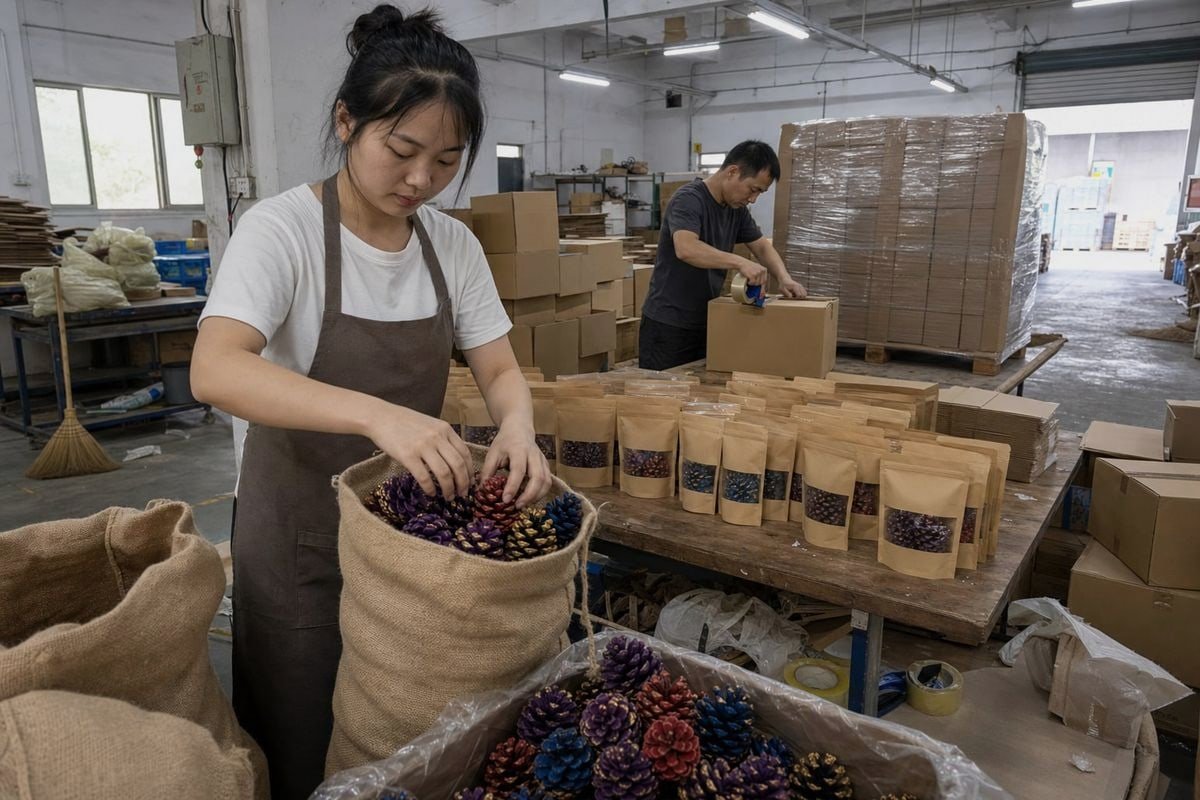
Packaging is never just the box. On our lines, a single order can involve four packaging layers, and each one carries material plus labor cost. Understanding these layers is the fastest way to read a unit price breakdown accurately.
The Four Packaging Layers
- Primary packaging — the consumer-facing unit: a drawstring burlap sack, a resealable kraft pouch with a window, or a plastic jar. This is where private label manufacturing 1 costs live: your logo, your artwork, your language versions.
- Compliance elements — warning labels, usage instructions, barcodes, and country-specific safety text. For fire products shipped to the US and EU, these are non-negotiable. Our CE marking 2 and SGS/Intertek test reports back these labels, and we print them as part of the packaging step.
- Master cartons — corrugated shipping boxes, usually holding 12 to 48 retail units, with shipping marks.
- Palletizing and export prep — pallets, corner protectors, strapping, and stretch wrap so the container arrives intact.
Included vs. Extra in a Typical Quote
| Packaging Item | Usually Included in Unit Price | Usually a Separate Fee |
|---|---|---|
| Standard kraft pouch or bag | ✔ | |
| Custom-printed private label pouch | ✔ (plate/setup fee) | |
| Warning labels and barcodes | ✔ (once artwork is set) | |
| Master carton with shipping marks | ✔ | |
| Retail display box (PDQ) | ✔ | |
| Palletizing and strapping | ✔ under FOB/EXW terms |
A practical tip: ask whether the quote is based on standard packaging or your custom spec. Two quotes with identical unit prices can differ hugely if one assumes a plain bag and the other assumes a full-color printed pouch with a display tray.
Which Miscellaneous Fees Might Show Up in My Supplier's Quotation?
A Canadian camping brand once forwarded me a competitor's quote and asked one blunt question: "What is hiding inside this misc line?" It was a fair question. The line was 8% of the order value with zero explanation.
Miscellaneous fees in pine cone quotes commonly cover documentation, artwork or label changes, small-order handling below minimum order quantity, inspection arrangements, and export paperwork. A legitimate misc fee should always be itemized on request; refusal to break it down is a red flag.

Misc is a catch-all bucket, and that is exactly why it deserves scrutiny. In our own quotations, we push these items onto named lines whenever we can, because an unexplained lump sum creates mistrust even when the amount is fair. Here is what typically hides inside that bucket.
Common Misc Fee Categories
- Documentation charges. Certificates of origin, export declarations, and compliance paperwork. For fire-related goods, buyers often need our test reports attached to shipping documents, and preparing that set takes real administrative time.
- Small-order handling. If your trial order falls below the standard minimum order quantity 3, the supplier's line efficiency drops. Some factories bundle that penalty into misc rather than raising the unit price. We prefer flexible trial MOQs with a transparent small-run surcharge instead.
- Artwork and label revisions. Changing barcode files, adding a second language, or revising warning text mid-order triggers reprint costs.
- Third-party inspection coordination. If you book an SGS or Intertek quality control inspection, the supplier may charge for arranging access and staff time, even though you pay the inspector directly.
- Sourcing agent commissions. If an intermediary sits between you and the factory, their margin sometimes appears as a vague misc or service line. Buying directly from the factory removes this layer entirely.
- Surcharges. Fuel, energy, or peak-season handling adjustments. Some modern quoting systems now index these dynamically instead of using a flat fee, and a few buyers are also seeing ESG-related lines such as carbon offset 4 or green-material premiums passed through transparently.
The rule is simple. None of these charges are illegitimate by nature. They become a problem only when they are unlabeled. Always ask for the misc line item by item, in writing, before you approve.
How Can I Compare Pine Cone Quotes Fairly Across Different Manufacturers?
Seventeen years of exporting to 30+ countries has taught our team one hard lesson: the cheapest headline price almost never produces the cheapest delivered container. Buyers who compare only unit prices routinely overpay.
Compare pine cone quotes by calculating total landed cost, not unit price. Add the base price, sample fees, packaging, misc charges, freight forwarding charges, import duties and taxes, and inspection costs under the same Incoterm. Then verify certifications, since a failed customs check erases any savings.

A fair comparison needs a level playing field. Two quotes only become comparable when you normalize the Incoterm 5, the packaging spec, and the compliance scope. Here is the process I recommend to every purchasing manager who contacts us.
A Five-Step Landed Cost Calculation
- Fix the Incoterm. Ask every supplier to quote FOB from the same port region. An EXW quote that excludes inland transport will always look cheaper than it really is.
- Fix the packaging spec. Send all suppliers the same pouch, carton, and labeling requirements so packaging fees are apples to apples.
- Add every line item. Sample fee, setup fees, packaging, misc, and any small-order surcharge.
- Add logistics and border costs. Get freight forwarding charges for the same container size, then layer on import duties and taxes 6 for your destination market.
- Divide by total sellable units. That number — the landed cost calculation per unit — is the only figure worth comparing.
Sample Comparison Framework
| Cost Line | Supplier A (Low Unit Price) | Supplier B (Transparent Quote) |
|---|---|---|
| Unit price basis | EXW, plain bag | FOB, custom pouch |
| Sample fee | "Free" (built into price) | Charged, credited on bulk order |
| Packaging | Extra, quoted later | Included and itemized |
| Misc fees | Lump sum, unexplained | Itemized in writing |
| Compliance docs | Not confirmed | ISO 9001 7, BSCI, CE, SGS reports |
| True landed cost | Unknown until shipment | Calculable before ordering |
One final filter matters more than any price line: compliance. A pine cone quote without valid test reports carries hidden risk that no spreadsheet captures. Customs holds, retailer rejections, or liability exposure can cost more than the entire order. We treat ISO 9001, BSCI, CE, and SGS/Intertek documentation as a hard requirement precisely because our US and European buyers cannot sell without them. Fold compliance verification into your comparison, and the cheapest-looking quote often stops looking cheap.
Conclusion
Sample, packaging, and misc fees are not padding — they reflect real preparation costs. Demand itemization, verify compliance, and compare landed cost. That is how smart buyers avoid expensive surprises.
Footnotes
1. Background on private label production referenced regarding custom packaging costs. ↩︎
2. Background on the European conformity marking referenced for compliance labeling. ↩︎
3. Defines the MOQ concept central to small-order handling fee discussion. ↩︎
4. Explains the ESG-related surcharge concept mentioned as an emerging quote line item. ↩︎
5. Explains standardized trade terms used to fix shipping responsibility in quote comparisons. ↩︎
6. US government trade resource explaining import duty and tax calculations for landed cost. ↩︎
7. Authoritative Wikipedia entry for the international quality management standard. ↩︎



 English
  Spanish
  German
  French
  Arabic
  Portuguese
Join the Conversation