






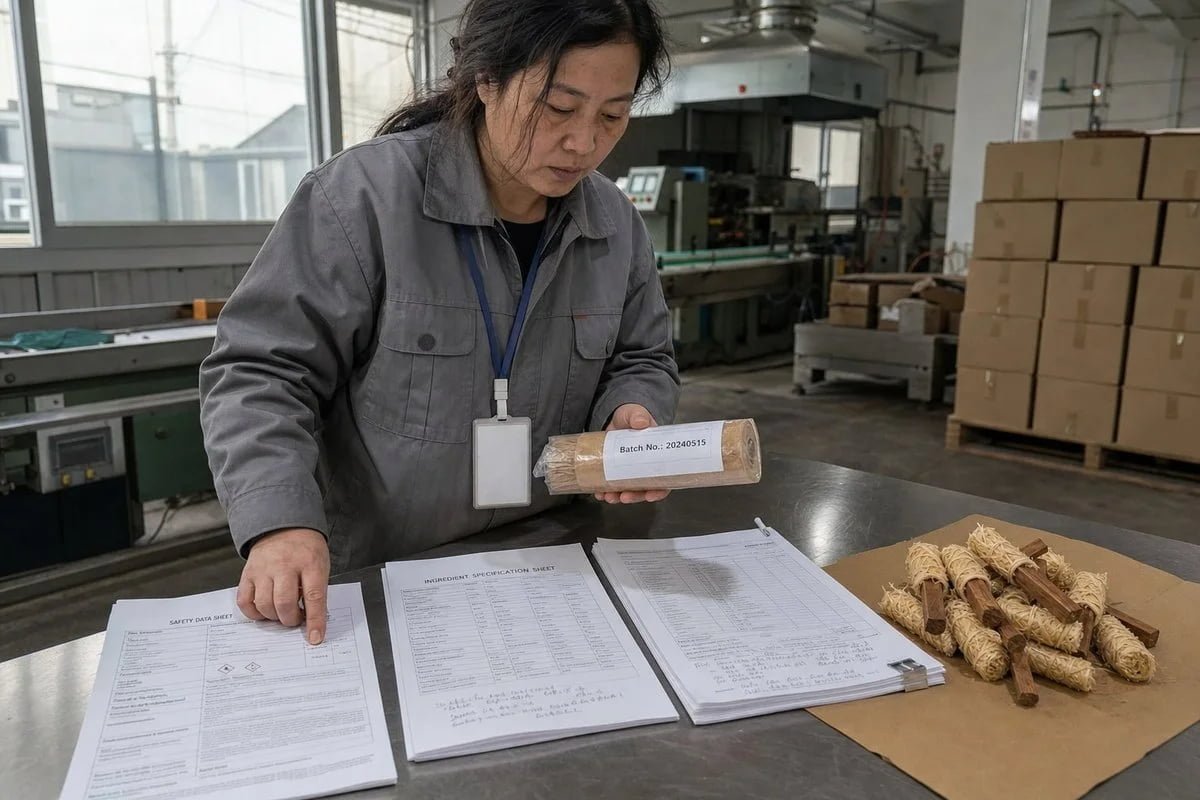
Verifying wood fire starter smoke against food-contact safety standards became urgent for us after a buyer's grill line nearly failed a retail audit. One vague "non-toxic" claim almost cost them the contract.
To verify wood fire starter smoke meets food-contact safety standards, request full ingredient disclosure, an SDS, third-party lab reports covering PAHs, VOCs, and heavy metal testing, and confirm certifications like SGS or Intertek. Marketing claims alone never prove food-contact safety.
That short answer covers the essentials. Now let me walk you through each step in detail, based on what actually happens in factories, labs, and retail audits.
What certifications should I request to confirm my wood fire starter supplier meets food-contact safety standards?
A German distributor once asked our compliance team for "the food-safe certificate" on our wax-dipped wood rolls. We had to explain that no single certificate exists — safety is proven by a stack of documents.
Request ISO 9001 quality certification, BSCI social audits, CE marking where applicable, and third-party test reports from SGS or Intertek covering combustion emissions, heavy metals, and PAHs. Also ask for the SDS, full ingredient specification, and any FDA food grade certification for wax coatings.

Here is the honest truth from 17+ years of exporting fire-starting goods to 30+ countries: there is no universal "food-contact safe smoke" certificate for fire starters. Buyers who understand this ask better questions. Buyers who don't get fooled by vague labels.
The document stack that actually proves safety
Instead of one magic paper, you should build a file. In our export experience, serious retail sourcing channels in the US and Europe expect the following:
| Document | What It Proves | Who Issues It |
|---|---|---|
| ISO 9001 certificate | Consistent quality management | Accredited certification body |
| SGS / Intertek test report | Emissions, PAHs, heavy metal testing | Independent third-party lab |
| Safety Data Sheet (SDS) | Chemical composition and combustion hazards | Manufacturer |
| Ingredient specification sheet | Exact wax, fiber, and binder identity | Manufacturer |
| BSCI audit report | Ethical, controlled production environment | Audit platform |
| FDA food grade certification 1 (for wax) | Coating meets food-contact material rules | Supplier of the wax raw material |
Why the raw-material chain matters
A fire starter is only as clean as its inputs. Ask whether the wax supplier can document GRAS status 2 or FDA food grade certification for the coating material. Ask whether the wood wool comes from virgin, untreated timber. In our own production lines in Ningbo, we trace each batch of natural wood wool back to its source. That traceability is what an auditor will test, not the label on the box.
Also check the date and scope of every report. A test report from five years ago, on a different formulation, proves nothing about today's product. Reports should name the exact product, the test standard, and the lab.
How can I verify that test reports for smoke emissions are accurate and up to date?
Early in our export history, a competitor's buyer forwarded us a "lab report" for comparison. It took our QC manager ten minutes to spot that the report number didn't match the lab's database.
Verify test reports by checking the report number directly with the issuing lab, confirming the report date is within 12–24 months, matching the tested product name and batch to your actual SKU, and ensuring the test methods cover Polycyclic Aromatic Hydrocarbons and combustion residues.

Fake and recycled test reports are more common in this industry than most purchasing managers realize. The good news is that verification is straightforward if you follow a process.
A five-step verification process
- Contact the lab directly. SGS, Intertek, and similar labs let you verify a report number and issue date. Never rely only on the PDF the supplier sends.
- Match the product identity. The report must name the exact formulation. A report for a plain wood roll does not cover a paraffin-dipped version. Our team has seen suppliers stretch one report across an entire catalog.
- Check the test scope. A flammability test says nothing about smoke chemistry. Look for methods that measure Polycyclic Aromatic Hydrocarbons 3, Volatile Organic Compounds, and particulate residues.
- Confirm the date. Formulations drift. Wax suppliers change. A report older than two years should trigger a retest request, especially before a large retail program.
- Cross-check the SDS. The Material Safety Data Sheet should list the same ingredients the test report evaluated. Mismatches are a red flag.
What a legitimate report looks like
A real report carries the lab's letterhead, a unique reference number, the applicant's name, sample description, test standards cited by number, results with detection limits, and a signature block. If any of these are missing, ask why. When we prepare compliance packs for buyers in the US, Germany, and the UK, we include the raw report plus batch records, because auditors increasingly ask how the tested sample relates to mass production. A first sample that reflects mass-production quality is only credible when batch-to-batch QC records back it up.
One trade-off we weigh constantly on our production line: paraffin ignites reliably and costs less, but for food-adjacent programs we steer buyers toward a vegetable wax coating 4 instead. The ingredient choice defines the smoke.
Avoid petroleum distillates, kerosene, synthetic glues that release formaldehyde, recycled or pressure-treated wood containing arsenic or chromium, and unknown chemical accelerants. Choose untreated natural wood wool bound with soy wax, beeswax, or vegetable stearin, with no non-toxic chemical additives left unverified.

Ingredient review is where most food-contact risk is created or eliminated. A fire starter has only three or four components, so scrutinizing each one is realistic.
Ingredient risk comparison
| Component | Safer Choice | Avoid | Why It Matters |
|---|---|---|---|
| Fiber base | Untreated natural wood wool, FSC-sourced | Recycled pallets, treated construction debris | Treated wood can carry arsenic, copper, chromium |
| Coating | Vegetable wax coating, soy wax, beeswax | Kerosene, petroleum distillates | Petroleum coatings deposit Volatile Organic Compounds 5 and chemical taint |
| Binder | Vegetable stearin, natural compression | Synthetic resin glues | Some glues release formaldehyde during combustion |
| Accelerant | None needed | Undisclosed chemical boosters | Unknown additives make emissions unpredictable |
Hidden risks buyers rarely check
Two risks sit outside the ingredient list itself. First, machinery lubricants: compression and pelletizing equipment should use H1-certified food-grade lubricants, or industrial oil can migrate into the starter. We audit this on our own lines because one contaminated batch destroys trust. Second, geographic wood origin matters. Timber harvested from contaminated industrial soils can bioaccumulate lead or cadmium, which is why heavy metal testing on the finished product is worth requesting even when the wood looks clean.
Also keep moisture in view. Wood fiber above roughly 10% moisture smolders "cool," which increases creosote and soot deposition — exactly the residue you don't want drifting toward a food-contact surface. We control drying tolerances tightly for this reason, and we recommend buyers write a moisture specification into their purchase contracts.
Finally, be skeptical of the word "natural." Natural materials reduce chemical odor, but they don't prove food-contact safety by themselves. Only documented composition plus testing does that.
Which lab tests confirm that fire starter smoke won't contaminate food during grilling or camping use?
A UK fireplace distributor once asked us to justify, test by test, why our wood rolls were suitable near a kettle grill. Building that evidence file taught us exactly which analyses matter.
Request PAH panel testing aligned with EFSA benchmarks, VOC emissions analysis, heavy metal screening for lead, cadmium, arsenic, and chromium, particulate and soot deposition tests, and residue migration testing onto food simulants under realistic ignition conditions. Together these confirm smoke won't contaminate food.
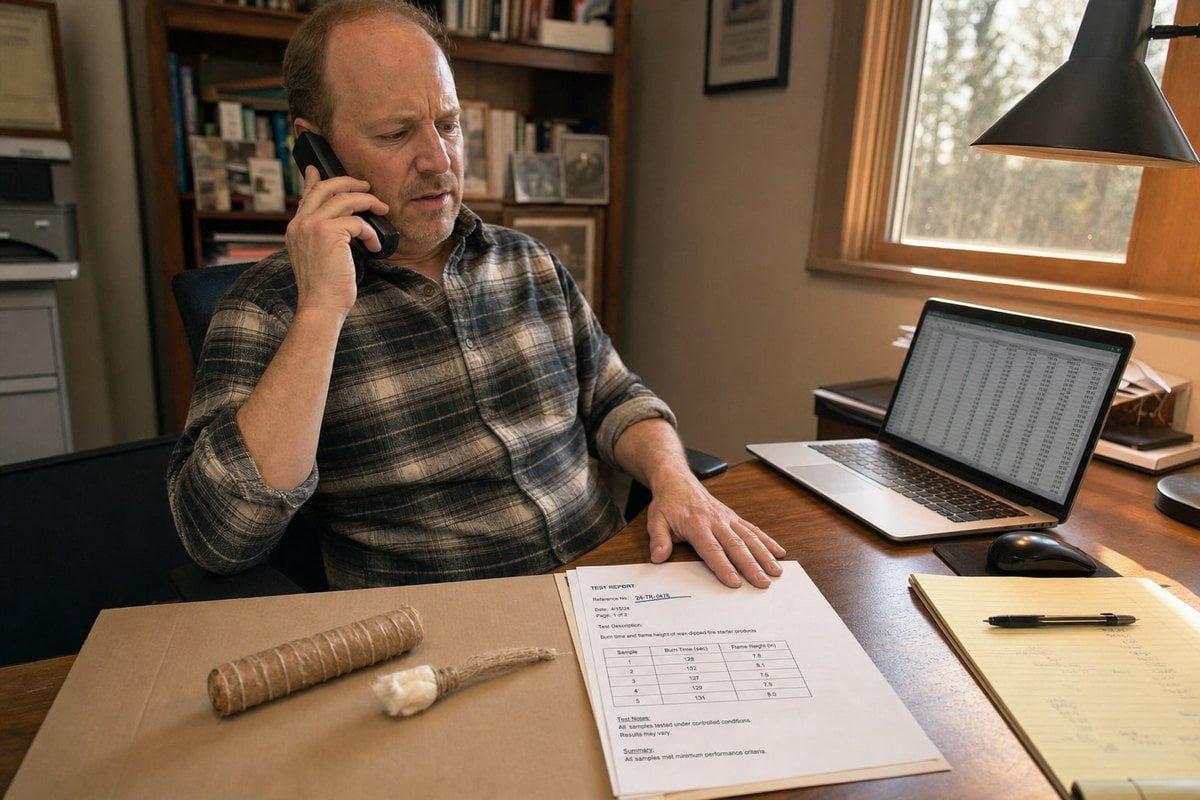
Regulators treat smoke near food as a food-contact material 6 problem. That framing tells you which lab tests carry weight and which are just noise.
The core test panel
| Test | Target Contaminants | Why It Matters for Food Use |
|---|---|---|
| PAH analysis | Benzo[a]pyrene and related Polycyclic Aromatic Hydrocarbons | PAHs are the primary carcinogenic concern in smoke; EFSA sets strict benchmarks for smoke-exposed foods |
| VOC emissions | Solvents, petroleum volatiles | VOCs cause chemical taint on food surfaces |
| Heavy metal testing | Lead, cadmium, arsenic, chromium | Contaminated or treated wood transfers metals through ash and soot |
| Particulate deposition | Soot, tar, creosote | Visible residue on grates and food-contact surfaces |
| Migration testing | Chemical transfer to food simulants | Confirms real-world exposure stays within limits |
| Sensory (taint) testing | Off-odors and flavors | Food-contact neutrality, expected by NSF International standards-minded auditors |
How realistic test conditions should look
The test setup matters as much as the test list. Combustion chemistry changes with airflow, oxygen access, and temperature — the same variables Codex guidance 7 flags for smoke generators. A meaningful evaluation ignites the starter exactly as a camper or griller would, places a food-contact surrogate at a realistic distance, then measures what actually deposits. When we develop new formulations, we replicate fireplace, fire pit, and kettle grill scenarios, because a product that burns clean in open air may behave differently under a grill hood.
One more point on intended use. Many fire starters are validated only for igniting fuel before food goes on — not as a smoke source during cooking. Your documentation should state this clearly, and your packaging and warning labels should match. We build those use-condition statements into private-label packaging for our OEM buyers, because a mismatch between claims and evidence is what retail audits punish hardest.
Conclusion
Unverified fire starters can quietly contaminate food and sink retail programs. Demand ingredient disclosure, verified lab reports, and realistic testing — documentation, not marketing, proves food-contact safety.
Footnotes
1. FDA's food-contact substance page clarifies what food-grade certification actually requires. ↩︎
2. FDA GRAS page defines the regulatory status buyers should request for wax ingredients. ↩︎
3. CDC reference explains PAH health risks relevant to smoke emissions testing. ↩︎
4. Background reference on wax composition supports the ingredient comparison discussion. ↩︎
5. EPA explains VOC health impacts, supporting the article's emissions testing guidance. ↩



Join the Conversation