







Wood fire starter specs and packaging trip up more importers than any other detail I see on our production line. One product will not fit every grill. Get the spec wrong, and returns pile up. Get the packaging wrong, and the product never survives the container ship — or the retail shelf. After 17+ years making wax-dipped wood rolls in our factory, I can tell you the fix is simpler than most buyers expect: design the spec to the grill, then design the box to the market.
Design wood fire starter specs by matching burn time, size, and material to each grill type: 8–12 minutes for charcoal, longer steady burns for smokers, low-residue formats for pellet grills. Package them in moisture-barrier, shelf-ready boxes with clear use-case labeling and required compliance marks.
That is the short answer. Below, I break down each decision — burn times, wood types, export packaging, certifications, and private-label branding — so you can build a spec sheet that actually sells.
What Burn Time and Wood Type Specs Work Best for Different Grill Sizes?
A buyer from Germany once asked us for "the longest-burning starter you can make." I talked him out of it. His customers used kettle grills, and a 20-minute burn was wasted wax. Our factory calibrates burn time to the fuel bed, not to a spec-sheet vanity number.
The best wood fire starter specs deliver 8–12 minutes of flame for charcoal grills, 10–15 minutes for smokers and Kamado grills, and 5–8 minutes for small portable grills. Natural wood wool dipped in food-grade paraffin wax offers the most reliable, odor-free ignition across all grill types.
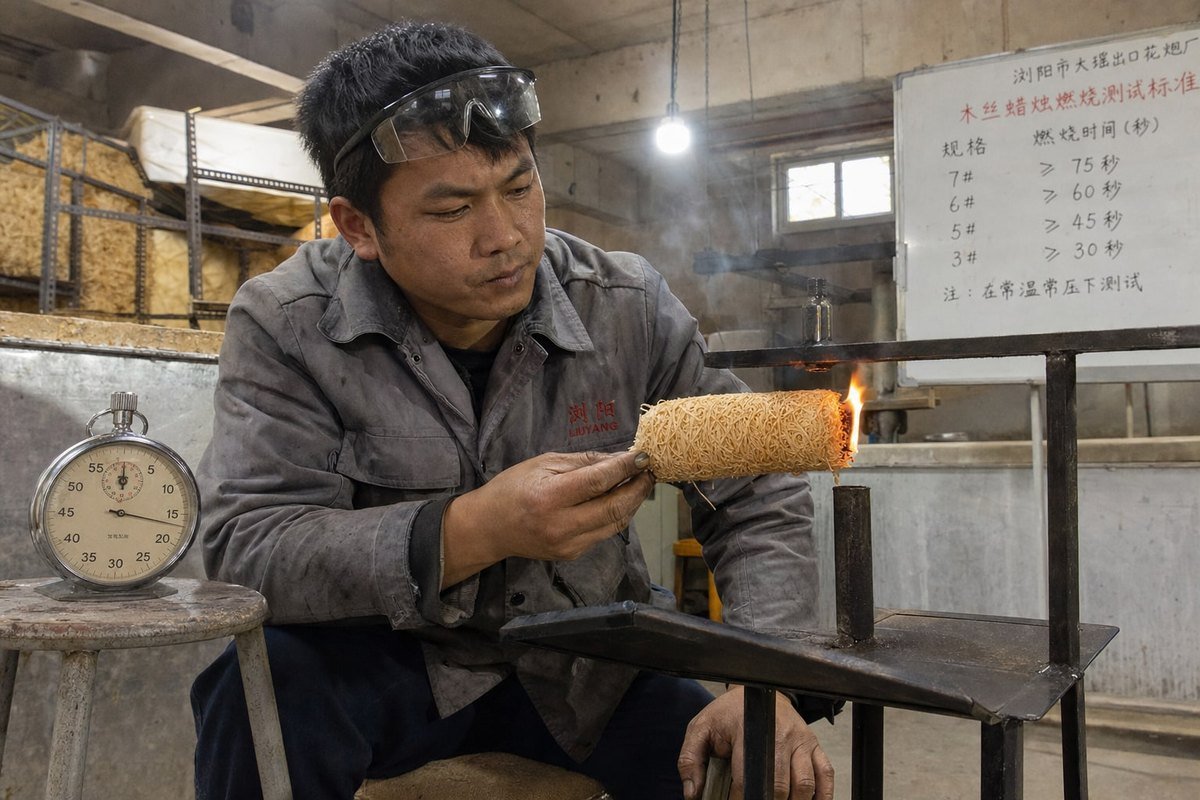
The core principle is simple. A fire starter only needs to burn long enough for the main fuel to reach self-sustaining ignition. Anything beyond that is wasted material and wasted cost. Anything less means your customer needs a second starter — and they will blame your brand, not their technique.
Matching Burn Time to Grill Type
Here is the framework we use when we build spec sheets for OEM clients:
| Grill Type | Target Burn Time | Recommended Format | Key Requirement |
|---|---|---|---|
| Portable / tabletop grill | 5–8 minutes | Mini roll or puck | Compact size, fast flame |
| Kettle charcoal grill | 8–12 minutes | Standard wood wool 1 roll | Survives airflow changes |
| Kamado / ceramic grill | 10–15 minutes | Dense wax-dipped roll | Food-safe, no chemical odor |
| Pellet grill | 5–10 minutes | Low-residue small roll | Clean burn near auger systems |
| Offset smoker | 12–15 minutes | Jumbo roll or double unit | Steady flame for dense splits |
| Fire pit / campfire | 10–15 minutes | Standard or jumbo roll | Weather tolerance |
Why Wood Type and Wax Matter
Natural wood wool — the shredded excelsior fiber you see in our wax-dipped rolls — ignites in seconds because of its thread-like surface area. We dip it in food-grade paraffin wax 2 to extend the burn and repel moisture. This combination outperforms resin-rich fatwood for cooking applications, because fatwood's pine resin can transfer a sharp odor to food on short-cook grills. Fatwood works fine for fire pits. It is a harder sell for Kamado grill compatibility, where ceramic walls trap aroma.
Moisture content standards matter just as much. We keep wood fiber below a strict moisture threshold before dipping, and we verify it batch by batch. A damp core smokes, sputters, and fails ignition tests. Users of charcoal chimney starters feel this immediately: a good roll lights a full chimney in 20–30 minutes total workflow, while a damp one stalls the whole process.
One more spec decision: density. A tightly wound roll burns slower and steadier. A loose roll flares fast. For smokers, we wind tighter. For portable grills, we wind looser and cut smaller.
How Should I Package Wood Fire Starters to Survive Export Shipping and Retail Display?
Early in our export history, we learned a hard lesson: a container crossing the equator in July can soften paraffin coatings if the inner packaging is wrong. Since then, our Ningbo facility treats packaging as an engineering problem, not an afterthought.
Package wood fire starters in wax-resistant inner liners with moisture-barrier protection, inside rigid printed cartons rated for container humidity and stacking loads. Use retail shelf-ready packaging with clear grill-type labeling, visible piece counts, and display-friendly formats like trays, boxed counts of 20–100, or hang-hole packs.
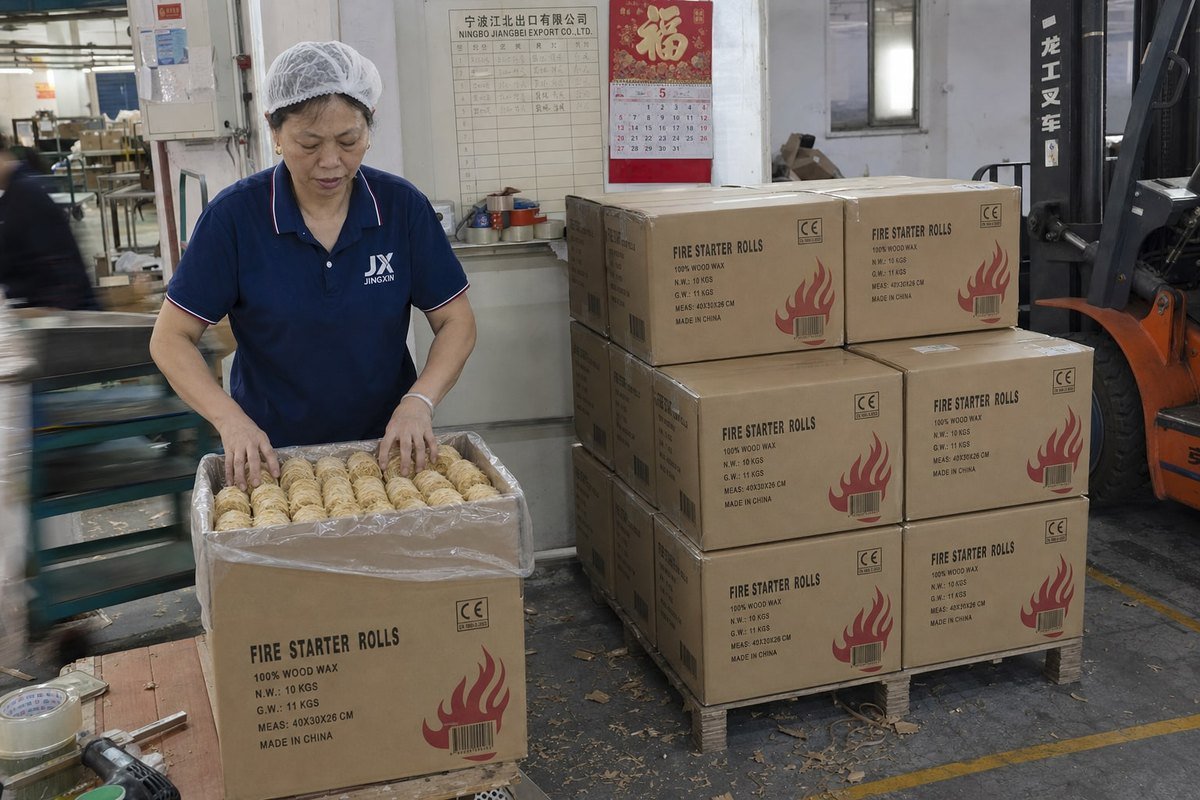
Packaging for fire starters has to solve three problems at once: survive the ocean, look good on the shelf, and communicate the use case in two seconds. Miss any one, and the product underperforms.
Layer One: Protecting the Product in Transit
Paraffin wax is stable, but it responds to heat and pressure. Inside a sealed container, temperatures swing widely, and cartons at the bottom of a pallet carry real weight. We address this in three ways. First, we use functional barrier papers or wax-coated liners inside each retail box, so humidity never reaches the wood fiber. Moisture is the silent killer of ignition speed. Second, we specify carton board strength based on stacking height, not just unit weight. Third, we include storage guidance on the box — keep below 45°C, away from open flame — because retailers and end users both need it.
Layer Two: Winning on the Shelf
Retail shelf-ready packaging is where good products become good sellers. The strongest listings and boxes name the compatible appliances right on the front: charcoal grills, pellet grills, smokers, fire pits, pizza ovens. Shoppers should never have to guess.
| Pack Format | Best For | Typical Count | Retail Advantage |
|---|---|---|---|
| Printed display box | Hardware and BBQ stores | 20–50 pcs | Front-facing branding, stackable |
| Bulk carton | Value channels, frequent grillers | 65–100 pcs | Low cost per piece |
| Tray / open dispenser | Countertop impulse buys | 24–36 pcs | Grab-and-go convenience |
| Hang-hole pouch | Camping and outdoor aisles | 6–12 pcs | Peg-board display, trial size |
Layer Three: Copy That Does Work
Instructional copy is not a legal add-on. It drives repeat purchase. We print simple how-to steps — how many pieces per chimney, where to place the roll under the fuel — directly on the box. Some clients now add QR codes linking to video instructions for specific grill setups. Plastic-free recyclable cardboard also matters increasingly in our EU markets, where buyers ask for compostable pulp trays instead of blister packs.
What Compliance Certifications Do My Wood Fire Starters Need for US and EU Grill Markets?
Compliance is the first question serious buyers ask us — often before price. Our factory holds ISO 9001 3 and BSCI certifications, and our products carry CE marks with SGS 4 and Intertek test reports, because our US and European clients cannot list a product without them.
Wood fire starters for US and EU markets need transport classification review under Class 4.1 flammable solids rules, Safety Data Sheets (SDS), CE marking with EN-standard testing for the EU, proper hazard and warning labels, and factory-level certifications like ISO 9001 and BSCI for retail sourcing approval.
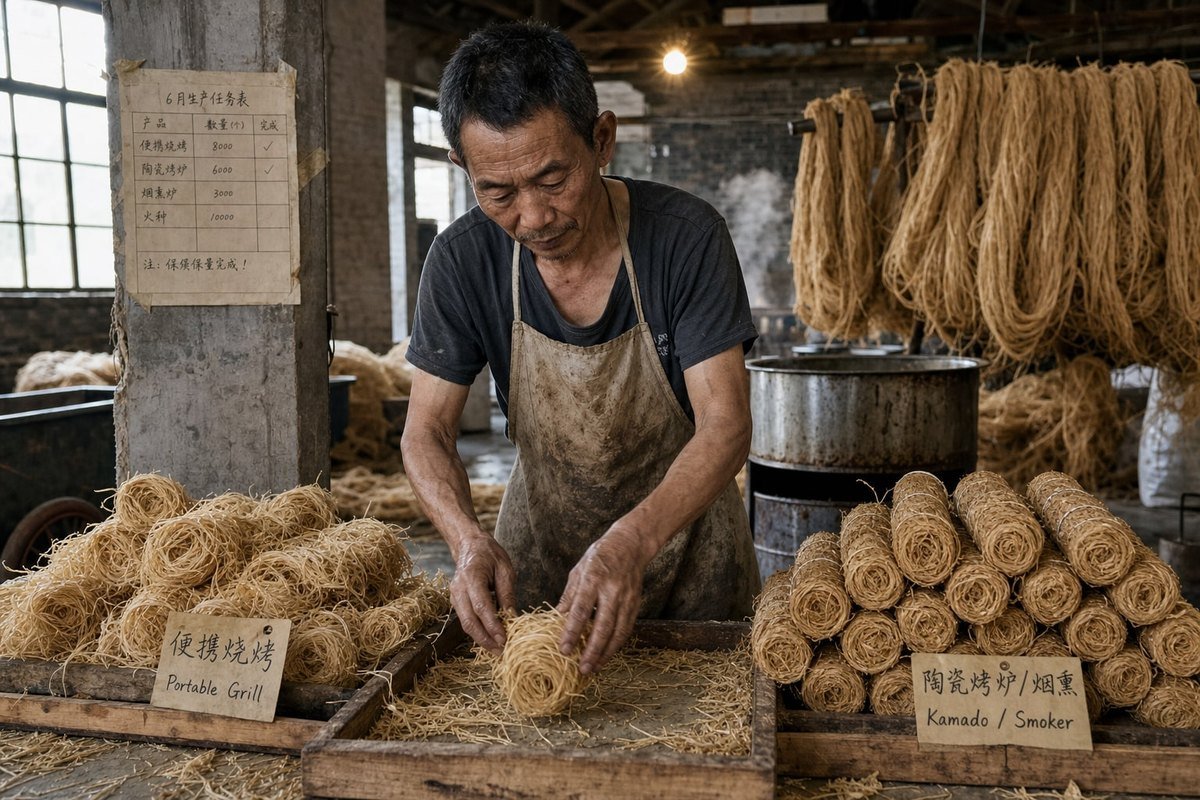
Let me walk through the compliance stack the way our documentation team handles it for a new client, because the order matters.
Step One: Transport Classification
Before anything ships, you need to know how your product is classified for transport. Wax-dipped wood starters may fall under Class 4.1 flammable solids 5 depending on formulation and test results. This classification drives everything downstream: carton markings, shipping documents, and which carriers will accept the freight. A supplier who cannot show you transport test documentation is a supplier who will strand your container at port.
Step Two: Product Safety Documentation
Safety Data Sheets (SDS) 6 are mandatory for both markets. Retailers request them during onboarding, and customs may request them during clearance. The SDS covers composition, flammability data, handling, and storage. We prepare SDS documents for every formulation we produce, including custom OEM blends, and we update them when a spec changes.
Step Three: Market-Specific Requirements
| Requirement | US Market | EU Market |
|---|---|---|
| Transport classification | DOT / IATA review, Class 4.1 assessment | ADR / IMDG review, Class 4.1 assessment |
| Safety documentation | SDS required by retailers | SDS required, REACH awareness |
| Product marking | Warning labels, cautionary statements | CE marking, EN-standard test reports |
| Factory audit | Retailer social audits common | BSCI 7 widely requested |
| Lab verification | SGS / Intertek 8 reports accepted | SGS / Intertek reports accepted |
Step Four: Factory Credentials
Large retail sourcing channels — the Home Depot type — audit factories, not just products. ISO 9001 shows your quality system is real. BSCI shows your labor practices pass. In our experience exporting to 30+ countries, buyers who skip this step with an uncertified supplier usually pay for it during their first retailer onboarding review. Third-party test reports from SGS or Intertek then verify what the certificates promise. Ask for all of these before you commit to a purchase order, and ask for reports dated within a reasonable window — not five-year-old paperwork.
Can I Get Custom Branding and Box Design for My Own Wood Fire Starter Line?
Last year, a Dutch BBQ distributor came to us with nothing but a logo and a target retail price. Ninety days later, his branded starter line was on shelves. That project is a fair picture of what true one-stop OEM/ODM looks like from our side.
Yes. Full private-label customization is standard with an OEM/ODM manufacturer: custom roll size, burn time, and count; branded box design with your logo and colors; compliant warning labels and barcodes; display-ready packaging formats; and optimized carton dimensions for your shipping lanes.
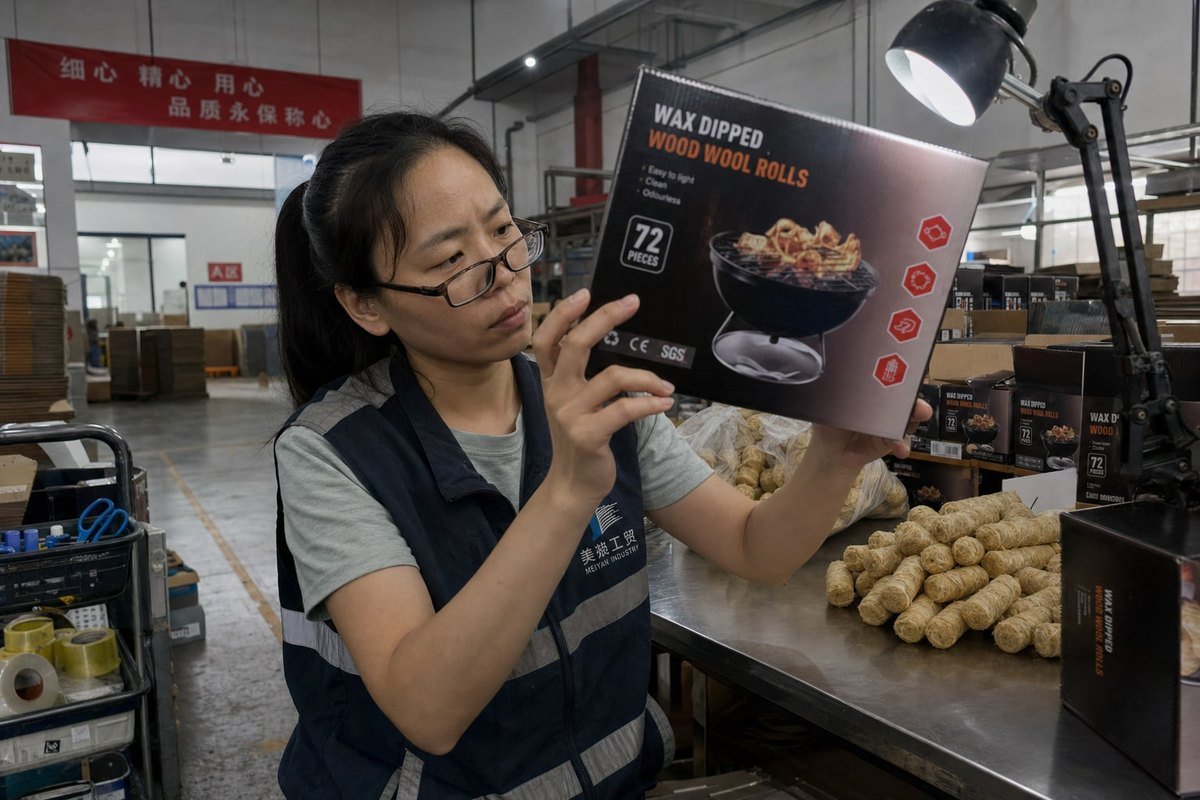
Private labeling a fire starter line is more than printing a logo on a box. Done properly, it is a structured process, and knowing the steps helps you plan your launch timeline realistically.
The OEM Process, Step by Step
- Define the product spec. We agree on roll dimensions, wax coating weight, target burn time, and piece count. This is where grill-type positioning gets locked in — a Kamado-focused line needs food-grade paraffin wax and odor-free formulation; a campfire line can prioritize weather resistance.
- Sample and verify. We produce samples from the actual production line, not a hand-made prototype. Because our batch-to-batch quality control is strict, the first sample reliably reflects mass-production quality. Test the sample in the actual grills your customers use.
- Design the packaging. Our team adapts your artwork to the box structure, adds required warning labels, barcodes, and regulatory text for your market, and confirms the display format — boxed counts, trays, or hang packs.
- Confirm compliance paperwork. SDS, test reports, and transport documents are prepared under your brand name where required.
- Produce and ship. We optimize carton dimensions and pallet configuration for your logistics lane, which quietly saves real freight cost over a year of orders.
What You Can Customize
Almost everything is adjustable: roll length and diameter, wax dip depth for burn time requirements, piece counts from small trial packs to 100-piece bulk boxes, and even scent direction for buyers who want a natural wood aroma profile. We also support flexible MOQs for trial orders, because we know a purchasing manager needs to test sell-through before committing to full container volumes. What we will not compromise on is the compliance layer — every custom box still carries the correct warnings and marks for its destination market.
Conclusion
Mismatched specs and weak packaging quietly kill fire starter lines. Match burn time to the grill, protect the product in transit, certify everything, and brand it properly — that is how a starter line succeeds.
Footnotes
1. Wikipedia entry for wood wool, also known as excelsior, describing its properties and uses. ↩︎
2. Background reference on the wax material used to coat and extend fire starter burn time. ↩︎
3. Official ISO standard explaining the quality management certification referenced for factory credibility. ↩︎
4. SGS is the third-party testing and verification body referenced for compliance reports. ↩︎
5. US DOT PHMSA governs hazmat transport classification for flammable solid shipments like wax-dipped starters. ↩︎
6. OSHA's hazard communication standard defines SDS requirements for flammable product exports. ↩︎
7. amfori operates the BSCI social compliance program cited for factory labor audits. ↩︎
8. Intertek is the other named lab providing certification and test report verification.



 English
  Spanish
  German
  French
  Arabic
  Portuguese
Join the Conversation