






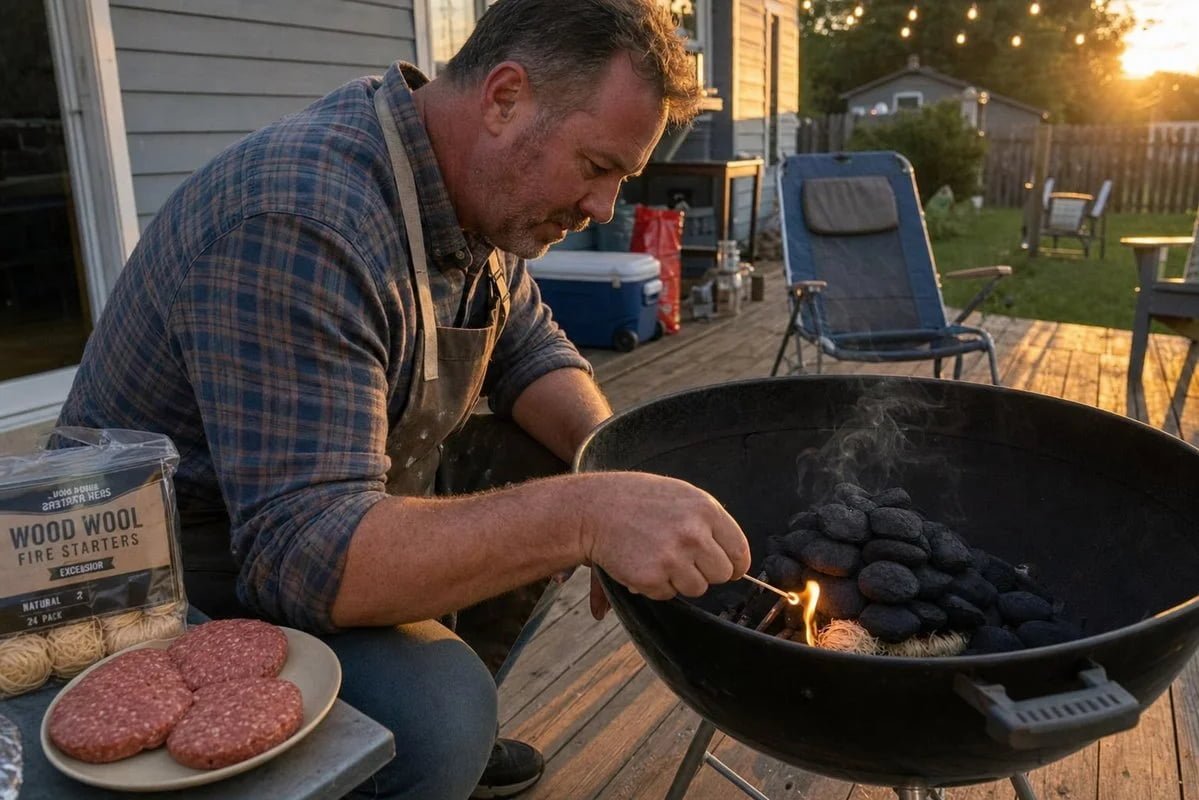
Wood fire starter material shapes grilled food flavor more than most buyers realize. On our production line, we've seen how one wrong ingredient can taint an entire cook.
Wood fire starter material affects grilled food flavor by shaping early combustion chemistry. Petroleum-based accelerants can leave a chemical aftertaste, while natural wood wool and food-grade wax starters burn clean, letting the primary fuel's smoke — not the igniter — season the food.
The starter is not just a flame source. It is a smoke-shaping tool. Let me walk you through what actually happens in those first critical minutes of a fire.
What Ingredients in Wood Fire Starters Could Affect the Taste of My Grilled Food?
During a QC audit at our Ningbo facility years ago, we burned competitor samples side by side with ours. The odor difference alone told us why some starters ruin food.
Kerosene, mineral spirits, and other petroleum-based accelerants are the main taste offenders in fire starters. They release volatile organic compounds that cling to food. Natural ingredients — wood wool, sawdust, and refined paraffin or beeswax — combust cleanly and leave no detectable flavor residue.
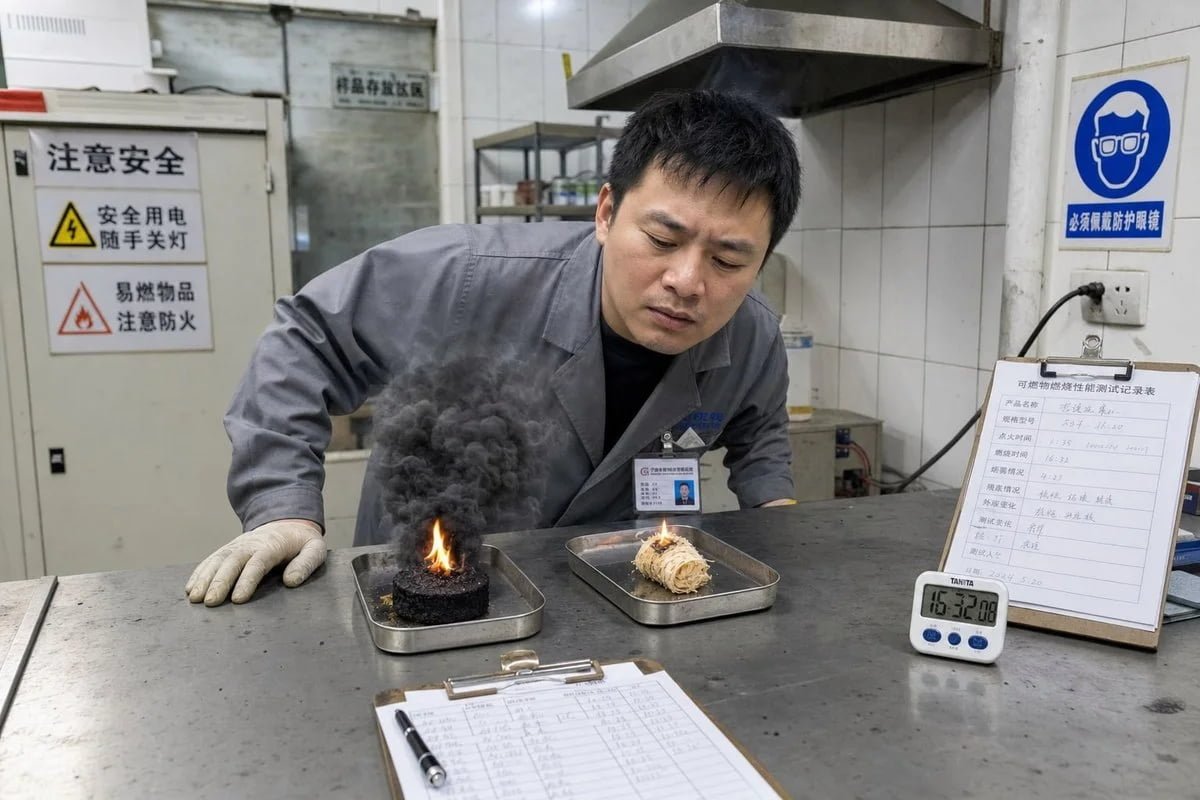
The ingredient list on a fire starter matters as much as the ingredient list on the food itself. When a starter ignites, everything in it becomes airborne. Some of those compounds land on your grill grates. Some land directly on the meat. Our lab team learned this early: if a material smells harsh when burning, it will taste harsh on food.
The Problem Ingredients
Petroleum distillates are the biggest risk. Lighter fluid and kerosene-soaked briquettes contain aliphatic hydrocarbons 1. If they are not fully combusted before food goes on, they leave a persistent, medicinal chemical aftertaste. Glossy paper, dyed cardboard, and dryer lint hacks add synthetic dyes and even microplastics to the smoke. Delicate proteins like fish pick up these off-notes fast.
The Safe Ingredients
Natural materials behave differently. Wood wool firelighters — the shredded excelsior rolls we produce — are just fine wood fiber. Their lignin combustion byproducts are the same phenols and carbonyls 2 found in normal wood smoke, so nothing foreign enters the flavor picture. Refined paraffin 3 and beeswax burn to carbon dioxide and water vapor when fully ignited.
| Ingredient | Combustion Byproducts | Flavor Risk |
|---|---|---|
| Kerosene / lighter fluid | Aliphatic hydrocarbons, VOCs | High — chemical aftertaste |
| Glossy paper / dyed cardboard | Ink compounds, synthetic residues | Moderate — metallic notes |
| Fatwood (high resin) | Terpenes, resinous soot | Moderate — piney astringency |
| Wood wool + refined paraffin 4 | Standard wood smoke compounds | Very low — flavor neutral |
| Beeswax-coated sawdust | Clean CO₂ and water vapor | Very low — flavor neutral |
One more nuance: fatwood resin content deserves attention. It is natural, but heavy terpenes 5 can bond with surface fats on meat during ignition and impart an overpowering piney edge. Natural does not automatically mean neutral.
How Do I Choose a Fire Starter That Won't Leave Chemical Residue on My Menu Items?
A German distributor once asked us a blunt question: how do I prove to restaurant clients that your starters won't taint a steak? That conversation reshaped how we document our materials.
Choose starters made only from untreated wood fiber and food-safe wax, verified by SGS or Intertek test reports. Avoid anything listing petroleum distillates, self-lighting coatings, or unnamed accelerants. Then follow the ash-over rule: cook only after coals turn grey and smoke runs thin.

Selection comes down to three checkpoints: what the starter contains, how it burns, and how you use it. I will break each one down the way we explain it to new buyers.
Read the Material Declaration
A trustworthy supplier discloses every input. Our wax-dipped wood rolls list two components: excelsior wood wool and refined wax. If a product sheet says "proprietary accelerant blend," treat that as a red flag. Vague wording usually hides petroleum content.
Watch the Smoke Color
Smoke tells the truth. Thick, black smoke signals incomplete combustion, which deposits bitter soot and carbon particles 6 on food. A quality starter transitions quickly to clean blue smoke — thin, almost invisible, and the mark of complete combustion. When we run burn tests on each production batch, smoke color is one of our pass/fail criteria.
Follow a Clean Ignition Process
Even a perfect starter needs correct technique:
- Place the starter under your charcoal or wood, never on top.
- Light it and let flames fully engage the primary fuel.
- Wait for the ash-over phase — grey coals mean the starter's volatile organic compounds 7 have dissipated.
- Check for thin, clean smoke before food touches the grate.
- Never add starter material mid-cook.
The chimney starter method pairs well with natural starters. One wood wool roll under a chimney replaces newspaper entirely, removes ink residue from the equation, and delivers evenly lit coals in about fifteen minutes. Many pitmasters we supply use exactly this combination for competition cooking, where a single off-note can cost points.
Are Wax-Dipped Wood Firestarters Safe and Flavor-Neutral for Commercial BBQ Use?
Wax-dipped wood rolls are our core product line, so I will be direct about both their strengths and their genuine limits for commercial kitchens.
Yes — wax-dipped wood firestarters made from untreated wood wool and refined paraffin or beeswax are safe and flavor-neutral for commercial BBQ. The wax combusts completely during ignition, before food is placed, leaving only ordinary wood smoke from the primary fuel.
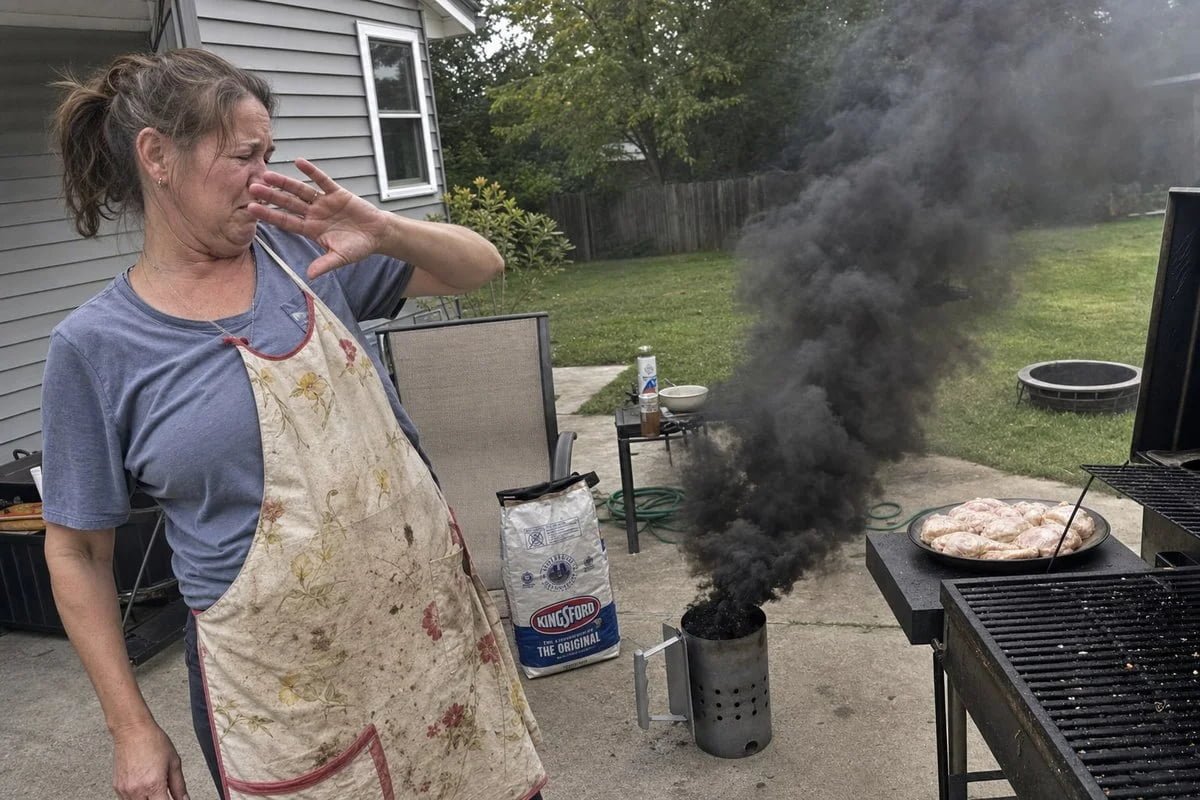
The concern most commercial buyers raise is logical: wax sounds like a coating that could melt onto food. The chemistry says otherwise, and the timeline says otherwise too. Here is why.
Refined paraffin is a highly purified, food-adjacent wax — the same family of material used to coat cheese rinds and produce. When it burns with sufficient oxygen, it breaks down into carbon dioxide and water vapor. There are no phenols and carbonyls beyond what the wood fiber itself contributes, and those are identical to the compounds in normal hardwood smoke. The wax is fully consumed within the first few minutes of ignition. By the time coals ash over and food goes on — typically 15 to 20 minutes later — nothing of the starter remains.
What Actually Matters: Wax Quality
Not all wax-dipped products are equal. This is where sourcing discipline pays off:
| Wax Type | Burn Character | Commercial Suitability |
|---|---|---|
| Refined paraffin (food-grade adjacent) | Clean, odorless, complete combustion | Excellent |
| Beeswax | Clean, faint honey aroma during ignition only | Excellent |
| Recycled industrial wax | Unpredictable additives, possible black smoke | Poor — avoid |
| Wax with added accelerants | VOC release, chemical odor | Unacceptable for food use |
At our factory, we specify wax purity in every purchase order and verify each incoming lot before dipping. In 17+ years supplying BBQ distributors across the US and Europe, batch-to-batch wax consistency has been the single biggest quality lever. A restaurant chain cannot tolerate one carton that smokes black while another burns clean.
For commercial volume, wax-dipped rolls also solve an operational problem: they light reliably in wind and damp conditions, burn 8–10 minutes, and eliminate lighter fluid from the workflow entirely. That removes the chemical aftertaste risk at the source rather than managing it downstream.
How Can I Verify a Supplier's Fire Starters Meet Food-Safe Compliance Standards for My Market?
The hardest lesson from exporting to 30+ countries: compliance is not one checkbox. A starter cleared for the US can still fail German retail requirements.
Request current SGS or Intertek test reports, confirm ISO 9001 and BSCI certification, verify CE marking for EU markets, and audit the full material declaration. Then order a trial batch and burn-test it yourself before committing to volume.
Purchasing managers ask me about verification more than any other topic, and rightly so. A flavor complaint is bad; a compliance failure at customs or on a retailer's shelf is far worse. Here is the verification framework I recommend to every new buyer, based on what our own clients demand from us.
The Document Checklist
Start with paperwork, but scrutinize it. Certificates expire. Reports can reference a different product than the one you are quoted.
| Document | What It Proves | What to Check |
|---|---|---|
| SGS / Intertek test report | Material composition, heavy metals, VOC emissions | Report date, exact product SKU tested |
| ISO 9001 certificate | Consistent quality management system | Current validity, certifying body |
| BSCI audit | Ethical, audited factory conditions | Audit score and date |
| CE documentation | EU market conformity | Applies to your specific product variant |
| Material safety data sheet | Full ingredient disclosure | No unnamed accelerants or distillates |
Verify the Factory, Not Just the Paper
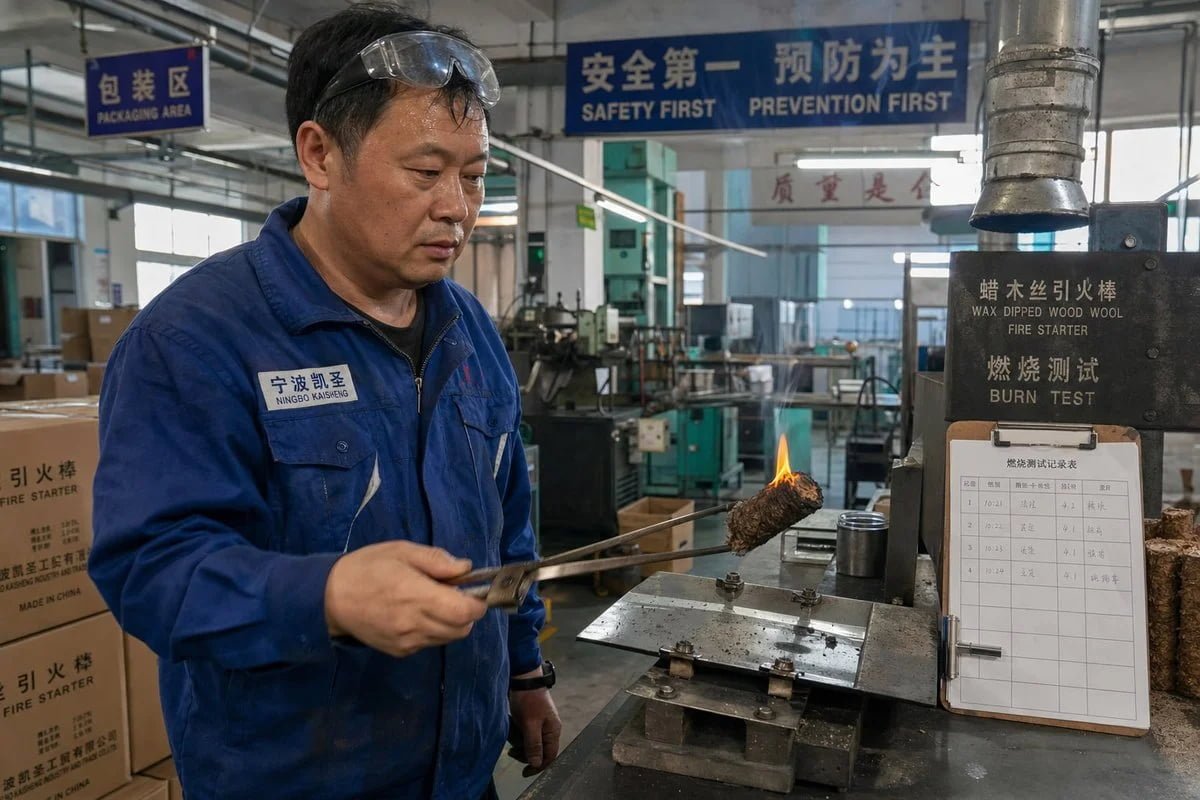
Trading companies often present borrowed certificates. Ask for the factory's name on every document and confirm it matches your supplier. When buyers visit our Ningbo production site, we walk them through incoming wax inspection, dipping lines, and batch burn tests. A real factory can show you the process behind the certificate. A reseller cannot.
Run Your Own Burn Test
Documents reduce risk; testing eliminates doubt. Order samples and evaluate three things. First, smell during ignition — any chemical odor disqualifies the product. Second, smoke behavior — you want a fast transition to clean blue smoke, never sustained black soot. Third, a real cook test on a delicate protein like chicken or fish, which reveals off-flavors that beef would mask. We encourage trial orders precisely because our first sample reflects mass-production quality, and a buyer who tests thoroughly becomes a long-term partner.
Finally, check market-specific labeling: warning labels, barcodes, and language requirements differ between the US, EU, and Middle East. A compliant product with non-compliant packaging still gets rejected at retail.
Conclusion
Fire starter material quietly decides whether food tastes of clean wood smoke or chemical residue. Choose natural, certified, wax-dipped wood starters — and verify your supplier before you scale.
Footnotes
1. Explains the hydrocarbon chemistry behind petroleum-based fire starter off-flavors. ↩︎
2. NIH/NIEHS resource on wood smoke chemical composition referenced in the article. ↩︎
3. FDA regulates paraffin wax as a food-contact additive, supporting the food-safety claim. ↩︎
4. US federal regulation confirms refined paraffin wax's approved food-contact status and purity standards. ↩︎
5. Background on terpene compounds responsible for resinous, piney flavor notes from fatwood. ↩︎
6. EPA guidance on particulate matter explains soot and carbon particle formation from incomplete combustion. ↩︎
7. EPA authoritative source on VOC emissions and their impact,



 English
  Spanish
  German
  French
  Arabic
  Portuguese
Join the Conversation