







Fireplace colored pine cones sell fast in Canada — until a shipment gets flagged for missing French text. Our production team has seen buyers lose whole seasons over one label mistake.
To label fireplace colored pine cones for Canada's CPLA compliance, show the product identity and net quantity in both English and French, add the dealer's name and Canadian address, use metric units, meet minimum type-size rules, and avoid any false or misleading flame-performance claims.
That is the short answer. The details matter, though. Below, I walk through the warning text, the test reports, the label materials, and how a supplier should support all of it.
What Warning Statements and Bilingual Text Does CPLA Require on My Packaging?
A Canadian distributor once sent our packaging team a rejected label proof. The issue was simple: the net quantity appeared in English only. We now check French text on every Canada-bound artwork file.
CPLA requires the product identity and net quantity declaration in both English and French on the principal display panel, with net quantity in metric units. The dealer's name and address may appear in one language, but safety warnings for a burnable product should be fully bilingual.

Let me break this down the way we brief our own artwork designers, because the CPLA has a clear structure once you see it in pieces.
The Three Mandatory Label Elements
The Consumer Packaging and Labelling Act 1 covers prepackaged consumer products. Colored pine cones in a pouch, jar, or burlap sack are squarely in scope. Three elements are mandatory:
| Element | What It Means | Bilingual? |
|---|---|---|
| Product identity | Common or generic name, e.g., "Colored Fireplace Pine Cones / Pommes de pin colorées pour foyer" | Yes, both languages |
| Net quantity | Count or metric weight on the principal display panel, in legible type | Yes, both languages |
| Dealer identity | Name and business address of the manufacturer, importer, or distributor | One language is acceptable |
Warning Statements That Actually Protect You
The CPLA itself does not dictate fire-safety wording. But it prohibits false or misleading representations, and a fire-use product with no use restrictions can mislead by omission. In our experience shipping color-flame pinecones to Canada and Europe, the safest posture includes warnings such as:
- Use only in wood-burning fireplaces, fire pits, or campfires.
- Do not use in gas fireplaces or gas log sets.
- Do not use on cooking fires or BBQ grills.
- Keep away from children; do not leave fires unattended.
- Use in a well-ventilated area.
Each statement should appear in English and French. Type-size rules scale with the panel area, so a small pouch still needs readable text. We keep bilingual warning blocks at equal visual weight in both languages — Canadian retail buyers check this closely, and it signals professionalism on the shelf.
Which Test Reports and Certifications Should I Request from My Manufacturer Before Import?
Documentation questions come up in nearly every first call we take from Canadian importers. Buyers who ask for paperwork upfront clear customs faster and negotiate retail listings with far less friction.
Request SGS or Intertek test reports covering combustion emissions and heavy-metal content, the supplier's ISO 9001 and BSCI certificates, a material composition sheet for coatings and colorants, and batch-level quality records. These documents support CPLA truthfulness claims and CCPSA hazard assessments.

Here is the tension every importer faces. Some sellers treat colored pine cones as a simple novelty and skip testing. The stricter view — and the one Canadian enforcement supports — is that a product designed to be burned needs evidence behind its safety claims. I side firmly with the stricter view, and not just because our factory holds the certificates. The CPLA bans misleading representations. If your package says "safe" or "non-toxic" and you hold no test report, that claim is exposed. Worse, colored-flame products made with certain metallic salts can trigger Canada Consumer Product Safety Act 2 scrutiny for toxic combustion byproducts, which sits on top of CPLA packaging rules.
The Document Checklist We Prepare for Canada-Bound Orders
| Document | Purpose | Who Uses It |
|---|---|---|
| SGS/Intertek combustion test report 3 | Verifies emissions and colorant safety claims | Health Canada queries, retail buyers |
| Material composition sheet | Confirms no restricted heavy metals in coatings | Your compliance reviewer, CBSA 4 if flagged |
| ISO 9001 certificate 5 | Shows the factory has real quality systems | Retail vendor onboarding |
| BSCI audit report 6 | Confirms ethical production | Large retail sourcing channels |
| Batch QC records | Proves mass production matches the approved sample | Your own quality assurance |
After 17-plus years running production lines, I can tell you the sample-to-mass-production gap is where importers get hurt. A supplier may test one golden sample, then ship untested batches. Ask how batch-to-batch consistency is controlled before you sign, not after a container lands in Vancouver.
How Do I Choose the Right Label Materials and Placement for Fireplace Products?
Kraft pouches, burlap sacks, and plastic jars all behave differently on our packing lines. A label that looks perfect on a flat proof can wrinkle, fade, or peel once it meets real packaging.
Choose moisture-resistant, smudge-proof label stock matched to your package surface — coated paper for kraft pouches, laminated synthetic labels for jars, printed hang tags for burlap sacks. Place mandatory bilingual information on the principal display panel and warnings where visible before use.
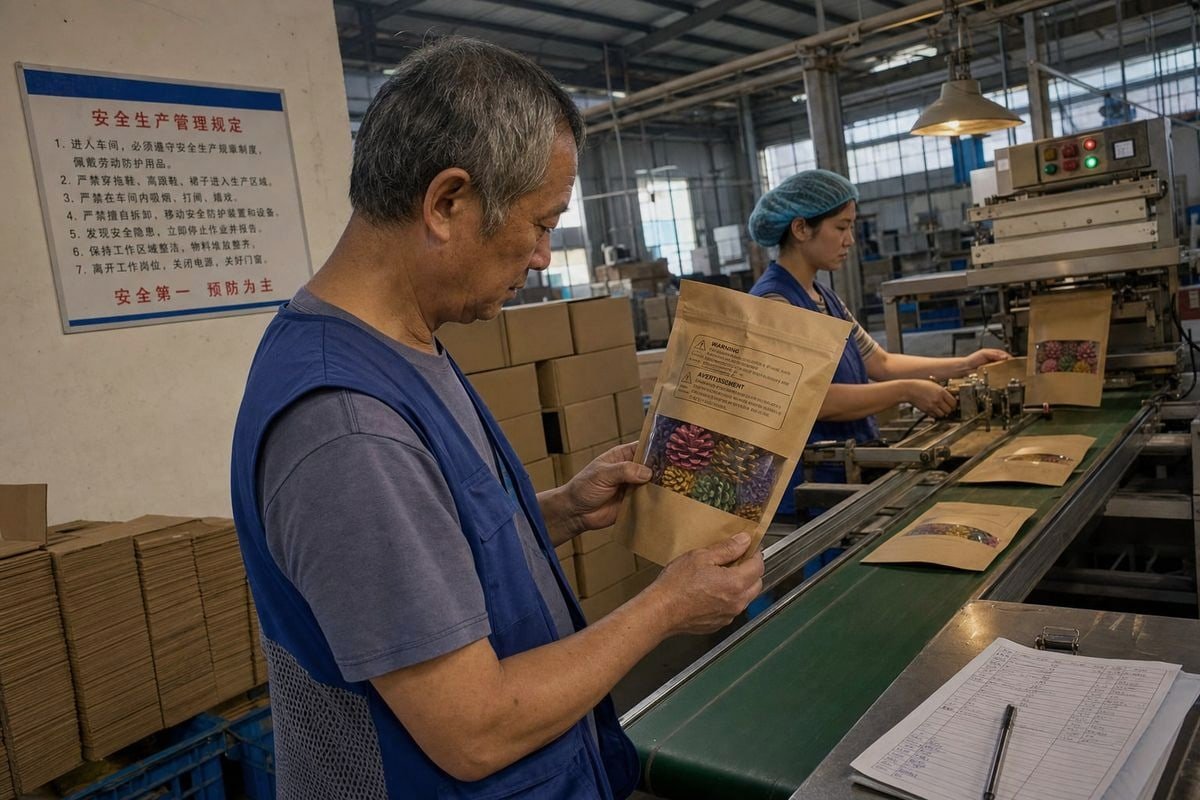
Placement is a legal question first and a design question second. The principal display panel is the surface the consumer sees at purchase. That is where product identity and net quantity must sit, in both languages, at the required type size. Warnings can sit on the back panel, but they must be findable before the consumer uses the product. Burying a "wood fires only" warning under a fold-out tag defeats the purpose and invites a misleading-labeling argument.
Matching Label Stock to Package Format
We produce colored pine cones in three main formats, and each demands a different labeling approach:
| Package Format | Recommended Label Solution | Placement Notes |
|---|---|---|
| Stand-up kraft pouch | Direct print or coated paper label | Front panel carries identity and quantity; back carries bilingual warnings |
| Burlap drawstring sack | Printed hang tag plus sewn-in or adhesive panel label | Hang tag alone may detach; add a fixed label for mandatory elements |
| Plastic jar | Laminated synthetic wrap label | Wrap gives room for full bilingual text without shrinking type size |
Practical Design Rules We Apply
First, never let French text shrink below the English. Equal prominence keeps you safe and looks better. Second, test labels against moisture and handling — pine cones often sit near hearths and in garages. Third, keep flame-effect imagery honest. If your product produces blue and green flames, do not show a rainbow the chemistry cannot deliver. Marketing images and package warnings must tell the same story, because the CPLA judges the whole representation, not just the fine print. Fourth, leave clear space for barcodes and lot codes, which retailers require for traceability.
Can My Supplier Handle Custom Bilingual Labeling and Compliance Documentation for Canada?
A Canadian outdoor brand recently asked us to develop a private-label pinecone line with fully bilingual packaging from day one. That project taught me how much smoother launches go when compliance starts at the factory, not the border.
A capable supplier should provide OEM/ODM bilingual label design, print-ready English-French artwork, warning statements, barcodes, and lot coding, plus SGS or Intertek reports and certificates on request. If a factory cannot supply these, the compliance burden falls entirely on you.

Some buyers push back here. They argue that labeling is the importer's job, so any cheap factory will do, and the compliance work happens after arrival. I understand the logic, but it fails on cost and timing. Relabeling a container of pouches in a Canadian warehouse costs more per unit than printing correct packaging at the source. It also delays your selling season — and for a fireplace product, missing October means missing the year.
What a One-Stop Compliance Workflow Looks Like
At our Ningbo production facility, Canada-bound private-label orders follow a set sequence:
- We confirm the package format, panel sizes, and required bilingual elements with the buyer.
- Our team drafts artwork with English-French product identity, metric net quantity, dealer block, and warning statements.
- The buyer's legal or compliance reviewer approves the proof before any printing.
- We attach the relevant SGS/Intertek test reports and material sheets to the order file.
- Batch QC checks label print quality, adhesion, and lot coding before container loading.
Because our color-flame products are made from eco-friendly materials without harmful chemicals, the test documentation supports the safety wording on the label rather than contradicting it. That alignment matters. A label is a set of claims, and every claim needs something behind it. When you evaluate a supplier, ask to see a past bilingual label they produced, ask which lab tested their product, and ask how they handle a Health Canada or Competition Bureau inquiry. The answers reveal whether you have a partner or just a vendor. Flexible MOQs for a trial run help too — you can validate the label in-market before committing to a full seasonal volume.
Conclusion
CPLA compliance for fireplace colored pine cones comes down to bilingual identity and quantity, a dealer block, honest claims, real test reports, and a supplier who builds compliance in from the start.
Footnotes
1. Official Canadian statute establishing the bilingual labeling rules discussed throughout the article. ↩︎
2. Federal law governing toxic combustion byproduct scrutiny mentioned for colored-flame products. ↩︎
3. Official testing body site verifying emissions and colorant safety claims referenced for compliance. ↩︎
4. Official Canada Border Services Agency site relevant to shipment holds discussed in the article. ↩︎
5. ISO's official page explaining the quality management certification required from manufacturers. ↩︎
6. Background on the amfori BSCI ethical production audit referenced for supplier documentation. ↩︎
7. Official site of Canada's primary CPLA enforcement agency named in the article. ↩︎



 English
  Spanish
  German
  French
  Arabic
  Portuguese
Join the Conversation