






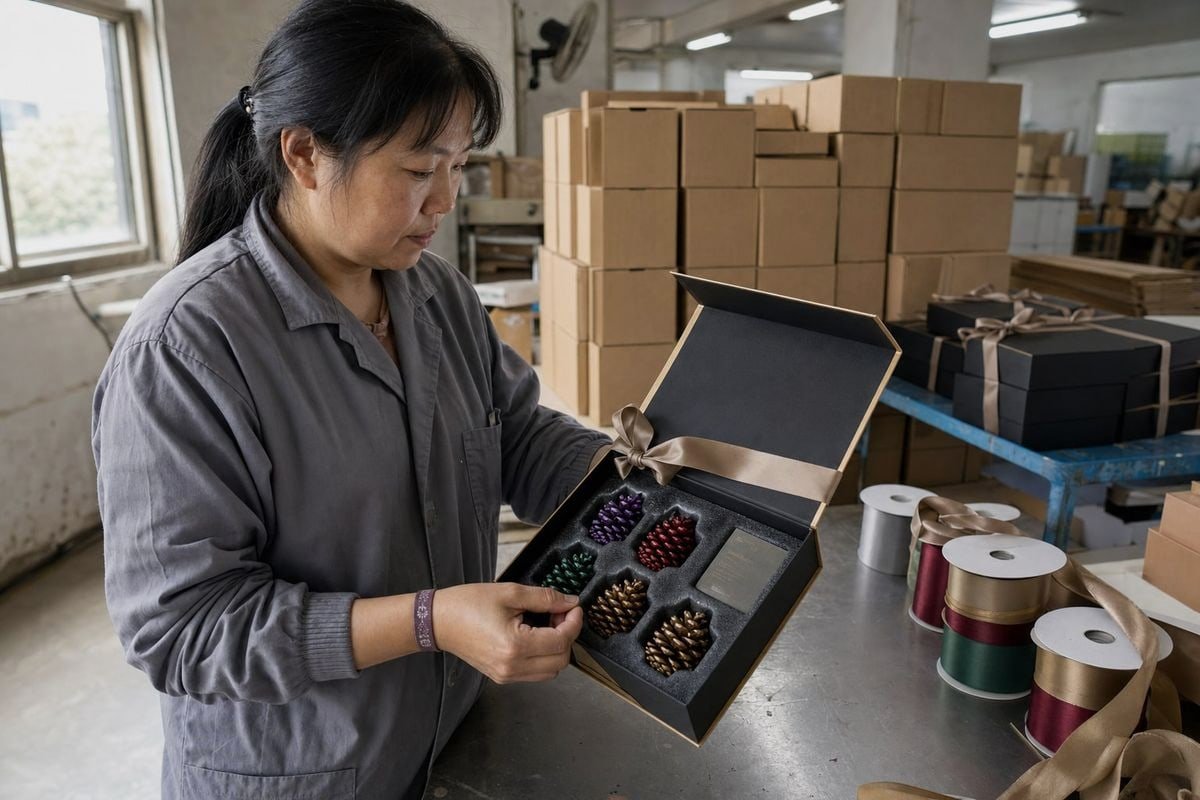
Designing a high-end gift box with card and ribbon for colored pine cones sounds simple — until our packaging team sees another buyer's flimsy, craft-store-looking prototype arrive for review.
To design a high-end gift box for colored pine cones, use a rigid or magnetic-closure box, a restrained color palette, thick double-faced satin or velvet ribbon, a foil-stamped card on premium cardstock, and a fitted insert that protects the painted finish during shipping.
That is the short answer. But if you are sourcing this box from an overseas supplier 1, four practical questions decide whether the final product actually looks premium. Let's walk through each one.
What certifications should I check before approving my gift box supplier's packaging materials?
At our Ningbo facility, compliance paperwork gets reviewed before any packaging artwork does. We learned early that a beautiful box means nothing if customs or a retail auditor rejects it.
Before approving packaging materials, verify ISO 9001 for quality management, BSCI for ethical production, SGS or Intertek test reports on inks and coatings, CE marking where applicable, and FSC or recycled-content documentation if you make eco claims on the box.

Certifications are not decoration for a supplier's website. For fire-themed products like our color-flame pinecones, they are the difference between a smooth port clearance and a container sitting in a bonded warehouse. Over 17 years of exporting to the US, Germany, the UK, and 30+ other markets, we have seen buyers lose entire seasonal windows because a supplier could not produce a valid test report on demand.
The core documents to request
Ask for these before you sign anything. A real factory can send them within a day. A trading company usually needs to "check with the workshop" — which tells you something.
| Certification / Report | What It Covers | Why It Matters for a Gift Box |
|---|---|---|
| ISO 9001 | Quality management system | Batch-to-batch consistency in printing and box rigidity |
| BSCI | Social/ethical compliance | Required by many US and EU retail chains |
| SGS / Intertek reports | Heavy metals, ink safety, material testing | Painted pine cones and printed boxes must pass migration limits |
| CE (where applicable) | EU product safety conformity | Essential for fire-related products sold in Europe |
| FSC / recycled content | Sustainable paper sourcing | Backs up any "eco-friendly" claim printed on packaging |
Check the scope, not just the logo
One thing our compliance team stresses to new buyers: read the scope of the certificate. An ISO 9001 certificate 2 covering "trading services" is not the same as one covering production lines. Also confirm the test report matches the actual materials — the same rigid box with a different metallic spray paint 3 on the pine cones inside may need a fresh report. When we develop private-label packaging for a client, we align the testing plan with their destination market first, because US and EU thresholds are not identical.
A German distributor once sent us photos of a competitor's shipment: gorgeous painted cones, chipped bare by loose packing. That single complaint shaped how we spec every ribbon and insert today.
Choose double-faced satin, grosgrain, or velvet ribbon at least 25mm wide, paired with 300gsm or heavier premium cardstock for the note card. Combine these with a fitted insert or nesting tray so the painted pine cones never rub against each other in transit.

Shipping is the silent killer of artisanal gift presentation. A box can leave the factory looking flawless and arrive looking tired. In our experience, three components decide the outcome: the ribbon, the card, and the internal structure. Get all three right and even a six-week sea shipment to the US East Coast arrives shelf-ready.
Ribbon: weight beats width
Thin polyester ribbon crushes flat and creases under carton pressure. Double-faced satin ribbon holds its body, and velvet actually improves the tactile impression after handling. Simple satin ribbon techniques — a layered wrap with an oversized bow tied at final packing rather than at the print stage — prevent the bow from being flattened in the master carton. For rustic holiday decor themes, a textured cotton or linen-blend ribbon over a kraft box also travels well.
Card: cardstock and finish
Premium cardstock selection matters more than the design itself. We recommend 300–350gsm stock with a matte laminate 4 or soft-touch finish, plus foil stamping for the logo. Custom gift tags punched and threaded through the ribbon knot survive shipping better than loose inserted cards, which slide and dent corners.
Insert and filler: structure first, styling second
| Component | Budget Option | Premium Option | Shipping Performance |
|---|---|---|---|
| Insert | Shredded paper | Custom die-cut nesting tray | Tray prevents paint chipping from friction |
| Filler | Crinkle paper | Wood wool or tissue paper layering | Wood wool cushions and looks organic |
| Lining | Plain white tissue | Silk or linen-textured liner | Adds luxury cue, protects glossy finishes |
| Ribbon | 15mm single-face satin | 25–38mm double-faced satin or velvet | Wider ribbon resists creasing |
Among box filler ideas, wood wool is our default for colored pine cones: it grips the cones, hides minor shifting, and reinforces the natural premium aesthetic.
Can I get custom branding and private-label options on the gift box without committing to a huge MOQ?
Trial orders are where trust gets built. Roughly half the private-label projects we run start with a buyer who was burned by a supplier demanding 20,000 units before printing a single logo.
Yes. A capable factory can offer private-label gift boxes at trial-friendly MOQs by using standard box structures with custom printed sleeves, foil-stamped cards, branded tags, and custom ribbon — reserving fully bespoke box tooling for repeat orders at higher volumes.

The trick to low-MOQ branding is knowing which elements carry the brand impression and which elements carry the tooling cost. They are not the same list. Full custom box dies, embossing plates, and magnetic-closure molds are expensive to set up, so they push MOQs up. But most of the perceived branding on a gift box comes from cheaper, flexible elements.
Branding elements ranked by MOQ impact
- Printed sleeve or belly band — low MOQ, high visual impact. It wraps a stock rigid box and carries your full-color artwork.
- Foil-stamped note card and custom gift tags — very low MOQ. Small-format printing is cheap to run in short batches.
- Custom ribbon printing — moderate MOQ. Plain premium ribbon in your brand color needs almost no minimum; logo-printed ribbon needs a modest run.
- Custom box color and logo hot-stamping — moderate MOQ, using existing box tooling.
- Fully bespoke box structure — highest MOQ. Save this for your second or third reorder once sell-through is proven.
When we set up private-label programs 5 for camping brands and fireplace distributors, we usually propose a phased path: start with a stock magnetic box, custom sleeve, branded card, and coordinated ribbon. Color palette coordination across these four items — say, navy box, gold foil, cream ribbon — reads as fully bespoke to the end customer. Once the buyer confirms retail demand, we move them to dedicated tooling with barcodes, warning labels, and display packaging 6 included. This protects your cash flow and our production planning at the same time.
How do I make sure my first gift box sample matches what I'll actually receive in mass production?
The hardest lesson from our first decade of exporting: a perfect sample proves nothing unless the factory can document how it was made. Repeatability is a system, not a promise.
Request a pre-production sample made on the actual production line, approve a signed golden sample with documented specs for cardstock weight, ribbon width, paint finish, and insert dimensions, then require batch QC photos and a pre-shipment inspection against that golden sample.

Samples fail buyers in a predictable way. The sample room hand-finishes one beautiful box; mass production then substitutes a lighter cardstock, a narrower ribbon, or a slightly different metallic spray paint on the cones — and each small change alone looks defensible. Together, they gut the premium feel. Our answer, refined over 17 years and strict batch-to-batch quality control, is to lock every variable in writing before tooling starts.
The golden sample checklist
| Spec to Lock | How to Document It | Common Drift in Mass Production |
|---|---|---|
| Box board thickness | Grams per square meter, stated on the spec sheet | Thinner chipboard that flexes under pressure |
| Ribbon | Material, width in mm, physical swatch attached | Single-face satin swapped for double-face |
| Card | Cardstock weight, finish, foil color code | Lighter stock, digital print replacing foil |
| Pine cone finish | Paint/wax type, gloss level, color standard | Duller sheen, weaker gold-tip detailing |
| Insert fit | Die-line drawing plus drop test | Looser cavities that let cones shift |
Three checkpoints, not one
First, insist the pre-production sample comes off the real line, not the sample room. Second, sign and keep two golden samples — one at the factory, one with you — so disputes have a physical reference. Third, book a pre-shipment inspection 7 that compares random cartons against your retained sample. When we run this process for our color-flame pinecone gift sets, the first sample reliably reflects mass-production quality because the same lines, the same operators, and the same materials produce both. Any supplier who resists this three-checkpoint structure is telling you how the story ends.
Conclusion
A cheap-feeling box quietly kills a premium product before anyone opens it. Certified luxury packaging materials, ship-proof ribbon and card choices, low-MOQ private labeling, and a locked golden sample solve that. Get those four right, and colored pine cones stop looking rustic-craft and



 English
  Spanish
  German
  French
  Arabic
  Portuguese
Join the Conversation