






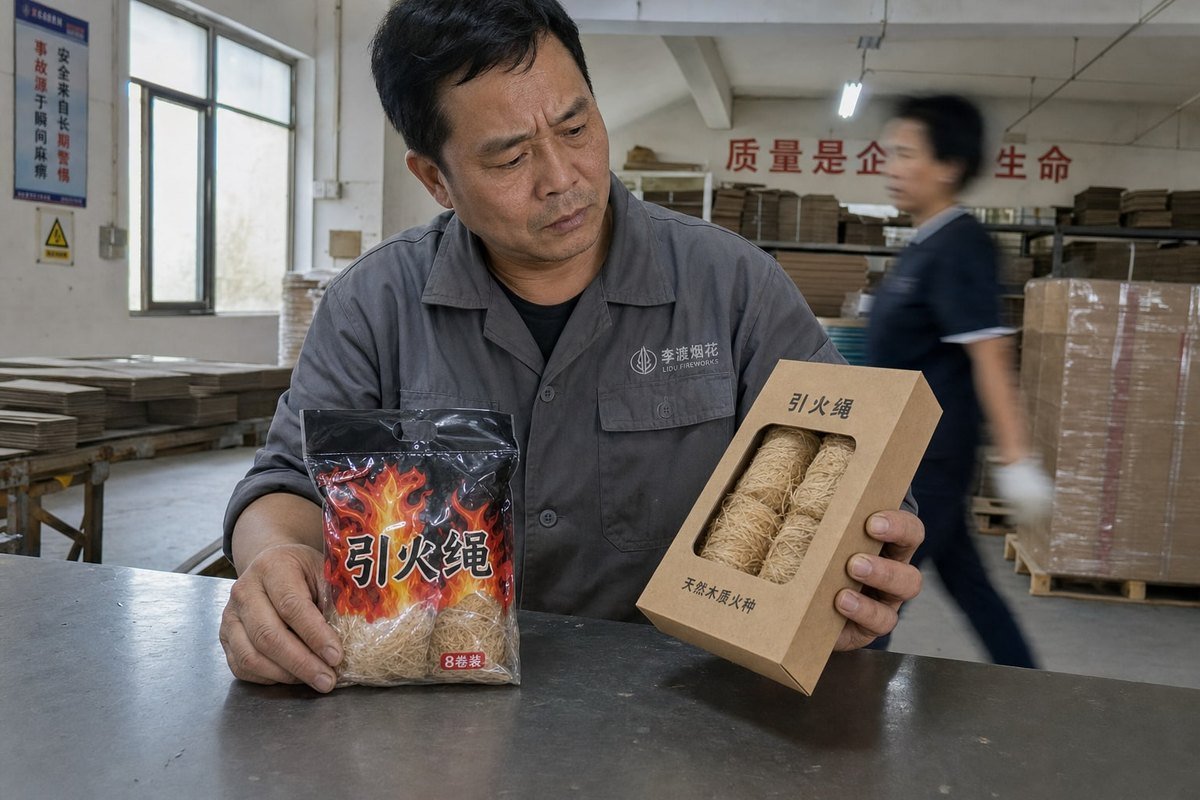
Premium positioning for wood fire starters often fails at the box, not the product moisture-resistant barrier coating 1. On our production line, I have seen excellent wax-dipped wood rolls get rejected by retail buyers simply because the packaging looked cheap. That hurts, because the buyer never even lit one.
Packaging conveys premium positioning for wood fire starters through moisture-resistant barrier materials, refined print quality, structured formats like rigid boxes or tins, natural-fiber textures, and clear usability cues. Together, these signal reliability, craftsmanship, and eco-conscious value that justify a higher retail price.
Let me break this down into four practical decisions. Each one shapes how your customers perceive your brand before they ever strike a match.
How Do I Choose Packaging Materials That Signal Premium Quality to My Customers?
A few years back, a German distributor sent me two competitor boxes and asked a blunt question: why does one feel expensive and the other feel disposable? The answer was material choice, not graphics.
Choose packaging materials that combine natural texture with real protection: FSC-certified kraft board, rigid paperboard, jute pouches, or metal tins with a moisture-resistant barrier coating. Premium perception comes from tactile weight, matte finishes, and materials that visibly match an eco-friendly product story.
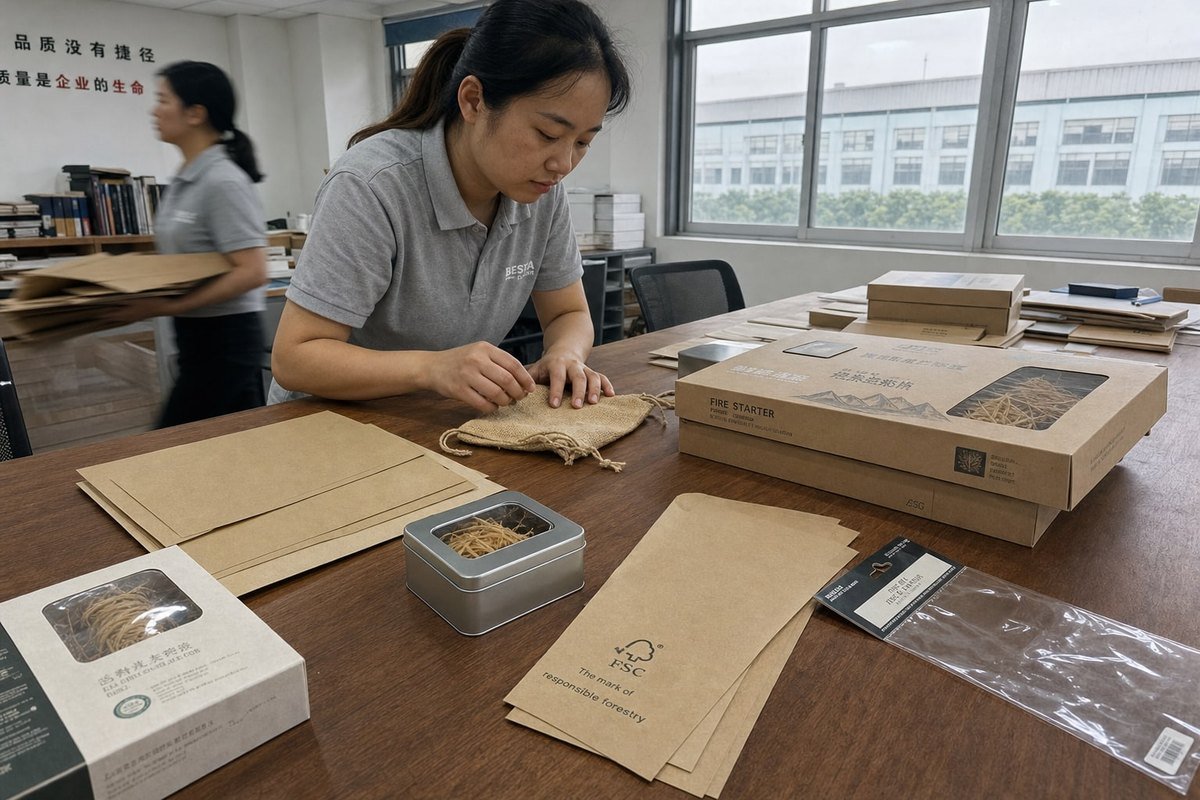
Material is the first thing a buyer touches, so it carries most of the premium signal. In our experience exporting to the US and Germany, retail buyers judge a sample box within seconds. Thin, glossy folding cartons read as commodity. Heavier board with a matte lamination reads as considered. That first tactile impression sets the price expectation.
For wood fire starters, the material has to do two jobs. It must look natural, and it must keep wax-dipped wood wool dry through ocean freight, warehousing, and retail handling. This is why we pair sustainable packaging materials 2 with a moisture-resistant barrier coating on the inside. The outside tells the eco story. The inside protects the burn performance.
Matching Material to Brand Position
Different market segments reward different materials. Here is how I map them for our OEM clients:
| Material | Premium Signal | Best For | Watch Out For |
|---|---|---|---|
| FSC-certified kraft board | Eco-credibility, craft feel | Outdoor and camping brands | Needs inner moisture liner |
| Rigid paperboard box | Engineered, giftable | Luxury hearth and home retailers | Higher unit cost |
| Jute drawstring pouch | Artisanal, reusable | Farm shops, gift traders | Weak moisture barrier alone |
| Metal tin | Durable, reusable, upscale | High-end fireplace accessories | Higher freight weight |
| Poly bag with header card | Low cost, visible product | Discount channels only | Undermines premium pricing |
One more point matters. The material story must be honest. If your label says natural and sustainable, but the customer finds a plastic tray inside, trust breaks. We advise clients to use paper-based inner dividers or shredded wood fill, which reinforces eco-friendly brand storytelling right down to the last layer of the tactile unboxing experience.
Can Custom Branding and Labeling Help My Wood Fire Starters Stand Out on Retail Shelves?
There is a shelf test I run with every new private-label design our team develops in Ningbo. We place the mockup between two best-selling competitor boxes and step back three meters. If your eye does not land on ours first, we redesign.
Yes. Custom branding with clean typography, a muted earth-tone palette, a visible product window, and quick-read usage icons makes wood fire starters stand out against bright, industrial mass-market packs. Distinctive private-label design shifts the product from commodity fuel to a branded lifestyle item.
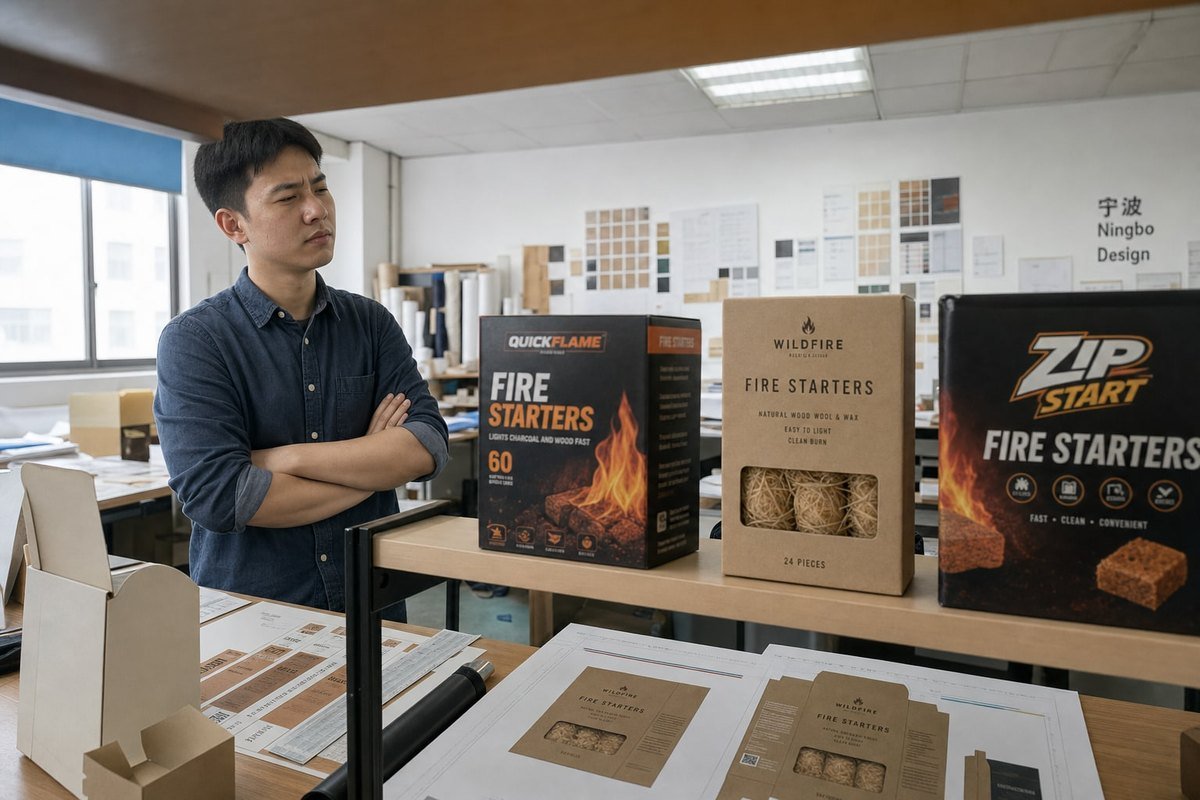
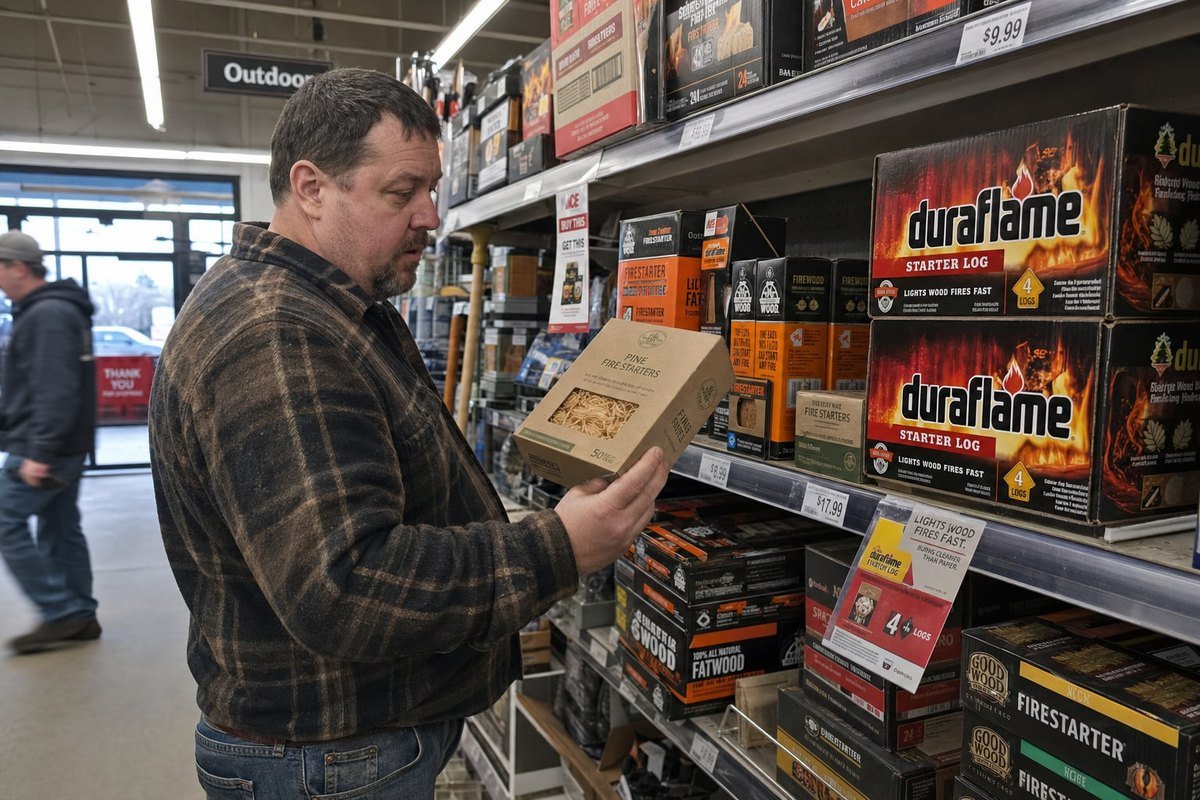
Most fire starter packaging in big-box retail looks the same. Black boxes, orange flames, bold shouting text. Our own standard export box uses that style too, because it works in high-volume channels. But when a client wants premium positioning, we push the opposite direction: minimalist aesthetic design 3, restrained color, and generous white space. On a crowded shelf, quiet stands out.
Branding Elements That Earn a Second Look
Here is the priority order I recommend to purchasing managers building a private label 4:
- A die-cut window or photo panel. Buyers want to see the fibrous wood wool texture. Visible product proves the artisanal wood firelighters inside are natural, not chemical blocks.
- Ingredient transparency on the front. Wood wool, food-grade wax, no harmful chemicals. Plain claims justify a premium price and support ingredient-conscious shoppers.
- Usage icons. One match, one starter, burn time in minutes. Icons reduce friction at the point of sale and make the pack feel engineered.
- A short origin story on the back. Two or three sentences about sourcing and craft. This is where eco-friendly brand storytelling lives.
- Barcode, warning labels, and compliance marks placed cleanly. Sloppy label placement quietly signals a sloppy factory.
We handle all of this in-house as part of one-stop OEM support, including custom boxes, display packaging, and barcodes. My honest advice: invest your design budget in typography and structure before foil stamping. A well-set logo on heavy matte board outperforms gold foil on thin stock every time.
What Packaging Compliance Standards Should I Verify Before Importing Wood Fire Starters?
Compliance questions come up in nearly every first call I have with US and European buyers, and rightly so. After 17 years of exporting fire-starting goods to 30+ countries, I can say the buyers who check compliance first save themselves the most pain later.
Verify flammable-goods labeling and hazard warnings for your market, packaging material safety and recyclability rules, accurate net-weight and origin marking, barcode and retailer labeling specs, and factory-level certifications such as ISO 9001, BSCI, CE marking, and third-party SGS or Intertek test reports.
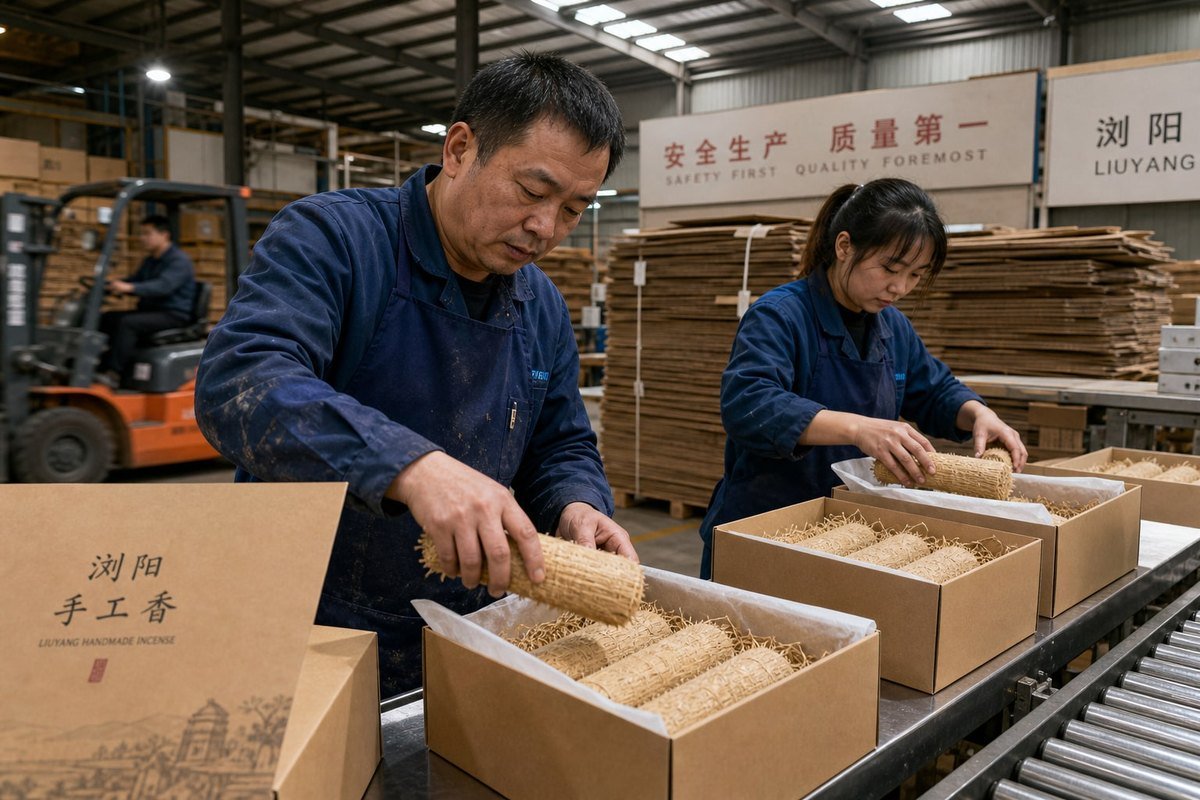
Premium positioning collapses instantly if a shipment is held at customs or pulled from shelves. So I treat compliance as part of the packaging design, not an afterthought. Warning text, pictograms, and certification marks 5 need to be planned into the layout from day one, or they end up crammed into a corner as ugly stickers.
The Compliance Checklist I Walk Buyers Through
| Compliance Area | What to Verify | Why It Matters |
|---|---|---|
| Product safety marks | CE marking where applicable, third-party test reports 6 from SGS or Intertek | Retail chains often refuse listings without documented test evidence |
| Hazard and warning labels | Correct flammability warnings, keep-away-from-children text, market language requirements | Missing warnings can trigger recalls and liability exposure |
| Packaging material rules | Recyclability symbols, packaging waste directives in the EU, state-level rules in the US | Eco claims must be legally supportable, not just marketing |
| Labeling accuracy | Net weight, piece count, country of origin, importer address | Customs and retailers audit these details on arrival |
| Factory credentials | ISO 9001 quality system, BSCI social audit | Large sourcing channels require audited suppliers |
| Retailer specs | Barcode format, carton markings, display-ready packaging rules | Non-compliant cartons get rejected at distribution centers |
One practical note from our side. Because we run our own production lines rather than trading, we keep current test reports on file and share them before sampling. I always tell buyers: ask for the actual report, not just a claim that certification exists. A supplier who hesitates to send documents is telling you something important. For premium wood fire starters, compliant packaging is also a trust signal to end customers, since visible certification marks reinforce the professional-grade perception you are paying to build.
How Do I Balance Premium Packaging Design With Cost-Effective MOQs for a Trial Order?
The trade-off I weigh most often with new clients is this: rigid gift boxes look fantastic, but their tooling and minimums can crush a trial-order budget. A Canadian importer once asked us for a 500-unit trial in full luxury packaging, and we had to redesign the plan together.
Balance premium design with trial-order economics by using standard box structures with custom printing, digital or short-run print methods, shared tooling, and phased upgrades. Start with a well-printed kraft carton or sleeve, validate sell-through, then invest in rigid boxes, tins, or windows at reorder volume.
Premium does not have to mean expensive at the start. It has to mean coherent. On a trial order, your goal is to test whether the market accepts your positioning, not to win a design award. So we guide clients through a phased approach that protects both budget and brand.
A Phased Packaging Strategy for New Importers
| Phase | Typical Volume | Packaging Approach | Premium Cues Retained |
|---|---|---|---|
| Trial order | 500–2,000 units | Standard-size kraft carton, custom digital print, matte finish | Natural material, clean typography, ingredient transparency |
| First reorder | 3,000–10,000 units | Offset printing, die-cut window, custom insert | Visible product, tactile unboxing experience |
| Scale-up | 10,000+ units | Rigid box, tin, or jute pouch options, seasonal editions | Giftable product presentation, reusable formats |
A few cost levers make this work. First, standard box dimensions avoid new tooling charges. Second, one print design across multiple SKUs spreads plate costs. Third, an unprinted inner liner with a printed outer sleeve delivers a premium layered feel at folding-carton prices. Fourth, FSC-certified wood products 7 and papers can often be sourced at modest premiums when planned early, so your eco claims survive the budget review.
I will be direct about one thing. We position ourselves as a long-term partner, not the cheapest quote, and our flexible MOQs exist so buyers can prove the concept properly. A trial order in honest, well-executed packaging tells you far more than a compromised version of a luxury design. Validate first. Upgrade with confidence later.
Conclusion
Weak packaging quietly caps your price and your shelf placement. Premium wood fire starter packaging solves this: protective materials, honest branding, verified compliance, and phased investment build lasting trust.
Footnotes
1. Background on packaging science concepts like barrier coatings and protective materials. ↩︎
2. EPA resource on sustainable materials management supports the eco-friendly packaging claims discussed. ↩︎
3. Provides design context for the minimalist branding approach recommended in the article. ↩︎
4. Background on private label branding strategy relevant to the packaging design guidance. ↩︎
5. Comprehensive Wikipedia entry explaining certification marks and their global use in verifying product quality and safety standards. ↩︎
6. SGS is a named third-party testing authority mentioned for compliance verification. ↩︎
7. Explains the forest stewardship certification standard referenced for sustainable packaging sourcing. ↩︎



 English
  Spanish
  German
  French
  Arabic
  Portuguese
Join the Conversation