






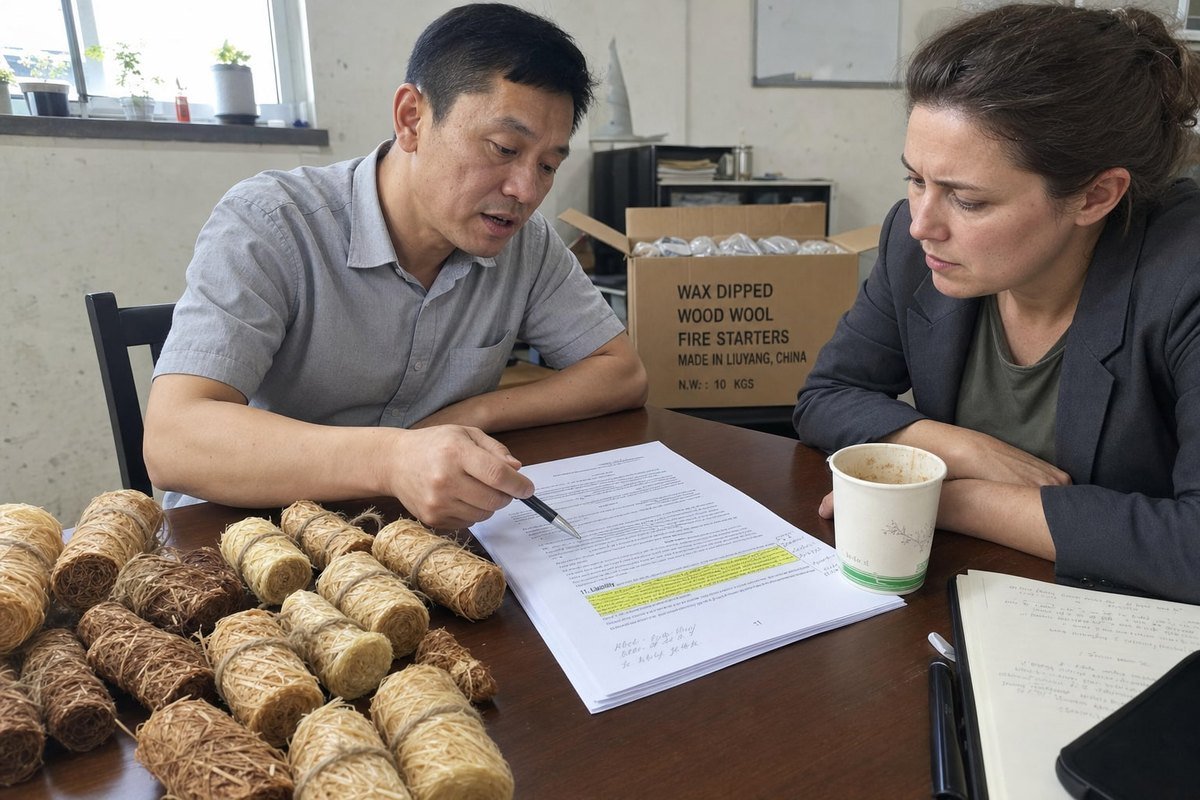
Liability and compensation clauses for wood fire starters decide who pays when something burns wrong. I have watched buyers sign generic contracts, then face recall bills alone. Our export team helps them draft smarter terms instead.
Define liability and compensation clauses by tying them to real fire-related risks: require supplier indemnification for defect-caused injury and property damage, cap ordinary breach liability at contract value, carve out recalls and gross negligence, mandate product liability insurance, and use liquidated damages only for delivery failures.
That is the short answer. But each of those elements needs careful drafting. Below, I walk through the four questions every importer should resolve before signing a [purchase agreement for ignition products](https://sunrichfire.com/what-key-terms-specify-wood-fire-starters-contract/).
What liability clauses should I require from my wood fire starter supplier before signing a contract?
A German distributor once sent me a draft contract written for garden furniture. Our wax-dipped wood rolls are ignition products, so I sent it back with the liability section rewritten from scratch.
Require an indemnification clause covering third-party injury, property damage, and defect claims; a warranty of compliance with safety and labeling laws; a defined limitation of liability with carve-outs; a force majeure clause excluding quality defects; and clear allocation of recall and disposal costs.
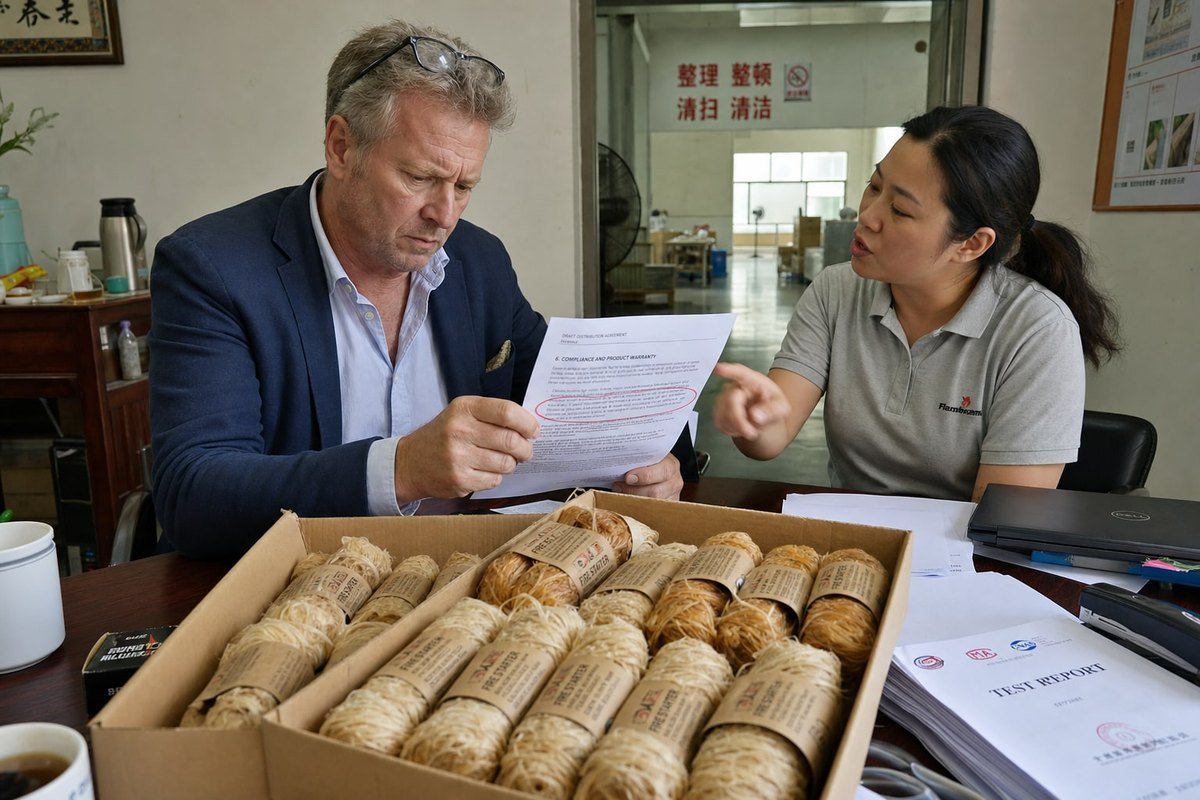
The core mistake I see is buyers relying on "standard goods" boilerplate. Wood fire starters are flammable solids by design. Their failure modes are not scratches or color fading. They include property fires, personal injury from flare-ups, and shipping violations. Your liability clauses must anticipate those specific hazards, not generic commercial ones.
The five clause types that matter most
Start by separating liability into its distinct layers. Each layer needs its own language, and the layers must not contradict each other. In our 17+ years exporting fire products to the US and Europe, contracts that mix indemnity language with liability caps in a single vague paragraph cause the longest disputes.
| Clause Type | What It Covers | Key Drafting Point |
|---|---|---|
| Indemnification provisions | Third-party claims for injury, property damage, product liability | Use "to the extent caused by" language, not "all losses" |
| Limitation of liability | Overall cap on supplier exposure | Cap at contract value, with fire-harm carve-outs |
| Compliance warranty | Safety, labeling, packaging, transport laws | Name the specific regulations and markets |
| Recall allocation | Notice, retrieval, replacement, refunds | Assign each cost line to a party |
| Force majeure clause 1 | Uncontrollable non-performance events | Exclude defects the supplier could prevent |
Match scope to control
A good rule from procurement practice: allocate each risk to the party best able to prevent it. We control formulation, wax coating, packaging, and warning labels. So we accept liability tied to those. You control storage after delivery, retail display, and end-customer instructions. A fair contract reflects that split. Avoid overbroad "hold harmless" wording without scope. Precise verbs like "pay," "compensate," and "reimburse," plus a defined term for "loss," protect both sides from accidental risk transfer neither party intended.
How do I define compensation terms if a product defect leads to safety incidents or recalls?
Years ago, a wholesaler asked us a blunt question: if one defective batch ignited unpredictably on a customer's patio, who would pay for the recall? We built our answer into every contract since.
Define compensation by listing recoverable loss categories explicitly: replacement goods, recall logistics, customer refunds, disposal, third-party injury settlements, and regulatory fines. Exclude undefined consequential losses, but preserve direct recovery for fire damage caused by defective units, backed by supplier insurance.
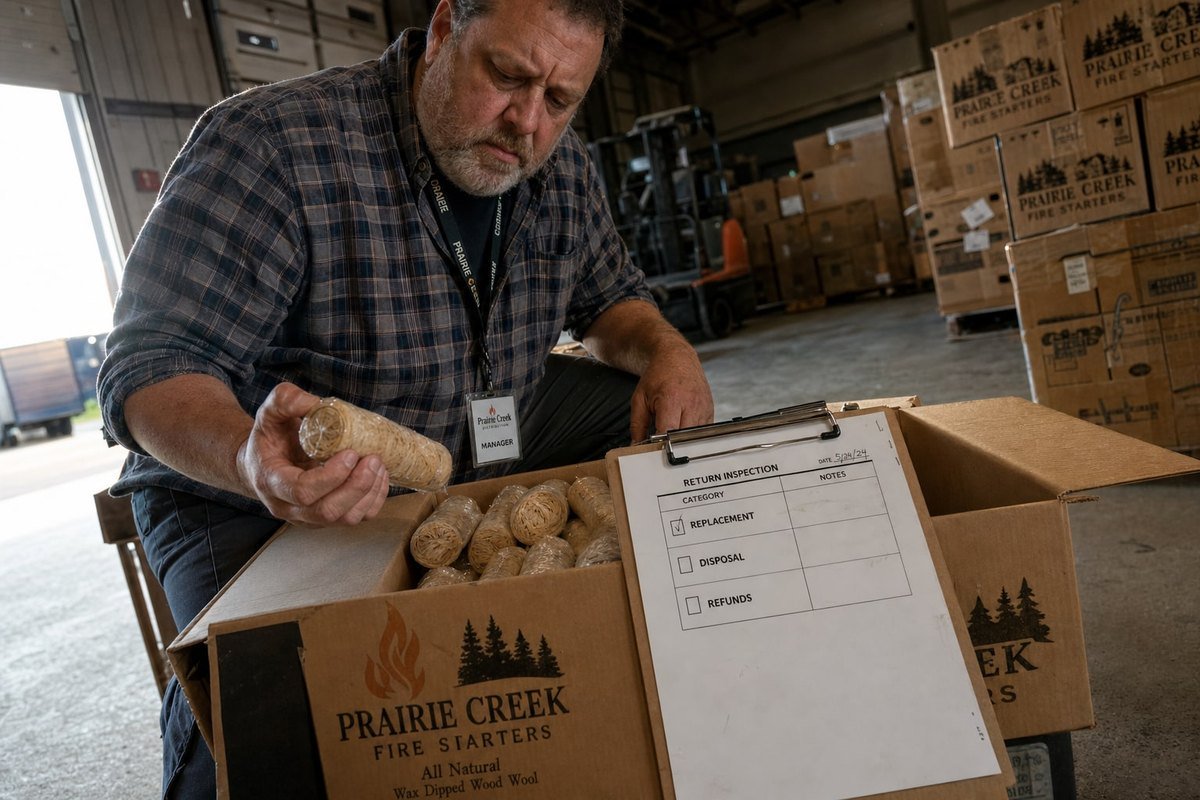
Compensation clauses answer a simple question: who gets paid for what loss? Liability clauses then set how far that payment obligation goes. Confusing the two creates gaps. In my experience negotiating with importers across 30+ countries, the strongest contracts itemize loss categories rather than using catch-all phrases.
Separate direct losses from consequential losses
Most commercial contracts exclude indirect or consequential loss, loss of profits, and loss of use. That is reasonable. But for an ignition product, you must define those terms carefully. Fire damage to a customer's deck caused by a defective unit is a direct, foreseeable loss. Do not let a lazy "no consequential damages" clause swallow it. Define "consequential loss" in the contract, and expressly state that defect-caused property damage and bodily injury are recoverable direct losses.
Allocate recall costs line by line
A recall involves many distinct expenses. Assign each one. A typical fair allocation for a defect traced to manufacturing looks like this:
| Recall Cost Item | Defect Caused by Supplier | Defect Caused by Buyer's Storage |
|---|---|---|
| Regulatory notice and filing | Supplier | Buyer |
| Retrieval and reverse logistics | Supplier | Buyer |
| Replacement product | Supplier | Buyer |
| Safe disposal of flammable stock | Supplier | Shared |
| Customer refunds | Supplier | Buyer |
| Brand-damage remediation | Negotiated | Buyer |
Add root-cause discipline
Compensation should follow evidence. We keep batch records and retained samples on our production lines exactly so a defect claim can be traced to a specific lot. Require your supplier to cooperate in root-cause analysis, and tie the payment trigger to that finding. This keeps breach of contract remedies fair and keeps disputes short. Also consider a reputational indemnity if the supplier misrepresents material sourcing, since illegal or undisclosed inputs can trigger recalls even when the product burns fine.
What certifications and test reports should I request to reduce my liability risk as an importer?
When a US retail sourcing team audited our Ningbo facility, they asked for our full document stack before discussing price. That order of priorities was exactly right.
Request ISO 9001 quality system certification, third-party test reports from labs like SGS or Intertek, a Safety Data Sheet, flammability and burn-performance test results, transport classification documents for flammable solids, social compliance audits such as BSCI, and FSC certification where sustainability claims appear on packaging.
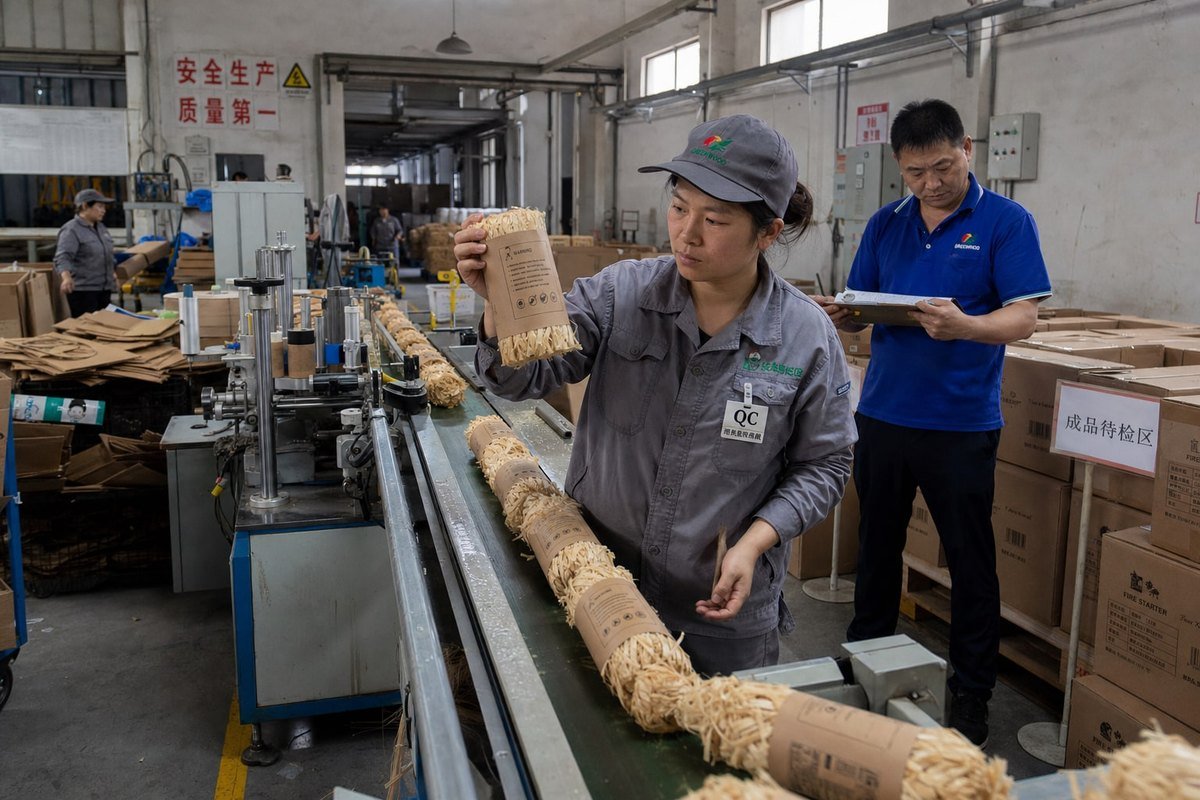
Documentation is your first line of defense as an importer. If a claim arises, regulators and courts will ask what due diligence you performed. A complete file showing certified production, independent testing, and compliant transport shifts the negligence question back toward the supplier and strengthens your indemnification provisions in practice, not just on paper.
The document checklist
Here is the stack I recommend every buyer request, based on what our own compliance team maintains for the US, German, UK, and French markets:
| Document | Purpose | Liability Effect |
|---|---|---|
| ISO 9001 2 certificate | Proves a working quality management system | Supports consistent batch quality claims |
| SGS or Intertek test reports | Independent verification against flammability testing standards 3 | Establishes baseline product safety |
| Safety Data Sheet (SDS) | Discloses wax, wood, and any additives Safety Data Sheet 4 | Protects against non-disclosure claims |
| Transport classification (IMDG/IATA) | Confirms legal sea or air shipment of flammable solids | Shifts transport non-compliance risk to supplier |
| BSCI audit report | Verifies ethical production | Reduces reputational and supply-chain exposure |
| FSC certification 5 or chain-of-custody | Backs sustainable-wood claims | Prevents greenwashing penalties and sourcing disputes |
| CE marking documentation | Confirms EU market conformity where applicable | Supports customs clearance and retail listing |
Make documents contractual, not decorative
A certificate on a website means little. Write the documents into the contract as warranties. State that the supplier warrants the certifications remain valid throughout the supply relationship, and that loss of a certification triggers notice obligations and, where relevant, compensation. If your packaging says "natural" or "chemical-free," require the SDS and test reports to substantiate it. Undisclosed chemical accelerants in a product marketed for grills can create food-safety contamination exposure, and your contract should indemnify you against exactly that scenario.
How can I structure penalty clauses in my purchase agreement to protect against quality inconsistencies?
The trade-off I weigh most often in negotiations is this: buyers want automatic penalties, while we want penalties tied to measurable specifications. The compromise is almost always better for both sides.
Structure penalties as tiered liquidated damages tied to measurable specifications: delivery delay per week, moisture content variance, burn-time shortfall, and short shipments. Keep penalties for performance failures separate from indemnity for injury claims, and cap liquidated damages while preserving termination rights for repeated breaches.
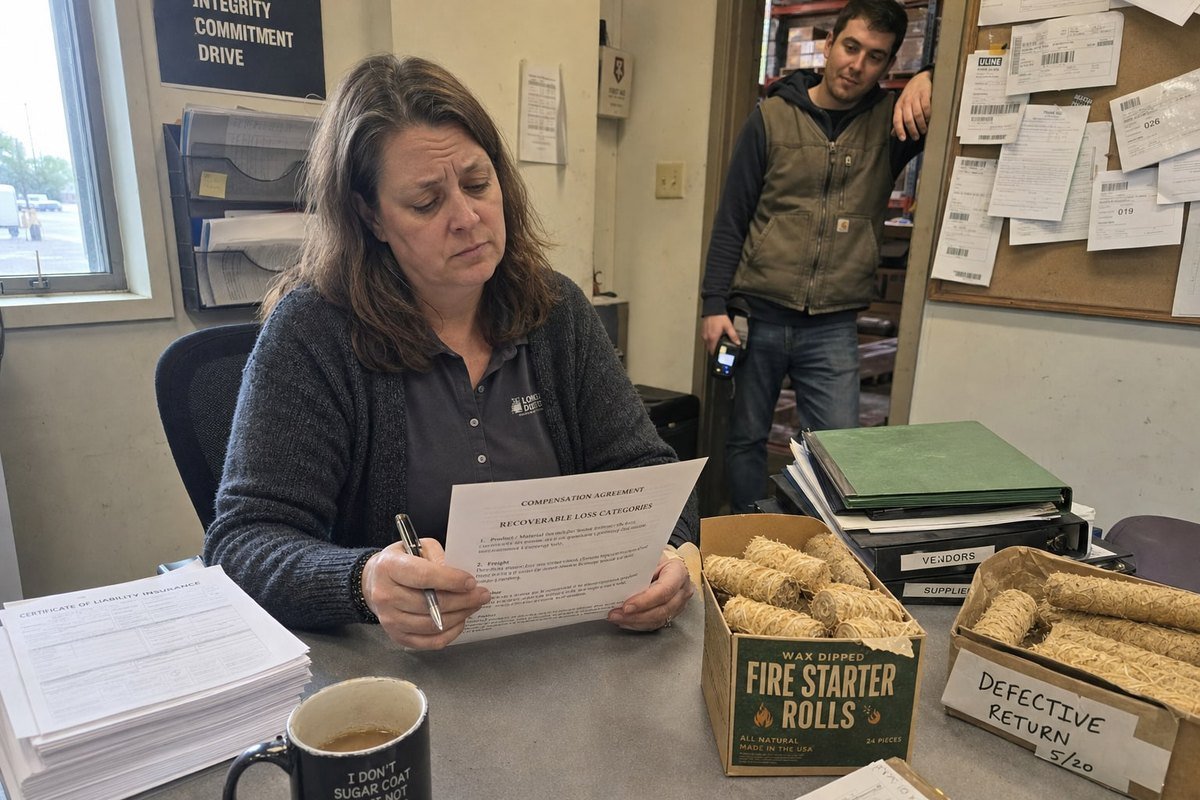
Penalty clauses fail when they punish things nobody can measure. They work when they attach fixed amounts to objective, testable specifications. For wood fire starters, the key measurables are moisture content, wax coating weight, burn time, ignition reliability, and delivery timing. Our quality assurance protocols track these values batch by batch precisely because buyers write them into contracts.
Build a tiered liquidated damages schedule
Liquidated damages 6 exist for predictable, quantifiable performance failures. They are not a substitute for product liability insurance 7 or indemnity after a harmful event. Keep the two remedy tracks separate. A workable tiered structure looks like this:
- Delivery delay: a small percentage of the order value per week late, capped at an agreed maximum, with a right to cancel beyond a hard deadline.
- Short shipment: pro-rata refund plus expedited replacement at supplier cost.
- Moisture variance: tiered deductions when tested moisture exceeds the agreed specification, since excess moisture causes ignition failure and breaches the performance warranty.
- Burn-time shortfall: a per-batch credit when average burn time falls below the warranted minimum.
- Repeated non-conformance: termination rights plus recovery of re-sourcing costs after a defined number of failed batches.
Anchor penalties to an agreed testing method
A penalty without a test method invites disputes. Specify who tests, which lab, which sampling standard, and which tolerance applies. We provide retained samples from every production run so a third-party lab can arbitrate disagreements. Also confirm your force majeure clause excuses only genuine non-performance events. It should never excuse quality defects, poor packaging, or careless storage, because those sit fully within the supplier's control.
Conclusion
Strong liability and compensation clauses do not eliminate risk. They allocate it to the party best able to prevent, insure, and absorb it. I have seen generic contracts leave importers exposed exactly when a defect strikes. Match your clauses to the real hazards of wood fire starters: require scoped indemnification, defined loss categories, a capped limitation of liability with fire-harm carve-outs, verified certifications, adequate insurance, and measurable penalty triggers. Then choose a supplier whose documentation and production discipline make those clauses enforceable in practice. That combination of contract language, insurance backing, and operational control is what actually protects your business.
Footnotes
1. Wikipedia explains the legal concept of force majeure excluding uncontrollable events from liability. ↩︎
2. Authoritative Wikipedia entry providing a comprehensive overview of the ISO 9001 quality management standard. ↩︎
3. Background reference on flammability testing concepts relevant to fire starter safety verification. ↩︎
4. Explains the purpose and standardized format of SDS documents mentioned for chemical disclosure. ↩︎
5. Official FSC site verifies chain-of-custody sustainability claims referenced for wood sourcing. ↩︎
6. Defines the contractual remedy concept used for delivery delay and specification penalties. ↩︎
7. Trade.gov guidance explains product liability insurance relevant to import risk protection. ↩︎



 English
  Spanish
  German
  French
  Arabic
  Portuguese
Join the Conversation