







Liability for late delivery in a wood fire starters contract can make or break a season. I have seen buyers lose shelf space 1 over one missed shipping window, and our factory rewrote its own delivery clauses after helping a distributor recover from exactly that scenario.
Define liability for late delivery by fixing a precise delivery trigger, stating whether time is of the essence, setting liquidated damages such as 0.5–1% of order value per week of delay, capping total exposure at 5–15%, and carving out force majeure and buyer-caused delays.
That is the short answer. But each of those elements needs careful drafting. Below, I walk through the clauses, the math, the excuses, and the guarantees you should negotiate before you sign.
What clauses should I include to protect my business from late delivery penalties?
A few years back, one of our German fireplace distributors sent us a draft contract with a single vague line: "Goods shall be delivered promptly." Our export team pushed back — vague wording protects nobody, including the buyer.
Include a precise delivery definition tied to an Incoterms rule, a time is of the essence statement, a liquidated damages clause with a per-week rate, a 24–48 hour delay notice obligation, a grace period, a cover right, a liability cap, and termination for default provisions.

The biggest drafting mistake I see is treating "delivery" as one event. It is not. In a wood fire starters deal, delivery could mean the date we hand wax-dipped wood rolls to the carrier in Ningbo, the date the container clears your port, or the date your warehouse accepts the goods after inspection. Each definition shifts the liability trigger. Tie your definition to a specific Incoterms rule — FOB, CIF, or DDP — so both sides know exactly when risk and lateness are measured.
The core protective clauses
Here is the clause set I recommend to every buyer who works with us:
| Clause | What it does | Buyer benefit |
|---|---|---|
| Delivery definition + Incoterms | Fixes the exact liability trigger | No arguments over "when" |
| Time is of the essence | Makes the deadline a material term | Enables termination for serious delay |
| Liquidated damages | Pre-agreed compensation per week late | No need to prove actual loss |
| Delay notice (24–48 hours) | Forces early warning of problems | Time to mitigate and re-plan |
| Grace period | Short cure window before penalties | Keeps minor slips commercial, not legal |
| Cover right | Buy elsewhere at seller's expense | Protects seasonal shelf commitments |
| Liability cap | Limits total exposure, often 5–15% | Keeps suppliers willing to sign |
| Termination for default | Exit for repeated or material delay | Ends a failing relationship cleanly |
Why the notice clause matters most
In our experience exporting to 30+ countries, the notice obligation prevents more losses than any penalty does. If we spot a raw material bottleneck 2 in week two of production, a contractual duty to notify you within 48 hours gives you six weeks to adjust promotions, reroute freight, or split the shipment. A penalty clause 3 only pays you after the damage is done. A notice clause helps you avoid the damage entirely. Pair the two, and add a mitigation of loss duty on both sides so neither party can sit back and let losses pile up.
How do I calculate fair compensation if my wood fire starters shipment arrives late?
The trickiest negotiation I ever sat through involved a UK importer who wanted uncapped damages and a supplier-side colleague who wanted zero. We landed in the middle, and the deal has run smoothly for years since.
Calculate fair compensation using liquidated damages of 0.5–1% of the order value per commenced week of delay, capped at 5–15% of the total order. Alternatively, claim actual damages: cover costs, lost margin, expedited freight, and foreseeable losses flowing directly from the breach.

There are two broad models, and your contract should pick one deliberately rather than leave it to a dispute.
Model one: liquidated damages
Liquidated damages fix the compensation in advance. You do not need to prove your actual loss, which matters because retail losses are hard to quantify. How do you value lost shelf space in a hardware chain? How do you price a cancelled autumn promotion? A pre-agreed formula skips that fight. Well-known public procurement terms use around 0.5% of the purchase price per commenced week, capped at 7.5% — a sensible benchmark. One drafting warning: describe the figure as a genuine pre-estimate of loss, not a punishment. Courts in many jurisdictions strike down penalty clauses that are purely punitive.
Model two: actual damages
If you claim actual damages 4 instead, the classic measure is the loss flowing directly and naturally from the breach of contract. Where a market exists, that often means the price difference between the contract price and the market price 5 when delivery should have happened. But for seasonal fire products, the bigger losses are usually downstream — and that is where consequential damages become the battleground.
| Loss type | Typically recoverable? | Notes |
|---|---|---|
| Price difference on cover purchase | Yes | Core direct loss |
| Expedited air or express freight | Usually | If reasonably incurred to mitigate |
| Lost gross margin on cancelled orders | Sometimes | Must be foreseeable at signing |
| Lost slotting fees / shelf placement | Contested | Spell it out expressly if you want it |
| Reputational harm, business interruption | Rarely | Often excluded as consequential damages |
A seasonal multiplier worth considering
Some buyers now negotiate an escalated rate for delays landing in the October–December window, since a two-week delay in November destroys far more value than the same delay in April. Our factory accepts this logic when the buyer commits to firm forecasts early enough for us to plan capacity.
Can force majeure clauses reduce my supplier's liability for production delays?
During one particularly rough shipping season, port congestion held three of our containers for weeks. What saved every relationship was not luck — it was a force majeure clause 6 we had negotiated honestly with each buyer beforehand.
Yes. A force majeure clause excuses the supplier from liability for delays caused by events beyond reasonable control, such as extreme weather, export bans, or port shutdowns. It normally extends the delivery date rather than ending the contract, and requires prompt notice.

A well-drafted force majeure clause is not a loophole. It is a fairness mechanism. The key is defining exactly which events qualify — and which do not.
What should qualify as force majeure
For wood fire starters, the realistic triggers include government export restrictions 7, natural disasters hitting the production region, factory fires 8, epidemic-related shutdowns, and genuine transport paralysis such as port closures. Modern clauses have grown broader after recent supply chain disruption worldwide, and now often name logistics bottlenecks and regulatory interventions explicitly rather than relying on "acts of God" language.
What should not qualify
This is where buyers must hold the line. Ordinary business risks are not force majeure. Raw wood price increases, a supplier's own poor planning, labor shortages from underpaying workers, or a subcontractor simply failing to perform — none of these should excuse a delay. When we negotiate these clauses at our factory, we accept that distinction, because a supplier with 17+ years of production depth should absorb normal operating risk. That is what strict batch-to-batch quality control and capacity planning exist for.
Procedural safeguards to demand
- Notice within a fixed window, typically 48–72 hours of the event.
- Evidence of the event, such as official announcements or carrier notices.
- A duty to mitigate — the supplier must seek workarounds, not just wait.
- An extension of time equal only to the actual delay caused.
- A termination right for either party if the event lasts beyond, say, 60 days.
Also address buyer-caused delay in the same section. If you deliver artwork late, change packaging specifications mid-production, or fail to confirm warning labels and barcodes on time, the schedule should extend accordingly — and the supplier may fairly claim extra costs. We build private-label approval milestones into every OEM timeline for precisely this reason. Clear milestones protect both sides.
What lead-time guarantees should I negotiate before signing a wood fire starters supply contract?
Before a Dutch buyer placed their first trial order with us, they asked one sharp question: "What is your real lead time, not your sales lead time?" I respected that. Honest lead-time talk up front prevents almost every late-delivery dispute later.
Negotiate a fixed production lead time from order confirmation, a firm ex-factory or shipment date under agreed Incoterms, milestone checkpoints for samples and QC, a short grace period, escalating remedies tied to delay length, and priority capacity allocation for peak-season purchase orders.
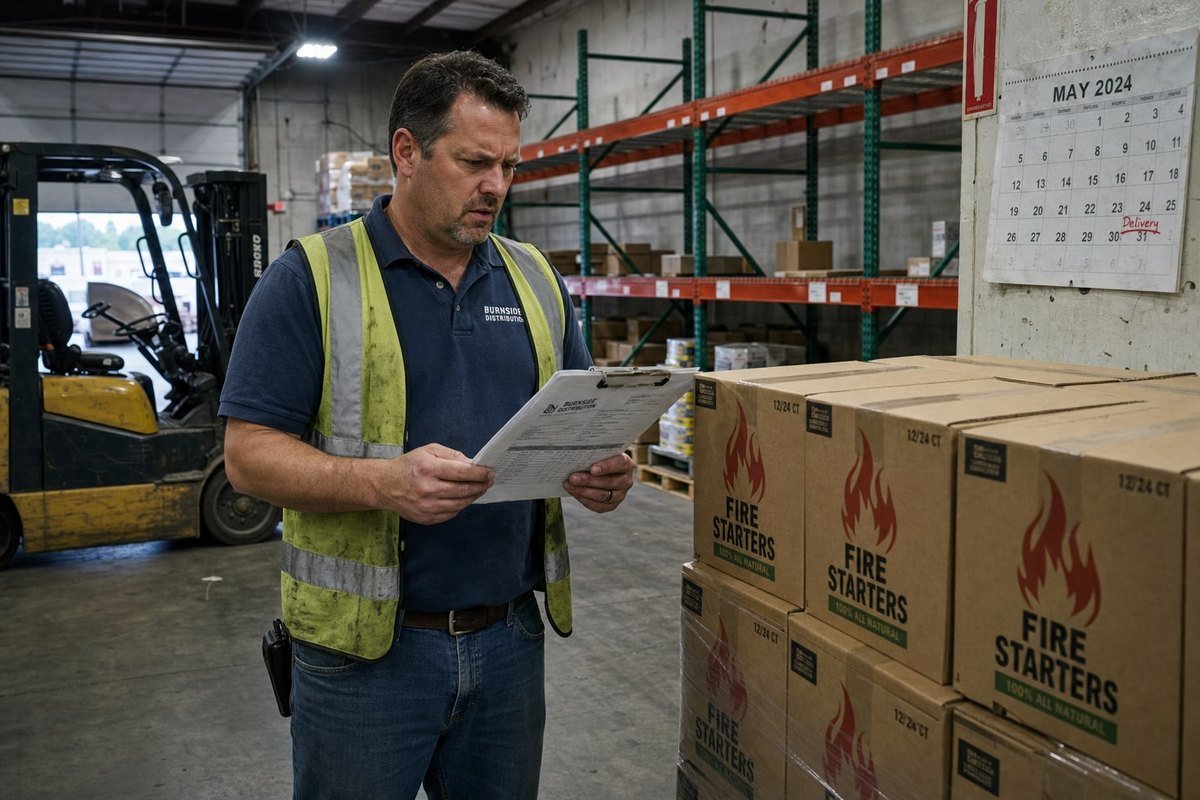
Lead-time guarantees turn a vague promise into a measurable commitment. The structure I recommend splits the timeline into verifiable milestones, so a delay is caught early instead of discovered at the port.
Milestone-based lead-time structure
| Milestone | Typical timing | Verification |
|---|---|---|
| Order confirmation + deposit | Day 0 | Signed PO and pro forma invoice |
| Pre-production sample approval | Days 7–14 | Buyer sign-off in writing |
| Production complete | Days 30–45 | Factory notice with batch QC records |
| Third-party inspection (SGS/Intertek type) | Days 45–50 | Inspection report shared |
| Ex-factory / shipment | Days 50–55 | Bill of lading date |
Each milestone should carry its own notice duty. If the sample stage slips, you know on day 15 — not day 50. In our own OEM projects, we treat the first approved sample as the binding quality and timing reference for mass production, because that is what a real factory with complete production lines can commit to. A trading company reselling from unknown workshops usually cannot.
Escalating remedies by delay length
Rather than one blunt penalty, tier the consequences. A structure like this keeps small slips commercial and reserves heavy remedies for real failures:
- Days 1–7 late: grace period, no penalty, but written explanation required.
- Days 8–21 late: liquidated damages accrue weekly at the agreed rate.
- Days 22–35 late: buyer gains the right to cover from an alternative source at the seller's expense.
- Beyond day 35, or any delay that misses a stated seasonal cutoff: termination for default, refund of deposits, and accrued damages.
Two extra guarantees seasonal buyers forget
First, negotiate priority capacity for your peak window. October-to-December orders should carry a contractual capacity reservation, confirmed against forecasts you provide by a set date. Second, tie documentation to delivery. If your market requires sustainability data, safety test reports, or compliance certificates at the time of import, state that goods arriving without complete documents count as late. Physical pucks sitting in a bonded warehouse without paperwork are commercially useless — your contract should say so.
Conclusion
Late wood fire starters cost you shelf space, promotions, and trust. Define delivery precisely, fix liquidated damages, cap liability, carve out genuine force majeure, and demand milestone-backed lead times — then sign.
Footnotes
1. Authoritative Wikipedia entry explaining the commercial importance and management of retail shelf space allocation. ↩︎
2. Technical explanation of production bottlenecks that impact manufacturing throughput and delivery timelines. ↩︎
3. Legal definition from Cornell Law School explaining the enforceability and nature of penalty clauses in contracts. ↩︎
4. Legal definition of actual damages, providing clarity on compensation for proven losses resulting from a breach. ↩︎
5. UCC legal standard for calculating buyer damages based on the market price at the time of breach. ↩︎
6. Comprehensive overview of force majeure clauses and their role in excusing contractual obligations during unforeseen events. ↩︎



 English
  Spanish
  German
  French
  Arabic
  Portuguese
Join the Conversation