






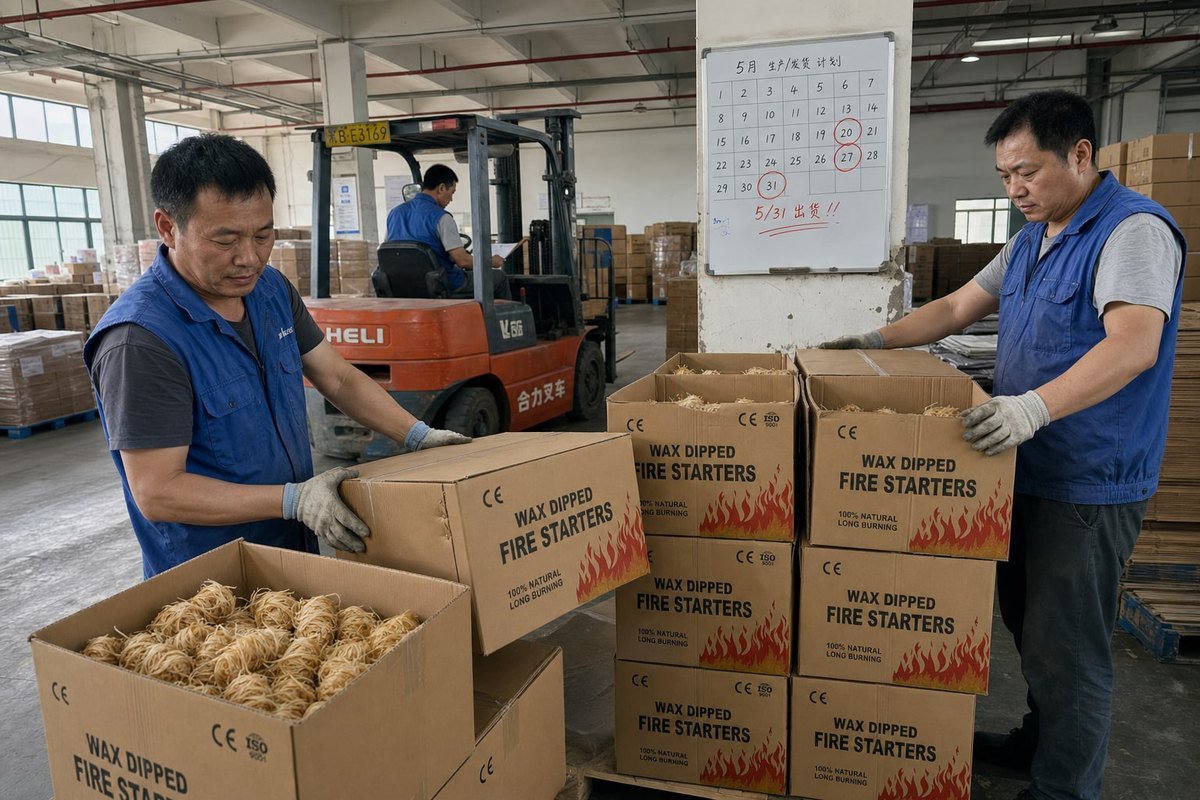
Every spring, our production line in Ningbo shifts into high gear because buyers who ignored wood fire starters in January suddenly need containers of them by May.
To avoid stockouts of wood fire starters during peak grilling season, place bulk orders 90–120 days before demand peaks, set reorder points using peak-season sales data, hold higher safety stock levels, verify your supplier's production capacity in writing, and confirm compliance documents before shipping.
Stockouts on this small SKU hurt more than most buyers expect. A missing fire starter can kill a whole grill-and-charcoal basket. Let me walk you through the four decisions that prevent that.
How much lead time do I need to plan for wood fire starter shipments before peak season hits?
A German distributor once emailed us in late April asking for a full container by Memorial Day. We had to tell him the honest truth: ocean freight alone made it impossible.
Plan 90–120 days of total lead time for bulk wood fire starter shipments. That covers 25–35 days of production, 30–40 days of ocean freight to the US or Europe, plus customs clearance, inland trucking, and warehouse receiving. Orders placed by January or February arrive safely before summer.

Lead time optimization starts with working backward from your first big selling weekend, not forward from when you feel like ordering. In our experience exporting to the US, Germany, and the UK for over 17 years, the buyers who never run out all share one habit: they treat the pre-season calendar as fixed and non-negotiable.
Break the lead time into stages
Each stage carries its own risk. If you only track the total, a small delay hides until it becomes a big one.
| Stage | Typical Duration | Common Risk |
|---|---|---|
| Order confirmation and sampling | 5–10 days | Slow artwork approval for private labels |
| Production of wax-dipped wood rolls | 25–35 days | Raw wood wool 1 availability, factory queue |
| Ocean freight (China to US/EU) | 30–40 days | Port congestion, peak season logistics surcharges |
| Customs and inland delivery | 7–14 days | Missing compliance paperwork |
| Warehouse receiving and put-away | 3–7 days | Labor shortages during busy months |
Add these together and you land near 100 days on a normal run. Then add a buffer. We tell our long-term partners to assume at least two weeks of slack, because supply chain disruptions rarely announce themselves in advance.
Freeze your forecast early
Demand forecasting 2 for a seasonal SKU works best when you lock the pre-season order quantity by a fixed date. We suggest a forecast freeze in January for June demand. Use last summer's weekly sales, not annual averages. Peak weeks for wood fire starters can run several times higher than shoulder-season weeks, and averaging flattens that spike out of your plan. Air freight can rescue a small shortfall later, but it destroys margin on a low-ticket item like fire starters. Ordering early is almost always cheaper than shipping fast.
What MOQ and reorder strategy will keep my inventory stocked without overbuying?
One trade-off we discuss with almost every new buyer is simple: a bigger first order lowers unit cost, but a smaller staged order lowers cash risk. There is a middle path, and it works.
Use a staged bulk ordering strategy: place one large pre-season order covering 60–70% of forecast demand, then schedule one or two smaller replenishment orders. Set your reorder point as average daily sales multiplied by lead time, plus safety stock for demand spikes.
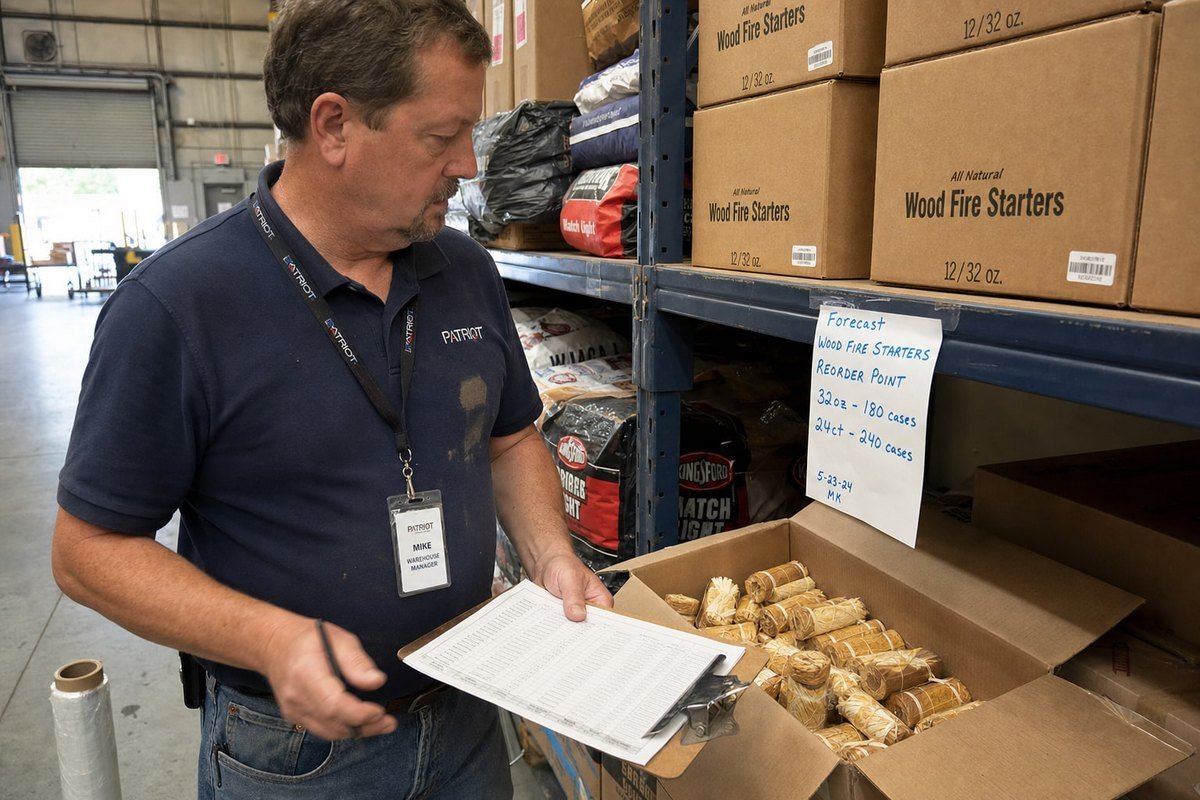
Overbuying wood fire starters ties up cash and warehouse space through winter. Underbuying loses attachment sales on charcoal, grills, and wholesale BBQ supplies. The staged approach protects you on both sides.
The reorder point, in plain numbers
The formula is basic. Reorder point equals average daily usage times lead time in days, plus safety stock 3. The trick is which "average" you use. For a seasonal SKU, calculate it from peak-season weeks only. If you sell 200 packs a day in June and your replenishment lead time is 45 days, your baseline is 9,000 packs before any buffer. Then raise safety stock levels for the volatile weeks around holidays and hot weekends.
Match order size to your sales tier
| Buyer Profile | Suggested Approach | Why It Works |
|---|---|---|
| First-time importer testing the SKU | Trial MOQ order, single shipment | Limits risk while validating sell-through |
| Regional distributor with one prior season | 60% pre-season, 40% mid-season top-up | Balances unit cost against demand uncertainty |
| Large retail sourcing channel | Full-container pre-season plus standing replenishment | Locks capacity and pricing early |
We keep MOQs flexible for trial orders because we would rather earn a second season than force an oversized first one. Once a buyer has real POS data, warehouse replenishment cycles can tighten to biweekly reviews during June and July. Apply ABC classification 4 too: if fire starters are an A-item attachment to grill sales, they deserve more safety stock than a slow C-item accessory. During the hottest eight weeks, replan weekly. A ten-minute stock review every Monday beats a panicked air-freight quote every August.
How can I make sure my supplier's production capacity can handle a seasonal demand spike?
A lesson we learned early in our 17 years: buyers do not lose sleep over price quotes, they lose sleep over whether the factory can actually deliver in July. So we started opening our production schedule to serious partners.
Verify capacity by asking for the factory's monthly output data, current order book for your delivery window, raw material sourcing plan for wood wool and wax, and a written delivery commitment. Then confirm the supplier is a real factory, not a trading company reselling capacity.
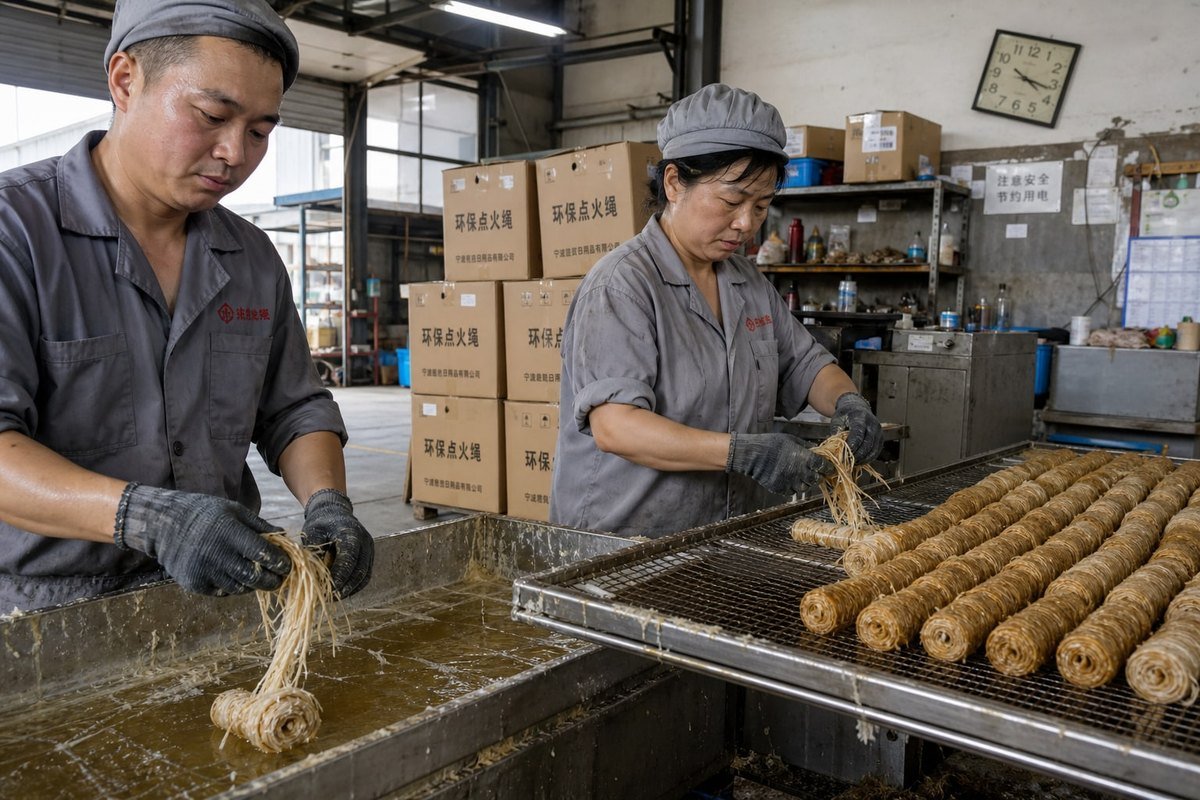
Seasonal demand spikes stress every link in a supplier's chain, not just the final assembly line. Wood wool bundles depend on wood shaving supply. Wax dipping depends on paraffin availability. paraffin wax supply 5 Packaging depends on printers who are also slammed before summer. A capacity check has to cover all of it.
Questions that separate real factories from resellers
Ask these before you sign a bulk purchase order:
- What is your maximum monthly output for wax-dipped wood fire starters, and how much is already committed for my delivery month?
- Where do you source raw wood wool, and do you hold buffer stock of raw materials before peak season?
- Can I audit the facility or see recent third-party inspection reports?
- Will you commit to a delivery window in writing, with a defined remedy if you miss it?
- If my sell-through beats forecast, how fast can you produce an emergency top-up run?
A trading company stumbles on questions one and two because it does not control the line. A genuine factory answers with specifics. When buyers visit our Ningbo facility, we walk them through the wood wool rolling stations, the wax-dipping tanks, and the batch QC records, because seeing the process is the fastest way to trust the capacity claim.
Do not rely on a single point of failure
Even with a strong primary supplier, qualify a backup source before the season starts, not after a disruption hits. Split purchase orders across staged deliveries so one delayed vessel does not empty your shelves. Confirm which ports your supplier ships from, since congestion at one port 6 can add weeks. Hyper-local sourcing of complementary items like fatwood kindling can also hedge risk, though core wax-dipped rolls usually stay most economical from a specialized factory. The goal is resilience, not redundancy for its own sake.
Which quality and compliance checks should I confirm before placing a bulk pre-season order?
A UK buyer once told us his previous shipment sat in customs for three weeks because the supplier could not produce a valid test report. That container missed the entire early-summer window. Paperwork failures cause stockouts just as surely as production delays do.
Before a bulk order, confirm the supplier holds ISO 9001 and BSCI certification, valid CE marking where required, and current SGS or Intertek test reports. Also verify burn-time consistency, wax coating quality, correct warning labels, barcodes, and market-specific packaging compliance.
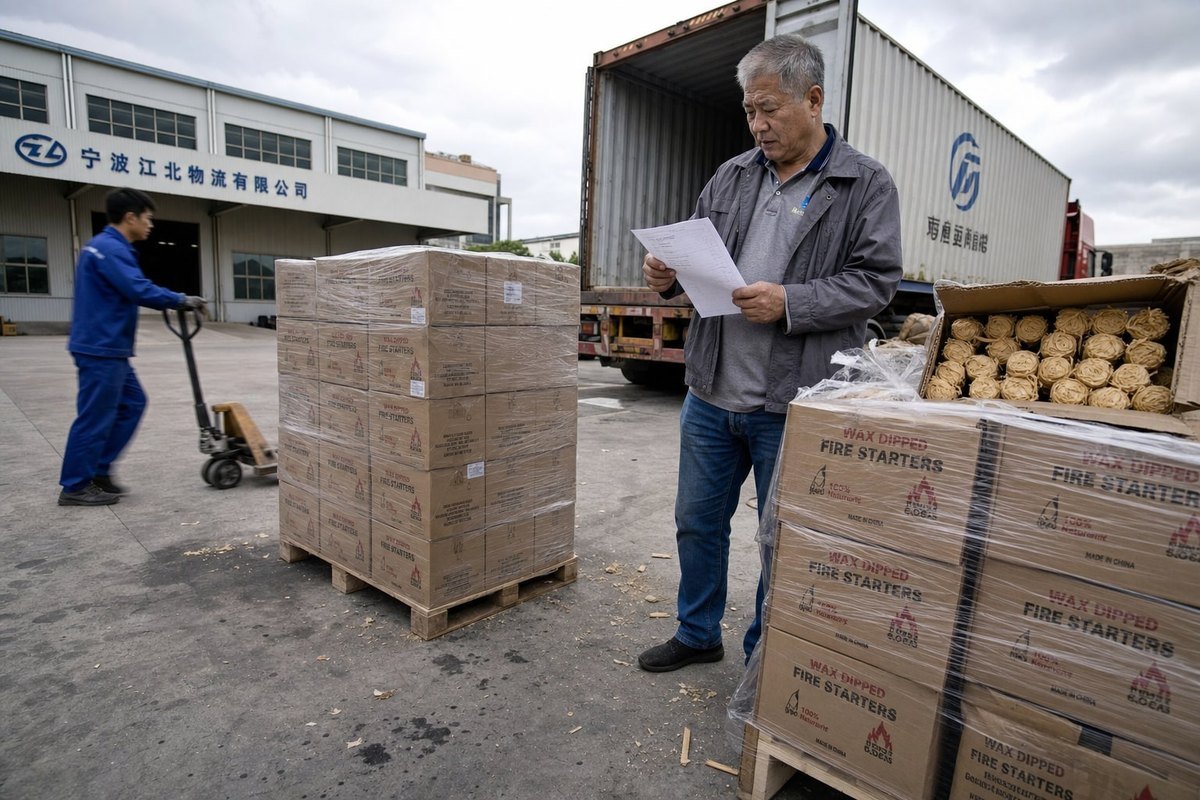
Compliance is not a nice-to-have for fire products 7 entering the US or EU. It is the difference between goods that clear customs on schedule and goods that become a peak-season disaster. In our export work across 30+ countries, the smoothest seasons always belong to buyers who audit documents in winter, not in June.
The pre-order compliance checklist
| Check | What to Verify | Why It Prevents Stockouts |
|---|---|---|
| Factory certifications | ISO 9001, BSCI audit reports | Confirms stable, ethical production during peak load |
| Product testing | SGS or Intertek reports, CE where applicable | Prevents customs holds and retail delisting |
| Burn performance | Burn time per piece, ignition reliability across batches | Avoids returns that drain replacement stock |
| Materials | Eco-friendly wood wool and wax, no harmful chemicals | Meets retailer and consumer safety expectations |
| Packaging | Warning labels, barcodes, language requirements per market | Stops shelf-ready goods from being rejected at receiving |
Lock quality before you lock quantity
Ask for a production sample and a golden sample agreement, so the first sample legally defines mass-production quality. Batch-to-batch consistency matters most on burn time: if one lot burns eight minutes and the next burns four, a customer lighting a charcoal chimney starter will notice, and reviews will follow. We run batch QC on wax coating weight and ignition tests precisely because a fire starter is judged in the first sixty seconds of use. Also confirm inventory management software compatibility on labeling — a wrong barcode format can strand a compliant shipment in your own warehouse. Finally, get the full document pack (test reports, certificates, packing lists) before the vessel sails, not after it docks.
Conclusion
Stockouts of wood fire starters drain grill-season revenue far beyond one small SKU. Order 90–120 days early, stage your POs, verify factory capacity, and confirm compliance before you commit.
Footnotes
1. Alibaba is a leading B2B sourcing platform for raw materials like wood wool used in production. ↩︎
2. Explains the forecasting method used to plan seasonal pre-season order quantities accurately. ↩︎
3. Defines the inventory buffer concept referenced when calculating reorder points for peak demand. ↩︎
4. Describes the inventory prioritization method mentioned for allocating safety stock across SKUs. ↩︎
5. Comprehensive source for paraffin wax production and industrial supply information. ↩︎
6. IMO oversees global shipping issues including port congestion that can delay import timelines. ↩︎
7. CPSC regulates safety and compliance standards for fire-related consumer products entering the US. ↩︎



 English
  Spanish
  German
  French
  Arabic
  Portuguese
Join the Conversation