






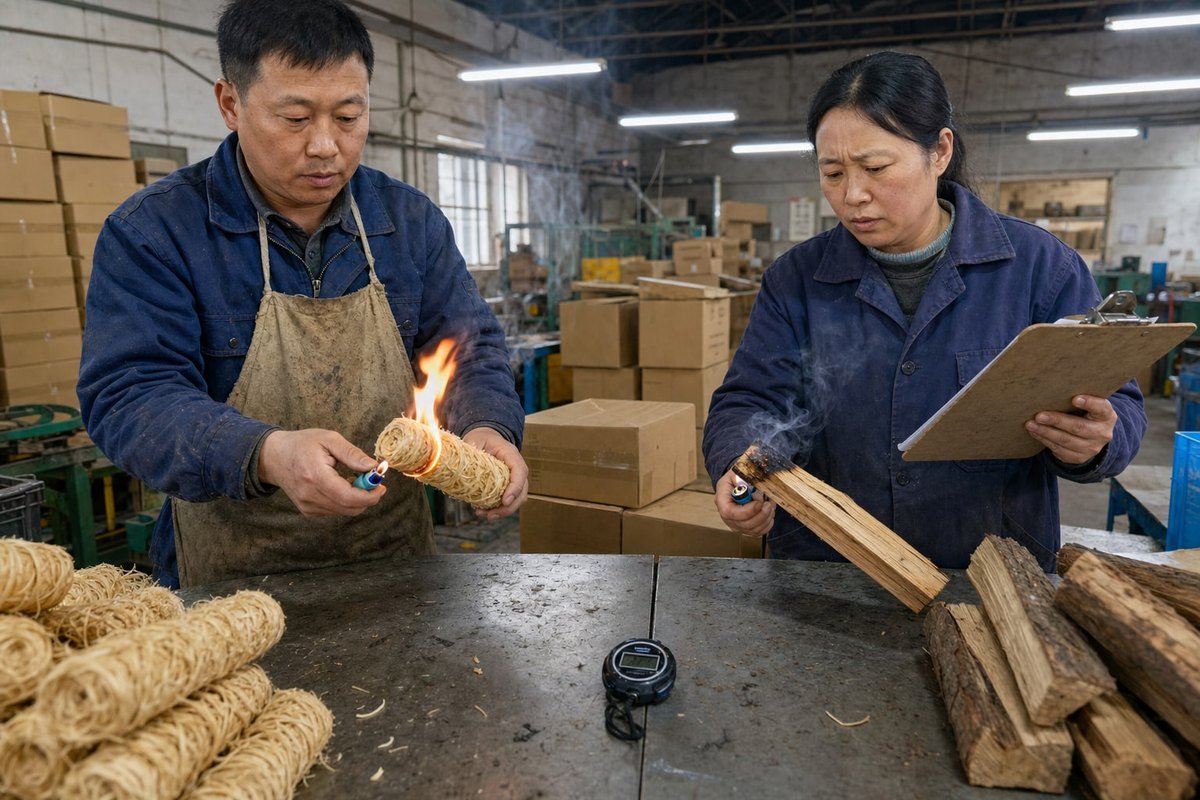
On our production line in Ningbo, I watch wood fire starters ignite in seconds while a split log resists a lighter for minutes. Buyers ask me why constantly. The frustration is real — and the physics behind it is fascinating.
Wood fire starters ignite faster than firewood because they combine a high surface area to volume ratio, extremely low moisture content, and combustible wax or resin binders. This lets them reach ignition temperature in seconds, while dense logs absorb heat slowly and resist pyrolysis.
That is the short answer. But the details matter if you sell, source, or simply use these products. Let me walk you through the science, the design, and the sourcing side.
What Makes Wood Fire Starters Catch Flame So Much Faster Than Raw Firewood?
During a QC test last winter, my team timed our wax-dipped wood rolls against seasoned oak splits using the same lighter. The rolls flamed in under five seconds. The oak never caught at all.
Fire starters catch flame faster because thin wood wool fibers heat to ignition temperature almost instantly, moisture is nearly zero, and wax coatings release flammable vapors at low heat. Firewood must first dry, then pyrolyze, before it can produce enough gases to sustain a flame.
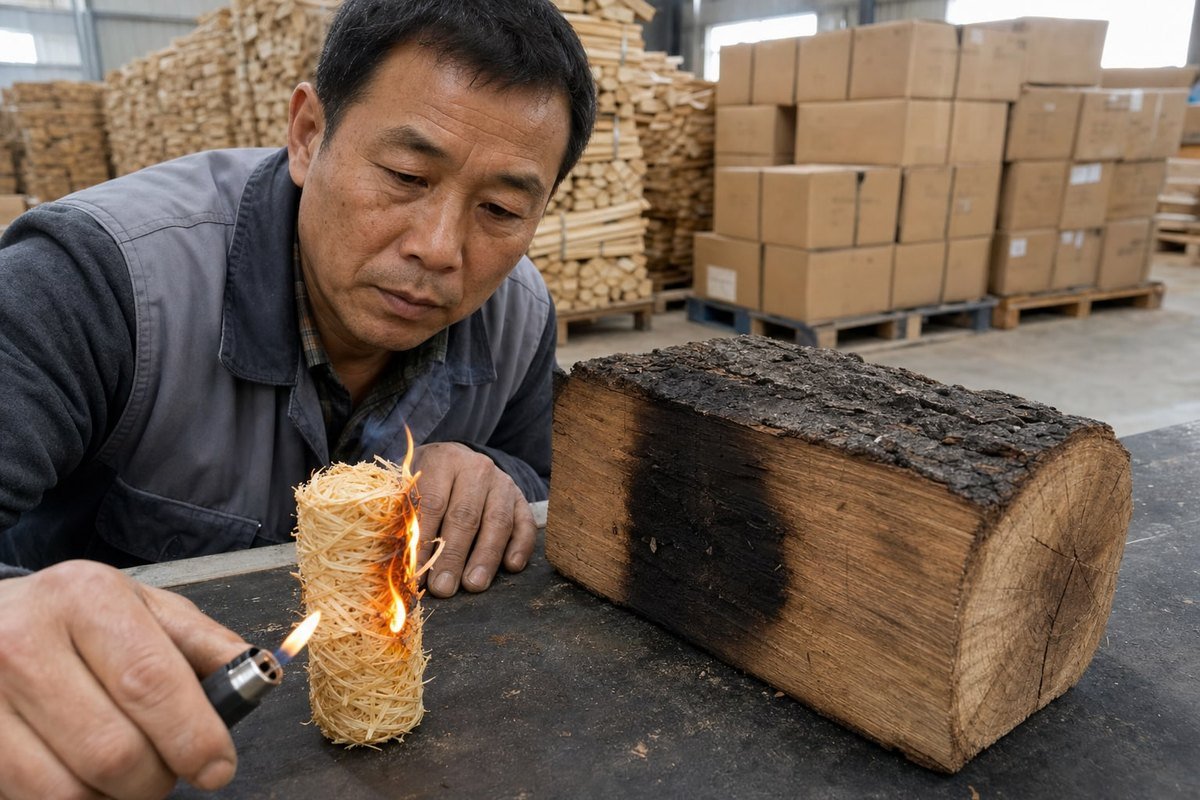
Wood does not actually burn as a solid. Heat breaks it down first — a process called pyrolysis 1 — and the released pyrolysis gases are what ignite. So the real question is: how fast can you push a piece of wood into producing those gases? That is where fire starters win on every variable.
The Physics in Plain English
Think of the fire triangle 2: fuel, oxygen, and heat. A log has plenty of fuel, but the heat side is the bottleneck. A thick log has low surface area relative to its mass, so a flame only touches a small fraction of it. Worse, wood's low thermal conductivity means heat crawls inward slowly, and the cold interior acts as a heat sink that drains energy away from the surface.
A shredded wood wool starter flips every one of those factors. Each strand is thinner than a matchstick. Heat penetrates it fully in moments, and air flows freely between fibers, feeding oxygen exactly where combustion starts.
| Factor | Wood Fire Starter | Raw Firewood Log |
|---|---|---|
| Surface area to volume ratio 3 | Very high (thin fibers) | Very low (thick, solid) |
| Moisture content 4 | Near 0% (wax-sealed) | 15–25% even when seasoned |
| Thermal mass 5 | Tiny — heats fast | Large — absorbs heat like a sink |
| Ignition aid | Paraffin 6 or resin vapors | None |
| Time to flaming ignition | Seconds | Minutes, often fails alone |
The wax coating adds one more advantage. Paraffin volatilizes at low heat, creating a small flammable vapor cloud around the fibers. That vapor ignites well below the roughly 400–500 °C range solid wood needs, so the flame becomes self-sustaining almost immediately.
Can I Rely on Wax-Dipped Fire Starters to Work Even in Damp or Cold Conditions?
A German distributor once shipped our samples to a campsite trial in November rain, half expecting failure. His follow-up email said the wax rolls lit on the first strike while his backup kindling refused to cooperate.
Yes. Wax-dipped fire starters work reliably in damp and cold conditions because the paraffin coating seals the wood fibers against humidity, and the wax itself burns hot for several minutes. Unlike loose tinder, they resist moisture absorption and ignite even with cold, wet hands.
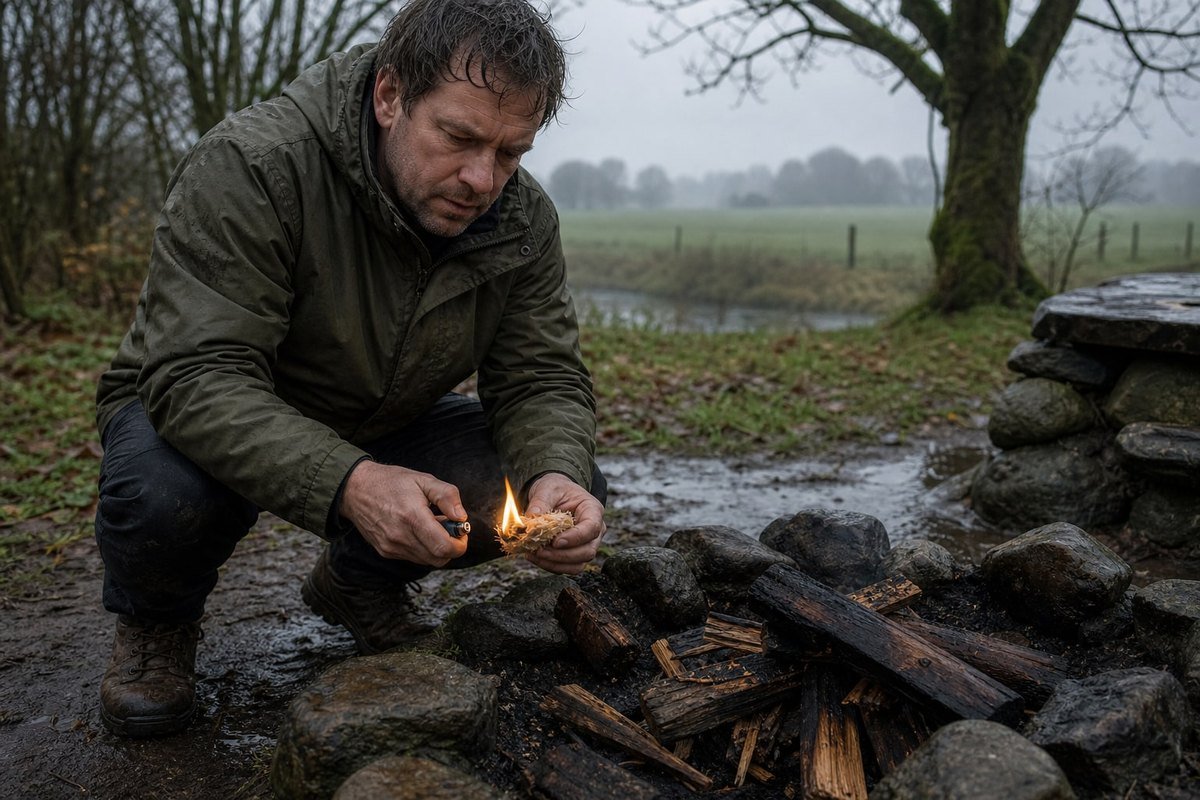
Moisture content is the single biggest reason fires fail. Every gram of water inside a fuel must be boiled off before that fuel can reach ignition temperature. That evaporation steals heat, delays pyrolysis, and produces smoke instead of flame. Damp weather makes everything worse: kindling absorbs humidity from the air, cold ground chills the fuel, and wind carries away what little heat your match provides.
How the Wax Layer Changes the Equation
Wax is hydrophobic. When we dip our wood rolls, the paraffin penetrates and coats the fibers, so ambient humidity simply cannot soak in. The starter that leaves our factory at near-zero moisture content stays that way in a garage, a truck bed, or a dew-covered tent vestibule. In our export experience — we ship to rainy markets like the UK and the Netherlands — this weather resistance is often the deciding factor for buyers.
Cold matters too, but less than people assume. A wax-dipped starter has so little thermal mass that even a winter-chilled roll reaches vapor-release temperature from a single lighter flame. The wax then burns steadily for eight to ten minutes in a typical formulation, giving surrounding kindling ample time to dry out and catch — even if that kindling is slightly damp itself.
Two honest caveats from our testing bench. First, no starter can ignite genuinely soaked logs; it can only compensate for marginal dampness. Second, storage still matters: keep starters off wet ground and out of standing water, because prolonged submersion can eventually wick moisture into exposed fiber ends.
How Do Wood Fire Starters Simplify Fire-Lighting Compared to Traditional Kindling?
Trade-offs drive our product development. When we designed our current wood roll, the debate was burn time versus flame height — because a starter must replace an entire armful of tinder and split kindling, not just a match.
Wood fire starters compress the traditional tinder-and-kindling stages into one step. A single wax-coated roll delivers a hot, steady flame for several minutes, long enough to ignite medium firewood directly. This removes the gathering, splitting, and careful stacking that traditional kindling demands.
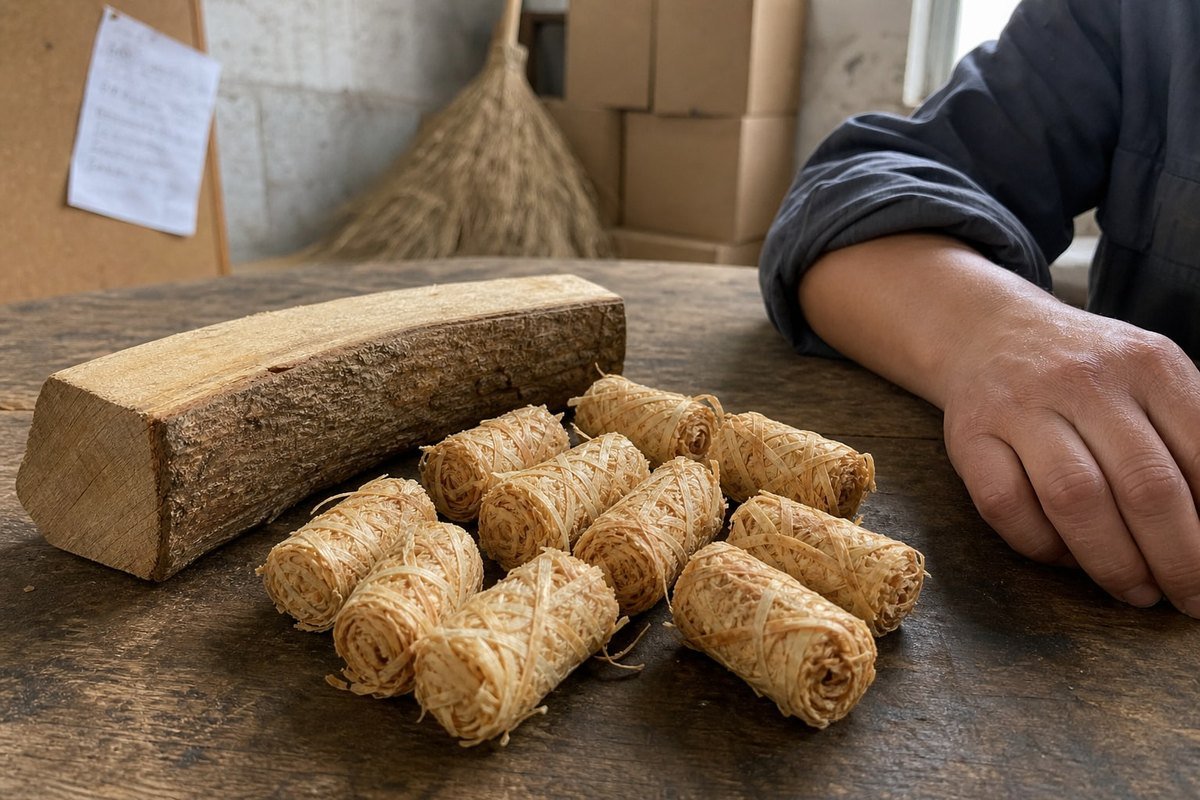
Traditional fire-building is a relay race. Tinder passes heat to kindling, kindling passes heat to small splits, and splits finally ignite the logs. Each handoff can fail. Tinder burns out in thirty seconds. Kindling collapses and smothers the flame. Anyone who has restarted a campfire three times knows the frustration.
From Four Stages to Two
A quality fire starter shortens the relay. Here is the comparison our sales team shares with new distributors:
| Step | Traditional Method | With a Wood Fire Starter |
|---|---|---|
| 1 | Gather dry tinder (paper, bark, shavings) | Place one starter under the wood |
| 2 | Split and arrange fine kindling | Light the starter |
| 3 | Light tinder, nurse the flame carefully | Add logs as the flame builds |
| 4 | Feed kindling gradually, then add splits | — |
| Typical time to established fire | 15–30 minutes, skill-dependent | 5–10 minutes, beginner-friendly |
The reason this works comes back to sustained heat flux. Ignition science shows that the intensity and duration of heat hitting the wood is the most important variable. A sheet of newspaper delivers a brief, weak flame. A wax-and-wood-fiber roll delivers a taller, hotter flame for eight minutes or more, which dries the log surface, drives pyrolysis gases out, and holds the flame in place until the wood sustains itself.
There is also a stove-specific benefit. In fireplaces and wood stoves, a longer-burning starter warms the flue sooner. Warm flue gas 7 rises faster, draft improves, and the fire receives more oxygen exactly when it needs it. That is why even users with kiln-dried kindling on hand often keep starters as their first stage — one product, fewer failure points, cleaner start.
What Should I Look for When Sourcing Wood Fire Starters That Ignite Consistently Every Time?
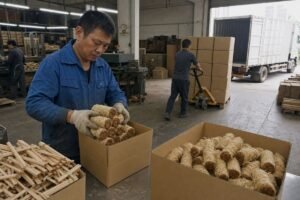
Batch consistency taught me a hard lesson early in my 17 years in this trade: one under-waxed production run can cost a distributor a retail listing. That is why our Ningbo facility weighs and burn-tests samples from every batch.
Look for consistent wood fiber and wax ratios, near-zero moisture content, verified burn time of five minutes or more, and international certifications such as ISO 9001, CE, and SGS test reports. Consistent sourcing means every starter in every box ignites the same way.

Not all fire starters perform equally, and the differences rarely show on the packaging. Some products light instantly but burn out in ninety seconds — too briefly to transfer enough heat into firewood. Others use inconsistent wax dipping, so half a box works and half does not. For a purchasing manager, the sourcing checklist below separates reliable suppliers from risky ones.
A Practical Sourcing Checklist
| Criterion | What to Verify | Why It Matters |
|---|---|---|
| Composition | Stated fiber-to-wax ratio (e.g., 50% wood fiber, 50% paraffin) | Determines flame height, burn time, and ignition ease |
| Burn time | Independently tested, typically 5–10 minutes | Short burns fail to ignite larger firewood |
| Moisture control | Kiln-dried fiber, sealed packaging | Any absorbed humidity delays ignition and adds smoke |
| Certifications | ISO 9001, BSCI, CE, SGS or Intertek reports | Hard requirement for US and EU retail channels |
| Batch consistency | Factory QC records, sample-vs-bulk comparison | Ensures the trial order matches mass production |
| Customization | Private label, box design, warning labels, barcodes | Shelf-ready product without extra handling |
Questions Worth Asking Any Supplier
First, ask whether the wood wool comes from consistent raw material. Fiber diameter affects the surface area to volume ratio, which directly controls ignition speed. Second, ask how wax penetration is controlled — surface-only coating burns fast and dies; full penetration burns evenly. Third, request burn-test videos from three separate batches, not just one polished sample. In our experience exporting to 30+ countries, buyers who verify batch-level consistency avoid nearly all downstream complaints.
Finally, weigh compliance early. European and North American retailers increasingly refuse fire products without test documentation. A cheap starter without SGS or CE backing is not a bargain; it is a stalled shipment waiting to happen.
Conclusion
A struggling fire wastes time, patience, and reputation — for campers and for the brands that supply them. Wood fire starters solve this by engineering around physics: thin fibers, sealed dryness, and wax-fed vapors that ignite in seconds where seasoned firewood cannot. Source them from a certified factory with proven batch consistency, and every fire starts on the first strike.
Footnotes
1. Explains the chemical decomposition process that releases flammable gases wood needs to ignite. ↩︎
2. Authoritative fire-safety organization reference for the fuel-oxygen-heat combustion model. ↩︎
3. Core physics concept explaining why thin fibers ignite faster than thick logs. ↩︎
4. USDA forest products research authority on how wood moisture affects ignition and burning. ↩︎
5. Background concept clarifying why low thermal mass lets fire starters heat up almost instantly. ↩︎
6. Authoritative Wikipedia entry providing a comprehensive overview of paraffin wax properties and industrial uses. ↩︎
7. EPA program on wood-burning appliances explains flue gas draft and stove combustion efficiency. ↩︎


 English
  Spanish
  German
  French
  Arabic
  Portuguese
Join the Conversation