







Every failed fire starter costs your brand a customer BSCI 1. On our production line in Ningbo, I've seen how one wrong ratio of wax, resin, and wood fiber ruins everything.
In fire starters, wax acts as the main fuel, binding agent, and moisture barrier; resin works as a natural accelerant that lowers the ignition point and burns hotter; wood fiber provides the porous wick structure that absorbs melted fuel and sustains steady combustion.
These three materials work as a system, not as separate ingredients. Let me break down each one, so you can source and specify fire starters with confidence.
How Does the Type of Wax Affect My Fire Starters' Burn Time and Performance?
During a QC audit last year, I compared two wax batches side by side. One burned eight minutes, the other twelve. Same wood rolls, different wax grade. That test changed our sourcing spec.
Wax type directly controls burn time, ignition ease, and weather resistance. Paraffin wax with a higher melting point burns longer and resists moisture better, while softer, low-melt waxes ignite faster but burn out sooner. The wax-to-fiber ratio fine-tunes total combustion time.

Wax is the energy reservoir of any fire starter. It holds a high energy density, but it cannot burn as a solid block. It must first melt, wick into a fibrous carrier, and then vaporize at the flame front. Only the vapor actually burns. This phase-change process is why wax gives a steady, controlled flame instead of a quick flash. It is also why wax alone, without wood fiber, performs poorly as a starter.
Comparing Common Wax Options
In our 17+ years of producing wax-dipped wood rolls, we have tested most commercial waxes. Here is how they compare in practice:
| Wax Type | Melting Point | Burn Time | Water Resistance | Best Use Case |
|---|---|---|---|---|
| Fully refined paraffin wax | Higher | Long, steady | Excellent | Retail fire starters, wet climates |
| Semi-refined paraffin | Medium | Medium | Good | Budget-oriented lines |
| Soy wax | Lower | Shorter | Moderate | Eco-positioned brands |
| Recycled wax blends | Variable | Inconsistent | Variable | Low-cost, low-spec markets |
More wax generally means longer combustion time and better waterproofing properties. But there is a trade-off. If the coating is too thick, the surface becomes sealed and glossy. Then a single match struggles to catch the fibers underneath. Our standard 50% wood fiber and 50% paraffin formulation exists because that balance ignites in seconds yet still delivers a burn long enough to light damp kindling. For buyers, the lesson is simple: ask your supplier which wax grade they use and request burn-time test data per batch, not just per product line.
Why Does Resin Content Matter When I'm Sourcing Reliable Fire Starters?
A German distributor once asked me why his previous supplier's cubes sparked well but died in wind. The answer sat in the formulation: no resinous component, just cheap wax and loose sawdust.
Resin matters because it acts as a natural accelerant and tackifier. Its volatile terpenes lower the ignition point, help the starter catch from weak heat sources like ferro-rod sparks, and push flame temperatures higher, improving reliability in cold, damp, or windy conditions.

Resin is the least understood of the three materials, yet it often decides whether a starter lights on the first strike. Natural resins like pine pitch contain volatile compounds that vaporize at low temperatures. That means the flame gets fuel almost instantly, before the wax has even melted. This is exactly why fatwood 2 — resin-saturated pine heartwood — has been prized as tinder for centuries. The resin does the fast work; the wood does the slow work.
What Resin Adds to the Formulation
- Faster catch. Resin responds to low-energy ignition sources, including sparks and short matches.
- Hotter flame. Resin-rich blends burn more aggressively, which helps light thick or damp logs.
- Better adhesion. Resin acts as a secondary binding agent, holding sawdust and chips together.
- Natural waterproofing. Like wax, resin is hydrophobic, adding a second moisture barrier.
There are trade-offs, though. Too much resin creates heavier smoke and can contribute to creosote buildup 3 in indoor chimneys. That is why serious formulations balance the resin-to-wax ratio carefully, and why our fireplace-oriented products lean on refined paraffin wax as the primary fuel with only controlled resinous content. When we develop custom blends for OEM clients, indoor versus outdoor use is the first question we ask. For sourcing managers, resin content is a specification worth putting in writing — it affects performance, smoke output, and even shelf labeling requirements in some markets.
What Role Does Wood Fiber Play in Ensuring Consistent Ignition Quality?
Early in my career, I assumed the fiber was just cheap filler. Then a batch of overly compressed wood wool 4 failed our ignition test, and I learned the fiber is the engine of the whole product.
Wood fiber is the structural matrix of a fire starter. Its porous network wicks melted wax to the flame by capillary action, provides the surface area and oxygen pathways needed for ignition, and controls burn rate through its density and compression.
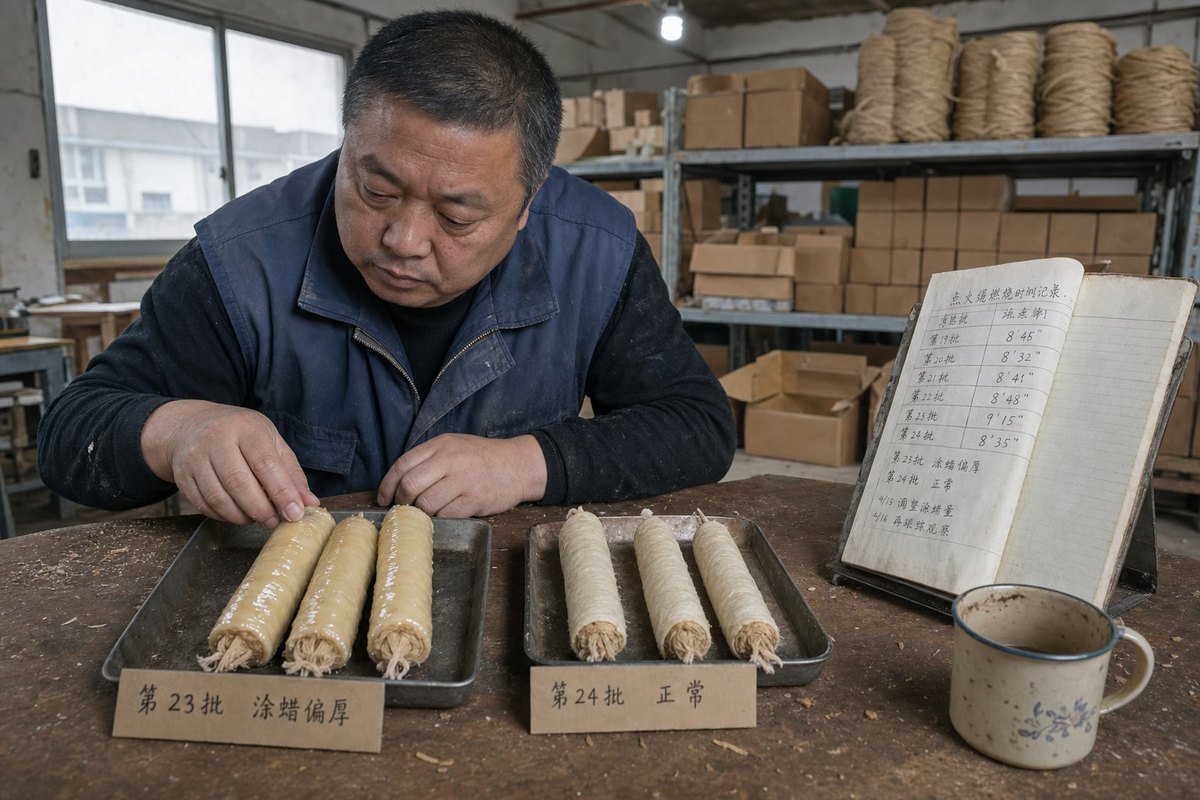
Think of wood fiber as both scaffold and delivery system. A flame needs three things: fuel, oxygen, and heat. Wood fiber supplies the geometry that lets all three meet. Thin strands ignite quickly because they have a huge surface-to-mass ratio 5. The voids between strands let oxygen flow into the flame. And the capillary network pulls liquid wax upward, feeding the flame continuously, the same way a candle wick does.
How Fiber Density Regulates Performance
Compression density is the hidden control knob in fire starter manufacturing. Here is the relationship we manage on every production run:
| Fiber Density | Ignition Speed | Burn Duration | Fuel Retention | Risk |
|---|---|---|---|---|
| Loose (shavings) | Very fast | Short | Low | Burns out before kindling catches |
| Medium (wood wool rolls) | Fast | Balanced | Good | Minimal — the industry sweet spot |
| High (sawdust briquettes) | Slow | Very long | High | Hard to light without an accelerant |
Wood wool — long, curled strands shaved from softwood — hits the balance most retail buyers want. It lights fast like tinder but holds enough wax to burn like a small candle. Compacted sawdust briquettes sit at the other extreme; they store more fuel but need help igniting. There is also a wind benefit few people mention: as the fiber chars, it forms a micro-porous carbon shell that shields the liquid wax pool from gusts, stabilizing the flame outdoors. Fiber sourcing matters too. Most quality wood wool comes from sustainable biomass and wood-industry byproducts, which supports the eco claims many of our European clients need for their packaging.
How Can I Verify These Raw Materials Meet International Safety and Compliance Standards?
One of our long-term UK buyers puts it bluntly at every annual review: no valid test report, no purchase order. After exporting fire products to 30+ countries, I consider that attitude completely correct.
Verify compliance by requesting current third-party test reports from labs like SGS or Intertek, confirming factory certifications such as ISO 9001 and BSCI, checking CE conformity where required, and auditing whether raw materials — wax, resin, and fiber — are documented batch by batch.

Compliance for fire starters is not one certificate. It is a chain of evidence covering the materials, the process, and the finished product. A supplier can show a beautiful sample, but if the paraffin wax grade changes between batches, your retail customers will notice — and your returns department will too. This is why we run strict batch-to-batch quality control at our factory: the first sample a client approves must match container number twenty.
A Practical Verification Checklist
- Ask for factory-level certificates. ISO 9001 6 proves a documented quality system. BSCI covers social compliance, which large retailers increasingly demand.
- Request product test reports. SGS or Intertek reports should confirm composition, combustion behavior, and the absence of harmful chemicals.
- Check market-specific marks. CE conformity 7 and correct warning labels matter for EU shelf placement; barcode and labeling formats differ by market.
- Verify raw material traceability. Ask where the wax, resin, and wood fiber come from, and whether each incoming lot is inspected.
- Test burn consistency yourself. Light ten units from one carton. Combustion time should fall within a tight range, not vary wildly.
| Document | What It Proves | Red Flag If Missing |
|---|---|---|
| ISO 9001 certificate | Consistent quality management | Ad-hoc production, batch drift |
| SGS/Intertek report | Verified composition and safety | Unknown chemicals, false claims |
| CE documentation | EU market conformity | Customs and retail rejection risk |
| Batch QC records | Traceability per production run | No recourse when defects appear |
One more practical tip from our OEM work: put the composition on the packaging, exactly as tested. Our own boxes state the wood fiber and paraffin percentages because transparent labeling builds retailer trust and simplifies customs clearance. If a supplier hesitates to declare composition, treat that hesitation as your answer.
Conclusion
Wax fuels and waterproofs, resin accelerates and binds, wood fiber wicks and structures. Choose a certified partner who controls all three, and your fire starters will never fail your customers.
Footnotes
1. Official amfori page for the Business Social Compliance Initiative (BSCI) solution. ↩︎
2. Background reference explaining fatwood, the resin-saturated tinder wood mentioned in the article. ↩︎
3. EPA's Burn Wise program explains creosote and wood smoke risks referenced in the resin discussion. ↩︎
4. Authoritative Wikipedia entry for wood wool, also known as excelsior. ↩︎
5. Explains the physical concept behind why thin wood fibers ignite quickly. ↩︎
6. ISO 9001 is the internationally recognized quality management standard referenced for factory certification. ↩︎
7. Official EU guidance explains CE marking requirements mentioned for market compliance. ↩︎



 English
  Spanish
  German
  French
  Arabic
  Portuguese
Join the Conversation