







Combustion performance standards for wood fire starters confused me too, back when our first big EU order nearly stalled over a missing burn-time report. One vague spec sheet can freeze an entire shipment at customs, cost you a season of shelf space, and damage a retail relationship you spent years building. That risk is exactly why our factory built its testing protocols around recognized benchmarks from day one.
Common combustion performance standards for wood fire starters include EN 1860-3 in Europe and UL/ULC 2115 in North America. They evaluate ignition time, burn duration (typically 8–12 minutes minimum), flame stability, smoke opacity, VOC emissions, flash point, and residue, since no single global standard exists.
There is no one universal certificate. Instead, buyers face a patchwork of regional standards and test methods. Let me walk you through what actually matters when you source these products.
Which international certifications verify safe combustion performance for wood fire starters?
A German distributor once opened our first meeting with a single question: "Show me your EN 1860-3 1 test data." In our 17 years exporting fire products, that question has never gone away.
EN 1860-3 is the primary European standard verifying safe combustion for solid-fuel firelighters, while ANSI/CAN/UL/ULC 2115 covers North America. Supporting certifications include SGS or Intertek test reports, DINplus certification for fuel quality, and ISO 9001 for consistent manufacturing processes.

The certification landscape splits by region and by product claim. Understanding which certificate does what saves you from paying for tests you do not need — and from skipping the ones your market demands.
The core certification map
| Standard / Certification | Region | What It Verifies |
|---|---|---|
| EN 1860-3 standard | Europe | Safety, performance, and burning behavior of firelighters for solid fuels |
| UL/ULC 2115 2 | US & Canada | Fire-hazard safety of processed firelogs and firestarters |
| DINplus certification | Germany / EU | Quality and cleanliness of solid fuel products |
| ISO 9001 | Global | Quality management system behind production |
| SGS / Intertek reports | Global | Third-party lab verification of composition and performance |
| FSC-certified wood 3 | Global | Sustainable sourcing of the wood fiber itself |
EN 1860-3 originated in the barbecue category, but buyers across Europe now treat it as the reference point for firelighters in general. It checks ignition behavior, burn duration, and flash point 4 limits. For liquid or gel accelerants, flash point requirements are strict because a low flash point creates flashback risk. Solid wax-and-fiber starters, like the wax-dipped wood rolls we produce, sit in a much safer category here.
North American buyers lean on UL/ULC 2115. It focuses on hazard mitigation — the product must not flare unpredictably or shed burning fragments.
Beyond combustion itself, sourcing claims matter. FSC-certified wood supports environmental marketing, and some retailers ask about food-safe certification when starters are marketed for grilling near food. Neither replaces a combustion standard, but both strengthen a retail listing.
One nuance from our experience: certification of the product and certification of the factory are different things. A supplier can hold ISO 9001 yet never have tested a specific SKU. Ask for both.
How do I evaluate burn time and flame consistency before placing a bulk order?
Our QC team burns samples from every production batch on a timed test bench — a habit we formed after learning early on that "about ten minutes" means different things to different suppliers.
Evaluate burn time by igniting multiple samples under identical conditions and timing from ignition to flame-out; quality starters sustain 8–12 minutes minimum. Check flame consistency by observing flame height stability, absence of smoldering, and whether the flame reliably transfers heat to kindling.
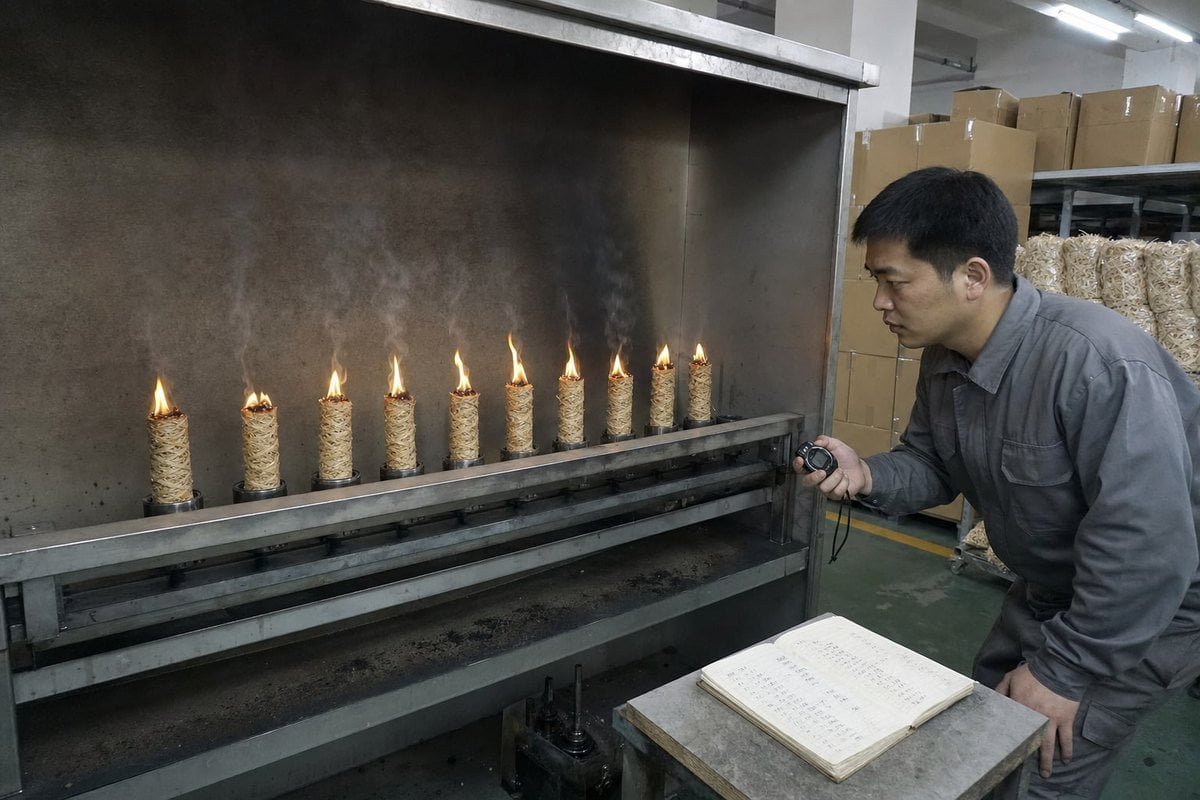
Burn duration is the single most practical metric because the starter must stay lit long enough for kindling to reach its auto-ignition temperature 5. A starter that flares brightly for three minutes and dies is worse than one with a modest, steady flame lasting ten.
A simple pre-order evaluation process
- Request samples from an actual production run, not a hand-made prototype. Ask the supplier to confirm the batch number.
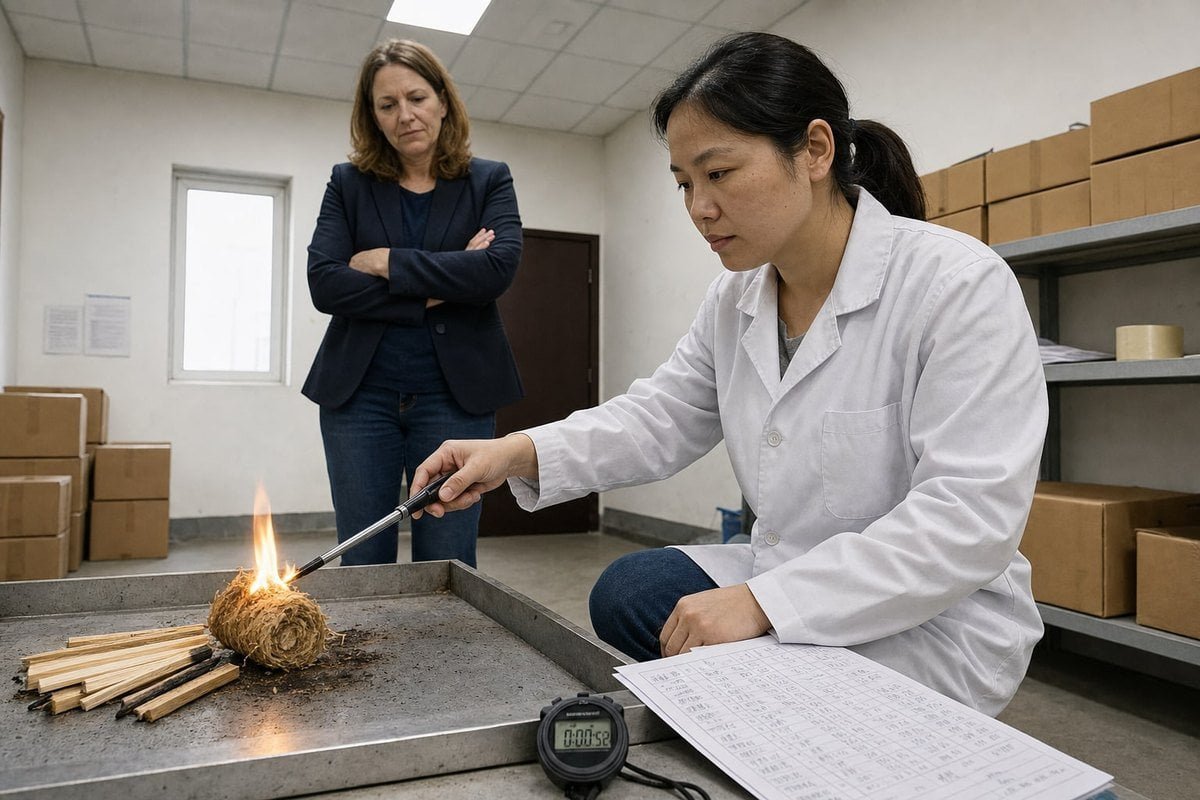
- Test at least ten pieces. Single-sample tests hide variation. Record ignition time — a good starter catches a match flame within a few seconds.
- Time the full burn. Look for consistent burn duration across all samples, ideally within a tight range around the stated spec.
- Watch flame behavior. The flame should be upright and stable, not sputtering. Sputtering usually signals uneven wax distribution or high moisture content in the wood fiber.
- Do a real-world ignition test. Place the starter under split kindling and confirm the fire catches without relighting. Research on ecological fire starters shows heating values ranging roughly from 25 to 32 MJ/kg, so calorific value alone does not guarantee success — heat delivery over time does.
- Check the leftovers. Low ash content and no sticky residue mean cleaner stoves and grills, which matters to end customers.
One more tip from our export work: test in the conditions your customers will face. A starter destined for Canadian campers should be tested cold and slightly damp, because moisture tolerance separates premium products from cheap ones. Wax coating is the key defense here — it seals the fiber core and keeps ignition reliable even in wet weather.
Bigger flames are not automatically better. Combustion guidance consistently favors a hot, controlled, well-aerated flame over maximum visible fire, because a controlled flame produces less soot and lower carbon monoxide output during startup.
What test reports should my supplier provide to prove compliance with US and EU standards?
A purchasing manager from the Netherlands once told me she rejects any supplier who sends marketing brochures when she asks for lab reports. I understood completely — paperwork is where compliance lives or dies.
Suppliers should provide third-party test reports from labs like SGS or Intertek covering EN 1860-3 or UL/ULC 2115 performance, composition analysis, flash point data, burn duration results, and emissions figures, plus ISO 9001 and BSCI factory certificates confirming production and ethical standards.
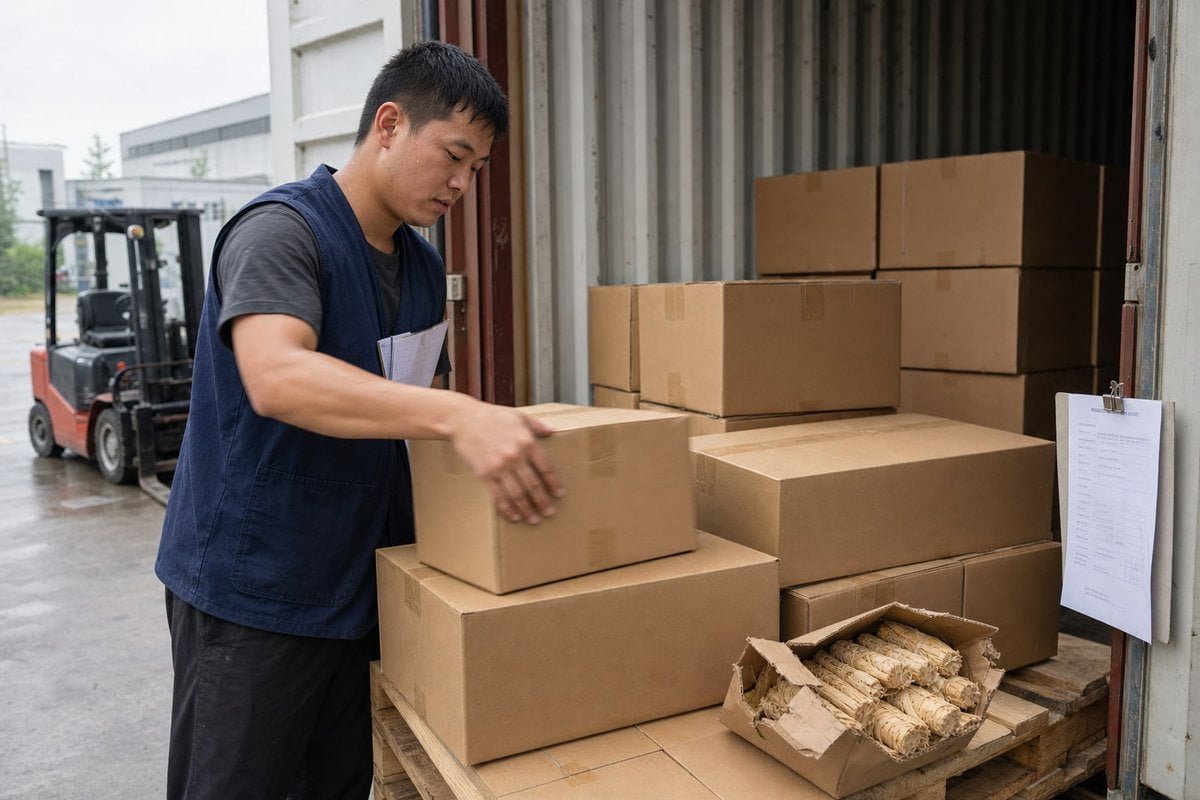
Not all documents carry equal weight. Here is how I advise buyers to categorize what lands in their inbox.
The document checklist, ranked by importance
| Document | Issued By | Why You Need It |
|---|---|---|
| EN 1860-3 or UL/ULC 2115 test report | Accredited third-party lab | Proves the SKU meets regional combustion and safety criteria |
| Composition & material safety data | Lab or manufacturer | Confirms contents (e.g., wood fiber and wax ratio) and absence of banned substances |
| Flash point and ignition time data | Third-party lab | Verifies the product will not flare dangerously during handling or lighting |
| Emissions / smoke report | Lab | Documents VOC emissions, smoke opacity, and carbon monoxide output at startup |
| ISO 9001 certificate | Certification body | Shows the factory runs a controlled quality system |
| BSCI audit report | Audit body | Confirms ethical labor practices — increasingly mandatory for large retailers |
| FSC chain-of-custody (if claimed) | FSC-accredited body | Backs any "sustainable wood" marketing claim |
Red flags to watch for
First, check the report date. Test reports older than two or three years may not reflect current formulations. Second, match the product description on the report to the exact SKU you are buying — we have seen traders present a report for one product while shipping another. Third, verify the lab. SGS and Intertek reports carry reference numbers you can confirm directly with the lab.
Emerging requirements deserve attention too. Some US buyers now reference EPA-linked opacity expectations — limiting visible smoke during the initial ignition window — and ASTM E84 7 indices are sometimes cited to describe flame spread and smoke development in starter materials. For "natural" claims, ASTM D6866 8 bio-based carbon verification is gaining traction as a way to distinguish plant-derived wax blends from purely petroleum-paraffin formulas. Our own boxes state composition plainly — wood fiber plus paraffin — because transparent labeling prevents disputes later.
Can combustion performance stay consistent across mass-production batches?
The hardest promise in this business is not making one great sample — it is making container number twelve burn exactly like the first sample we couriered eight months earlier. Our production lines in Ningbo were built around that challenge.
Yes, combustion performance can stay consistent across batches when the factory controls raw material moisture content, wax temperature and dip time, piece weight tolerances, and runs timed burn tests on every batch. Consistency depends on process discipline, not luck.
Batch variation is the silent killer of fire starter brands. End customers rarely complain about one bad piece — they simply stop buying the brand. So the real question for any buyer is: what does the factory control, and how tightly?
The variables that drive batch consistency
| Variable | Why It Matters | How It Is Controlled |
|---|---|---|
| Wood fiber moisture content | Damp fiber delays ignition and causes smoldering | Incoming material checks; fiber kept within a defined moisture range |
| Wax-to-fiber ratio | Determines burn duration and calorific value delivered | Weight checks before and after wax dipping |
| Piece weight and density | Heavier or looser pieces burn at different rates | Sampling scales on the line with defined tolerance limits |
| Wax temperature at dipping | Affects coating depth and ignition time | Temperature monitoring during the dip cycle |
| Storage conditions | Humidity exposure degrades ignition reliability | Sealed packaging and dry warehousing before shipment |
What a disciplined batch process looks like
On our lines, each batch gets a timed burn test before packing. Operators light random samples, record ignition time and burn duration, and compare results against the SKU's specification. If a batch drifts outside tolerance — say, burn time drops because a fiber shipment arrived with higher moisture — the batch is held and reworked, not shipped. That is the practical meaning of "the first sample reflects mass-production quality." Seventeen years of repeat orders taught us that buyers forgive many things, but not inconsistency.
For buyers, the actionable step is simple. Ask your supplier three questions: What tolerances do you hold on piece weight? Do you burn-test every batch or only at product launch? Can you share batch QC records with shipments? A factory with real process control answers immediately. A trading company usually cannot, because it has never seen the production floor.
Conclusion
Sourcing fire starters without checking combustion performance standards is a gamble no serious buyer should take. One failed inspection can wipe out a season's margin.
The good news: the path is clear. Verify EN 1860-3 or UL/ULC 2115 compliance for your market. Demand current third-party test reports from labs like SGS or Intertek. Test burn duration, ignition time, and flame stability yourself before committing to volume. Then confirm your supplier runs real batch-level QC, not just a good sample department.
At our factory, we built our export business on exactly this logic — certified products, transparent test data, and batch discipline that keeps container twelve identical to sample one. Choose partners who can prove the same, and your fire starter line becomes a repeat-order asset instead of a compliance headache.
Footnotes
1. CEN is the official body publishing the EN 1860-3 firelighter safety standard. ↩︎
<span id="


 English
  Spanish
  German
  French
  Arabic
  Portuguese
Join the Conversation