






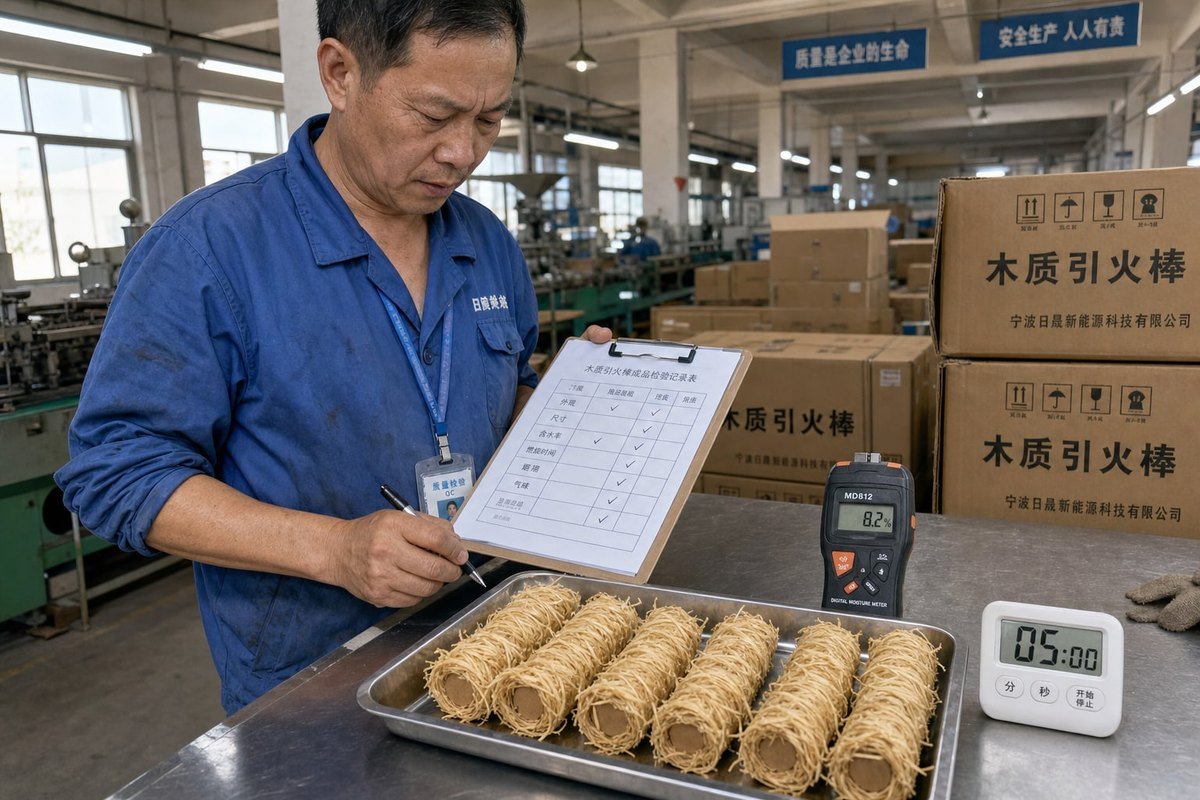
Setting inspection criteria for wood fire starters saved one of our earliest US buyers from a costly recall. Vague specs like "easy-light" mean nothing when a pallet fails at the warehouse. On our production line in Ningbo, we learned that measurable pass/fail checks are the only protection a buyer really has.
To set inspection criteria for wood fire starters, define measurable pass/fail thresholds: moisture content below 12%, ignition within 3 seconds, burn time of 8–12 minutes, ash residue under 5%, verified certifications (SGS, ISO 9001, CE), sealed packaging, and documented batch-to-batch consistency testing.
Those numbers are a starting point, not the finish line. Below, I break each area down so you can build a checklist that fits your own market and use case.
How do I define acceptable moisture content and burn time for wood fire starters?
During a QC audit last winter, our team rejected a batch of wood wool because a humidity spike in the drying room pushed moisture past our tolerance. That day reminded me why numbers beat instincts.
Set moisture content at or below 10–12% using moisture content analysis on raw wood wool, and require an average burn duration of 8–12 minutes. Ignition should occur within 3 seconds of flame contact, with a self-sustaining flame in under 15 seconds.
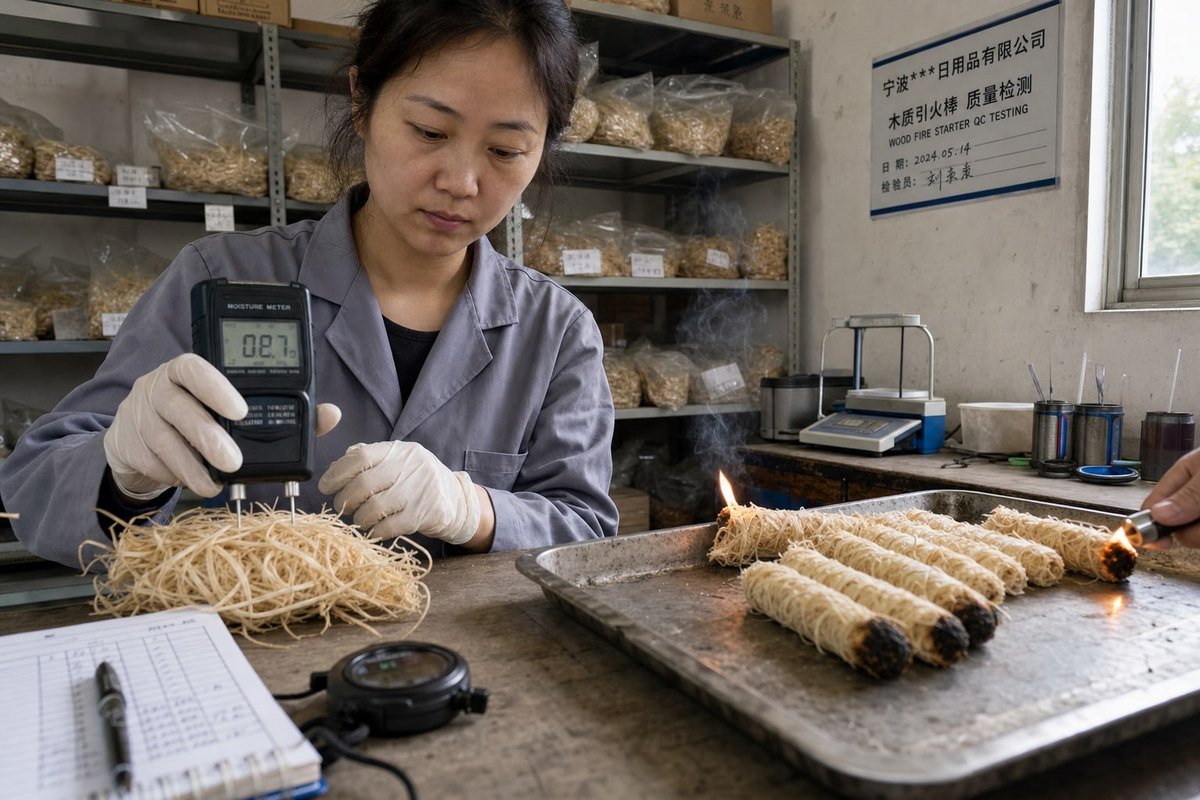
Moisture and burn time are the two performance criteria that decide whether a fire starter actually works for the end customer. In our experience exporting wax-dipped wood rolls to Germany, the UK, and Canada, these two specs also cause the most disputes when they are left undefined in a purchase order. So put hard numbers in writing.
Why moisture content comes first
Wood wool absorbs humidity fast. If the fiber core holds too much water, ignition reliability drops, smoke rises, and the paraffin wax ratio 1 cannot compensate. We run moisture content analysis 2 on incoming wood wool before it ever touches the wax bath. You should require the same from any supplier. Ask for the moisture reading method (pin meter or oven-dry test) and the acceptance limit.
Matching burn time to the fuel load
Burn duration should match what the starter must ignite. A small kindling stack needs less time than damp split logs or a full charcoal bed. Here is the framework we recommend to our B2B buyers:
| Use Case | Minimum Burn Time | Ignition Target | Key Risk if Spec Fails |
|---|---|---|---|
| Indoor fireplace / stove | 8 minutes | Within 3 seconds | Excess smoke indoors |
| Camping / outdoor | 10 minutes | Within 15 seconds after damp exposure | Failed ignition in wind or rain |
| BBQ / charcoal | 10–12 minutes | Within 3 seconds | Charcoal bed never catches |
| Retail shelf-ready bulk | 8 minutes sustained | Within 3 seconds | Pallet-level rejection |
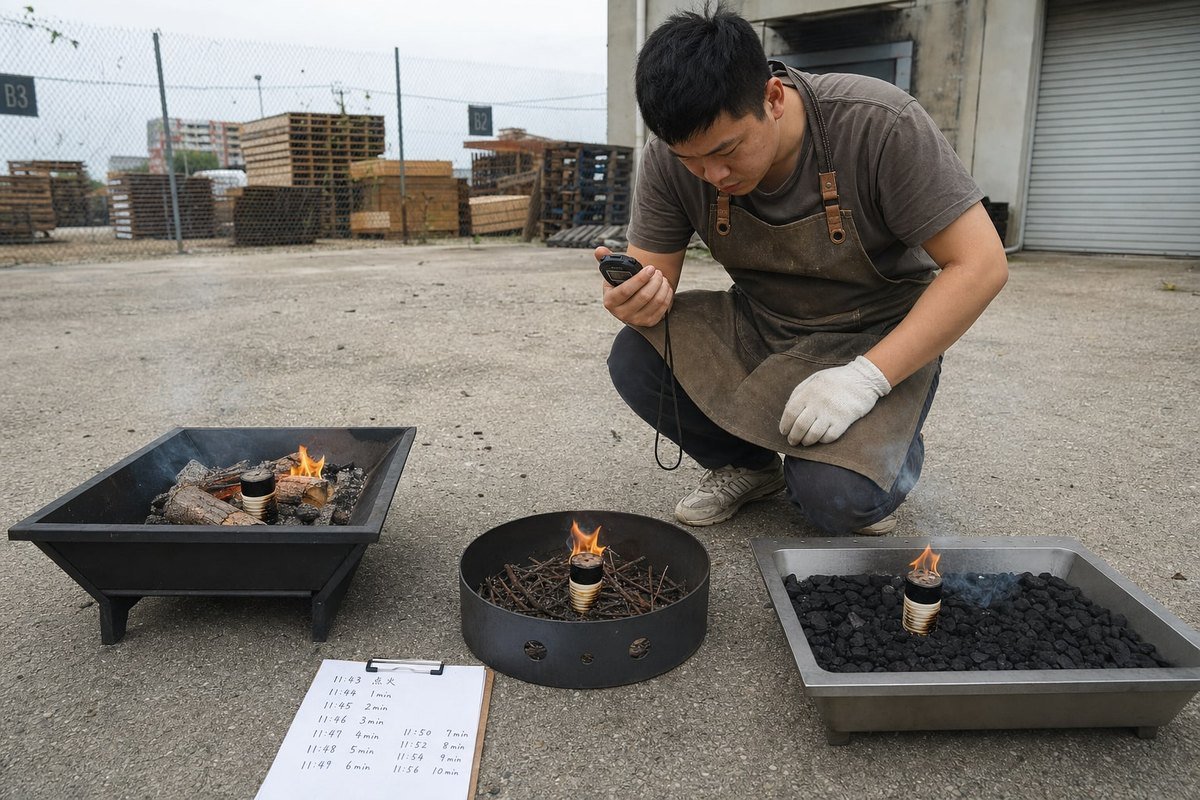
Test at least 10 units per sample lot. Record time-to-light, time-to-self-sustaining flame, and total useful flame minutes. Then write those results into your contract as the acceptance baseline. If a supplier resists documenting these numbers, treat that as a warning sign, not a negotiation point.
What certifications should I require to confirm compliance with US and EU safety standards?
A Dutch distributor once told me he had lost a retail listing because his previous supplier's "lab tested" claim came with no actual report. That conversation shaped how we present our own SGS and Intertek documentation today.
Require ISO 9001 for quality management, SGS or Intertek third-party test reports, CE-relevant documentation for EU markets, BSCI for social compliance, and an SDS covering the wax and any additives. For BBQ-intended starters, add food-contact-safe material verification and low smoke emission standards.

There is no single universal consumer standard 3 written specifically for wood fire starters. That surprises many first-time importers. It means the burden shifts to you, the buyer, to assemble a compliance package from established frameworks. Having supplied fire-starting goods to 30+ countries over 17 years, we treat this documentation stack as a hard requirement, because our retail buyers do.
The core document stack
Ask every candidate supplier for these items before you approve a sample:
- ISO 9001 certificate — proves a functioning quality management system behind batch testing protocols.
- Third-party test reports (SGS or Intertek) — independent verification of composition and combustion behavior, not marketing text.
- SDS (Safety Data Sheet) — mandatory whenever wax, binders, or any treated fiber is involved. It confirms chemical-free composition claims.
- BSCI audit report — increasingly demanded by European retail chains for ethical sourcing.
- FSC certified wood documentation — if your brand markets sustainability, chain-of-custody paperwork protects that claim.
- CE-relevant conformity documents — for EU-bound goods, confirm which directives the supplier claims apply and get the paperwork.
Market-specific expectations
US and EU buyers weigh these differently. US retail sourcing teams tend to focus on SDS accuracy, labeling, and liability exposure. EU buyers lean harder on CE documentation, REACH-related chemical disclosures 4, and smoke emission standards for indoor-use products. If your starters target charcoal BBQs, insist on verification that no petroleum solvents 5 can transfer flavor or toxins to food. Reject any product containing kerosene, lighter fluid, or methanol outright for family and indoor contexts. Paper certificates can be forged, so verify report numbers directly with the testing body. It takes ten minutes and has saved several of our buyers from bad partners.
Which packaging and labeling details do I need to inspect before mass production?
Balancing shelf appeal against seal performance is a trade-off we work through on almost every OEM project. A beautiful box that lets volatile resins evaporate is a slow-motion product failure.
Inspect packaging seal integrity, moisture-barrier properties, warning labels, batch codes, barcodes, storage instructions, and country-specific compliance text. Confirm inner packaging protects the wax coating from heat and abrasion, and approve a physical pre-production sample of the final printed box before mass production.
Packaging is where good products get rejected at the destination port. Our OEM team builds custom boxes, display packaging, warning labels, and barcodes for private-label buyers, and the pre-production packaging review is the step we never let a client skip. A digital proof is not enough. Hold the printed box, stress the seal, and drop-test the carton.
The physical inspection checklist
Wood fire starters are hygroscopic and wax-coated, so the packaging has two jobs: keep moisture out and keep volatile oils in. Poor seals let the resins that drive ignition reliability evaporate over months in a warehouse. Check these points on the pre-production sample:
| Inspection Point | Pass Criteria | Common Failure |
|---|---|---|
| Packaging seal integrity | Airtight or moisture-resistant closure | Loose flaps, unsealed poly bags |
| Barrier material | Blocks humidity during ocean freight | Thin kraft with no inner liner |
| Warning labels | Correct language, flammability icons, keep-away-from-children text | Missing EU-language variants |
| Batch code and barcode | Printed, scannable, traceable to production date | Sticker-applied codes that peel |
| Piece count accuracy | Matches declared count (e.g., 100 pcs) | Short-fill discovered at retail |
| Unit protection | No wax abrasion or crushed rolls | Loose fill causing breakage |
Labeling for your target market
Each destination market has its own labeling expectations. EU shipments generally need multilingual warnings and hazard pictograms 6 where applicable. US retail channels demand accurate net contents, origin marking 7, and scannable UPCs. We keep a labeling matrix per country for our export markets, and I recommend every importer build the same. Also verify storage instructions appear on the box; wax-dipped starters stored near heat sources can soften and clump, which triggers avoidable customer complaints.
How can I verify batch-to-batch consistency between my sample and full production order?
The hardest lesson from our early export years: a perfect sample means nothing if lot 40 differs from lot 1. That is why we built batch testing protocols into every production line we run.
Verify consistency by sealing a golden sample, defining tolerances in the contract (weight within ±0.5 g, burn time within a set range), requiring per-batch test records, commissioning pre-shipment inspection with random sampling across cartons, and comparing results against the approved sample's documented benchmarks.

Sample-to-production drift is the single biggest risk in sourcing wood fire starters, because natural materials vary. Wood wool density shifts, wax bath temperatures fluctuate, and the paraffin wax ratio can creep if dip times change. A disciplined supplier controls all three. A careless one hopes you will not notice until the container lands.
Build a golden sample system
Follow this process on every new program:
- Approve and seal a golden sample. Both parties sign and retain identical reference units. Every future dispute resolves against this physical benchmark.
- Write tolerances into the purchase order. Unit weight within ±0.5 g, average burn duration within your agreed window, ash residue levels under 5% by weight, and no visible bloom, seepage, or wax pooling.
- Require in-process batch records. Ask for moisture readings, wax bath temperature logs, and burn test results per production lot, not per order.
- Commission pre-shipment inspection. Use random sampling drawn from multiple cartons and multiple production days. Never let the supplier hand-pick the test units.
- Run your own arrival test. Burn 5–10 units from different cartons and log the results against the golden sample data.
What drift looks like
| Symptom | Likely Cause | Action |
|---|---|---|
| Faster, weaker burn | Wax under-saturation | Reject lot; audit dip process |
| Sooty flame, black residue | Filler overload or unrefined wax | Request SDS review and re-test |
| Weight variance beyond ±0.5 g | Inconsistent fiber winding | Tighten line QC; re-inspect |
| Hard ignition on some units | Moisture regain in storage | Check warehouse humidity and seals |
Because our sample rooms and production lines sit under one roof, our first sample reliably reflects mass-production quality. Whoever you source from, demand that same alignment — and demand the paperwork that proves it.
Conclusion
Vague claims cause failed ignitions, smoky returns, and rejected pallets. Written inspection criteria — moisture limits, burn benchmarks, verified certifications, packaging checks, and batch controls — turn sourcing risk into a repeatable, defensible process.
Footnotes
1. Wikipedia article on paraffin wax, detailing its properties as a common fuel component in fire starters. ↩︎
2. Wikipedia page explaining the technical process of moisture analysis used to ensure raw material quality. ↩︎
3. Wikipedia entry for fire lighters, providing context on the product type and its common compositions. ↩︎
4. Official ECHA page explaining REACH regulations, which govern chemical disclosures for products sold in the EU. ↩︎
5. Authoritative OSHA resource on solvent hazards and safety standards. ↩︎
6. Official OSHA guide to GHS-compliant hazard pictograms. ↩︎
7. Official US federal regulation for country of origin marking. ↩︎



 English
  Spanish
  German
  French
  Arabic
  Portuguese
Join the Conversation