







Buyers keep asking me whether scented fireplace pine cones weaken the colored flame effect. Get it wrong, and your shelf product disappoints customers. Our production trials in Ningbo answered this question the hard way.
Scented fireplace pine cones can affect the colored flame effect, but scent does not create the color. Metal salts produce the color, while fragrance oils may burn yellow, add soot, or shorten burn time, slightly diluting color vividness unless the formulation is properly balanced.
That short answer hides a lot of practical detail. Below, I break down the chemistry, the certifications, the customization limits, and the import rules you need to know before placing an order.
What certifications confirm my color-flame pinecones are safe when combined with fragrance additives?
A German distributor once refused a whole quotation from us because a competitor could not show a fragrance-compatible SGS report 1. That single email taught me how much paperwork matters in this niche.
Color-flame pinecones with fragrance additives should carry ISO 9001 factory certification, SGS or Intertek chemical safety test reports, CE marking for the EU, and BSCI social compliance audits. These confirm the metal salts and fragrance oils are tested together, not separately.

The key point most importers miss is this: a certificate for an unscented cone does not automatically cover the scented version. When fragrance oil is added, the combustion profile 2 changes. So the test must be run on the finished, combined product.
At our factory, we submit both scented and unscented variants for testing. The lab burns the actual product and checks emissions, heavy metal content 3, and residue. This is why our SGS and Intertek reports 4 name the exact SKU, not just a product family. If your supplier shows you a generic report, ask which formulation it covers.
The core certifications and what they actually prove
| Certification | What it covers | Why it matters for scented cones |
|---|---|---|
| ISO 9001 | Factory quality management system | Confirms the fragrance dosing process is controlled and repeatable |
| SGS / Intertek report | Chemical composition and emissions | Verifies the salt-plus-fragrance mix contains no harmful chemicals |
| CE marking | EU product safety requirements | Legally required for consumer fire goods in most EU markets |
| BSCI | Social and ethical audit | A hard requirement for many US and EU retail chains |
Questions to ask your supplier
- Does the test report cover the scented SKU specifically?
- Was the burn test done on the finished coated cone?
- Is the report less than two years old?
- Can the lab reference number be verified online?
In our experience exporting to 30+ countries over 17 years, buyers who verify these four points avoid nearly every customs and retail compliance problem 5. The paperwork is not a nice-to-have. For serious retail channels, it is the entry ticket.
Can I customize scent intensity without weakening the flame color performance?
There is a trade-off we weigh on every OEM project: more fragrance oil means stronger aroma, but it also means more yellow flame from the oil itself. Finding the balance point is the real engineering work.
Yes, scent intensity can be customized without weakening flame color, but only within limits. Keeping fragrance oil below a balanced threshold preserves color vividness, because excess oil burns yellow, adds soot, and can mask the green, blue, and purple tones from metal salts.
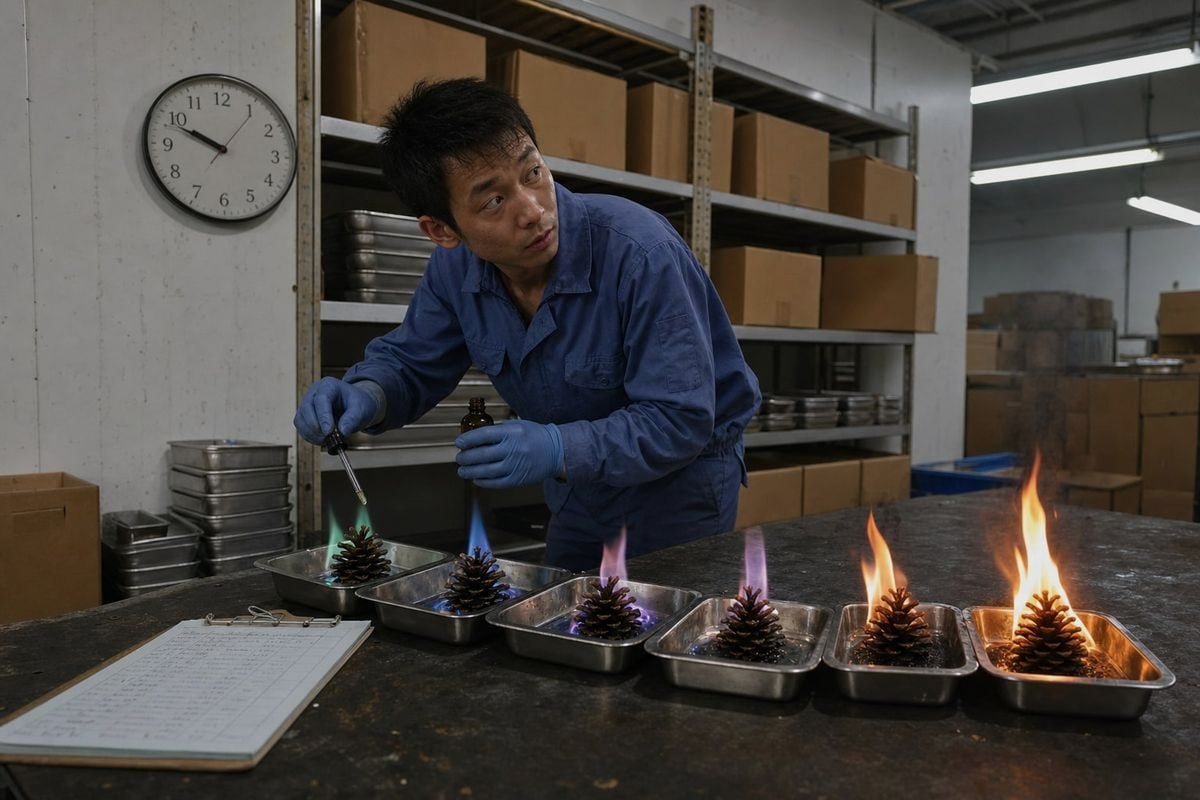
Here is why the limit exists. The colored flame effect comes from metal ions. Copper compounds 6 give green and blue-green. Strontium gives red. Sodium gives yellow. These ions light up when the flame excites them. Fragrance oils, on the other hand, are hydrocarbon-based. They burn with their own bright yellow-orange flame. If the oil layer is too heavy, that yellow flame competes with the cooler colors and washes them out. Blue and green suffer first, because they are the easiest colors to mask.
On our production line, we run burn tests at several fragrance dosing levels before locking an OEM formula. We watch three things: how vivid the color stays, how much smoke appears, and how long the color lasts. Some retail products claim color for a few minutes; better formulations hold color for ten minutes or more. Heavy scenting can cut that window because the oil accelerates combustion.
How fragrance load changes performance
| Fragrance level | Aroma strength | Color vividness | Typical result |
|---|---|---|---|
| Light | Subtle | Full | Best color, gentle scent |
| Medium (balanced) | Clear | Slightly reduced | The sweet spot for most retail buyers |
| Heavy | Strong | Noticeably diluted | More soot, shorter color window |
Some premium formulations chemically balance the fragrance with the color additive to reduce interference. That is exactly the approach we take in ODM projects: we adjust both sides of the recipe together, rather than simply spraying more oil onto a finished color cone. My honest advice to purchasing managers is simple. Decide which effect leads your product story — scent or color — and let us tune the formula around that priority.
How do I verify batch-to-batch consistency between scented and unscented color-flame pinecones?
A lesson we learned early: a beautiful first sample means nothing if container number three burns differently. One of our first large fireplace-distributor clients tested us on exactly this point before signing a yearly contract.
Verify batch consistency by requesting documented burn tests from each production lot, comparing color duration and vividness against a retained golden sample, checking salt-concentration records, and confirming the factory weighs both the salt treatment and fragrance coating per batch.

Consistency is harder with scented cones than with unscented ones. The reason is simple. An unscented cone has one variable: the salt treatment. A scented cone has two: the salt treatment and the fragrance layer. If either drifts between batches, the burn result changes. That is why user reviews often say unscented color cones perform more consistently. It is not that scent is bad. It is that scent doubles the number of things a factory must control.
The process we use, and what you should demand
- A golden sample is sealed and retained from your approved pre-production run.
- Every batch gets a documented soak time and salt concentration record. DIY-style soaking runs eight hours or overnight; industrial dosing must be logged, not guessed.
- Fragrance is applied by measured weight, not by eye. Small dosing errors compound fast at scale.
- Each lot goes through a live burn test. We time the color window and compare vividness against the golden sample side by side.
- Drying time is controlled for several days, because moisture changes both ignition and color intensity.
- Batch records travel with the shipment paperwork, so you can trace any complaint back to a lot number.
Ask your supplier to show you steps two, four, and six in writing. A factory with real production depth can produce these records within a day. A trading company usually cannot, because they never see the production floor. After 17+ years running complete production lines, I can say the paperwork trail is the single most reliable predictor of whether batch ten will match batch one.
Which packaging and labeling requirements apply when I import scented color-flame pinecones for retail?
During a packaging review call last year, a Dutch importer asked us to redesign a kraft pouch three times before launch. Every change came from a labeling regulation, not from aesthetics.
Retail imports of scented color-flame pinecones require fire-safety warning labels, usage instructions stating wood-fire-only use, ingredient or hazard disclosure per destination rules, CE marking in the EU, country-of-origin marking, barcodes, and child-safety cautions, all printed in the destination market's language.

Packaging for this product category does two jobs. It sells the magic, and it manages the risk. Our drawstring burlap sacks and stand-up kraft pouches with clear windows handle the first job. The label content handles the second, and that is where importers get caught.
The most important warning is often the least glamorous one: these cones are for wood-burning fires only. Residue from the treatments can clog burner parts in gas fireplaces, so retailers expect that restriction stated clearly on the pack. Scented versions add another layer. Because fragrance oils raise indoor-air considerations, several markets expect ventilation guidance or ingredient disclosure on the label.
Core label elements by market
| Label element | US retail | EU retail | Notes |
|---|---|---|---|
| Fire hazard warning | Required | Required | Must be prominent, not on the back fold |
| Wood-fire-only statement | Expected by retailers | Expected by retailers | Protects against gas-fireplace misuse claims |
| CE marking | Not applicable | Required | Applies to consumer fire goods |
| Country of origin | Required | Required | Must survive to point of sale |
| Local-language text | English | Each destination language | Multi-language panels are common |
| Barcode / EAN-UPC | Required | Required | We generate these in-house for OEM clients |
As a one-stop OEM partner, we handle warning labels, barcodes, custom boxes, and display packaging as part of the private-label service 7, and we pre-check artwork against the destination market before printing. My practical advice: lock the label content before the packaging design, never after. It saves weeks.
Conclusion
Scent adds atmosphere; salts create the color. Balance the two, demand SKU-specific certifications, verify batch records, and label correctly — and scented color-flame pinecones become a safe, shelf-ready bestseller.
Footnotes
1. SGS is a globally recognized testing body verifying chemical safety of combined flame-fragrance formulations. ↩︎
2. Explains combustion chemistry, clarifying why added fragrance oils alter burn behavior and color output. ↩︎
3. CDC resource on health risks from heavy metal exposure relevant to combustion emissions testing. ↩︎
4. Intertek provides independent lab verification of emissions and chemical composition for finished SKUs. ↩︎
5. WTO trade topics page covers compliance standards relevant to cross-border retail imports. ↩︎
6. Background on how metal salts like copper produce distinct flame colors during combustion. ↩︎
7. Alibaba.com is a leading sourcing platform for private-label and OEM manufacturing partnerships. ↩︎



 English
  Spanish
  German
  French
  Arabic
  Portuguese
Join the Conversation