







Colored fireplace pine cones look magical on our production line, but buyers often ask one hard question first: how long do they actually burn BSCI audits 1? Guess wrong, and your customers feel cheated. Get the real numbers, and your product listing sells itself.
Colored fireplace pine cones typically burn for 5 to 15 minutes per cone, with most commercial products delivering 5 to 10 minutes of colored flame. Wax-coated cones can reach 15 to 20 minutes. Hot fires, excess airflow, moisture, small cones, and thin coatings all shorten burn time.
That range is wide for a reason. Below, I break down what drives burn time, what kills it, and how you can control it before you commit to a bulk purchase.
What burn time can I expect from color-flame pinecones before I place a bulk order?
A German distributor once emailed me a one-star review from his customer: "The colors were gone in five minutes." His listing had promised twenty. Setting the right expectation matters as much as the product itself.
A single commercial color-flame pinecone burns for about 5 to 10 minutes. Two or three cones burned together produce roughly 10 to 12 minutes of visible color effect. Larger, wax-enriched cones can reach 10 to 15 minutes, while a big batch of plain cones can sustain a fire for 30 minutes or more.

Here is the honest truth I share with every new buyer: colored pine cones are a visual accent, not a fuel source. People sometimes expect them to burn like candles. They do not. The color chemicals 2 release fastest at high heat, so the visible blue, green, and purple effect often fades before the cone itself is fully consumed. In a roaring fire, the color show may last only half as long as it would over steady, moderate coals.
Realistic burn-time expectations
Use this quick reference when writing product copy or answering retail-partner questions:
| Product type | Typical burn time |
|---|---|
| Single commercial color cone | 5–10 minutes |
| Two to three cones burned together | 10–12 minutes total effect |
| Large or resin-heavy waxed cone | 10–15 minutes |
| Wax-coated DIY-style fire starter cone | 15–20 minutes |
| Large batch of plain pine cones | 30+ minutes overall |
Note the difference between color duration and smolder duration. A cone may glow and smolder for a while after the color fades. For marketing claims, we always advise our private-label clients to quote the colored-flame window, not the total combustion time. That keeps reviews positive and returns low. In our 17+ years exporting to the US, Germany, and the UK, the listings that under-promise slightly always outperform the ones that over-promise.
Which raw materials or coatings affect how long my pinecones burn?
When we developed our current color-flame pinecone formula in Ningbo, we tested the same coating on three different cone species. The burn times differed by nearly 40 percent. The base material matters more than most buyers realize.
Cone species, resin content, cone size, wax coating thickness, and the specific metal-salt colorant all determine burn time. Large, dense, resin-heavy cones with a generous wax layer burn longest; small, loose cones with thin chemical-only coatings burn fastest, sometimes under five minutes.
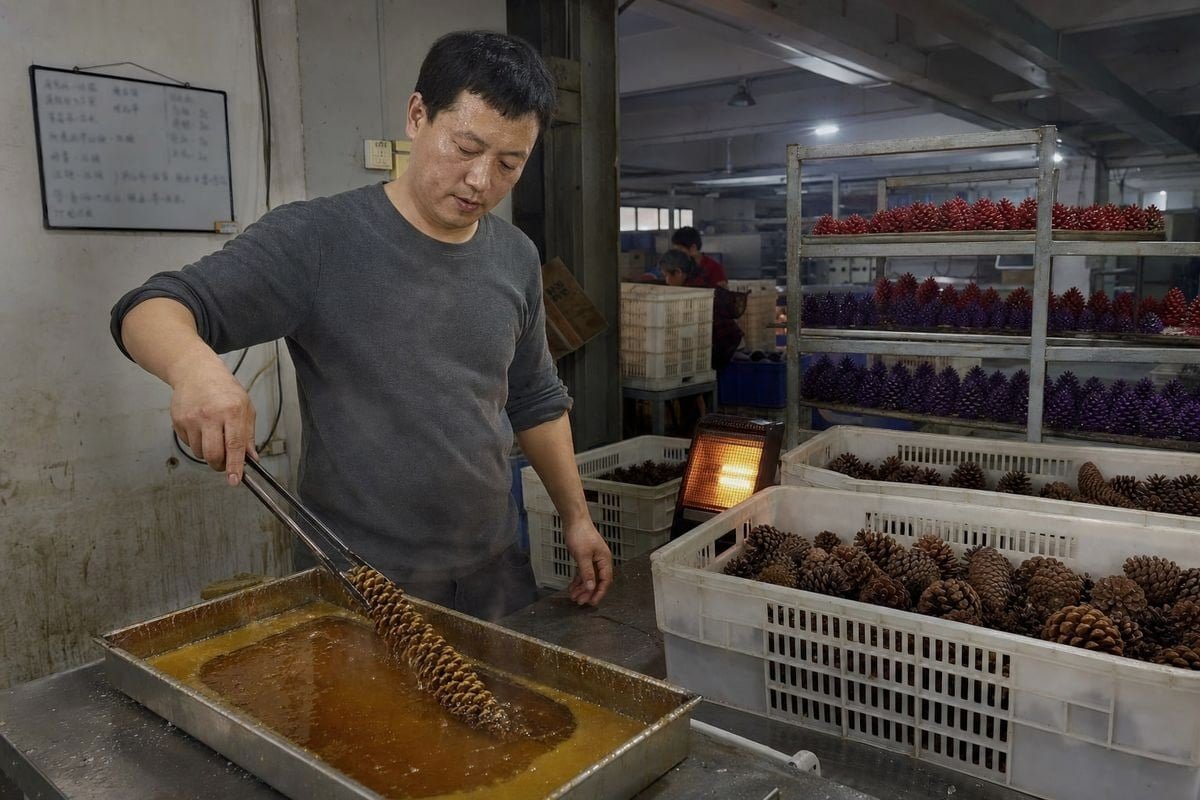
Let me break this down the way we do it during product development, because each variable is a lever you can adjust in an OEM order.
Cone species and density
Larger, resin-heavy cones such as Ponderosa hold more combustible material and natural pitch. They burn notably longer than small, light cones like Douglas fir 3. Burn duration can vary by 30 to 40 percent based on species alone. That is why we specify cone type and size grading in every production contract, and why our batch-to-batch QC includes cone weight sampling.
Wax content
Wax is the biggest single extender of burn time. It adds fuel, and it slows the release of the color chemicals so the effect lasts longer. A cone with a proper wax dip can run 15 to 20 minutes. A chemical-soak-only cone may struggle to reach five. The trade-off is real, though: heavy wax buildup can leave residue in a fireplace, so we calibrate coating thickness rather than simply maximizing it.
The colorant itself
The chemical chosen for the color also changes the burn profile:
| Colorant type | Flame color | Burn behavior |
|---|---|---|
| Copper-based compounds | Blue / blue-green | Burns slightly cooler and longer |
| Boric acid | Green | Moderate, steady release |
| Strontium-based compounds | Red | Faster, hotter consumption |
| Potassium / lithium-based | Purple / red | Shorter, more intense color |
One safety note we insist on: never mix different chemical treatments in one batch or one fire. It can be unsafe, and it disrupts both color and burn performance. Our formulas are eco-friendly, single-treatment, and backed by SGS and Intertek test reports, because for our US and EU buyers, compliance is a hard requirement, not a nice-to-have.
How do storage and humidity impact my pinecones' burn duration once they reach my warehouse?
A Dutch importer once stored a trial container in an unheated coastal warehouse over a wet autumn. By December, his samples lit poorly and burned unevenly. The product had not changed. The storage had.
Humidity is one of the most common causes of shortened burn time and ignition failure. Damp cones burn poorly, unevenly, and with weak color. Stored in airtight, temperature-stable packaging, colored pinecones keep consistent burn performance for roughly 12 to 18 months.
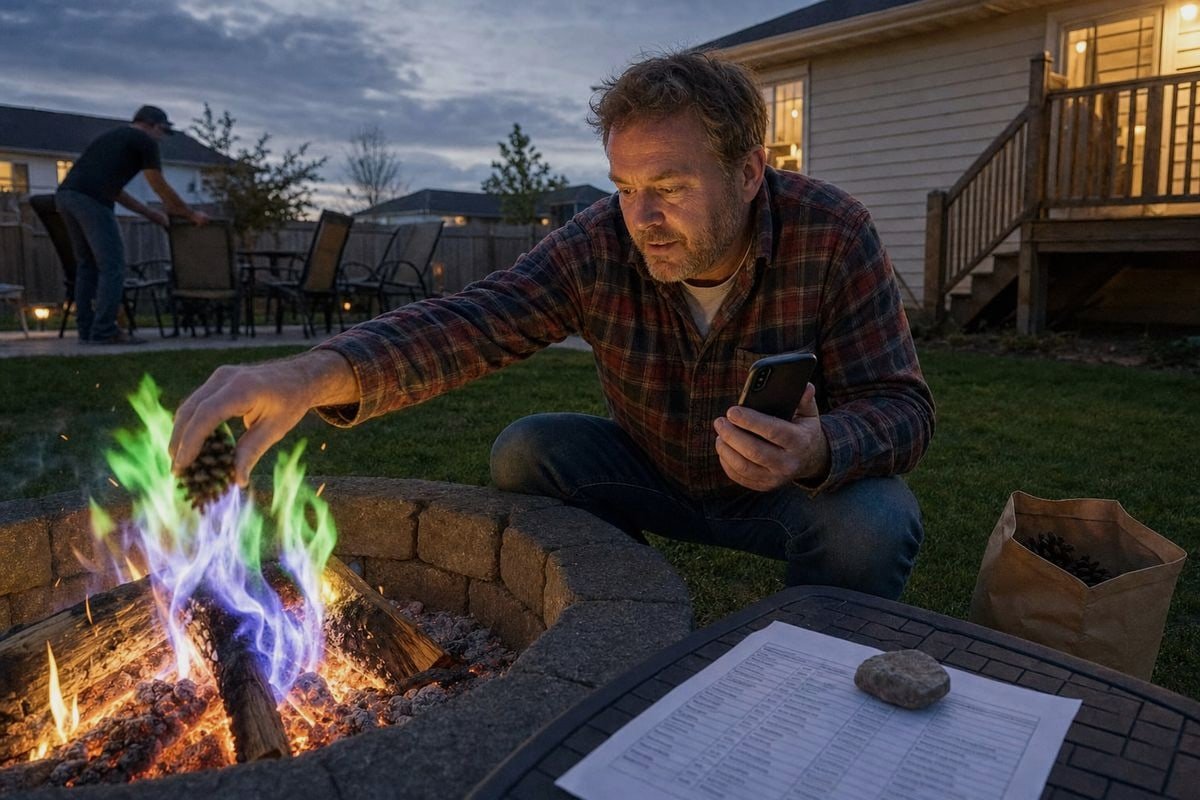
Pine cones are natural, porous material. They pull moisture from the air like a sponge. Once moisture gets in, three things happen. First, ignition becomes slow and unreliable. Second, energy that should feed the flame gets wasted boiling off water, so the burn is shorter and cooler. Third, the color effect weakens, because the metal salts need strong, clean combustion to show their full brilliance.
Temperature swings cause a separate problem. Repeated warming and cooling can degrade the wax coating and allow accelerants to evaporate slowly. That is premature aging, and it quietly eats your shelf life before the product even reaches a store shelf.
Warehouse best practices we recommend to buyers
- Keep master cartons sealed until the goods move to retail.
- Store below roughly 60 percent relative humidity 4, away from exterior walls and loading doors.
- Avoid temperature swings; steady room temperature protects the wax layer.
- Rotate stock on a first-in, first-out basis within 12 to 18 months.
- Never store opened stock near water heaters, boilers, or damp concrete floors.
Packaging is your first line of defense here, and it is something we control at the factory. Our resealable stand-up pouches and jar options exist precisely because loose or breathable retail packaging lets humidity in during long ocean transit. For buyers shipping to humid markets like Brazil or the Middle East, we adjust the packaging spec accordingly. One more handling note: ash from colored cones contains metal-salt residues, so tell your end customers not to spread it in gardens or compost, unlike ordinary wood ash.
Can I request custom burn times when I order private-label pinecones from a manufacturer?
The most common ODM request we receive is not about color at all. It is a buyer saying: "My competitor claims 10 minutes. Can you get me 15?" The answer, within physical limits, is usually yes.
Yes. A capable factory can tune burn time by adjusting cone size and species, wax coating thickness, colorant formula, and per-pack quantity. Realistic custom targets range from roughly 5 minutes for budget lines up to 15–20 minutes for premium wax-enriched cones.

Custom burn time is an engineering exercise, not a marketing checkbox. At our facility, we adjust four levers, and each one carries a cost and compliance implication you should understand before signing off on a spec sheet.
The four levers and their trade-offs
| Lever | Effect on burn time | Trade-off to consider |
|---|---|---|
| Larger cone grade | Longer burn | Higher raw material and freight cost per unit |
| Thicker wax dip | Significantly longer burn | Possible fireplace residue; heavier units |
| Colorant formula choice | Moderate effect | Copper blues run longer; reds run shorter |
| More cones per pack | Longer total effect | Higher pack cost, but stronger perceived value |
Here is how a custom order typically runs on our side. First, you tell us the target burn time and price point. Second, our engineers produce samples at two or three coating levels. Third, we burn-test them and send you video documentation plus physical samples. Fourth, once you approve, we lock the spec, and our batch QC ensures mass production matches that first sample. That last step is where 17+ years of production discipline matters most; a beautiful sample means nothing if container two drifts from container one.
Private-label support 5 goes beyond the cone itself. We handle custom pouches, kraft bags, jars, display boxes, warning labels, and barcodes, all aligned with CE marking 6 and backed by ISO 9001 7 and BSCI audits. For trial orders, we keep MOQs flexible so you can validate a burn-time claim in your market before scaling. In my experience, buyers who test one pallet with honest 10-minute claims reorder faster than those who launch big with inflated numbers.
Conclusion
Colored fireplace pine cones burn 5 to 15 minutes, shortened by heat, airflow, moisture, and thin coatings. Specify materials, storage, and burn targets upfront, and partner with a certified factory that proves consistency.
Footnotes
1. Official amfori BSCI page explaining the social compliance audit program mentioned in the article. ↩︎
2. Background chemistry explaining how metal-salt compounds create colored flame effects. ↩︎
3. Background reference on the tree species cited as an example of a smaller, faster-burning cone. ↩︎
4. Explains the humidity metric buyers must control to preserve burn performance in storage. ↩︎
5. Connects buyers to global manufacturing and private-label sourcing resources for OEM products. ↩︎
6. Official EU resource explaining the CE compliance marking referenced for exported products. ↩︎
7. Official standard reference for the quality management certification mentioned in the article. ↩︎



 English
  Spanish
  German
  French
  Arabic
  Portuguese
Join the Conversation