






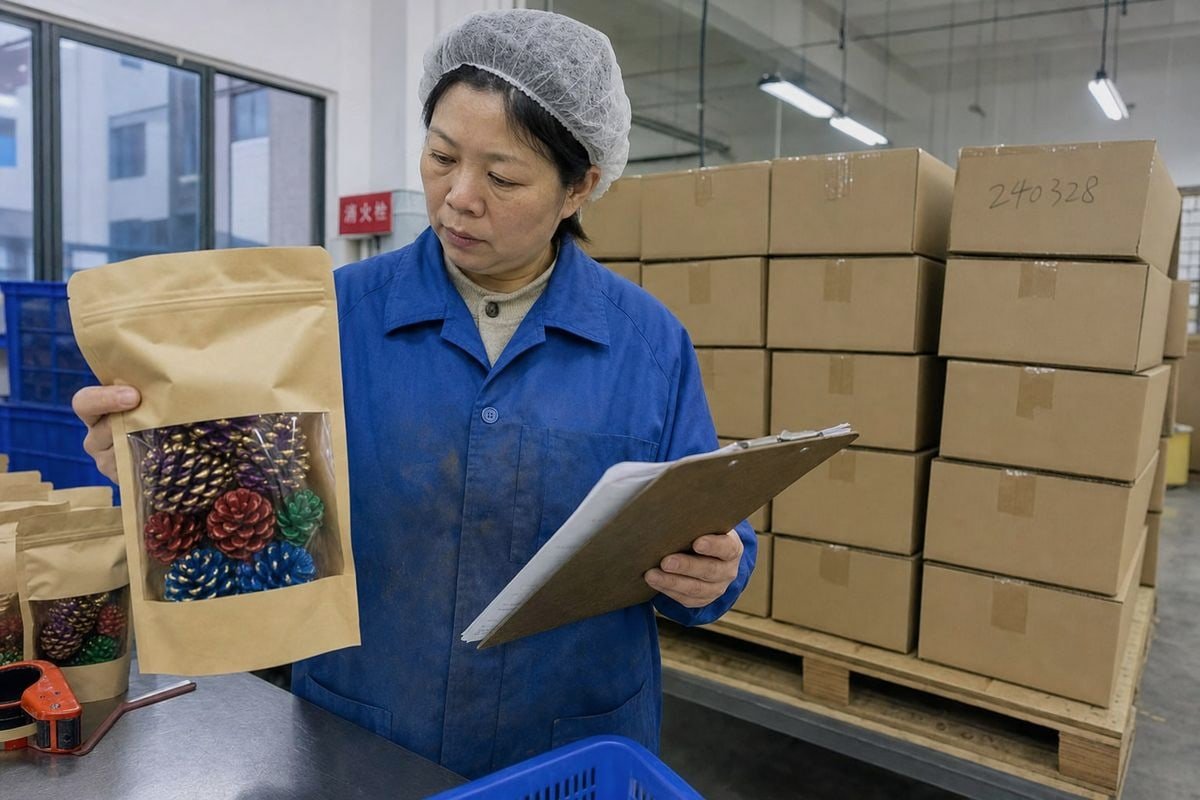
Packaging, labeling, and EPR compliance for pine cones in the EU trips up more importers than product quality ever does Packaging and Packaging Waste Regulation 1. On our production line, we see rejected shipments caused by paperwork, not pinecones.
To verify packaging, labeling, and EPR compliance for pine cones in the EU, confirm the supplier's EPR registration numbers in national registries, check packaging against PPWR recyclability and labeling rules, require multilingual safety warnings for color-flame products, and collect test reports, declarations of conformity, and phytosanitary certificates.
That is the short answer. Below, I break each step into a practical checklist you can use before your next bulk order.
What documents should I request to confirm my supplier's EPR registration is valid across EU member states?
A German distributor once asked us for one "EU-wide EPR certificate." We had to explain gently: no such single document exists. EPR is national, and our export team verifies it country by country.
Request the supplier's national EPR registration numbers for each destination country, proof of active membership in a Producer Responsibility Organization, recent fee-payment or reporting confirmations, and written clarification of who holds producer obligations — the supplier, the importer, or you as the distance seller.

Here is the core issue. The EU sets the EPR framework, but every member state runs its own registry, its own fees, and its own reporting cycle. A valid registration in Germany means nothing in France. So your verification has to match your actual sales map.
Match documents to each market
In our 17+ years exporting to Germany, France, the Netherlands, and Poland, we have learned that buyers who verify registrations before launch avoid marketplace suspensions later. Amazon and other platforms now block listings without proof of EPR compliance in several EU countries.
Ask for these documents and cross-check them yourself:
| Country | Registry / Scheme | What to verify |
|---|---|---|
| Germany | LUCID (Verpackungsregister) | Registration number searchable in the public LUCID database |
| France | CITEO (via ADEME registry) | Unique identifier (IDU) and current-year contract |
| Netherlands | Verpact | Registration confirmation and reporting status |
| Poland | BDO registry | BDO number and packaging waste entry |
| Spain | Envases registry | Producer registration certificate |
Clarify who the "producer" is
This is the trap. Under most national schemes, the party that first places packaged goods on that country's market is the obligated producer. If you import our color-flame pinecones into France under your own brand, that obligated party is usually you, not us. We can supply packaging weight data, material composition sheets, and unit counts to make your reporting easy. But a Chinese factory's paperwork rarely replaces your own registration. Get this allocation in writing before you sign a purchase order. Also confirm the registration is active for the current year, not just historically issued.
Which warning labels and multilingual safety texts must appear on my color-flame pinecone packaging?
The trade-off we weigh on every private-label run is label space versus language count. A kraft stand-up pouch has limited print area, yet a five-country launch needs five languages of warnings.
Color-flame pinecone packaging must carry warnings in the official language of each destination market, covering flammability, keep-away-from-children notices, indoor ventilation guidance, and never-cook-over-colored-flames instructions, printed legibly, indelibly, and at minimum required font sizes, with the responsible EU operator's name and address.
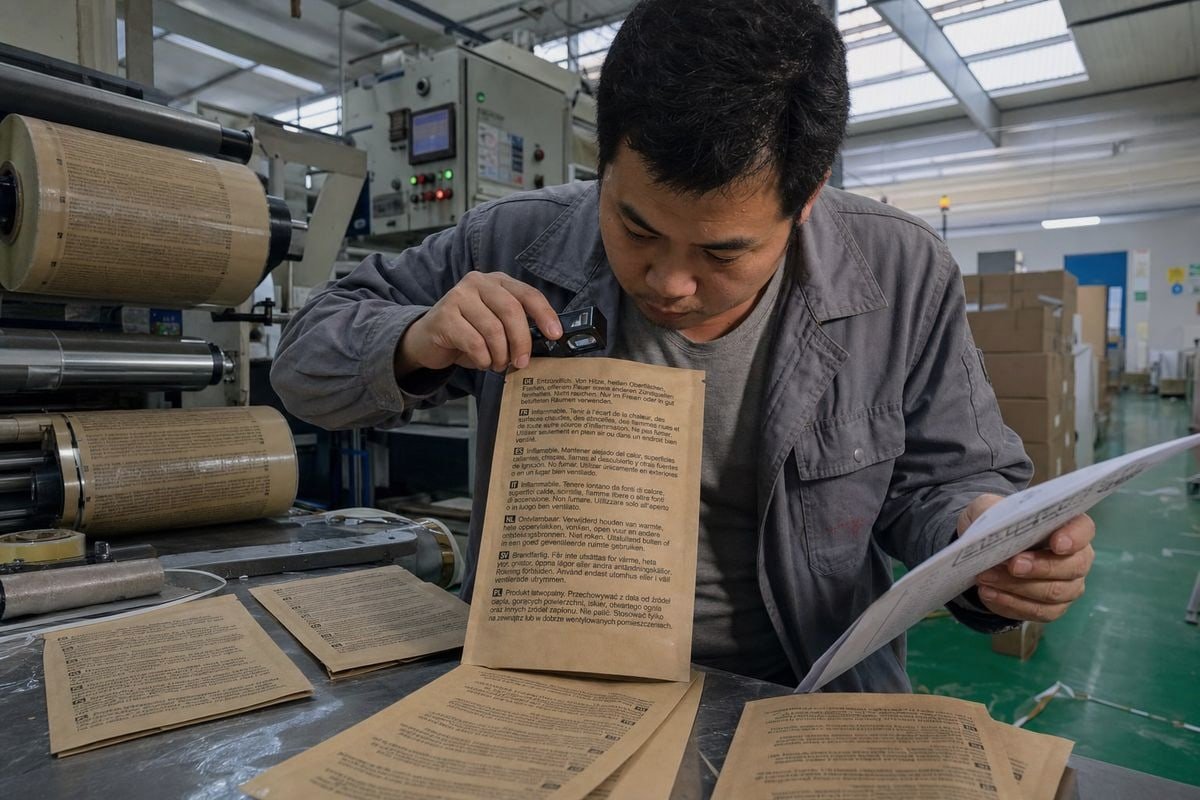
Color-flame pinecones are not ordinary decorative goods. They contain mineral colorants that change flame color, so they sit closer to fire-related consumer products than to plain botanicals. That changes the label conversation entirely. Our compliance team builds every EU label around three layers: legal legibility rules, safety content, and market-language requirements.
The legibility baseline
EU labeling rules require information to be accurate, easy to see, not misleading, and indelible. Mandatory text needs a minimum x-height of 1.2 mm. If the largest surface of the pack is under 80 cm², 0.9 mm is allowed. On our resealable pouches, we test print durability against abrasion and humidity, because a warning that rubs off in transit fails the "indelible" requirement.
Core safety texts we print for EU buyers
- Flammable product — keep away from open flame until intended use.
- Keep out of reach of children and pets.
- For use in fireplaces, fire pits, and campfires only.
- Do not cook food over colored flames.
- Use in well-ventilated areas; do not burn in unvented indoor stoves.
- Do not remove or open the pinecone; place the whole unit on the fire.
Language coverage
Germany expects German. France legally requires French for safety information. The Netherlands accepts Dutch, and Poland requires Polish. In practice, we build a single multilingual back panel or add a country-specific sticker layer for smaller trial orders. Also include your EU responsible operator's name and address, batch code, and net quantity. If your branding uses flags or landscape imagery, make sure it does not imply a false country of origin.
How do I verify that my packaging materials meet EU recycling and Extended Producer Responsibility requirements?
Two years ago, a Dutch buyer switched our standard pouch to a mono-material kraft bag mid-project. Their reason surprised me: eco-modulated EPR fees made the recyclable option cheaper over a full year of sales.
Verify packaging by identifying every material layer, confirming recyclability under the new Packaging and Packaging Waste Regulation, requesting the supplier's material composition data sheet, checking for upcoming harmonized sorting labels and QR-based producer identification, and matching packaging categories to national EPR fee structures.

The EU is moving from fragmented national packaging rules to a harmonized system under the Packaging and Packaging Waste Regulation 2 (PPWR, Regulation (EU) 2025/40). This shift makes verification more structured, but also more documentation-heavy. Declarations of conformity and technical files now matter as much as the physical pack.
Know your material stack
Start by listing every component: pouch body, clear window film, drawstring, zipper, label stock, and ink. Composite structures — like kraft paper laminated to plastic film — often attract higher EPR fees and worse recyclability grades than mono-materials 3. Our burlap sacks with jute ties score well here; laminated pouches with plastic windows need closer review.
Key PPWR dates to plan around
Some industry summaries push buyers to redesign everything for 2026. In reality, the labeling duties stagger. Do not overcomply early or mis-time an expensive packaging redesign.
| Requirement | Approximate start | What it means for you |
|---|---|---|
| General PPWR obligations begin | 12 August 2026 | Sustainability and conformity groundwork starts |
| Harmonized material composition label | 12 August 2028 (or later, per implementing acts) | Pictograms for consumer sorting on packs |
| Reusable packaging label | 12 February 2029 (or later) | Only if you market packaging as reusable |
| Digital EPR identification | Tied to implementing acts | QR code or standardized digital marker showing producer compliance |
Documents to hold on file
Ask us — or any supplier — for the packaging material data sheet, recyclability assessment, and the EU declaration of conformity for the packaging once PPWR conformity applies. Keep records linking packaging types, weights, and quantities placed on each national market. Auditors and PROs will ask for exactly this. Several member states also offer eco-modulated fee reductions for paper or compostable packaging, which can offset the cost of switching materials for natural products like pinecones.
What test reports and certifications should I ask for before placing a bulk pinecone order for EU distribution?
The costliest lesson I have watched a buyer learn involved a container held at Rotterdam for missing phytosanitary paperwork. The pinecones were fine. The heat-treatment certificate was not in the file.
Before a bulk order, request phytosanitary certificates and heat-treatment proof per shipment, SGS or Intertek chemical safety test reports, CE-relevant documentation for fire products, the factory's ISO 9001 and BSCI certificates, packaging declarations of conformity, and burn-performance test results from the actual production batch.

Pinecones are plant material. That single fact triggers a compliance layer many first-time importers miss: the EU Plant Health Regulation 4 (EU) 2016/2031. Untreated forestry material can carry pests such as pine wood nematode 5, so customs expects proof of pest elimination. Heat treatment or kiln-drying — commonly 56°C held for 30 minutes — is the standard evidence. At our factory, we consolidate phytosanitary certification 6 per shipment batch rather than per unit, which keeps inspection costs and paperwork manageable for craft and decorative imports.
The document set we prepare for EU buyers
| Document | What it proves | Who issues it |
|---|---|---|
| Phytosanitary certificate | Pest-free plant material per shipment | Chinese plant quarantine authority |
| Heat-treatment record | 56°C / 30 min kiln treatment completed | Factory, verified at inspection |
| SGS / Intertek test report | Colorants contain no restricted harmful chemicals | Third-party lab |
| CE-related documentation | Product meets applicable EU safety requirements | Factory technical file |
| ISO 9001 certificate | Consistent quality management system | Accredited certifier |
| BSCI audit report | Social compliance at the production site | Audit body |
| Packaging declaration of conformity | Packaging meets EU packaging rules | Producer / factory |
Verify, do not just collect
A PDF is not verification. Check that test reports name the actual product and colorant formulation you are buying, not a generic item. Confirm report dates are recent and match your production batch. Ask whether the pine species has been screened against biodiversity and nature-protection lists, since certain rare pinus species face extra export restrictions. Finally, request a pre-shipment burn test video from your batch. Our batch-to-batch QC exists precisely so the sample you approved matches the container you receive — insist on the same from any supplier.
Conclusion
Verifying packaging, labeling, and EPR compliance for pine cones in the EU means checking national registrations, multilingual warnings, PPWR-ready packaging, and batch-specific certificates — before the container ships, not after.
Footnotes
1. Official EU source detailing PPWR requirements referenced for packaging recyclability compliance. ↩︎
2. Official EU source detailing PPWR requirements referenced for packaging recyclability compliance. ↩︎
3. Background on recyclability grading relevant to comparing composite versus mono-material packaging. ↩︎
4. Official EU page explaining plant health rules triggering phytosanitary certification for pinecones. ↩︎
5. Background on the pest driving mandatory heat-treatment and phytosanitary certification. ↩︎
6. International Plant Protection Convention explains phytosanitary certification standards for traded plant material. ↩︎
7.
 English
  Spanish
  German
  French
  Arabic
  Portuguese
Join the Conversation