






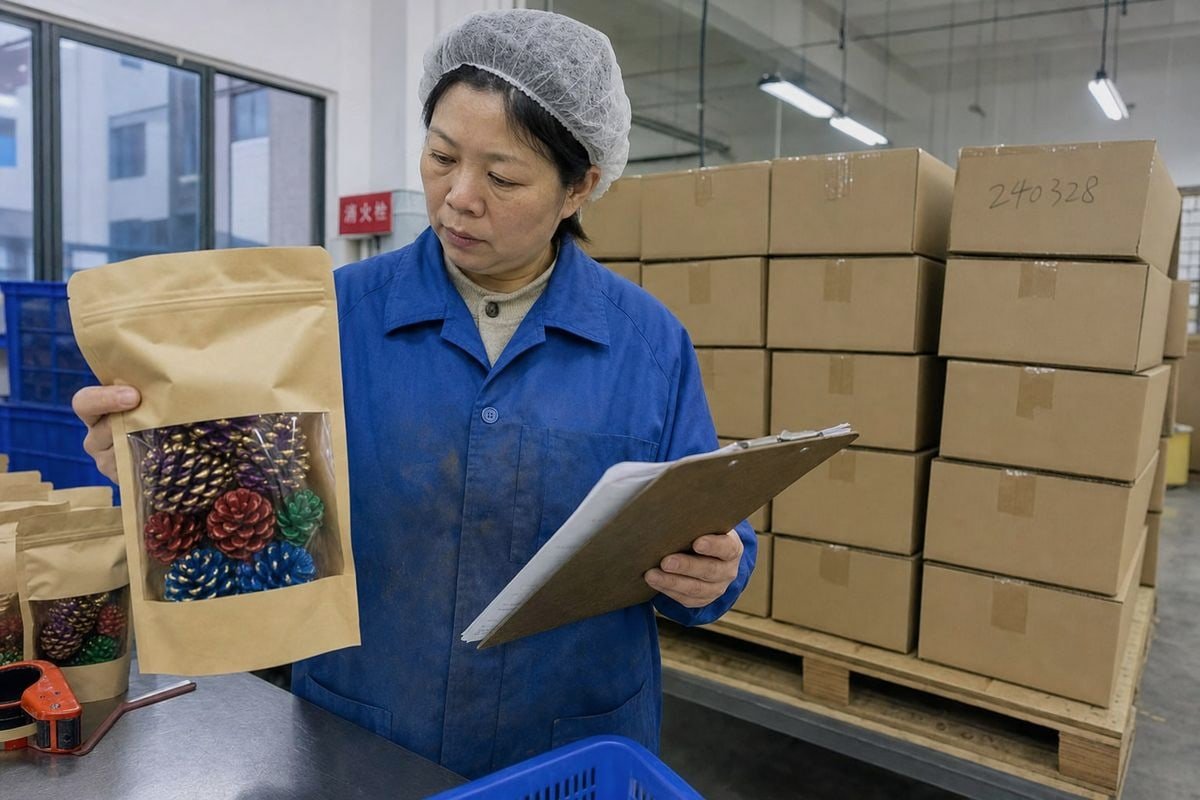
La conformité de l'emballage, de l'étiquetage et de la RPE pour les pommes de pin dans l'UE pose plus de problèmes aux importateurs que la qualité du produit elle-même. les emballages et les déchets d'emballages 1. Sur notre ligne de production, nous constatons des expéditions rejetées causées par des documents, pas par des pommes de pin.
Pour vérifier la conformité des emballages, de l'étiquetage et de la RFE pour les pommes de pin dans l'UE, confirmez les numéros d'enregistrement RFE du fournisseur dans les registres nationaux, vérifiez les emballages par rapport aux règles de recyclabilité et d'étiquetage de la PPWR, exigez des avertissements de sécurité multilingues pour les produits de couleur flamme, et collectez les rapports de test, les déclarations de conformité et les certificats phytosanitaires.
C'est la réponse courte. Ci-dessous, je détaille chaque étape dans une checklist pratique que vous pouvez utiliser avant votre prochaine commande en gros.
Quels documents dois-je demander pour confirmer que l'enregistrement REP de mon fournisseur est valide dans les États membres de l'UE ?
Un distributeur allemand nous a un jour demandé un "certificat RPE unique pour toute l'UE". Nous avons dû expliquer gentiment : un tel document unique n'existe pas. La RPE est nationale, et notre équipe d'exportation la vérifie pays par pays.
Demandez les numéros d'enregistrement nationaux de RSE du fournisseur pour chaque pays de destination, une preuve d'adhésion active à une organisation de responsabilité élargie des producteurs, des confirmations récentes de paiement de frais ou de déclaration, et une clarification écrite de qui détient les obligations du producteur — le fournisseur, l'importateur ou vous en tant que vendeur à distance.

Voici le problème principal. L'UE définit le cadre de la RPE, mais chaque État membre gère son propre registre, ses propres frais et son propre cycle de reporting. Un enregistrement valide en Allemagne ne signifie rien en France. Votre vérification doit donc correspondre à votre carte de ventes réelle.
Faites correspondre les documents à chaque marché
Au cours de nos 17 années d'exportation vers l'Allemagne, la France, les Pays-Bas et la Pologne, nous avons appris que les acheteurs qui vérifient les enregistrements avant le lancement évitent les suspensions de marché plus tard. Amazon et d'autres plateformes bloquent désormais les listes sans preuve de conformité RPE dans plusieurs pays de l'UE.
Demandez ces documents et vérifiez-les vous-même :
| Pays | Registre / Organisme | Ce qu'il faut vérifier |
|---|---|---|
| Allemagne | LUCID (Registre des emballages) | Numéro d'enregistrement consultable dans la base de données publique LUCID |
| France | CITEO (via le registre ADEME) | Identifiant unique (IDU) et contrat de l'année en cours |
| Pays-Bas | Emballé | Confirmation d'enregistrement et statut de reporting |
| Pologne | Registre BDO | Numéro BDO et entrée des déchets d'emballage |
| Espagne | Registre Envases | Certificat d'enregistrement du producteur |
Clarifiez qui est le "producteur"
C'est le piège. Selon la plupart des régimes nationaux, la partie qui met pour la première fois des produits emballés sur le marché de ce pays est le producteur responsable. Si vous importez nos pommes de pin colorées en France sous votre propre marque, cette partie responsable, c'est généralement vous, pas nous. Nous pouvons fournir des données sur le poids de l'emballage, des fiches de composition des matériaux et des décomptes unitaires pour faciliter votre reporting. Mais la paperasse d'une usine chinoise remplace rarement votre propre enregistrement. Obtenez cette allocation par écrit avant de signer un bon de commande. Confirmez également que l'enregistrement est actif pour l'année en cours, et pas seulement délivré historiquement.
Quelles étiquettes d'avertissement et textes de sécurité multilingues doivent figurer sur l'emballage de mes pommes de pin colorées ?
Le compromis que nous évaluons à chaque production en marque blanche est l'espace d'étiquetage par rapport au nombre de langues. Une pochette stand-up en kraft a une surface d'impression limitée, pourtant un lancement dans cinq pays nécessite cinq langues d'avertissements.
Les emballages de pommes de pin à flamme colorée doivent porter des avertissements dans la langue officielle de chaque marché de destination, couvrant l'inflammabilité, les avis de tenir hors de portée des enfants, les conseils de ventilation intérieure et les instructions de ne jamais cuire sur des flammes colorées, imprimés de manière lisible, indélébile et aux tailles de police minimales requises, avec le nom et l'adresse de l'opérateur responsable de l'UE.
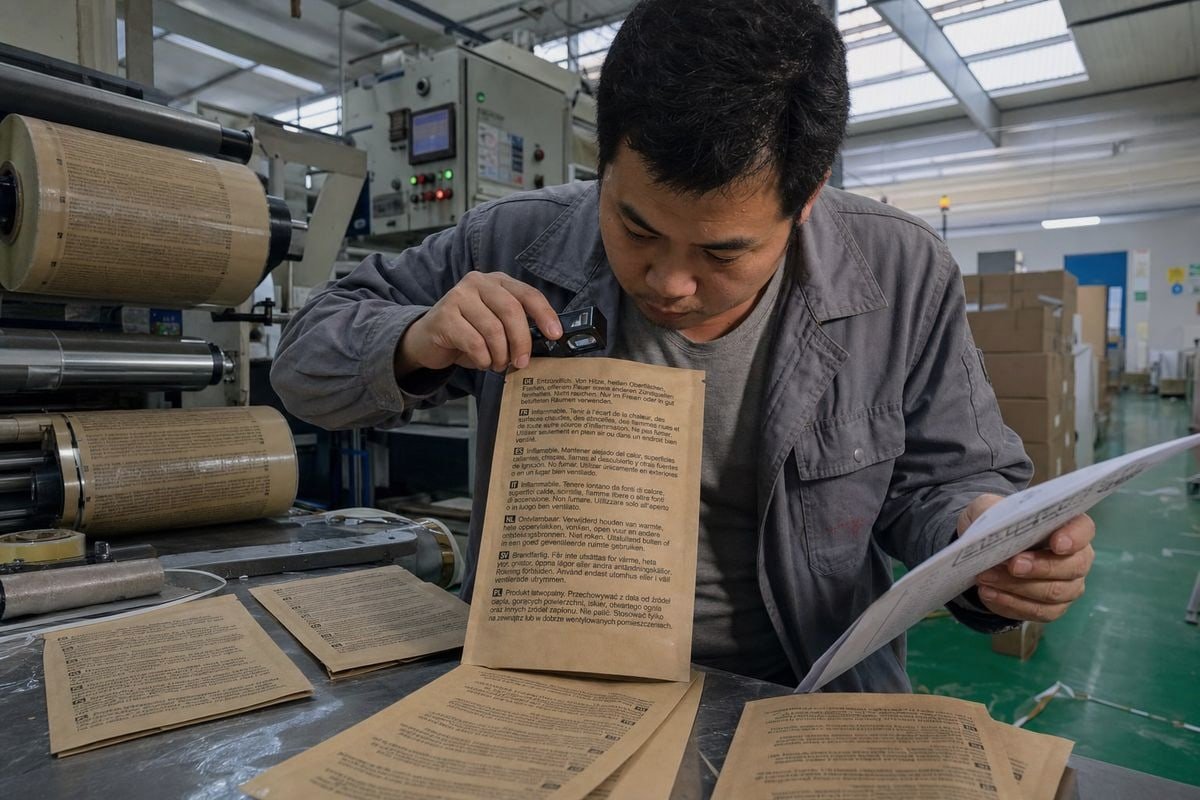
Les pommes de pin colorées ne sont pas des articles décoratifs ordinaires. Elles contiennent des colorants minéraux qui changent la couleur de la flamme, elles sont donc plus proches des produits de consommation liés au feu que des simples produits botaniques. Cela change entièrement la conversation sur l'étiquetage. Notre équipe de conformité construit chaque étiquette UE autour de trois couches : règles de lisibilité légales, contenu de sécurité et exigences linguistiques du marché.
La base de la lisibilité
Les règles d'étiquetage de l'UE exigent que les informations soient exactes, faciles à voir, non trompeuses et indélébiles. Le texte obligatoire doit avoir une hauteur de x minimale de 1,2 mm. Si la plus grande surface de l'emballage est inférieure à 80 cm², 0,9 mm est autorisé. Sur nos pochettes refermables, nous testons la durabilité de l'impression contre l'abrasion et l'humidité, car un avertissement qui s'efface pendant le transport échoue à l'exigence "indélébile".
Textes de sécurité essentiels que nous imprimons pour les acheteurs de l'UE
- Produit inflammable — tenir à l'écart des flammes nues jusqu'à l'utilisation prévue.
- Tenir hors de portée des enfants et des animaux domestiques.
- À utiliser uniquement dans les foyers, les braseros et les feux de camp.
- Ne pas cuire d'aliments sur des flammes colorées.
- Utiliser dans des zones bien ventilées ; ne pas brûler dans des poêles d'intérieur non ventilés.
- Ne pas retirer ni ouvrir la pomme de pin ; placer l'unité entière sur le feu.
Couverture linguistique
L'Allemagne attend de l'allemand. La France exige légalement le français pour les informations de sécurité. Les Pays-Bas acceptent le néerlandais, et la Pologne exige le polonais. En pratique, nous créons un panneau arrière multilingue unique ou ajoutons une couche d'autocollants spécifique au pays pour les petites commandes d'essai. Incluez également le nom et l'adresse de votre opérateur responsable dans l'UE, le code de lot et la quantité nette. Si votre marque utilise des drapeaux ou des images de paysage, assurez-vous qu'ils n'impliquent pas une fausse origine.
Comment vérifier que mes matériaux d'emballage répondent aux exigences de l'UE en matière de recyclage et de responsabilité élargie des producteurs ?
Il y a deux ans, un acheteur néerlandais a remplacé notre pochette standard par un sac en kraft mono-matériau en cours de projet. Leur raison m'a surpris : les frais RPE éco-modulés rendaient l'option recyclable moins chère sur une année complète de ventes.
Vérifier l'emballage en identifiant chaque couche de matériau, en confirmant la recyclabilité dans le cadre du nouveau règlement sur les emballages et les déchets d'emballage, en demandant la fiche de données de composition des matériaux du fournisseur, en vérifiant les futures étiquettes de tri harmonisées et l'identification du producteur basée sur QR code, et en faisant correspondre les catégories d'emballage aux structures de frais nationaux de la RSE.

L'UE évolue de règles d'emballage nationales fragmentées vers un système harmonisé sous la les emballages et les déchets d'emballages 2 (PPWR, Règlement (UE) 2025/40). Ce changement rend la vérification plus structurée, mais aussi plus lourde en documentation. Les déclarations de conformité et les dossiers techniques sont désormais aussi importants que l'emballage physique.
Connaissez votre composition matérielle
Commencez par lister chaque composant : corps du sachet, film transparent, cordon de serrage, fermeture éclair, étiquette, et encre. Les structures composites — comme le papier kraft laminé sur film plastique — attirent souvent des frais REP plus élevés et des notes de recyclabilité moins bonnes que les mono-matériaux 3. Nos sacs en toile de jute avec attaches en jute obtiennent de bons résultats ici ; les sachets laminés avec fenêtres en plastique nécessitent un examen plus approfondi.
Dates clés de la PPWR à planifier
Certains résumés de l'industrie poussent les acheteurs à tout repenser pour 2026. En réalité, les obligations d'étiquetage sont échelonnées. Ne sur-conformez pas trop tôt ou ne vous trompez pas dans le calendrier d'une refonte coûteuse des emballages.
| Exigence | Début approximatif | Ce que cela signifie pour vous |
|---|---|---|
| Les obligations générales de la PPWR commencent | 12 août 2026 | Les bases de la durabilité et de la conformité commencent |
| Étiquette harmonisée de composition des matériaux | 12 août 2028 (ou plus tard, selon les actes d'exécution) | Pictogrammes pour le tri par le consommateur sur les emballages |
| Étiquette d'emballage réutilisable | 12 février 2029 (ou plus tard) | Uniquement si vous commercialisez des emballages comme réutilisables |
| Identification numérique de la REP | Lié aux actes d'exécution | Code QR ou marqueur numérique standardisé indiquant la conformité du producteur |
Documents à conserver
Demandez-nous — ou à tout fournisseur — la fiche de données du matériau d'emballage, l'évaluation de la recyclabilité et la déclaration de conformité UE pour l'emballage une fois la conformité PPWR s'applique. Conservez des registres liant les types d'emballages, les poids et les quantités mis sur chaque marché national. Les auditeurs et les éco-organismes demanderont exactement cela. Plusieurs États membres offrent également des réductions de frais éco-modulées pour les emballages en papier ou compostables, ce qui peut compenser le coût du changement de matériaux pour des produits naturels comme les pommes de pin.
Quels rapports de test et certifications dois-je demander avant de passer une commande en gros de pommes de pin pour une distribution dans l'UE ?
La leçon la plus coûteuse que j'ai vue un acheteur apprendre concernait un conteneur retenu à Rotterdam pour manque de documents phytosanitaires. Les pommes de pin allaient bien. Le certificat de traitement thermique n'était pas dans le dossier.
Avant une commande en gros, demandez des certificats phytosanitaires et une preuve de traitement thermique par expédition, des rapports de test de sécurité chimique SGS ou Intertek, la documentation pertinente CE pour les produits de lutte contre l'incendie, les certificats ISO 9001 et BSCI de l'usine, les déclarations de conformité de l'emballage et les résultats des tests de performance de combustion du lot de production réel.
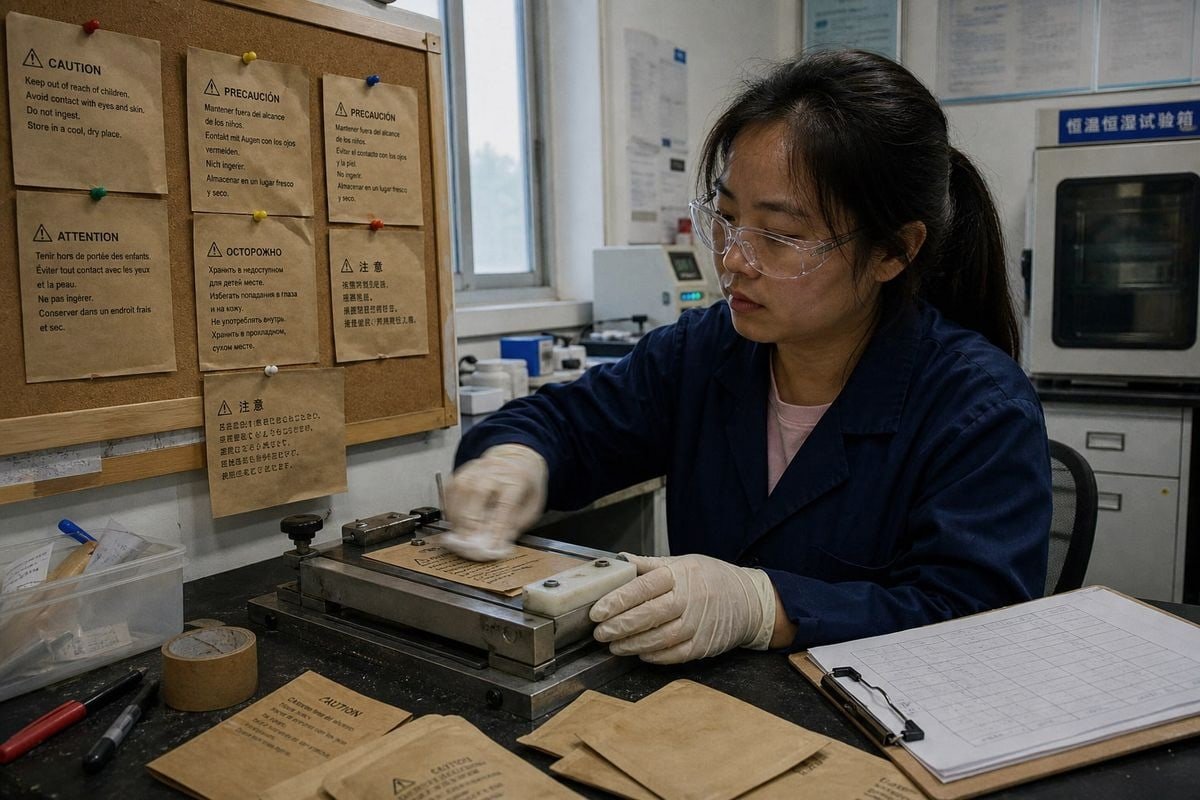
Les pommes de pin sont des matières végétales. Ce seul fait déclenche une couche de conformité que de nombreux importateurs pour la première fois manquent : le Règlement phytosanitaire de l'UE 4 (UE) 2016/2031. Les matières forestières non traitées peuvent transporter des ravageurs tels que règles concernant le nématode du pin 5, donc les douanes attendent une preuve d'élimination des ravageurs. Le traitement thermique ou le séchage au four — généralement 56°C pendant 30 minutes — est la preuve standard. Dans notre usine, nous consolidons la certification phytosanitaire 6 par lot d'expédition plutôt que par unité, ce qui maintient les coûts d'inspection et la paperasserie gérables pour les importations artisanales et décoratives.
L'ensemble de documents que nous préparons pour les acheteurs de l'UE
| Document | Ce qu'elle prouve | Qui le délivre |
|---|---|---|
| Certificat phytosanitaire | Matière végétale exempte de ravageurs par expédition | Autorité chinoise de quarantaine végétale |
| Enregistrement du traitement thermique | Traitement au four à 56°C / 30 min terminé | Usine, vérifié lors de l'inspection |
| Rapport de test SGS / Intertek | Les colorants ne contiennent pas de produits chimiques nocifs restreints | Laboratoire tiers |
| Documentation liée à la CE | Le produit répond aux exigences de sécurité de l'UE applicables | Dossier technique de l'usine |
| Certificat ISO 9001 | Système de gestion de la qualité cohérent | Certificateur accrédité |
| rapport d'audit BSCI | Conformité sociale sur le site de production | Organisme d'audit |
| Déclaration de conformité de l'emballage | L'emballage respecte les règles de l'UE en matière d'emballage | Producteur / usine |
Vérifiez, ne vous contentez pas de collecter
Un PDF n'est pas une vérification. Vérifiez que les rapports de test nomment le produit réel et la formulation de colorant que vous achetez, pas un article générique. Confirmez que les dates des rapports sont récentes et correspondent à votre lot de production. Demandez si l'espèce de pin a été examinée par rapport aux listes de biodiversité et de protection de la nature, car certaines espèces rares de pinus font l'objet de restrictions d'exportation supplémentaires. Enfin, demandez une vidéo de test de combustion avant expédition de votre lot. Notre contrôle qualité lot par lot existe précisément pour que l'échantillon que vous avez approuvé corresponde au conteneur que vous recevez — insistez pour la même chose de la part de tout fournisseur.
Conclusion
La vérification de la conformité des emballages, de l'étiquetage et de la REP pour les pommes de pin dans l'UE signifie vérifier les enregistrements nationaux, les avertissements multilingues, les emballages prêts pour la PPWR et les certificats spécifiques au lot — avant l'expédition du conteneur, pas après.
Notes de bas de page
Source officielle de l'UE détaillant les exigences de la PPWR référencées pour la conformité de la recyclabilité des emballages. ↩︎
Source officielle de l'UE détaillant les exigences de la PPWR référencées pour la conformité de la recyclabilité des emballages. ↩︎
Contexte sur la classification de la recyclabilité pertinente pour comparer les emballages composites par rapport aux emballages monomatières. ↩︎
Page officielle de l'UE expliquant les règles phytosanitaires déclenchant la certification phytosanitaire pour les pommes de pin. ↩︎
Contexte sur le ravageur justifiant le traitement thermique obligatoire et la certification phytosanitaire. ↩︎
La Convention Internationale pour la Protection des Végétaux explique les normes de certification phytosanitaire pour les matières végétales échangées. ↩︎
7.
 English
  Spanish
  German
  French
  Arabic
  Portuguese
Rejoignez la conversation