






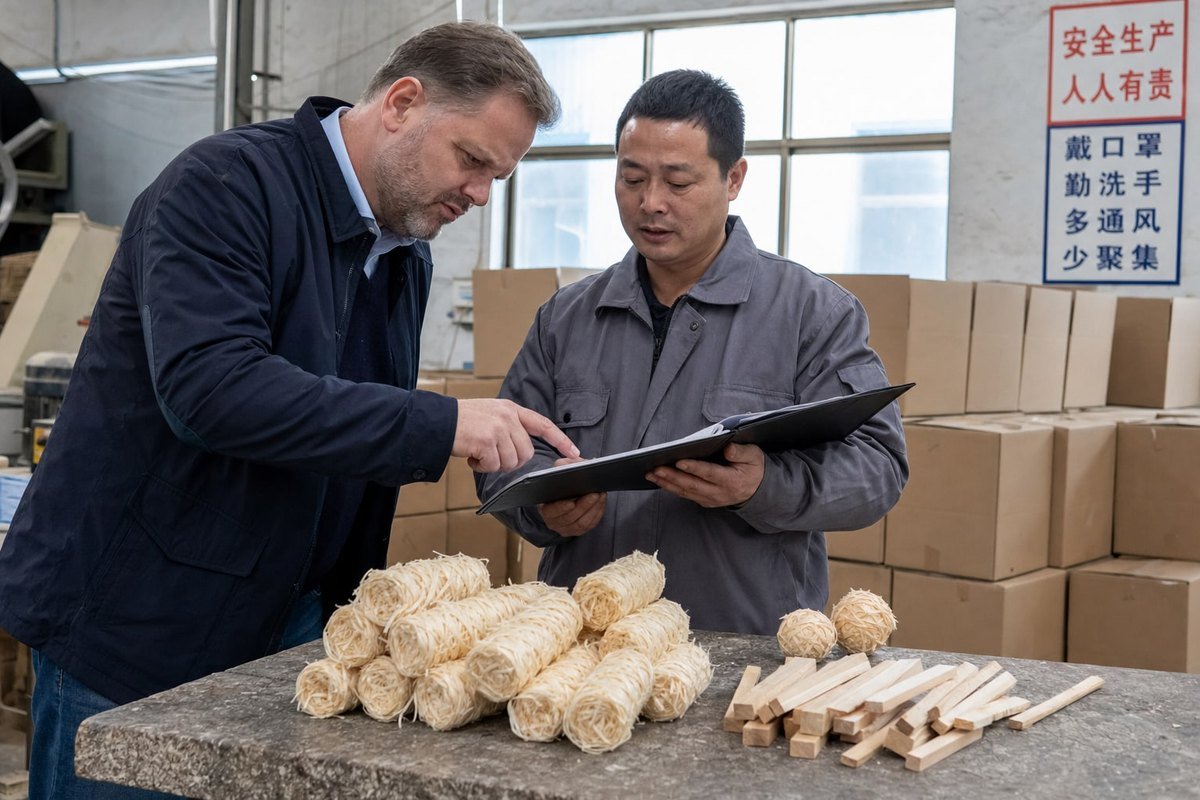
Verifying eco-friendly claims on wood fire starters is harder than it looks. On our production line, I have seen how easily green language can hide weak sourcing. One bad supplier can wreck your brand.
To verify eco-friendly claims when sourcing wood fire starters, request FSC or PEFC chain-of-custody certificates, independent lab test reports for chemical content, raw material traceability documents, and third-party sustainability audits. Confirm every certificate number in public registries and match it to the exact product SKU.
That answer sounds simple. In practice, each step has traps. I will walk you through the certifications, the sample tests, the paperwork, and the greenwashing 1 tricks — one section at a time.
What certifications should I ask suppliers to prove their eco-friendly claims are real?
A German distributor once asked me to prove our wax-dipped wood rolls were truly clean-burning. He did not want promises. He wanted certificates with numbers he could check himself. That request shaped how we handle every audit since.
Ask suppliers for FSC or PEFC chain-of-custody certificates for the wood, SGS or Intertek chemical test reports, ISO 9001 for quality management, and BSCI for ethical production. Each certificate must show an active status, the supplier's legal name, and the exact product scope.

Certifications only matter when they match the product in front of you. In our experience exporting to 30+ countries, buyers who get burned usually made one mistake: they accepted a certificate without checking what it actually covered. A factory can hold FSC certification 2 for one product line and still sell you uncertified stock from another.
The core certificates and what each one proves
Different documents answer different questions. Do not treat them as interchangeable. Here is how I explain it to new buyers during factory visits.
| Certificate | What it proves | How to verify it |
|---|---|---|
| FSC / PEFC chain of custody | Wood comes from sustainable forestry practices | Search the certificate number in the FSC or PEFC public database |
| SGS / Intertek test report | No non-toxic chemical additives issues; low VOC emissions | Match report number, product description, and test date with the lab |
| ISO 9001 3 | Consistent quality management system | Check the issuing body and expiry date |
| BSCI audit | Ethical labor and factory conditions | Request the audit report and score, not just the claim |
| CE / EN standards | Product meets EU safety requirements | Ask for the technical file and declaration of conformity |
Check scope, not just logos
When we renew our own ISO 9001 and BSCI audits, the auditors verify specific production sites and product categories. Your supplier's paperwork should do the same. Confirm three things on every document: the legal entity name matches the company on your invoice, the certificate is currently active, and the scope statement includes wood wool fire starters 4 or the exact product type you are buying. A trading company borrowing a factory's certificate will fail at least one of these checks. That single habit — matching scope to SKU — filters out most fake claims before you spend a dollar on samples.
Here is a trade-off I weigh every week: paraffin is cheap and burns hot, but it is petroleum-based. Some competitors coat their rolls in it and still print "natural" on the box. Your nose and a few simple tests can expose that fast.
Test samples by burning one in a ventilated space and checking for black soot, chemical odor, or oily residue. Then send samples to SGS or Intertek for VOC emissions, heavy metals, and wax composition analysis. Genuine paraffin-free firelighters burn with minimal smoke and leave clean ash.

Sample testing works best as a two-stage process. Do the cheap checks yourself first. Then pay a lab only for samples that pass. I have watched buyers skip stage one, spend money on lab fees, and reject an obviously bad product a lab could have flagged in five minutes of burning.
Stage one: simple in-house checks
You do not need equipment for these. You need a sample, a match, and attention.
- Smell the unlit sample. A vegetable wax coating smells faint and slightly sweet. Paraffin or kerosene smells sharp and industrial.
- Touch test. Rub the roll between your fingers. Petroleum wax leaves a greasy, persistent film. Plant-based wax feels drier.
- Burn test. Light one outdoors. Watch the smoke. Heavy black soot signals petroleum content or synthetic binders.
- Ash check. Let it burn out fully. Clean wood fiber and natural wax leave pale, powdery ash. Dark, sticky, or plasticky residue is a red flag — especially if your customers use wood ash in gardens.
Stage two: laboratory verification
For the samples that pass, commission independent testing. Ask the lab to confirm the wax type, screen for heavy metals 5 and synthetic dyes, and measure emissions against a recognized benchmark such as EN 1860-3 6 for barbecue firelighters. When we develop a new wax formula at our Ningbo facility, we run these tests before the product ever reaches a customer, because a first sample must reliably reflect mass-production quality. Also insist on batch-specific testing language in your purchase order. A test report from two years ago proves nothing about the container arriving next month. Tie the report date to your production run.
What documentation should I request to verify sustainable sourcing of raw materials?
Traceability taught me a hard lesson early in my 17 years in this trade. A raw material broker once offered us cheap wood shavings with no mill of origin. We declined. Months later, that wood was traced to a land-clearing operation. Paperwork is not bureaucracy — it is protection.
Request a chain-of-custody certificate covering the wood, raw material purchase invoices from certified mills, a product specification sheet listing all inputs, a supplier declaration of origin, and batch-level traceability records. Every document must name the same legal entity and production site.

Documentation should form an unbroken chain from forest to finished carton. If any link is missing, the sustainability claim breaks with it. When our team sources wood for our wood wool fire starters, we keep records at every handoff, because our European buyers increasingly ask for exactly this chain during their own third-party sustainability audits.
The minimum evidence pack
I recommend requesting these five documents together, as a set, before your first bulk order.
| Document | What it tells you | Red flag if missing |
|---|---|---|
| Chain-of-custody certificate | Wood links back to sustainable forestry practices | Supplier cannot prove forest origin |
| Mill purchase invoices | The wood was actually bought from a certified or verified mill | Broker-sourced wood of unknown origin |
| Product specification sheet | Full input list: wood type, wax type, binders, dyes | Hidden petroleum content or synthetic additives |
| Declaration of origin | Country and region of harvest | Possible illegal logging exposure |
| Batch traceability records | Each production lot maps to specific raw material intake | No recall path if a problem appears |
Ask about recycled and by-product content
Many of the greenest fire starters use recycled wood waste — sawdust and shavings from furniture mills or timber processing. This supports a circular economy 7, but the claim still needs proof. Ask which mills supply the waste, whether the volume is post-industrial, and how incoming material is inspected for contamination like paint, glue, or treated timber. Treated wood waste burned in a fireplace releases exactly the toxins your customers are trying to avoid. Also confirm how claims map to components. A carton made from certified board does not make the product inside sustainable. Insist that every claim states whether it covers the fire starter, the biodegradable packaging 8, or both. And if you want to reduce transport footprint further toward carbon neutral biomass goals, ask for the shipping route and consolidation plan — logistics is part of the environmental story too.
How do I spot greenwashing when comparing wood fire starter manufacturers?
Buyer conversations reveal patterns. When a purchasing manager from a US camping brand shares three competing quotes with me, I can usually spot the greenwashed one in under a minute. The tells are consistent, and once you know them, you will see them everywhere.
Spot greenwashing by flagging vague terms like "eco-friendly" or "green" with no supporting data, certificates without verifiable numbers, claims that ignore scope, self-issued "audits," and packaging claims disguised as product claims. Credible manufacturers volunteer specifics; greenwashers offer adjectives.

Greenwashing is rarely an outright lie. It is usually a true statement stretched past its scope. The fastest way to compare manufacturers is to translate every marketing claim into a testable question, then see who can answer with documents.
Vague claim versus verifiable claim
| Vague claim | What to demand instead |
|---|---|
| "Eco-friendly fire starters" | The specific benefit: certified wood, plant wax, recycled content — with proof |
| "Made with natural wax" | The wax named: soy, rapeseed, or beeswax, plus the percentage |
| "Made with recycled material" | Whether it covers the product, the carton, or both, and at what percentage |
| "Biodegradable" | Test method, timeframe, and the environment where it degrades |
| "Sustainably sourced wood" | An FSC or PEFC certified wood certificate number you can look up |
| "Clean burning" | Emissions data against a named standard such as EN 1860-3 |
Behavioral red flags in supplier conversations
Documents matter, but so does behavior. In my years handling OEM inquiries, I have learned that how a supplier answers is as revealing as what they answer. Watch for these patterns. First, deflection: you ask for a certificate number and receive a brochure. Second, borrowed credibility: a trading company presents a factory's certificates under its own name. Third, frozen paperwork: every test report is several years old, suggesting testing happened once for marketing, not as ongoing quality control. Fourth, resistance to site visits or video audits — a real factory with complete production lines has nothing to hide. Fifth, wording games: a supplier who refuses to put "paraffin-free" or a specific recycled percentage into the purchase order contract does not believe their own claim. Finally, compare fatwood claims carefully. Ethical fatwood should come from naturally fallen stumps, and a credible supplier can describe the harvest region and method. Silence on sourcing method usually means destructive practices somewhere upstream.
Conclusion
Vague green claims put your brand at risk. Unverified suppliers make it worse. The fix: demand certificates, lab tests, and traceability — then verify every number yourself before ordering.
Across this article, one principle repeats. A real eco-friendly claim survives translation into a document. FSC certification proves the forest. Independent lab reports prove the chemistry. Traceability records prove the supply chain. Contractual wording proves the supplier's confidence. At our factory in China, we built our compliance stack — ISO 9001, BSCI, CE, and SGS/Intertek testing — because our buyers in the US and Europe treat verification as a hard requirement, and so should you. When you compare wood fire starter manufacturers, ignore the adjectives. Follow the paperwork. The supplier who answers your hardest questions with certificate numbers, current test reports, and batch-level evidence is the one worth a long-term partnership.
Footnotes
1. Defines the deceptive marketing practice the article teaches buyers to detect and avoid. ↩︎
2. FSC's official site lets buyers verify chain-of-custody certificates and product scope directly. ↩︎
3. ISO's official page defines the ISO 9001 quality management standard referenced for supplier audits. ↩︎
4. Background on firelighter product types, including wood wool fire starters discussed throughout. ↩︎
5. WHO explains health risks from heavy metal exposure relevant to lab-tested wood fire starter samples. ↩︎
6. CEN, the European standards body, maintains EN 1860-3 for barbecue firelighter emissions testing. ↩︎
7. Background concept explaining why recycled wood waste sourcing supports sustainability goals. ↩︎
8. FTC guidance regulates how marketers may legally substantiate biodegradable and green claims. ↩︎

 English
  Spanish
  German
  French
  Arabic
  Portuguese
Join the Conversation