







Setting packaging specs for colored pine cones sounds simple until a container arrives with faded, damp cones. I have seen buyers lose a whole season over one weak liner spec on our production line.
To make colored pine cones last one heating season, specify a moisture-barrier inner liner with airtight seal integrity, UV-resistant outer packaging, a per-pack count matched to 20–40 fires, cushioning against breakage, and clear US/EU safety labeling, then validate everything with a simulated 6-month storage test.
That one sentence hides a lot of decisions. Below, I break each part into a spec you can send to a supplier today. Count, materials, moisture control, and compliance each get their own section.
How many colored pine cones should I include per bag or box to match one full heating season of use?
A German distributor once asked me why his 6-pack pouches sold well in October but generated complaints in January. The answer was simple: his customers ran out of cones halfway through winter.
A full heating season means roughly 20–40 fireplace sessions from November to March. At 1–2 colored pine cones per fire, a season pack should hold 25–50 cones, or about 1–2.5 kg net weight. Smaller 6–12 cone packs work only as trial or gift formats.

The count question is really a usage question. Before we quote packaging for any buyer, we ask three things. How often does the end customer light a fire? How many cones do they toss in per session? And how long is the local heating season? In the US Northeast, Germany, and Poland, the season runs about five months. In milder markets like France or the UK, it can be shorter. Your pack size should follow the market, not a round number.
Match pack size to sales channel
Different channels support different counts. E-commerce favors compact, sealed pouches. Big-box retail favors corrugated display boxes with visible product. Gift channels favor small, premium counts.
| Pack Type | Cone Count | Net Weight | Best Channel | Season Coverage |
|---|---|---|---|---|
| Trial pouch | 6–8 cones | 300–400 g | Online, impulse buys | 3–6 fires |
| Standard season bag | 25–30 cones | 1.2–1.5 kg | Fireplace retailers | Half to full season |
| Full season box | 40–50 cones | 2–2.5 kg | Distributors, big-box | Full season |
| Gift box | 5–6 cones | 250–300 g | Holiday gift trade | Sampler only |
Set fill tolerances in writing
Pine cones are natural. Sizes vary. So the spec must define both count and minimum net weight, plus a broken-cone limit. We typically hold ourselves to no more than 5% cones with visibly broken bracts per pack. Write that acceptance number into your spec. Otherwise, "full pack" means whatever the packer decides that day. Also define the cone size range, for example 6–9 cm length, so one pack does not mix tiny cones with oversized ones and look inconsistent on the shelf.
What packaging materials keep my colored pine cones dry, fragrant, and effective from production to the customer's fireplace?
During a QC audit at our Ningbo plant a few years back, we opened two identical cartons stored side by side for four months. One had a plain paper liner; the other had a 2-mil LDPE liner 1. Only the LDPE-lined cones still looked retail-ready.
Use a 2-mil LDPE inner liner or sealed stand-up pouch as the primary moisture barrier, high-density corrugated board or UV-resistant packaging film to block light, pH-neutral paperboard for direct contact, and metallized PET for scented variants to lock in aromatic oils.

Colored pine cones carry metal salt additives 2 such as copper compounds that create the flame effect. Those fireplace colorant chemicals interact with moisture, light, and paper. Your material spec has to manage all three interactions at once, not just look good on a shelf.
Compare the four main packaging formats
| Format | Moisture Protection | Shelf Appeal | Cost | Best Fit |
|---|---|---|---|---|
| Printed carton + LDPE liner | Good | Strong branding | Medium | Retail-ready seasonal product |
| Poly bag in corrugated carton | Good if film is right | Basic | Low | Value bulk packs |
| Rigid gift box + liner | Moderate | Premium | High | Gift and specialty retail |
| Stand-up pouch in display carton | Excellent | Modern, resealable | Medium-high | E-commerce, humid climates |
Buyers sometimes push back on the liner cost and ask for polyethylene mesh bags 3 instead, because mesh looks rustic and breathes. I understand the aesthetic appeal. But mesh alone offers zero moisture barrier and zero light protection, so the color treatment fades and the cones absorb humidity. If you want the mesh look, use it as a decorative inner sleeve inside a sealed barrier pouch, never as the primary package.
Layer materials by function
Think in three layers. The contact layer should be non-reactive. We specify pH-neutral, acid-free paperboard where board touches cones, because acidic paper can trigger oxidative browning against the metal salts. The barrier layer handles moisture and chemical leaching prevention, keeping colorant salts from migrating into outer paper packaging. The outer layer handles light, stacking strength, and branding. Opaque or UV-blocking films matter here since chemical colorants photodegrade under store lighting. For scented cones, upgrade the barrier layer to metallized PET, or the fragrance walks out of the pack long before the season ends.
How do I set moisture-barrier and sealing specs so my pine cones stay ready to burn after months in storage?
The trade-off I weigh most often with buyers is barrier cost versus flame colorant shelf life. A cheaper film saves a few cents per unit. A returned pallet of clumped, dull cones costs the whole margin.
Specify a low moisture vapor transmission rate film, heat-sealed with verified airtight seal integrity, internal relative humidity capped at 45%, food-grade desiccant packets or 2-way humidity sachets inside, and storage guidance of 50–75°F to prevent condensation cycles.
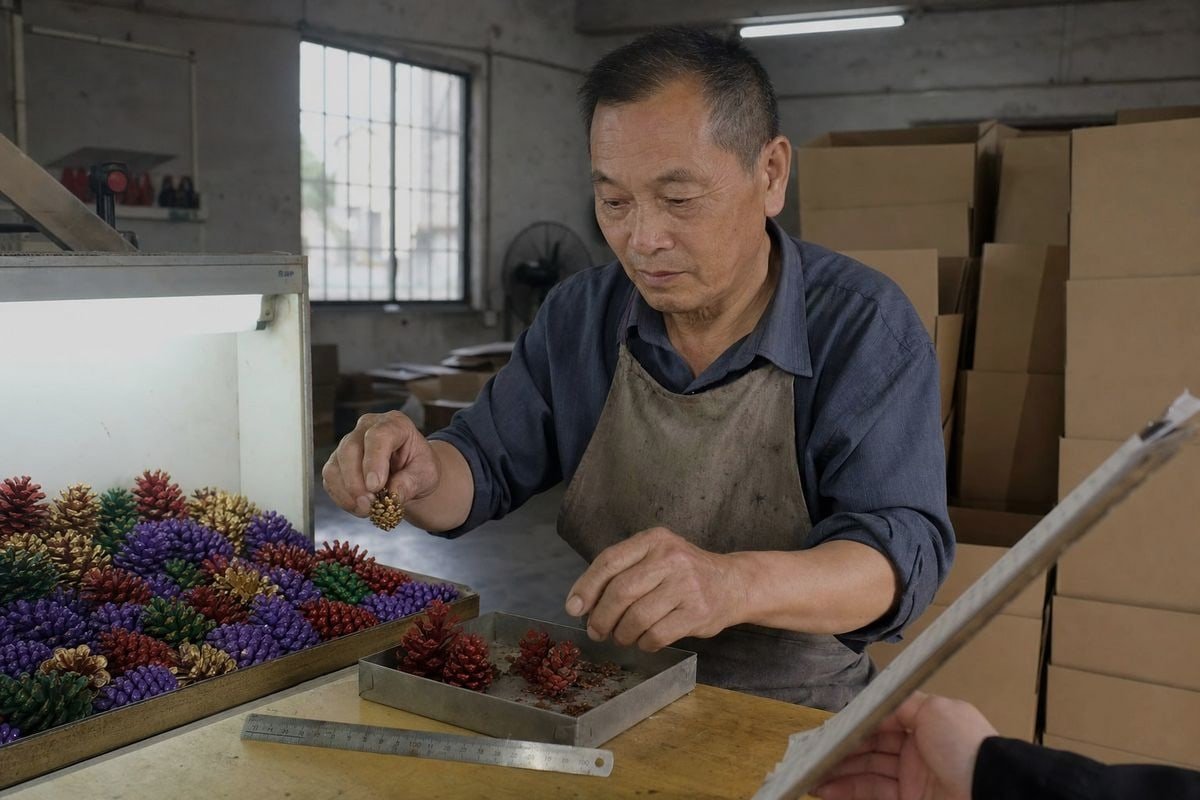
The core problem is hygroscopic salt stability. The same metal salt additives that color the flames also pull moisture from the air. Once damp, salts can cake, migrate, and stain the cones. The cones themselves are hygroscopic too; humid scales can partially close and lose that open, attractive shape. Your sealing spec is what stands between production week and a fireplace six months later.
Write the spec as measurable steps
- Pre-treat before sealing. Require thermal treatment around 200°F (93°C) for 60 minutes. This kills pests, crystallizes resin, and drives out residual wood moisture before the pack is closed.
- Set an internal humidity ceiling. Cap internal RH at 45% at the moment of sealing. Verify with a humidity indicator card in first-article samples.
- Define the film. Name the material and thickness, such as 2-mil LDPE minimum, and set a maximum moisture vapor transmission rate 4 for the chosen film in your acceptance criteria.
- Control humidity inside the pack. For sealed barrier pouches, add desiccant packets. For premium packs where cone shape matters, 2-way humidity sachets calibrated near 50% RH keep scales open without making the wood brittle.
- Test the seal. Require a seal integrity check 5, such as a squeeze or vacuum test, on a sampled basis every production shift.
- Set storage conditions. Print and specify 50–75°F storage, away from direct sun, to avoid dew-point condensation inside sealed units.
One nuance we learned through years of export shipments 6: fully airtight is not always right. Freshly processed cones can release trace moisture. For non-barrier carton formats, a small ventilation allowance through micro-perforations, around 5% of surface area, prevents internal condensation. Choose one strategy per SKU — sealed-and-desiccated, or ventilated-and-sheltered — and never mix them in the same package.
What compliance and labeling requirements should I follow when packaging colored pine cones for the US and European markets?
A lesson we learned early in our 17 years of exporting: a beautiful package with a weak label gets stopped faster than an ugly one with a correct label. Compliance paperwork is the real shelf pass in the US and EU.
Label colored pine cones as a fire-use-only product with chemical hazard warnings, "keep away from children and pets," "do not cook food over colored flames," ingredient disclosure per CLP in the EU, US FHSA-style cautionary text, plus batch codes, barcodes, and importer details.

Colored pine cones sit in an awkward category. They look like holiday décor but function as a chemical fire product. Regulators treat them by function, not appearance. So your packaging spec needs a dedicated labeling section, and your supplier needs test reports to back it up. In our case, buyers ask for SGS or Intertek reports before they even discuss price, and our CE, ISO 9001, and BSCI documentation is usually the first attachment in any serious inquiry.
Split the label spec by market
| Requirement | US Market | EU Market |
|---|---|---|
| Hazard communication | FHSA-style cautionary labeling for household chemical products | CLP-aligned pictograms and hazard statements |
| Chemical disclosure | Name active colorants; copper sulfate safety labeling where used | Ingredient identification per CLP classification |
| Use restrictions | "Not for cooking fires," "indoor fireplace/outdoor fire pit use only" | Same, in local languages of destination countries |
| Child safety | "Keep out of reach of children and pets" | Same, plus child-resistant considerations for loose chemical packs |
| Traceability | Batch/lot code, importer name and address | Batch/lot code, EU responsible person details |
| Retail data | UPC barcode, count, net weight | EAN barcode, count, net weight in metric |
Cover the non-negotiables
Three points deserve extra care. First, the cooking warning. Fireplace colorant chemicals are not food-safe, so every pack must clearly state that users should not roast marshmallows or cook over colored flames. Second, language coverage. A pack sold into Germany, France, and the Netherlands needs warnings in each language; we routinely print three to five language panels for European clients. Third, storage and disposal guidance. Because this is a seasonal product, tell the consumer how to store an opened pack — reseal, keep dry, keep cool — and how to dispose of ash. Add these lines to your artwork spec, not as an afterthought. Finally, require your supplier to hold current test reports for heavy metals and emissions 7. If they hesitate, that hesitation is your answer.
Conclusion
Weak packaging specs quietly destroy seasonal fire products. Define count by usage, layer barrier materials, seal to measurable humidity limits, and label for each market — then test before mass production.
Footnotes
1. Explains the plastic material used as the primary moisture-barrier liner in packaging specs. ↩︎
2. Background on chemical colorants used to create colored flame effects in fireplace products. ↩︎
3. Official EPA resource providing data on polyethylene and other plastic packaging materials. ↩︎
4. Defines the technical packaging metric used to specify film moisture-barrier performance. ↩︎
5. ISO provides quality and packaging testing standards relevant to seal integrity verification steps. ↩︎
6. WTO trade resource supports discussion of packaging lessons learned through international export practices. ↩︎
7. CDC/NIOSH resource on heavy metal exposure supports need for supplier test reports on chemical safety. ↩︎



 English
  Spanish
  German
  French
  Arabic
  Portuguese
Join the Conversation