






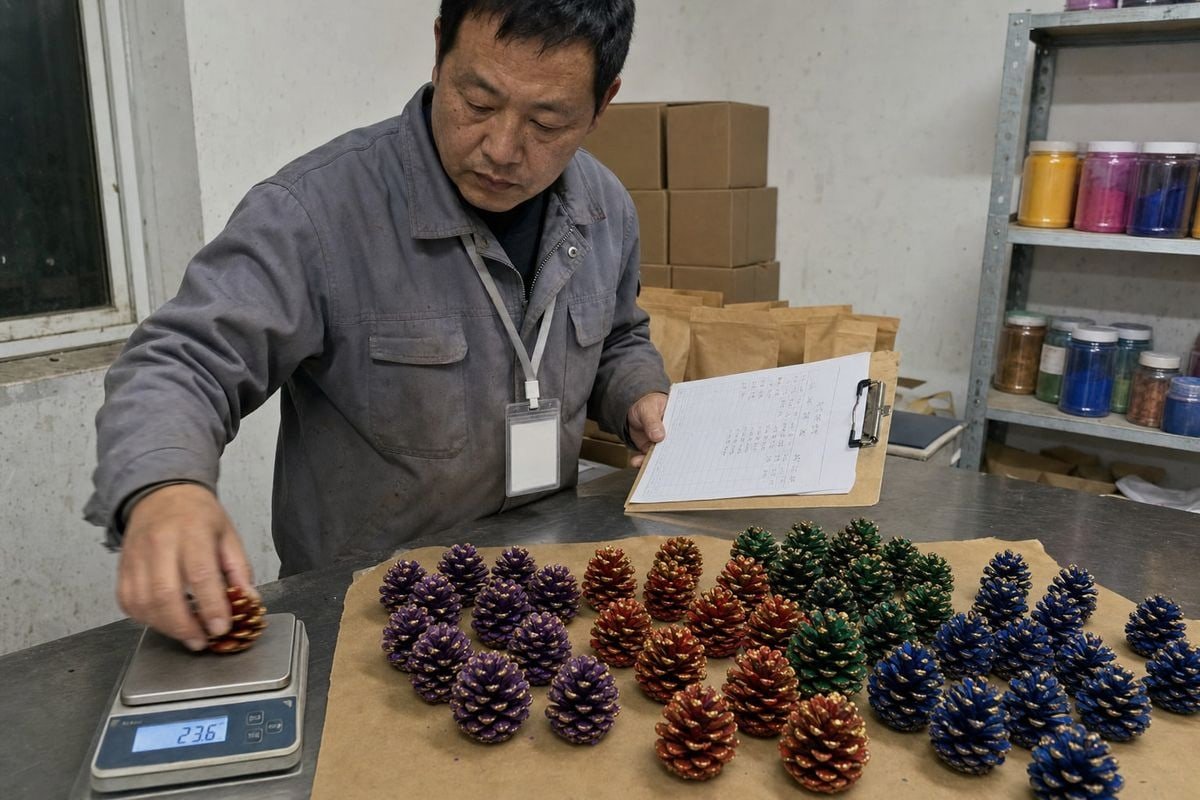
Sourcing fireplace colored pine cones sounds simple until a bulk shipment arrives with weak flame color. On our production line, I have seen buyers lose entire holiday seasons over skipped sampling.
To request fireplace colored pine cone samples, pay a small sample fee plus courier cost, ask for batch-matched cones with test reports, then negotiate by offering volume commitments, flexible lead times, and repeat seasonal orders in exchange for sample credit and tiered unit pricing.
That is the short answer. Below, I break down each step: sample costs, negotiation tactics, certifications to demand, and realistic timelines before mass production begins.
What does it cost to get color-flame pinecone samples before I commit to a bulk order?
A German distributor once asked me why we charge for samples at all. I walked him through our coating and drying process, and he stopped asking. Our factory treats every sample as a small production run.
Color-flame pinecone samples typically cost $20–$80 for a small pack, plus $30–$60 in courier fees. Most reputable factories, including ours, credit the full sample fee back to your first bulk order, making the real long-term cost close to zero.

Let me be direct about why samples are rarely free in this category. Colored pine cones are not stamped out of a mold. Each cone is harvested, dried, treated with mineral-based color agents 1, cured, and packed. Preparing a small batch of product testing samples takes almost as much line setup as a larger run. So a modest sample fee is normal. What matters more is what the fee includes and whether it converts into credit.
What a fair sample quote should include
When we quote samples from our Ningbo facility 2, the quote covers the cones, the retail-style packaging, and documentation. You should expect the same from any serious supplier. Here is a realistic cost picture:
| Cost item | Typical range | What to confirm |
|---|---|---|
| Sample product fee | $20–$80 per pack set | Is it credited to the bulk order? |
| Express courier (DHL/FedEx) | $30–$60 to US/EU | Who books the shipment? |
| Custom packaging mock-up | $0–$50 | Included for private label buyers? |
| Documentation (MSDS, test reports) | Usually free | Sent digitally before shipping? |
Questions to ask before paying
Ask whether the samples come from the same production batch that would supply your bulk order. Ask how long the cones were cured and how they are stored, because moisture ruins burn performance. Ask for written burning instructions confirming the cones are for wood-burning fireplaces and campfires only, never gas fireplaces. Finally, ask for a sample-to-credit clause in writing. In our experience exporting to 30+ countries, buyers who ask these four questions almost never get burned later. Buyers who chase free samples from unknown traders often receive cones that look nothing like the eventual bulk shipment.
How do I negotiate fair pricing and MOQs with a Chinese pinecone manufacturer?
Here is a trade-off I weigh every week at our Liuyang headquarters 3: a lower unit price for a buyer versus predictable production scheduling for our lines. Understanding that tension is your biggest negotiation advantage.
Negotiate by targeting volume-based bulk pricing tiers, requesting a lower trial-order minimum order quantity, offering flexible delivery windows, and committing to repeat seasonal orders. Ask for landed DDP or CIF quotes early, since freight heavily affects the true per-unit cost.

Most buyers negotiate the wrong thing. They hammer on unit price and ignore the levers that actually move the number. After 17+ years of quoting wholesale fire starters and color-flame products, I can tell you what genuinely works.
The levers that actually move price
- Volume tiers. Bulk pricing tiers usually start around 500 units or 10 full cases. Ask for the full tier table upfront, not a single quote. A buyer ordering 5,000 bags should never pay the 500-bag rate.
- Trial-order MOQ flexibility. We regularly lower the minimum order quantity 4 for first-time distributors who show a credible business profile: target market, retail channels, and projected annual volume. Share that profile early. It qualifies you for better terms and sometimes discounted samples.
- Off-season production slots. Pre-book production in January–March, before the holiday rush. Factories reward buyers who fill quiet capacity, and lead time for production is shorter then too.
- Landed price quotes. Pine cones are bulky and light, so volumetric weight drives freight shipping costs. Get DDP or CIF quotes early so you compare true landed cost, not just EXW price.
- Integrated custom packaging. Negotiate private label manufacturing — printed pouches, cotton bags, or gift boxes — as part of the unit price rather than a separate surcharge.
- Repeat-order pricing. Lock a standing rate for seasonal restocks. We value order certainty as much as margin, so a buyer who says "this becomes an annual program if the sample performs" gets real flexibility.
| Negotiation lever | Typical impact | Best time to raise it |
|---|---|---|
| Higher volume tier | 5–15% unit price reduction | First quotation request |
| Off-season booking | Discount plus faster lead time | Q1, before April |
| Flexible delivery date | Modest price concession | After sample approval |
| Repeat-order commitment | Locked seasonal rate | Contract stage |
| Consolidated shipping | Lower landed cost per unit | Quotation stage |
One caution: some buyers assume this niche allows aggressive bargaining. It does not. Coating chemistry, curing, and compliance testing carry fixed costs. Push a supplier below those costs and quality is the first thing cut — usually the color agent concentration, which means weaker rainbow flames in your customers' fireplaces.
What certifications and test reports should I ask for when requesting samples?
A UK fireplace retailer once told me his previous supplier "had all certificates" — then customs held his container for missing chemical documentation. That call reshaped how we present compliance files to every new buyer.
Request the Material Safety Data Sheet, SGS or Intertek burn and chemical test reports, EN71 or equivalent safety compliance, plus the factory's ISO 9001 and BSCI audit certificates. Verify the documents name the actual manufacturer, not a trading company.

Compliance is not paperwork theater in this category. These products go into living rooms and campsites, and the flame colors come from metal salts. Some cheap DIY-style products use aggressive rainbow flame chemicals like raw copper sulfate 5 coating applied without controls. Our products use eco-friendly formulations with no harmful chemicals, and we back that claim with third-party reports. You should demand the same evidence from anyone you source from.
The document checklist
| Document | What it proves | Red flag if missing |
|---|---|---|
| Material Safety Data Sheet (MSDS) | Chemical composition and handling safety | Supplier cannot say what creates the colors |
| SGS or Intertek test report | Independent verification of burn safety | Only self-issued "factory reports" offered |
| EN71 / CE compliance | Meets European safety standards | Product may be stopped at EU customs |
| ISO 9001 certificate | Documented quality management system | Batch-to-batch consistency is unverified |
| BSCI audit report | Ethical, audited factory conditions | Retail chains may reject the vendor |
How to verify the documents are real
Check three things. First, the company name on the certificate must match the factory you are paying, not a third party. Second, the report date should be recent — chemical test reports 6 older than two or three years deserve a refresh. Third, ask for the certificate number and verify it directly on the SGS or Intertek portal 7. This takes ten minutes and filters out most trading companies posing as factories.
Also request usage documentation with the samples. Legitimate suppliers state clearly, in writing, that colored cones are for wood-burning fireplaces and fire pits only. Residue can clog the air shutter, pilot, and burner orifices of a gas fireplace, and a supplier who omits that warning is exposing you to liability on your own retail shelf. When we develop private-label packaging for clients, warning labels and barcodes are built into the artwork from day one, because our US and EU buyers treat them as a hard requirement, not a nice-to-have.
How long does sampling and fee negotiation typically take before mass production starts?
The most expensive lesson I have watched importers learn is calendar math. A Canadian buyer approached us in late September wanting Christmas stock. Sampling alone made that impossible, and he sold nothing that season.
Expect 1–2 weeks for sample preparation, 3–7 days for courier delivery, 1–2 weeks for your burn testing and negotiation, then 25–40 days for mass production. Plan roughly 8–12 weeks total from first inquiry to goods leaving the factory.

The timeline is longer than most first-time buyers expect, and pine cones add a seasonal wrinkle that other wholesale fire starters do not have. Cones are a natural material. They must be harvested, opened, and dried before treatment, so many manufacturers concentrate fulfillment between April and December. Confirm your supplier's seasonal production window before you build your launch calendar around it.
A realistic step-by-step timeline
- Inquiry and quotation — 2 to 5 days. Share your business profile, target volume, and market. You get the tier table and sample terms faster.
- Sample production — 7 to 14 days. Batch-matched cones, cured and packed in your intended retail format.
- Courier transit — 3 to 7 days. Express shipping to the US or EU.
- Your evaluation — 7 to 14 days. Burn the cones in a real wood fire. Score flame color intensity, how fast the effect appears, duration, odor, smoke, residue, and packaging durability after transit.
- Negotiation and contract — 3 to 10 days. Finalize pricing tiers, MOQ, sample credit, packaging, and payment terms.
- Mass production — 25 to 40 days. Lead time for production stretches during the August–October peak; Q1 bookings run faster.
- Pre-shipment verification — 2 to 3 days. Request a batch-specific burn-test video showing cones from your actual production run, so bulk performance matches the approved sample.
Two habits compress this timeline. First, review the MSDS, test reports, and packaging artwork digitally while the physical samples are still in transit. Second, negotiate in parallel with evaluation rather than after it. Buyers who follow both usually shave two full weeks off the schedule. And because our first samples come off the same lines and QC process as mass production, buyers rarely need a second sampling round — which is where slower suppliers quietly lose a month.
Conclusion
Skipping samples risks your whole season. Request batch-matched samples with full compliance documents, negotiate on volume and certainty, and plan 8–12 weeks — that is how smart buyers source colored pine cones.
Footnotes
1. Explains how metal salts create colored flames, background for buyers evaluating pine cone treatments. ↩︎
2. Background on Ningbo, a major Chinese manufacturing and export hub referenced in the article. ↩︎
3. Context on Liuyang, a Chinese city known for manufacturing, relevant to the supplier's location. ↩︎
4. Alibaba is a primary sourcing platform where MOQ negotiation concepts are commonly applied. ↩︎
5. Authoritative NIH PubChem database providing comprehensive chemical and safety data for copper sulfate. ↩︎
6. Intertek is an accredited testing body relevant to verifying chemical safety documentation validity. ↩︎
7. SGS is a leading inspection body buyers use to verify authenticity of test certificates. ↩︎



 English
  Spanish
  German
  French
  Arabic
  Portuguese
Join the Conversation