






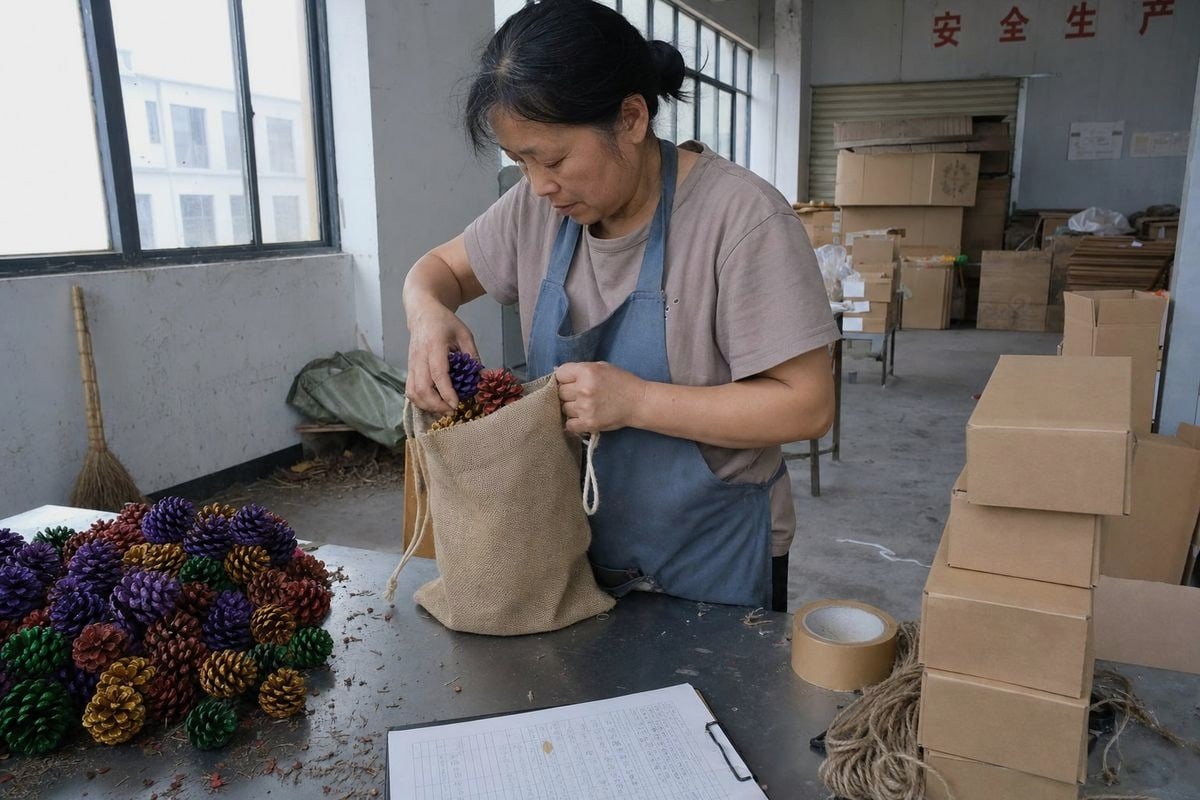
Requesting biodegradable packaging for fireplace colored pine cones sounds simple — until vague supplier replies, hidden plastic laminates, and failed transit tests turn your eco claim into a liability. On our production line, we see these gaps daily.
To request biodegradable packaging for fireplace colored pine cones, send suppliers a written RFQ specifying compostable materials for every component — outer carton, inner wrap, labels, tape, and filler — and require certifications like BPI or TUV Austria OK compost, material data sheets, physical samples, and confirmed MOQs before ordering.
That answer is the short version. Below, I walk through certifications, exact request wording, sampling, and lead-time questions — the four steps that separate a real eco-packaging solution from a marketing claim.
What certifications should I ask for to confirm the biodegradable packaging is genuinely eco-friendly?
A German distributor once returned a competitor's "eco" pouch to us for analysis. Inside the kraft paper sat a plastic laminate. Our lab confirmed it in minutes. Certifications exist to prevent exactly that surprise.
Ask for BPI certification (ASTM D6400) in North America or TUV Austria OK compost (EN 13432) in Europe, plus FSC certification for paperboard, PFAS-free declarations, and third-party test reports from labs like SGS or Intertek confirming the material composition of every packaging component.

Certification is the single fastest way to filter serious suppliers from marketing-driven ones. In our seventeen-plus years exporting fire-starting goods to the US, Germany, the UK, and beyond, we have learned that buyers who lead with certification requests get better quotes, faster. Suppliers know they cannot bluff a paper trail.
The core certifications, mapped to your market
| Certification / Standard | What it proves | Best for |
|---|---|---|
| BPI (ASTM D6400) | Industrial compostability, no toxic residue | US and Canadian retail |
| TUV Austria OK compost INDUSTRIAL (EN 13432 1) | Breaks down in industrial composting within a set timeframe | EU distribution |
| TUV Austria OK compost HOME | Composts in a backyard bin | Premium eco brands |
| FSC-certified paperboard 2 | Fiber from responsibly managed forests | Cartons, display boxes |
| SGS / Intertek test reports | Independent verification of material claims | Any market |
| PFAS-free declaration | No "forever chemicals" in coatings | US states with PFAS bans |
Two warnings from our own compliance work. First, "biodegradable" alone is not a certification. Anything biodegrades eventually — including plastic, over centuries. Compostability standards like EN 13432 add a timeframe and a toxicity limit, which makes them enforceable. Second, ask whether the certificate covers the finished package or only the raw film. A certified film with metallic inks, synthetic labels, or plastic ties may no longer qualify. Because our own factory holds ISO 9001 3, BSCI, CE, and SGS/Intertek documentation, we hand these reports over on request. Any supplier meeting genuine green procurement standards 4 should do the same without hesitation. If they stall, that silence tells you everything.
Also check Extended Producer Responsibility 5 (EPR) rules in your destination market. Several EU countries and US states now charge fees based on packaging recyclability, so verified compostable or recyclable formats can lower your long-term costs, not just your footprint.
How do I word my request so suppliers understand my exact packaging specifications?
When we quote OEM projects for color-flame pinecones, the clearest RFQs win the fastest turnarounds. Vague briefs like "make it eco-friendly" force three rounds of clarifying emails. Precise briefs get precise quotes.
Word your request component by component: name the outer carton, inner wrap, window film, labels, adhesives, tape, and filler separately, and ask the supplier to classify each as home-compostable, industrially compostable, recyclable, or merely biodegradable — in writing, with material specifications attached.

The core problem with fireplace colored pine cones is that the product and the packaging rarely share the same sustainability profile. The cones may be natural botanicals with color-changing flame chemicals applied, while the pouch around them is a mixed-material laminate that no facility can compost. Your wording must force the supplier to address every layer, not just the headline material.
Copy-and-paste request language
Here are lines we recommend our own B2B buyers use, because they map directly to how a factory quotes:
- "Please quote compostable or certified biodegradable materials for the outer carton, inner wrap, labels, and closure system."
- "Please specify whether each component is home-compostable, industrially compostable, recyclable, or only biodegradable."
- "Please confirm the packaging protects waxed or colored pine cones from moisture, wax transfer, and crushing during transit."
- "Please provide material specifications for all paper, films, inks, adhesives, and inserts, confirming water-based, non-toxic inks."
- "Please state whether any component contains plastic laminates, PVC, PFAS coatings 6, or inseparable mixed materials."
- "Please confirm a chemical compatibility check: the metal salts used for flame coloring must not degrade the bio-based packaging in storage."
Formats worth naming explicitly
Ask for options across recycled kraft paper bags, molded pulp trays, FSC-certified paperboard cartons, and compostable inner wraps. If you want a clear window, specify PLA film 7 only if your market accepts industrial compostability — and say so in the RFQ. For bulk buyers pursuing zero-waste product fulfillment, request a minimal-packaging or closed-loop bulk liner option too. One tension you must resolve upfront: shelf appeal versus end-of-life purity. A resealable zipper and glossy window sell well at retail but can break compostability. Tell the supplier which one you prioritize per sales channel, and you will avoid a redesign later.
Can I get a sample of the biodegradable packaging before committing to a bulk order?
A Canadian fireplace distributor once asked us to ship filled samples through actual courier networks before signing. Two pouches arrived with wax smearing on the inner wall. We revised the liner. That test saved his launch.
Yes — reputable suppliers provide physical packaging samples, usually within one to two weeks, sometimes for a small fee credited against your first order. Always request filled samples with actual pine cones inside, then run drop, humidity, and abrasion tests before committing to bulk.
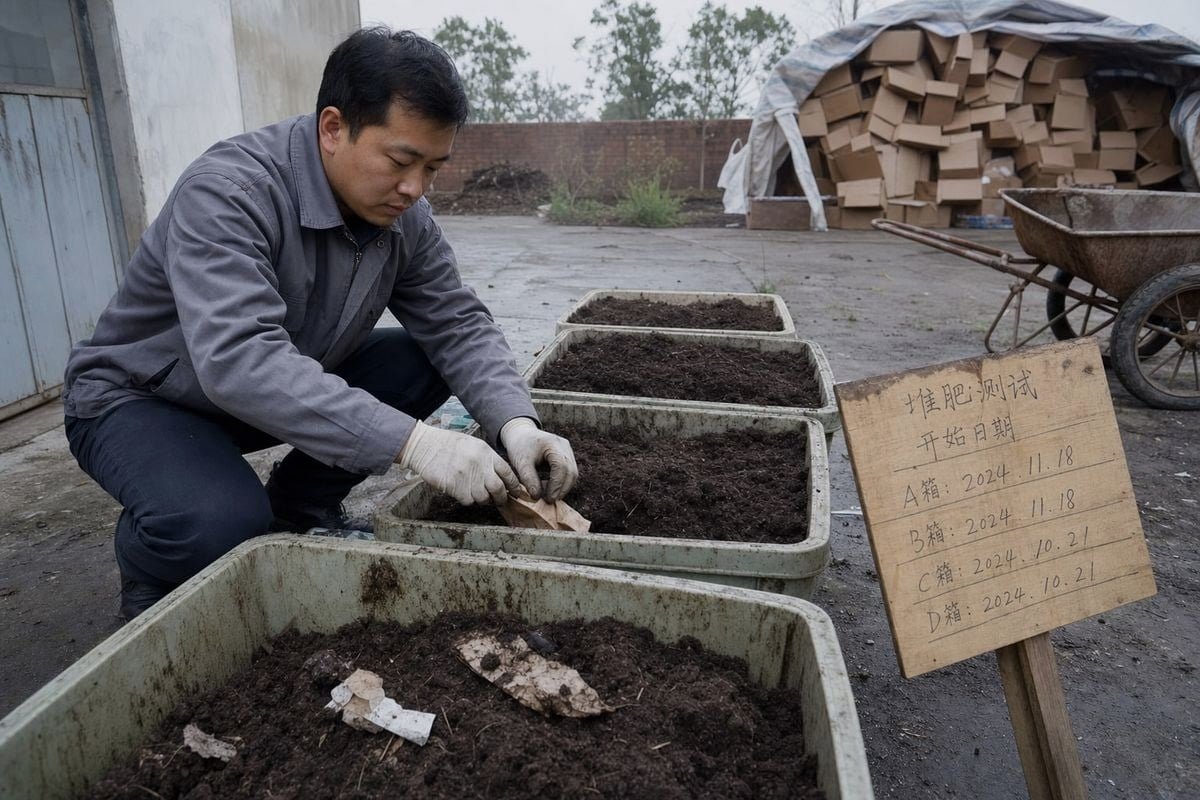
An empty sample tells you almost nothing. Fireplace colored pine cones are abrasive, moderately heavy, and often wax-coated or treated with color-changing flame chemicals. The real question is how the packaging behaves with the product inside, over time, in imperfect storage. Our own quality team fills sample pouches with production cones — not display units — because that is the only honest test.
A simple sample-testing protocol
We suggest buyers run this sequence over two to three weeks:
- Abrasion check. Shake the filled pouch daily. Pine cone scales are sharp; watch for punctures in paper or PLA windows.
- Humidity test. Store one sample in a damp environment, similar to a garage or wood shed, for ten days. Biodegradable films can soften and lose structural integrity in high humidity, so atmospheric resistance matters.
- Wax and color transfer. Warm the sample to summer-warehouse temperatures. Check for wax bleed or pigment staining on the inner surface.
- Drop test. Drop the shipping carton from waist height on each face. Check the cones for broken scales and the retail units for crushing.
- Seal and closure cycling. Open and reseal any closure twenty times. Compostable zippers behave differently from plastic ones.
Because our first samples come off the same lines as mass production, the sample genuinely predicts bulk quality — and that is exactly the standard you should hold every supplier to. If a supplier sends hand-made samples that will differ from production tooling, ask for a pre-production sample from the actual run before final payment. Sampling adds two or three weeks. Skipping it can cost you an entire season.
What questions should I ask about lead times and MOQs when switching to biodegradable packaging?
Balancing trial-order flexibility against custom-print economics is a trade-off we negotiate with buyers every season. Biodegradable materials change that math, because sustainable packaging materials often come from fewer mills with longer supply chains.
Ask five things: the MOQ specifically for the eco-friendly line, standard versus peak-season lead times, whether custom printing changes either number, how material shortages are handled, and whether tiered pricing applies. Expect eco MOQs and lead times to run higher than plastic equivalents.

Fireplace colored pine cones are a seasonal product. In our export schedule, Q4 orders for the US and European holiday season must leave the factory by late summer. If your compostable film or FSC-certified paperboard has an eight-week material lead time, and you find out in September, you have already missed the window. So timing questions are not administrative details — they are the difference between shelves stocked and shelves empty.
The questions, and why each one matters
| Question to ask | Why it matters |
|---|---|
| What is the MOQ for the biodegradable packaging line? | Eco substrates often have higher mill minimums than standard plastic or acetate |
| Is there tiered pricing at higher volumes? | Compostable materials carry a premium; volume tiers narrow the gap |
| What is the lead time in peak season vs. off-season? | Seasonal fire products face Q3–Q4 capacity crunches |
| Does custom printing change MOQ or lead time? | Plate-making and water-based ink runs add setup time |
| How do you handle compostable material shortages? | Fewer certified mills means supply risk; ask about approved substitutes |
| Can trial orders run at a lower MOQ? | A smaller first run lets you validate sell-through before scaling |
A realistic planning benchmark
| Stage | Typical timeframe |
|---|---|
| RFQ, quoting, and specification confirmation | 1–2 weeks |
| Packaging sampling and buyer testing | 2–3 weeks |
| Custom print approval and plate-making | 1–2 weeks |
| Bulk production of packaging and product | 4–6 weeks |
| Ocean freight to US/EU | 4–6 weeks |
Build in a buffer. Our one-stop OEM buyers who lock artwork, warning labels, and barcodes early consistently hit their seasonal windows; those pursuing plastic-free wholesale supplies for the first time should start conversations a full quarter earlier than they would for conventional packaging. And do not accept a verbal lead time. Get it on the proforma invoice, tied to a deposit date. That single line protects your whole season.
Conclusion
Vague eco claims put your brand at risk. Demand certifications, specify every component in writing, test filled samples, and confirm MOQs and lead times. With eco-conscious manufacturing partners, biodegradable packaging becomes a genuine advantage — not a gamble.
Footnotes
1. Explains the European compostability standard referenced for packaging certification. ↩︎
2. Official Forest Stewardship Council site verifies responsible paperboard sourcing standards. ↩︎
3. Official ISO page explains the quality management standard suppliers reference. ↩︎
4. Background on green procurement clarifies what suppliers must demonstrate. ↩︎
5. Background on EPR policies affecting packaging recyclability fees mentioned in the article. ↩︎
6. EPA resource explains PFAS chemicals and why coatings must avoid them. ↩︎
7. Comprehensive overview of polylactic acid properties and its common applications in packaging films. ↩︎


 English
  Spanish
  German
  French
  Arabic
  Portuguese
Join the Conversation