






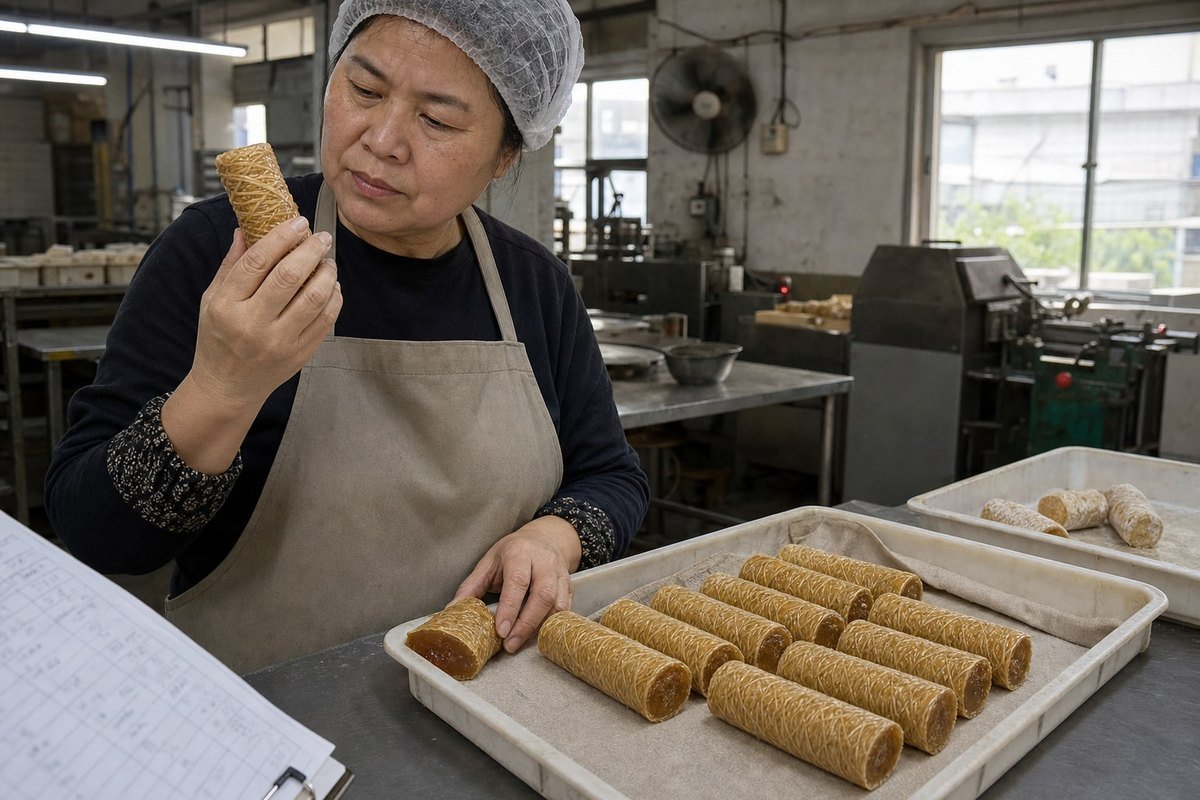
Buyers ask me how to judge wood fire starter quality before lighting one BSCI 1. On our production line, we screen thousands daily — and a bad batch can sink a retail brand fast.
To judge wood fire starter quality, check three things: the surface should show even wax coverage with a subtle sheen and no bare fiber patches; the cross-section should reveal full wax penetration to the core; and the piece should feel firm, dense, and dry — never crumbly, greasy, or damp.
These three checks take under two minutes per sample SGS/Intertek documentation 2. Below, I walk through each one the way our own QC team does it, so you can screen samples with confidence before committing to a bulk order.
What visual signs on the surface tell me a wood fire starter is properly wax-dipped and not defective?
A buyer from Germany once rejected a competitor's shipment purely on sight — pale, dusty rolls with exposed fiber tips. He was right. Our factory taught me the surface tells you almost everything first.
A properly wax-dipped fire starter shows a uniform honey-to-amber tone, a light satin sheen, tightly wound wood fibers, and no pale dry patches or drips. Defects include uneven color, bare wood-wool sticking out, white wax clumps, and loose unraveling strands.
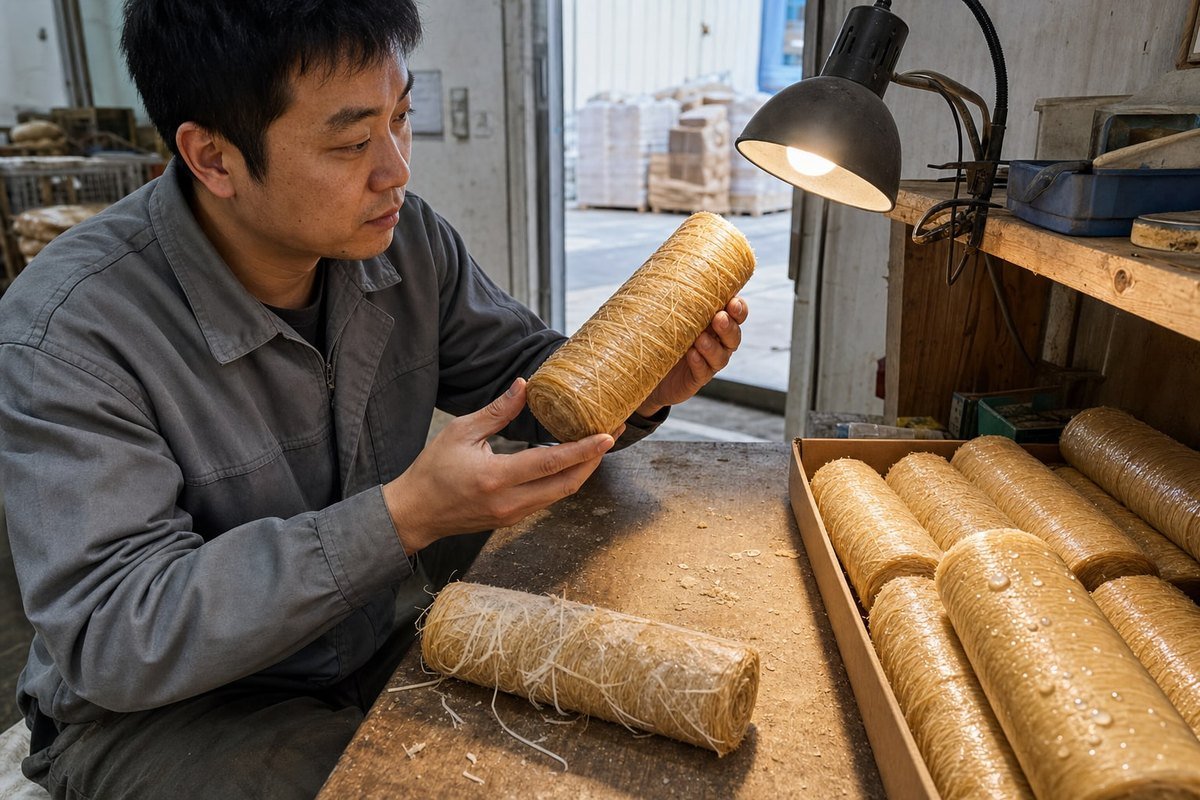
The surface is the fastest screen because wax coverage is the single biggest driver of ignition performance. In our workshop in Ningbo, every dipping batch gets a visual pass before it moves to packing. Here is what our inspectors look for, and what you should look for too.
Color and sheen
Good wax-dipped wood rolls sit in a consistent color band — pale golden-cream strands over warmer honey-brown cores. That warm tone comes from paraffin soaking into the wood fiber texture, not sitting on top of it. A hint of amber translucency at the strand edges is a strong positive sign. It means the wax has bonded with the fiber instead of forming a brittle shell. By contrast, a chalky, matte, straw-pale surface usually means the dip was too short, the wax was too cool, or the fiber was too wet to absorb it.
Structural signs
Check how the roll is wound. The wood-wool 3 should crisscross in a tight, nest-like pattern with rounded, sealed ends. Loose strands that pull free easily point to poor winding tension, which causes uneven burning and messy shelf presentation.
| Surface Sign | What It Means | Accept or Flag? |
|---|---|---|
| Even honey/amber tone with satin sheen | Full, consistent wax dip | Accept |
| Pale, chalky, dry-looking patches | Incomplete wax coverage | Flag |
| White clumps or heavy drips | Wax too cool during dipping | Flag |
| Bare fiber tips at the ends | Ends not submerged properly | Flag |
| Tight, compact winding | Good fiber tension, even burn | Accept |
| Greenish or gray discoloration | Damp or aged fiber stock | Reject |
One more tip from our export experience: water should bead on a well-sealed surface. If a drop soaks in immediately, the wax layer is too thin for humid shipping containers.
How can I evaluate the cross-section of a wood firestarter to confirm wax penetration and consistent burn time?
Cutting samples in half is standard practice in our QC room. Years ago, a trial batch looked perfect outside but showed a dry core — that lesson shaped how we calibrate dip time today.
Cut the fire starter in half. Quality pieces show wax penetration all the way to the core: the inner fibers look darker, slightly glossy, and bound together. A pale, loose, fluffy center means shallow dipping, which causes short, inconsistent combustion duration.

The cross-section is where marketing claims meet reality. Two starters can look identical outside, yet one burns eight minutes and the other burns three. The difference lives in the core. Here is the process I recommend to every purchasing manager who receives our samples — and any supplier's samples.
A simple four-step cut test
- Cut three pieces from different parts of the sample bag, not just one. Batch consistency matters more than one perfect piece.
- Look at the color gradient. Ideal cross-sections are nearly uniform in tone from edge to center. A sharp ring — dark outside, pale inside — reveals a surface-only dip.
- Press the exposed core. Saturated fiber feels firm and slightly waxy. A dry core compresses like cotton wool.
- Compare the wax-to-fiber ratio visually. In our standard formula of roughly 50% wood fiber and 50% paraffin, the cut face looks dense and semi-solid, with individual strands still visible but bound together.
Why penetration depth controls burn time
Paraffin is the fuel; wood fiber is the wick. If wax only coats the outside, the flame consumes that shell quickly and the bare core smolders out. Full resin-like saturation of the fiber — the same principle that makes natural fatwood 4 with dense heartwood so reliable — is what delivers steady combustion duration of eight to ten minutes instead of a flash and fade. This is also why moisture content 5 in the raw wood-wool matters upstream: damp fiber blocks wax absorption during dipping, and no amount of surface coating fixes it.
| Cross-Section Finding | Likely Cause | Burn Time Impact |
|---|---|---|
| Uniform tone, firm bound core | Correct dip time and wax temperature | Full rated burn, consistent |
| Dark ring, pale fluffy center | Dip too short or fiber too dense | Burn cut by half or more |
| Wet-looking, oily core | Excess wax, poor draining | Sooty flame, packaging stains |
| Loose strands falling from cut face | Low wax ratio, weak binding | Erratic ignition, crumbling |
When we develop custom burn times for OEM clients, this cut test is exactly how we verify each formula before the first sample ships.
What should the texture and weight feel like when I'm checking sample quality before placing a bulk order?
Whenever I hand samples to visiting buyers at our Liuyang headquarters, I ask them to close their eyes and just hold the pieces. Hands catch defects that eyes miss.
A quality wood fire starter feels noticeably heavier than plain wood-wool of the same size, firm under thumb pressure, dry and slightly waxy to the touch — never greasy, sticky, damp, or crumbly. Consistent weight across pieces signals reliable batch control.
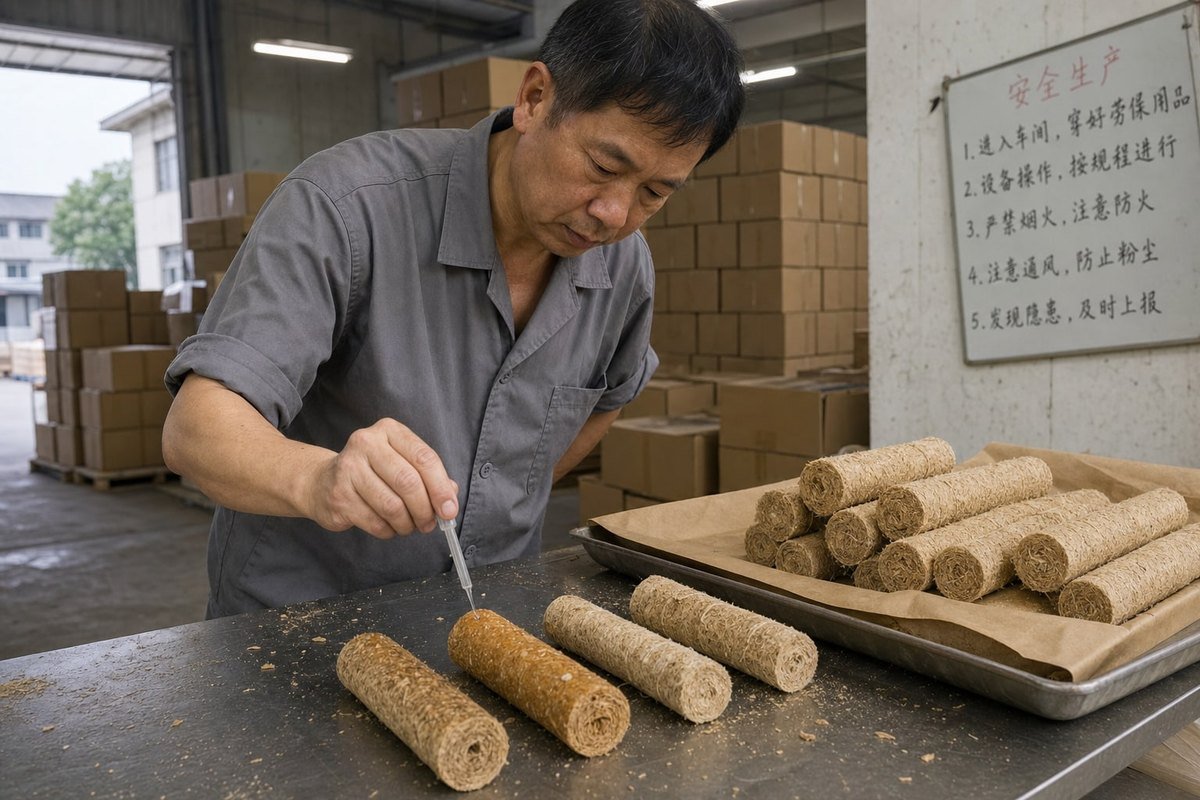
Feel is your proxy for two invisible variables: wax load and moisture content. You cannot see grams of paraffin, but you can absolutely feel them. Here is how I train new QC staff to use their hands, and how you can apply the same checks in five minutes at your desk.
The weight check
Pick up five pieces one after another. They should feel dense for their size — paraffin adds real mass, much like resin saturation makes genuine fatwood heavier than ordinary pine. More important than absolute weight is consistency. If one piece feels light and another feels heavy, the dipping process is not controlled, and your retail customers will get uneven ignition performance from the same box. On our lines, we spot-weigh pieces from every batch precisely because weight variation is the earliest warning of process drift.
The texture check
Run your thumb along the surface, then squeeze the middle of the roll.
- Dry, faintly waxy, slightly rough — correct. The wood fiber texture should still be perceptible through the wax.
- Firm with slight spring-back — correct. Good winding tension plus full saturation.
- Greasy or oily residue on your fingers — wrong wax grade or excess free paraffin. This stains packaging and shelves.
- Soft, spongy, or cool to the touch — trapped moisture. High moisture content ruins ignition and invites mold in sea containers.
- Crumbling strands when squeezed — under-waxed or degraded fiber.
The snap and smell check
Bend a piece gently. A saturated roll resists and flexes slightly; it should not shatter like glass or fold like wet cardboard. Then scratch the surface and sniff. A clean, natural pine aroma with a mild wax note is what eco-friendly, food-grade paraffin blends 6 smell like. A chemical, kerosene-like odor is a red flag for cheap fuel additives — something compliant buyers in the US and EU cannot afford on their shelves.
Which appearance and feel defects should I flag with my supplier to avoid batch-to-batch quality issues?
Batch consistency is the promise we stake our reputation on — the first sample must match container number ten. Over 17 years of exporting, I've learned which defects predict future trouble.
Flag these defects immediately: pale unwaxed patches, weight variation between pieces, oily or sticky surfaces, loose unraveling fibers, damp or musty smell, dry cores in cut tests, and inconsistent sizing. Each one signals a process-control gap that will worsen across bulk production.

A single flawed sample is a product issue. A pattern of flaws is a process issue — and process issues multiply at scale. When you flag defects with a supplier, describe the symptom precisely and ask what process variable caused it. A real factory can answer. A trading company usually cannot.
The defect-to-cause map
Use this table as your reporting language. It turns a vague complaint into an actionable QC conversation.
| Defect You Observe | Root Cause to Ask About | Risk If Ignored in Bulk |
|---|---|---|
| Pale patches, bare fiber tips | Dip depth, conveyor speed, wax temperature | Failed ignitions, customer returns |
| Piece-to-piece weight swings | No batch weighing, uncontrolled wax bath | Inconsistent burn times across one box |
| Greasy surface, stained packaging | Wrong paraffin grade, no drain stage | Damaged retail boxes, shelf rejection |
| Musty smell, cool damp feel | Raw fiber moisture content not tested | Mold in containers, whole-shipment loss |
| Dry core on cut test | Dip time too short for roll diameter | Burn time below spec, label claims fail |
| Size and shape variation | Manual winding without gauges | Display packaging fit problems |
How to structure the conversation
First, request cut-test photos from three different production days, not one. Second, ask how raw wood-wool moisture is verified before dipping — this ties directly to sustainable sourcing and fiber quality upstream. Third, ask for the supplier's certifications and third-party test reports; in our case, ISO 9001 7, BSCI, CE, and SGS/Intertek documentation is standard with every quotation, because our US and European buyers treat compliance as a hard requirement. Finally, agree on an acceptable quality limit in writing before the bulk order. Suppliers with genuine manufacturing depth welcome this. Suppliers without it go quiet — and that silence is your answer.
Conclusion
Poor fire starters destroy retail trust quickly. Judge quality by surface sheen, cut-test the core, and trust your hands on weight and texture — then hold your supplier to it.
Footnotes
1. Official amfori page for the Business Social Compliance Initiative. ↩︎
2. SGS is a leading third-party inspection and testing body referenced for compliance documentation. ↩︎
3. Authoritative Wikipedia entry defining wood wool and its manufacturing. ↩︎
4. Background on fatwood explains the resin-saturation principle referenced for wax penetration. ↩︎
5. USDA Forest Products Laboratory researches wood moisture content affecting material performance. ↩︎
6. Background on paraffin wax clarifies the fuel material used in wood fire starters. ↩︎
7. ISO 9001 is the referenced quality management certification standard for suppliers. ↩︎



 English
  Spanish
  German
  French
  Arabic
  Portuguese
Join the Conversation