







Quality standards and acceptance criteria for wood fire starter contracts are where most import deals quietly go wrong. I have reviewed contracts at our Ningbo facility that simply said "good quality wood fire starters" — nothing more. When a container arrives with starters that crumble, ignite slowly, or fail retail packaging checks, that vague wording gives the buyer no legal footing and the supplier no clear target. The dispute drags on, the retail launch slips, and both sides lose money. The fix is straightforward: treat wood fire starters like a controlled fuel product, with written specs, measurable acceptance criteria, and clear remedies.
Define quality standards for wood fire starter contracts by specifying materials, moisture content, unit weight, and dimensions; set measurable acceptance criteria for ignition time, burn duration, and defect rates per lot; require certified batch testing; and write clear remedies for rejection, replacement, or credit on non-conforming shipments.
Below, I walk through the four building blocks of a defensible contract: supplier certifications, performance criteria, quality control checkpoints, and dispute-handling terms. Each section gives you language and numbers you can adapt directly into your procurement specifications.
What certifications should I require from a wood fire starter manufacturer before signing a contract?
A buyer from Germany once told me his previous supplier "had all the certificates" — until his freight forwarder asked for the actual test reports and nothing arrived. At our factory, we treat documentation as part of the product, because for serious importers it is a hard requirement, not a nice-to-have.
Require ISO 9001 for quality management, BSCI or equivalent for social compliance, CE marking where applicable, and third-party test reports from labs like SGS or Intertek. For wood sourcing claims, request FSC certification compliance or equivalent chain-of-custody documents, plus Safety Data Sheets for wax components.
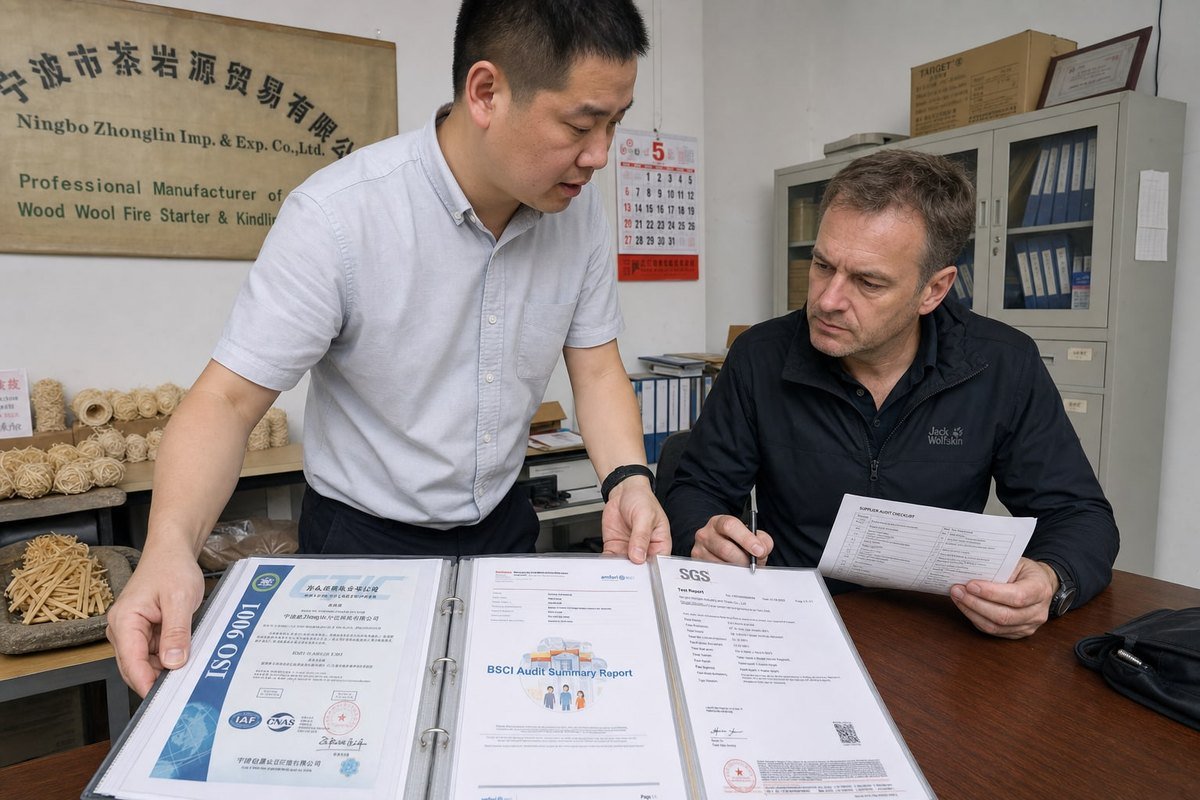
Certifications do two jobs in a contract. First, they prove the supplier runs a real quality system before your first order ships. Second, they give you contractual leverage: if a certificate is required in the contract and it lapses, you have grounds to pause orders or terminate.
The core certification stack
Not every document carries the same weight. I suggest splitting your requirements into three tiers and writing each tier into the contract explicitly.
| Tier | Document | What it proves | Contract treatment |
|---|---|---|---|
| Mandatory | ISO 9001 1 | A functioning quality management system | Condition of contract; must stay valid |
| Mandatory | SGS/Intertek test reports | Independent verification of the actual product | Required per product, renewed on formula change |
| Mandatory | Safety Data Sheets 2 (SDS) | Chemical safety of wax, binders, additives | Required before first shipment |
| Strongly recommended | BSCI audit 3 | Ethical and social compliance for retail channels | Required for big-box retail programs |
| Market-dependent | CE marking 4 / market-specific labels | Regulatory readiness for the EU | Required for EU-bound goods |
| Claim-dependent | FSC or PEFC chain of custody 5 | Sustainable sourcing of wood fiber | Required if "eco" or "sustainable" claims are made |
Verify, do not just collect
Ask for certificate numbers and check them with the issuing body. In our experience exporting to 30+ countries, real factories can produce audit reports within a day; trading companies often stall or send documents in another company's name. Also confirm the certificate holder matches the manufacturing entity on your contract. A mismatch is a red flag that you are buying through a middleman, which weakens your recourse if quality fails.
Finally, tie certifications to renewal. Write a clause requiring the supplier to notify you within a set number of days if any listed certification is suspended, withdrawn, or expires. That single sentence has saved several of our long-term partners from compliance gaps during retailer onboarding.
How do I set measurable acceptance criteria for burn time and ignition performance?
There is a trade-off I weigh constantly on our production line: tighter performance tolerances mean more consistent products but higher testing cost per batch. The answer is not "maximum strictness" — it is picking a small set of numbers that actually predict field performance.
Set acceptance criteria as numeric pass/fail thresholds: ignition within a few seconds of flame contact, an average burn duration of 8–12 minutes per unit, moisture content below a stated maximum, and a minimum ignition success rate — typically 98% or higher — verified on a random sample from each lot.
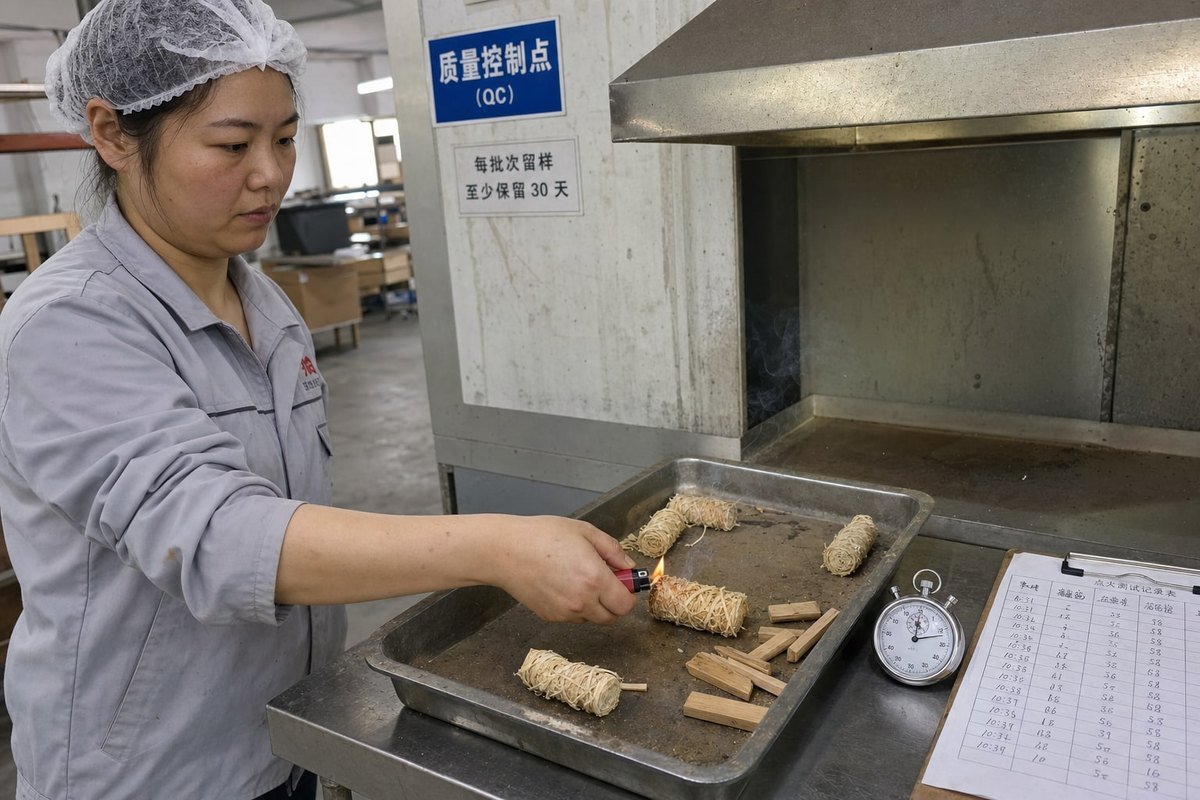
Vague words like "burns well" cannot be enforced. Numbers can. When we develop wax-dipped wood rolls for a new buyer, we agree on target figures during sampling, then lock those figures into the mass-production contract. The first sample must reflect what the factory can hold across thousands of units — that is the whole point of manufacturing depth.
The metrics that matter
Here are the performance parameters I recommend writing into procurement specifications, with typical commercial ranges you can adjust for your market.
| Parameter | Typical specification | Test method to state in contract |
|---|---|---|
| Ignition time | Ignites within 3–5 seconds of match or lighter contact | Single flame source, ambient indoor conditions |
| Average burn duration | 8–12 minutes minimum per unit | Timed burn of randomly selected units on a non-combustible surface |
| Ignition success rate | ≥98% of sampled units ignite on first attempt | Random sample per lot, documented pass/fail |
| Moisture content levels | Within an agreed band, e.g., below 12–20% depending on product type | Oven-dry or calibrated moisture meter method |
| Flame stability | Sustained visible flame, no self-extinguishing within stated burn window | Observed during timed burn test |
| Unit mass and dimensions | Agreed weight ± tolerance; length/diameter ± tolerance | Scale and caliper check on sampled units |
| Ash residue | Below an agreed maximum by weight, where relevant | Post-burn residue weighing |
Define the test conditions, not just the numbers
A burn time measured in a windless lab differs from one measured outdoors. Your contract should state the conditions: ambient temperature range, humidity limits, wind exposure, and the ignition source. If your customers use the product at altitude or in damp climates, say so, and agree on how conditioning before testing works. We have seen disputes arise purely because buyer and supplier tested the same lot under different conditions and got different average burn duration figures.
Combine performance and prescriptive specs
The strongest contracts use both. Prescriptive specs (dimensions, weight, moisture, wax coverage) are cheap to inspect at the factory gate. Performance specs (ignition time, burn duration) confirm the product actually works. Prescriptive checks catch most defects early; performance checks catch the rest before shipment.
What quality control checkpoints should I include from raw materials to finished packaging?
Years ago we traced a batch of underperforming wood wool rolls 6 back to a single pallet of raw fiber stored too close to an open loading door during a rainy week. That lesson shaped how we structure checkpoints today: quality fails at specific points in the chain, so your contract should inspect those points, not just the finished carton.
Require checkpoints at four stages: incoming raw material inspection for wood fiber and wax purity; in-process checks on compression density, dip weight, and moisture; finished-goods batch testing for ignition and burn performance; and pre-shipment inspection covering packaging integrity standards, labels, and carton counts.

Think of the supply chain as a series of gates. Each gate has a defined check, a record, and a named person responsible. Writing this into the contract turns "the supplier does QC" into an auditable obligation.
The four-gate checkpoint model
- Incoming materials. Wood fiber must be free of foreign matter — stone, metal, plastic, dirt. Wax must match the agreed grade, with Safety Data Sheets on file. If the buyer requires sustainable sourcing, chain-of-custody paperwork is checked here, at the point where raw material enters the factory.
- In-process production. Operators check roll compression, fiber winding consistency, and wax dip weight at set intervals. Moisture content levels are measured before and after wax coating, because trapped moisture is the top cause of slow ignition later.
- Finished-goods batch testing. A random sample from each production batch goes through timed ignition and burn tests against the contract thresholds. Results are logged per lot number, so any future complaint traces back to a specific batch record. These batch testing procedures should be defined in the contract, including sample size and frequency.
- Pre-shipment inspection. The final gate covers pack counts, barcode and GTIN accuracy 7, warning labels, retail-ready carton condition, and moisture-barrier packaging. For big-box retail programs, this gate matters as much as burn performance — a perfect product in a crushed or mislabeled carton still gets rejected at the distribution center.
Assign responsibility and keep records
Guidance from solid-biofuel quality assurance frameworks recommends naming an accountable quality person, defining handling and storage rules, and specifying test methods with calibrated equipment. Apply the same logic here. Your contract should require the supplier to retain QC records for each lot — we keep ours batch-by-batch precisely so a buyer's claim can be checked against real production data — and to grant reasonable audit rights, including third-party inspections at the buyer's option before major shipments.
How can I handle non-conforming batches or disputes in my supplier contract terms?
One of our US distributors once received a shipment where a small percentage of units had thin wax coverage from a dip-tank temperature drift. Because the contract already defined defect classes and remedies, we resolved it with a partial credit and a corrective action report inside a week — no lawyers, no lost season. That is what good remedy clauses buy you.
Handle non-conformance by defining defect classes and AQL-based rejection thresholds, requiring formal non-conformance reporting within a set timeframe, and specifying remedies in order: rework or replacement, credit or price adjustment, then rejection. Add retest rules, cost allocation for failed lots, and termination triggers for repeated failures.
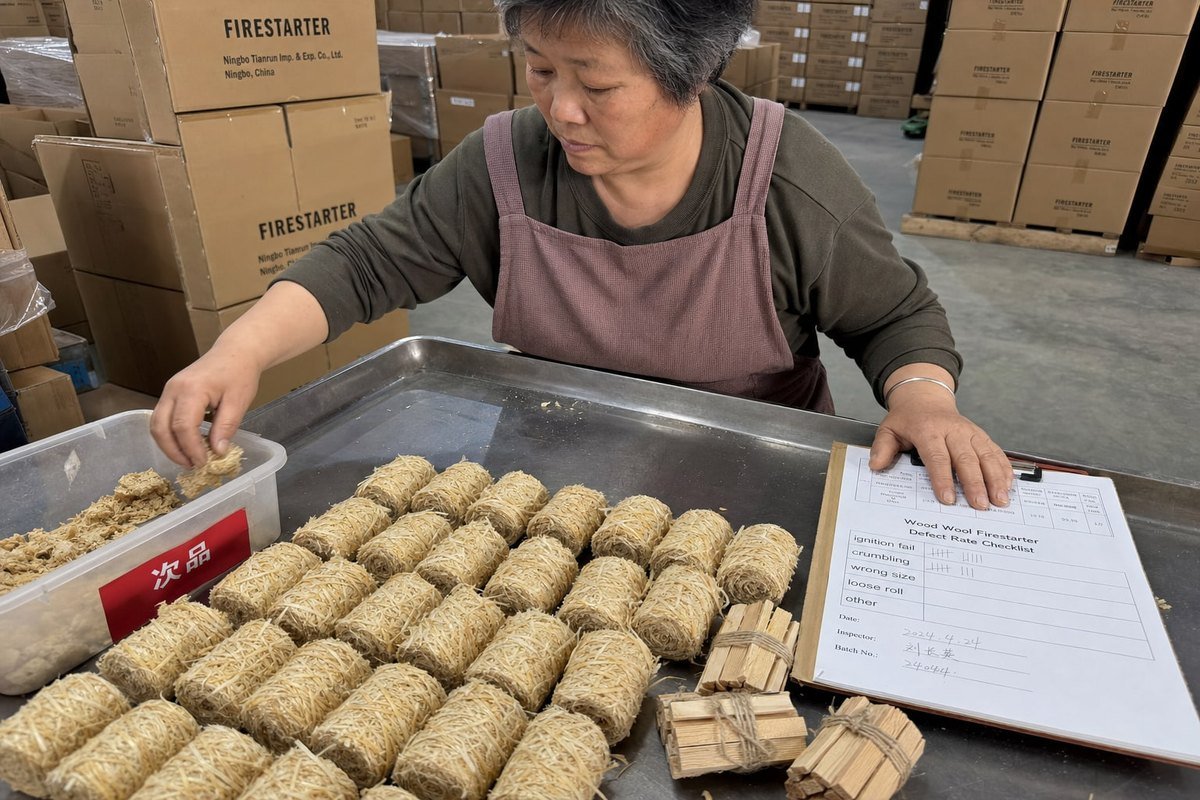
The goal of remedy clauses is not punishment. It is predictability. When both sides know exactly what happens after a failed inspection, small problems stay small.
Classify defects before you argue about them
Not all defects deserve the same response. Grade them in the contract, and tie each grade to a remedy.
| Defect class | Examples | Typical remedy |
|---|---|---|
| Critical | Product fails to ignite; prohibited chemical detected; missing safety labels | Reject lot; replacement or full credit; corrective action report required |
| Major | Burn duration below minimum; excess moisture; broken or crumbling units beyond tolerance | Sort/rework at supplier cost, or price adjustment on affected portion |
| Minor | Slight dimension variance; cosmetic wax unevenness; minor carton scuffing | Accept with note; monitor trend across subsequent lots |
Write the dispute process as a sequence
A clean escalation path prevents deadlock. I recommend this structure:
- Buyer issues a written non-conformance report with lot number, sample data, and photos within an agreed window after delivery.
- Supplier responds within a fixed number of business days with acceptance, rebuttal, or a request for retest.
- If the parties disagree, a pre-named independent lab 8 retests retained counter-samples. The contract states who pays: typically the losing party.
- Confirmed non-conformance triggers the remedy tied to the defect class, plus a documented corrective action for the root cause.
- Repeated failures — for example, two rejected lots in a rolling period — trigger enhanced inspection at supplier cost, and eventually a termination right.
Retain counter-samples
One clause buyers often forget: require the supplier to retain sealed samples from every shipped lot for an agreed period. Without retained samples, a dispute becomes your word against theirs. With them, an independent lab can settle the question in days. We retain lot samples as standard practice, and it has turned potential conflicts into quick, factual conversations more times than I can count.
Conclusion
Vague wording sinks fire starter deals; measurable specs save them. Define the product, certify the supplier, test every lot, and pre-agree remedies. A precise contract protects both sides — and your retail season.
Footnotes
1. Authoritative Wikipedia overview of the ISO 9001 quality management standard. ↩︎
2. Official OSHA Hazard Communication page detailing Safety Data Sheet (SDS) requirements. ↩︎
3. BSCI audits verify ethical and social compliance for retail-bound suppliers. ↩︎
4. CE marking confirms regulatory readiness for products entering the EU market. ↩︎
5. FSC/PEFC chain-of-custody certification verifies sustainable sourcing claims for wood fiber. ↩︎
6. Direct Wikipedia entry for wood wool, also known as excelsior. ↩︎
7. GTIN is the global standard barcode identifier verified during retail packaging inspection. ↩︎
8. Authoritative reference for the ISO/IEC 17025 standard used by competent testing laboratories. ↩︎



 English
  Spanish
  German
  French
  Arabic
  Portuguese
Join the Conversation