







Many buyers ask us about the sampling fee deduction clause before signing. Unclear sample terms cause disputes, delayed invoices, and lost trust — and our factory has seen it all.
A sampling fee deduction clause should define what the sampling fee covers, who pays it initially, when the deduction applies, and how it is recovered — typically as a credit against the first bulk invoice once a minimum order quantity is met, backed by written documentation.
Below, I break the clause down into four practical questions. Each section gives you drafting language ideas, negotiation tactics, and the quality-control terms that make the clause enforceable.
What should I include in a sampling fee deduction clause to protect my first bulk order?
A few years back, a German distributor sent us a two-line sample clause. It caused a three-week payment dispute. Our team now insists on precise wording from day one.
Include a defined term for the sampling fee, the exact costs covered, the deduction trigger, the recovery mechanism, a documentation requirement, a deduction cap, written notice rules, and a dispute process — all tied to your first bulk procurement agreement invoice.

A sampling fee deduction clause is a cost-allocation tool. It lets one party recover sample-related expenses from money otherwise payable under the contract. For wood fire starters, that matters more than for many products. The product is performance-sensitive. Burn time, ignition speed, and moisture content 1 all vary by material and wax ratio. So buyers sample heavily before committing to a mass production order.
The main drafting risk is ambiguity. Vague phrases like "buyer may deduct reasonable sampling charges" invite disputes. Nobody agrees on what "reasonable" means when an invoice is due.
Core elements the clause must answer
Your clause should answer five questions in plain language:
- What counts as a sampling fee? Product samples, lab testing, sample freight, retesting, or third-party inspection charges.
- Who pays first? Usually the buyer pays upfront, and the supplier credits it back later.
- When can the deduction happen? After an agreed sampling event, an acceptance failure, or invoice approval.
- How is it recovered? Direct invoice deduction, setoff against future payments, or a credit note.
- What proof is required? Test reports, receipts, vouchers, or written notice.
Recommended clause structure
| Element | What to specify | Why it matters |
|---|---|---|
| Defined term | "Sampling Fee" with listed cost categories | Prevents scope creep |
| Payment responsibility | Buyer pays upfront; supplier credits later | Standard in export deals |
| Deduction trigger | Confirmed purchase order terms met (e.g., MOQ reached) | Objective, verifiable |
| Mechanism | Credit on first bulk invoice or setoff | Avoids separate transactions |
| Cap | Maximum deductible per order or month | Protects supplier cash flow |
| Documentation | Receipts, test reports, written notice | Makes deduction defensible |
| Dispute rule | Pay undisputed portion on time | Keeps shipments moving |
One more point from our export experience 2. Keep the sampling fee deduction separate from your rejection rights for non-conforming goods 3. They are different remedies. Mixing them into one sentence creates confusion when a batch actually fails.
How do I negotiate sample costs with a wood fire starter manufacturer before signing a contract?
When buyers first contact our Ningbo production line 4, sample cost is usually their second question — right after certifications. The negotiation goes smoother when both sides state their positions early.
Negotiate sample costs before signing by requesting a written sample reimbursement policy, agreeing who pays for samples versus freight, setting a volume threshold for credits, and confirming whether custom private-label samples carry tooling or setup charges.

Sample cost negotiation is really a risk-allocation conversation. Each side has legitimate concerns. Understanding both positions helps you land on fair purchase order terms faster.
Buyer position versus supplier position
| Negotiation point | Buyer-friendly position | Supplier-friendly position |
|---|---|---|
| Who pays for samples | Supplier bears cost as a sales expense | Buyer pays; credited only after MOQ order |
| Sample freight | Supplier prepays shipping | Buyer covers courier costs |
| Deduction rights | Automatic offset against any invoice | Deduction only with prior written approval |
| Cap | No cap needed | Fixed cap per order or per month |
| Custom samples | Included free with serious inquiry | Charged at cost for private label manufacturing setups |
In our experience exporting eco-friendly firelighters to the US and Europe for over 17 years, most deals settle in the middle. Standard catalog samples are cheap to produce. Custom samples are not. If you want a specific wax ratio, a custom burn time, or branded packaging mockups, the factory spends real engineering hours. A fair compromise is treating those costs as prototype cost recovery: the buyer pays upfront, and the amount is credited once the first mass production order ships.
Practical negotiation steps
- Ask for the supplier's written sample policy before requesting anything.
- Separate product cost from freight cost in the discussion.
- Propose a volume threshold — for example, the credit applies only if the first order exceeds an agreed value.
- Get the agreed terms into the manufacturing supply agreement, not just an email.
- Confirm the credit mechanism: invoice line item, credit note, or unit cost adjustment.
One warning from the factory side. Suppliers resist open-ended deduction rights because they can turn into hidden discounts. If your clause is narrow and measurable, a serious factory will accept it quickly. If it is vague and unlimited, expect pushback — and treat a supplier who accepts it without question as a red flag.
Can I get sampling fees refunded or credited once I place a mass production order?
A Dutch fireplace distributor once told me they had lost sample fees at three different factories before finding us. The pattern was always the same: verbal promises, nothing in writing.
Yes — most manufacturers will refund or credit sampling fees once you place a qualifying mass production order, typically as a rebate-on-order credit against your first bulk invoice, provided the minimum order quantity is met and the terms are documented in writing.

The rebate-on-order structure is the industry norm for fire starter sampling. The buyer pays for samples upfront. This filters out non-serious inquiries and covers the supplier's direct costs. Then, once a qualifying bulk procurement agreement is signed and the order confirmed, the sample fee comes back as a credit.
Three common credit mechanisms
There are three ways the money comes back. Each has trade-offs.
| Mechanism | How it works | Best for |
|---|---|---|
| First-invoice credit | Full sample fee deducted from the first bulk invoice | Simple, one-time orders |
| Progressive NRE-style credit | Fee spread across the first three to five production runs | Large custom tooling or packaging setups |
| Unit cost adjustment | Per-unit price lowered slightly to absorb the fee | Long-term repeat programs |
The first-invoice credit is the cleanest. You see the deduction as a line item, and the paper trail is obvious. The progressive credit eases the supplier's immediate cash flow 5 on heavy customization projects. The unit cost adjustment works for ongoing programs, but it hides the credit inside pricing, which makes auditing harder.
Conditions that usually attach to the credit
Factories rarely offer unconditional refunds. Expect these strings:
- A minimum order quantity. The credit activates only when the MOQ is met. Our flexible trial MOQs mean this threshold is usually reachable for established importers.
- A time limit. Many suppliers require the bulk order within 90 to 180 days of sample delivery.
- Documentation. Keep your sample invoice, payment record, and the written credit promise together.
- Scope limits. Freight and third-party lab fees are often excluded from the credit unless negotiated separately.
Put the credit terms directly into your purchase order terms or the supply agreement. An email chain helps, but a signed clause wins disputes.
What contract terms ensure my sample matches the final bulk production quality?
Batch consistency is where our 17 years of production discipline earn their keep. A perfect sample means nothing if container number three burns differently than container number one.
Require a golden sample clause, written product specifications with tolerances, batch-level quality control standards, pre-shipment inspection rights, retained reference samples, and clear remedies for non-conforming goods — including rejection, replacement, or price deduction tied to documented test failures.
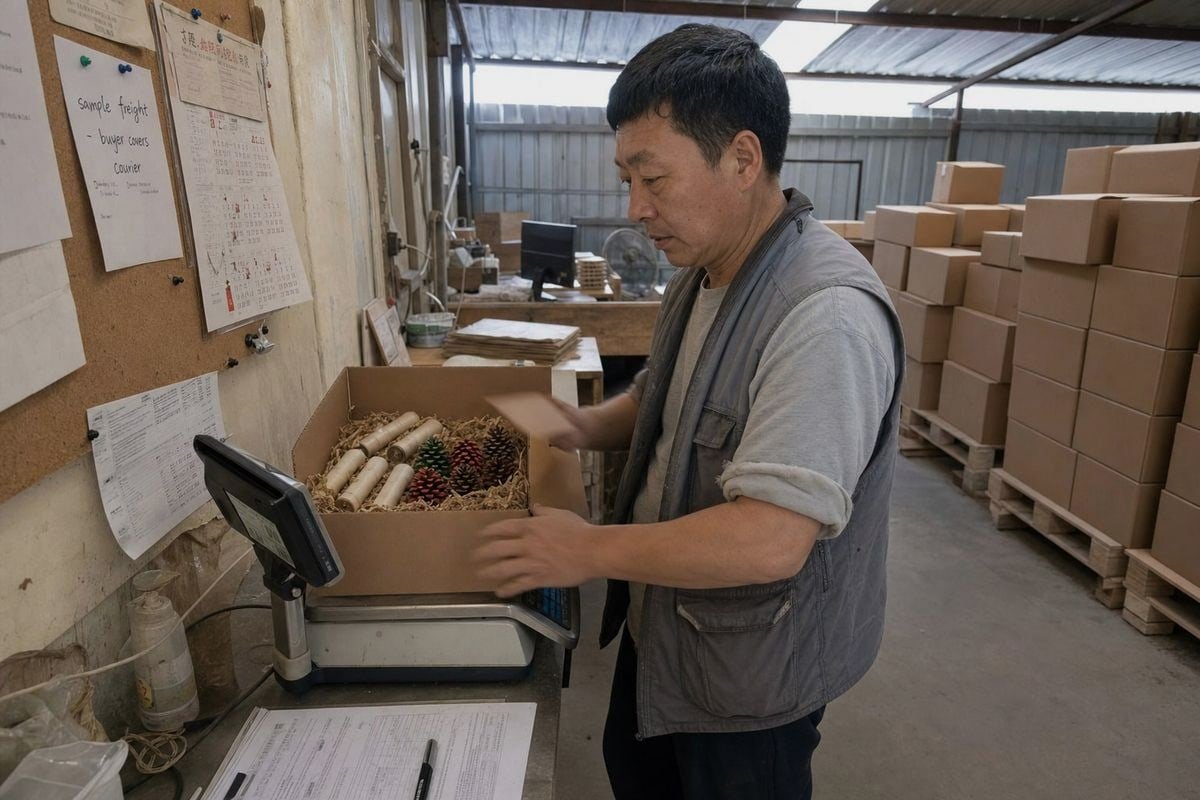
The sampling fee clause and the quality-matching clause work together. The first protects your money. The second protects your product. For wood fire starters, quality drift usually shows up in four places: raw material moisture, wax ratio, burn time, and packaging.
The golden sample mechanism
The most reliable term is a golden sample clause. Here is how it works in practice:
- Both parties approve a physical sample in writing.
- The factory retains one sealed counter-sample; the buyer keeps another.
- All bulk production must conform to the golden sample within stated tolerances.
- Any deviation requires prior written approval before production starts.
On our lines, every approved sample is logged with its wax-to-fiber ratio, dimensions, and target burn time. That record becomes the production standard 6. This is why strict batch-to-batch quality control matters more than a beautiful first sample — the sample only proves capability, while process discipline proves consistency.
Specification terms to write into the agreement
Your manufacturing supply agreement should pin down measurable specs, not adjectives. Useful examples for wood fire starters:
- Moisture content ceiling. Excess moisture reduces thermal efficiency. Set a maximum percentage, similar to standards used for kiln-dried kindling.
- Ignition and burn time range. For example, ignition within a set number of seconds and a minimum burn duration per piece.
- Composition disclosure. Wood fiber and wax percentages stated on packaging must match production reality.
- Compliance documents. Require valid test reports from recognized labs. Our buyers treat SGS or Intertek reports as a hard requirement, and so should you.
Inspection and remedy terms
Give yourself the right to inspect before shipment and to sample each delivered lot randomly. Then define the remedy path for non-conforming goods: written rejection notice 7 within a short window, supplier's choice to replace or credit, and — connecting back to the sampling clause — the buyer's right to deduct documented retesting costs. Keep the deduction right and the rejection right as separate, clearly worded remedies. That separation is what keeps a quality problem from becoming a payment war.
Conclusion
A vague sample clause quietly costs buyers money and trust. Define the fee, trigger, credit, and proof — then pair it with golden-sample quality terms for a dispute-free first order.
Footnotes
1. Comprehensive scientific explanation of moisture content and its measurement in various materials. ↩︎
2. Government resource for businesses navigating international trade and export logistics. ↩︎
3. Authoritative legal definition and buyer rights regarding non-conforming goods under the UCC. ↩︎
4. Historical and technical overview of industrial production and assembly systems. ↩︎
5. Financial guide explaining the importance of cash flow for business operations. ↩︎
6. Detailed overview of technical standards used to ensure quality and consistency in manufacturing. ↩︎
7. Legal requirements and procedures for issuing a rightful rejection notice under commercial law. ↩︎



 English
  Spanish
  German
  French
  Arabic
  Portuguese
Join the Conversation