






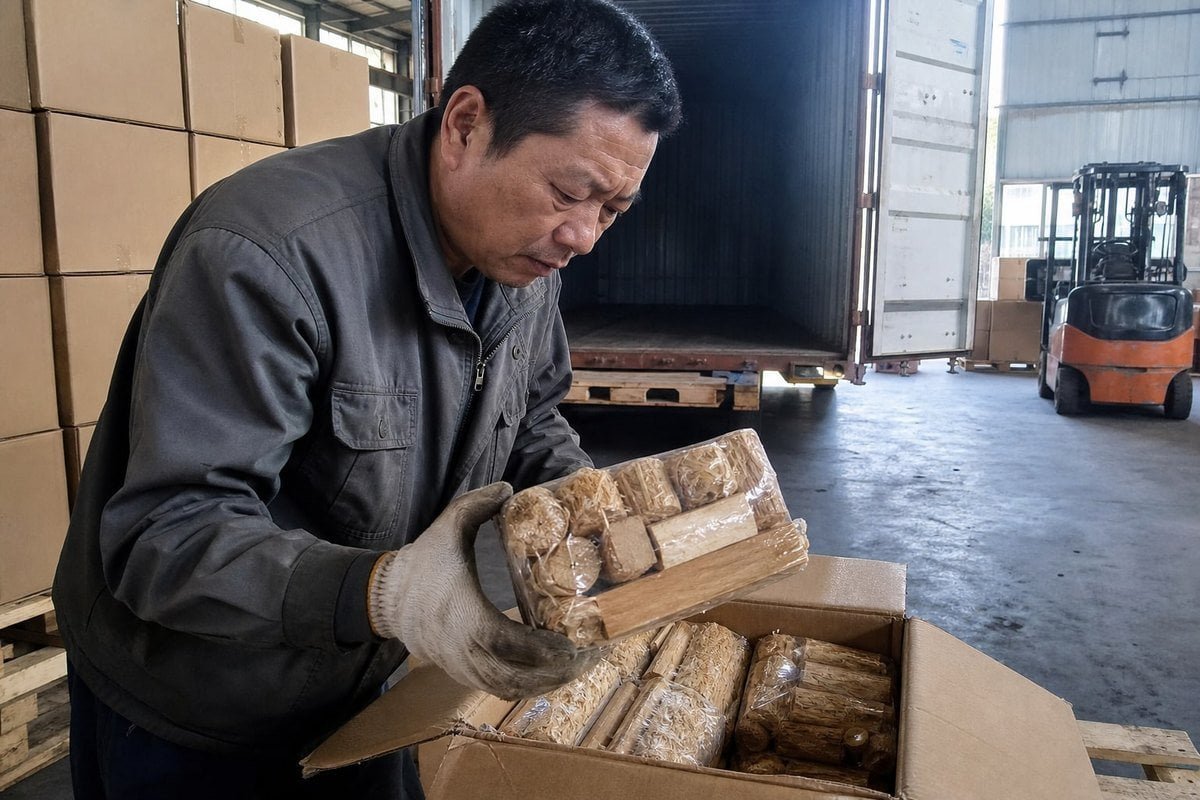
Wood fire starters' long-term storage stability makes or breaks an import order. On our production line in Ningbo, we've seen containers ruined by moisture before ever reaching a shelf.
To evaluate wood fire starters' long-term storage stability, check certified shelf life claims, test samples for moisture resistance and resin saturation, demand airtight packaging with moisture barriers, and verify the supplier's batch-to-batch consistency through documented quality control and third-party test reports.
That answer covers the essentials. But each of those four steps has details that separate a safe purchase from an expensive mistake. Let me walk you through them one by one.
What certifications should I check to confirm long-term storage stability before ordering?
A German distributor once asked us for our SGS reports before he even asked for a price. That order taught me how seriously professional buyers treat compliance paperwork.
Check for ISO 9001 quality management certification, SGS or Intertek third-party test reports covering moisture content and burn performance, BSCI social compliance audits, and CE marking where applicable. Together, these documents prove the supplier can produce stable, consistent fire starters over time.

Certifications don't directly measure shelf life. But they tell you whether a factory has the systems needed to produce a stable product. In our 17+ years exporting to 30+ countries, buyers who skipped this check often paid for it later with degraded stock.
Why each certificate matters for storage stability
ISO 9001 confirms the factory runs a documented quality management system 1. That means raw material inspection, in-process checks, and final testing happen on every batch. Without it, moisture content and wax coating thickness can drift from order to order. Drift kills long-term stability.
SGS and Intertek reports 2 go further. They give you independent lab data on the actual product. Ask specifically for test results covering moisture content, burn time, and material composition. A report showing low residual moisture and no harmful chemical binders 3 is direct evidence the product will store well.
BSCI matters less for chemistry but more for continuity. A factory with audited working conditions 4 tends to keep trained staff, and trained staff keep processes stable.
| Certification | What It Proves | Link to Storage Stability |
|---|---|---|
| ISO 9001 | Documented quality system | Consistent moisture content and coating control |
| SGS / Intertek reports | Independent lab verification | Verified composition, burn time, humidity resistance |
| BSCI | Audited social compliance | Stable workforce, stable processes |
| CE marking | EU market conformity | Confirms safe materials and labeling |
Questions to ask before ordering
Request the actual documents, not just logos on a website. Then check three things: the certificate holder name matches the factory (not a trading company), the reports are recent, and the tested product matches what you're buying. At our Liuyang headquarters, we keep all of these ready to share, because serious B2B buyers always ask.
How can I test wood fire starters for moisture resistance and shelf life during sampling?
Before we ship any new wax-dipped wood roll design, our QC team runs humidity chamber checks for weeks. I recommend buyers do a simplified version of the same thing.
Test samples by weighing them before and after humid exposure, submerging one briefly in water and attempting ignition, flexing aged pieces to check for brittleness, and comparing burn times against fresh stock. Stable starters resist moisture uptake and ignite reliably after stress testing.

You don't need a lab to run meaningful sample tests. You need a scale, a humid room, water, and patience. Here is the process we suggest to purchasing managers who visit our factory or receive trial samples.
A five-step sampling test procedure
- Weigh and record. Weigh each sample on a gram scale. Store half in a sealed bag as your control group.
- Humidity exposure. Leave the test group unwrapped in a bathroom or damp basement for two weeks. Weigh again. Significant weight gain means the product is absorbing ambient moisture, which signals a thin or uneven wax coating.
- Water challenge. Dip one starter in water for ten seconds, shake it off, and try to light it. Wax-coated wood wool with proper resin saturation should still catch flame. Uncoated fibers will fail.
- Flexural check. Bend or press an aged sample. A brittle, snapping texture suggests thermal degradation or loss of binding wax, which raises the ignition threshold.
- Burn comparison. Light one control and one exposed sample side by side. Compare ignition speed and total burn time. A stable product shows minimal difference.
What the results tell you
Fatwood heartwood and paraffin-saturated products 5 should show almost no weight change, because resin and wax repel water. Products relying on cheap chemical binders often gain weight fast and burn short. Also smell the samples: a sour or faded scent can mean volatile organic compounds 6 have escaped, reducing ignition performance.
Keep a written record of your findings. When you reorder, repeat the water challenge on the new batch. That single habit catches most stability problems before they reach your warehouse.
What packaging options help maintain quality during long-distance shipping and warehouse storage?
Shipping fire starters from Ningbo to Rotterdam means six weeks of temperature swings and ocean humidity. We learned early that packaging is not decoration — it is the product's life-support system.
Choose airtight packaging such as sealed plastic jars, heat-sealed poly bags, or lined kraft bags with moisture barriers, packed in sturdy cartons with desiccants. Avoid loose paper-only packaging, which allows humidity ingress and accelerant migration during transit and warehouse storage.
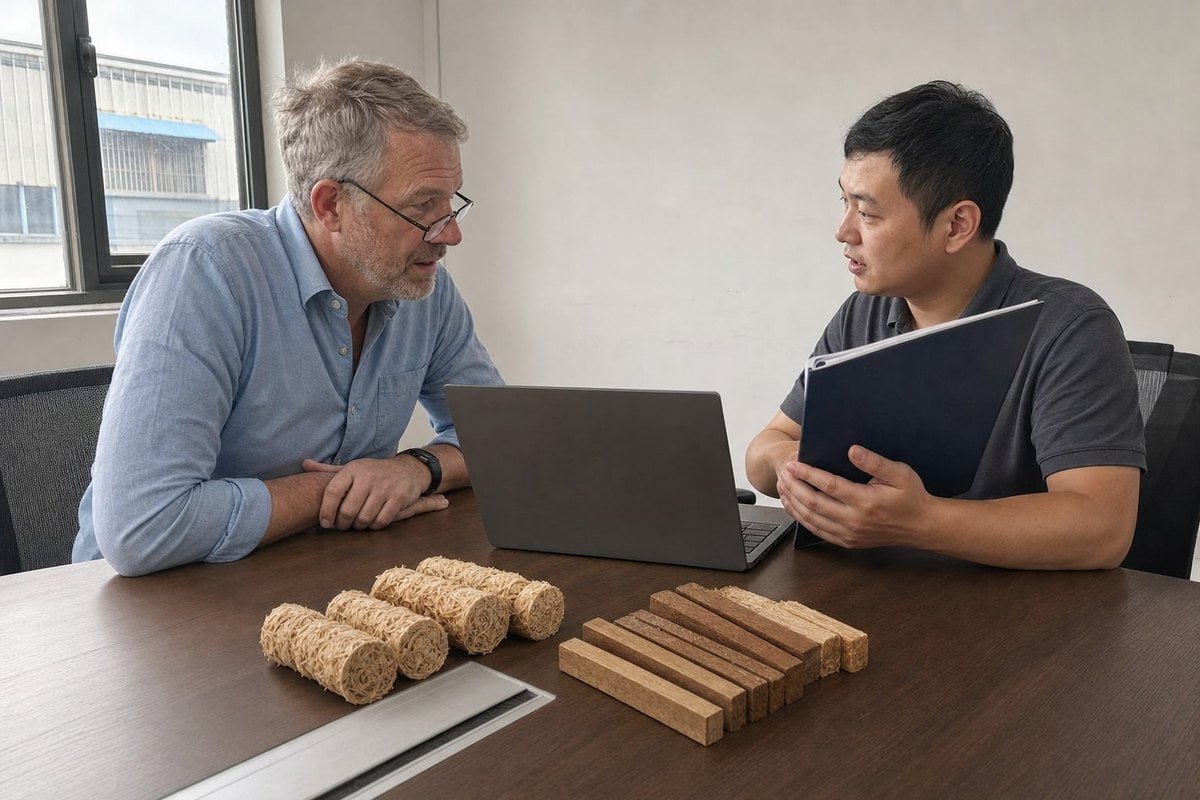
Packaging choices affect stability at three levels: the primary seal around the product, the retail unit, and the shipping carton. Each level fights a different threat.
Matching packaging to storage risks
| Packaging Option | Moisture Protection | Best Use Case | Watch Out For |
|---|---|---|---|
| Sealed plastic jar | Excellent | Retail shelves, humid markets | Higher unit cost, more volume |
| Heat-sealed poly bag | Very good | Bulk packs, e-commerce | Punctures during handling |
| Lined kraft bag | Good | Eco-positioned retail brands | Seam integrity must be tested |
| Plain paper box only | Poor | Dry, fast-turnover markets | Humidity ingress, wax leaching into paper |
Two failure modes deserve special attention. First, accelerant migration: over months, paraffin can slowly leach into unlined paper packaging, shortening burn time and staining the box. A simple inner liner prevents this. Second, thermal fatigue 7: repeated heat cycles in non-climate-controlled warehouses cause wax to expand and contract, opening micro-cracks that let moisture in. High-melt paraffin resists this far better than soft, low-melt blends, so ask your supplier what melting point their wax formula uses.
Shipping and warehouse practices
Cartons should include desiccant packs and sit on pallets, never directly on concrete floors, which wick moisture upward. For buyers targeting multi-year inventory or emergency-kit markets, we can pack in heavier-gauge sealed bags on request. As part of our one-stop OEM service, we customize packaging structure, warning labels, and barcodes so the product arrives shelf-ready and stays stable in your warehouse — humidity resistance built in from the first seal.
How do I verify a supplier's batch-to-batch consistency for stable long-term performance?
A UK buyer once told me his previous supplier's second shipment burned half as long as the sample. That conversation shaped how we document every production run at our factory.
Verify consistency by requesting batch production records, comparing golden samples against each new shipment, ordering staggered trial batches before committing to volume, and confirming the supplier controls raw material moisture content and wax formulation with written specifications and retained batch samples.
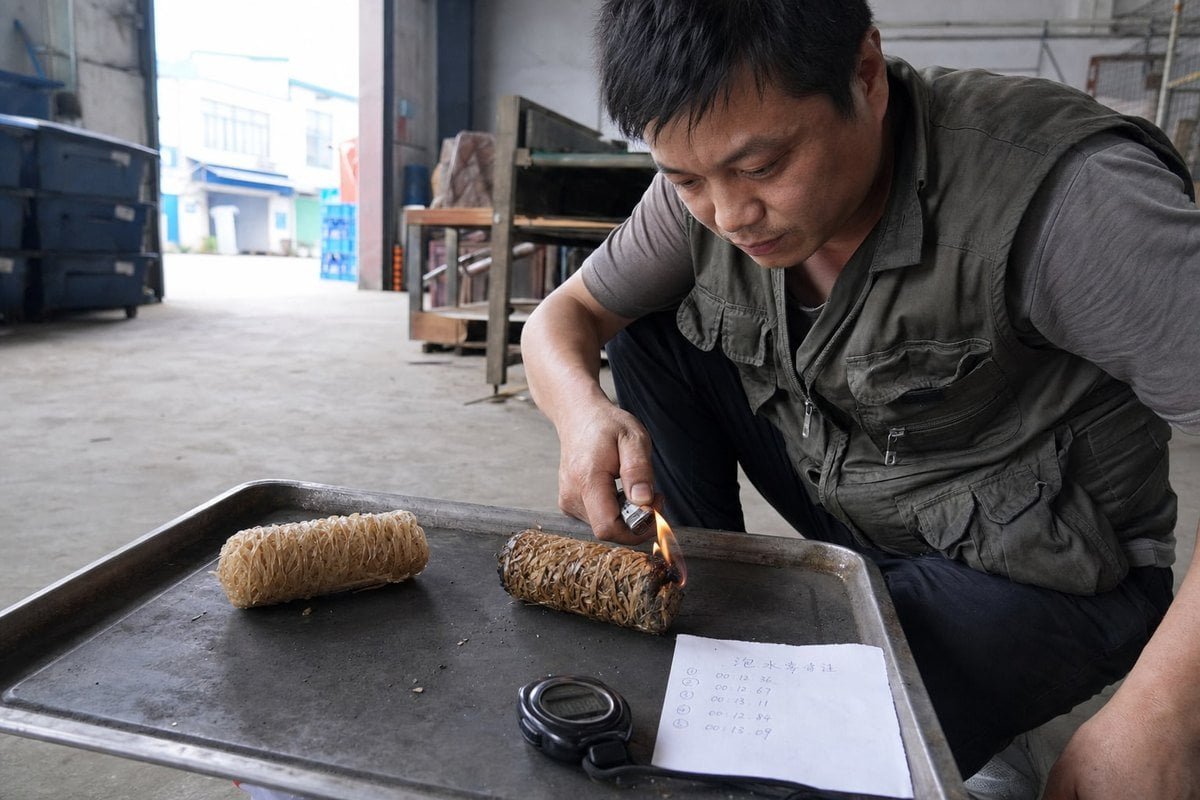
The sample you approve means nothing if mass production drifts away from it. Consistency comes from process discipline, and you can audit that discipline even from across an ocean.
Where inconsistency actually comes from
Most variation traces back to three inputs. Raw wood wool arrives with different moisture content depending on season and supplier. Wax blends can change if a factory switches paraffin grades to cut costs. And dipping time or temperature drift changes coating thickness. A factory with real manufacturing depth measures and logs all three. A trading company reselling from rotating workshops cannot control any of them — which is why we always encourage buyers to confirm they're dealing with an actual factory.
A practical verification checklist
| Verification Step | What to Request | What It Reveals |
|---|---|---|
| Golden sample agreement | Sealed, signed reference sample | A fixed benchmark for every future shipment |
| Batch records | Moisture readings, wax temperature logs | Whether process control actually exists |
| Staggered trial orders | Two or three small orders over months | Real-world consistency, not one-time effort |
| Retained samples | Factory keeps pieces from each batch | Traceability if a dispute arises |
| Pre-shipment inspection | Third-party or photo/video QC report | Coating quality and packaging seal before loading |
On our lines, we weigh wax pickup on wood rolls throughout each shift and hold retained samples from every batch. That is why we tell buyers our first sample reliably reflects mass-production quality — and why we invite them to test that claim with a small trial order before scaling up. Flexible MOQs exist precisely so you can verify us before you trust us.
Conclusion
Evaluating wood fire starters' long-term storage stability means checking certifications, stress-testing samples, demanding airtight packaging, and auditing batch consistency. Get those four right, and your inventory stays sellable for years. We're glad to prove each one — starting with a trial order.
Footnotes
1. ISO 9001 is the official standard referenced for factory quality management systems. ↩︎
2. SGS is the named third-party inspection body providing independent lab verification. ↩︎
3. Background concept on binder materials used in composite wood products like fire starters. ↩︎
4. BSCI is the amfori social compliance audit program directly referenced in the text. ↩︎
5. Background reference explaining paraffin wax properties relevant to moisture resistance. ↩︎
6. EPA defines volatile organic compounds, explaining chemical off-gassing affecting product performance. ↩︎
7. Explains material fatigue mechanism causing micro-cracks from repeated thermal cycling. ↩︎


 English
  Spanish
  German
  French
  Arabic
  Portuguese
Join the Conversation