






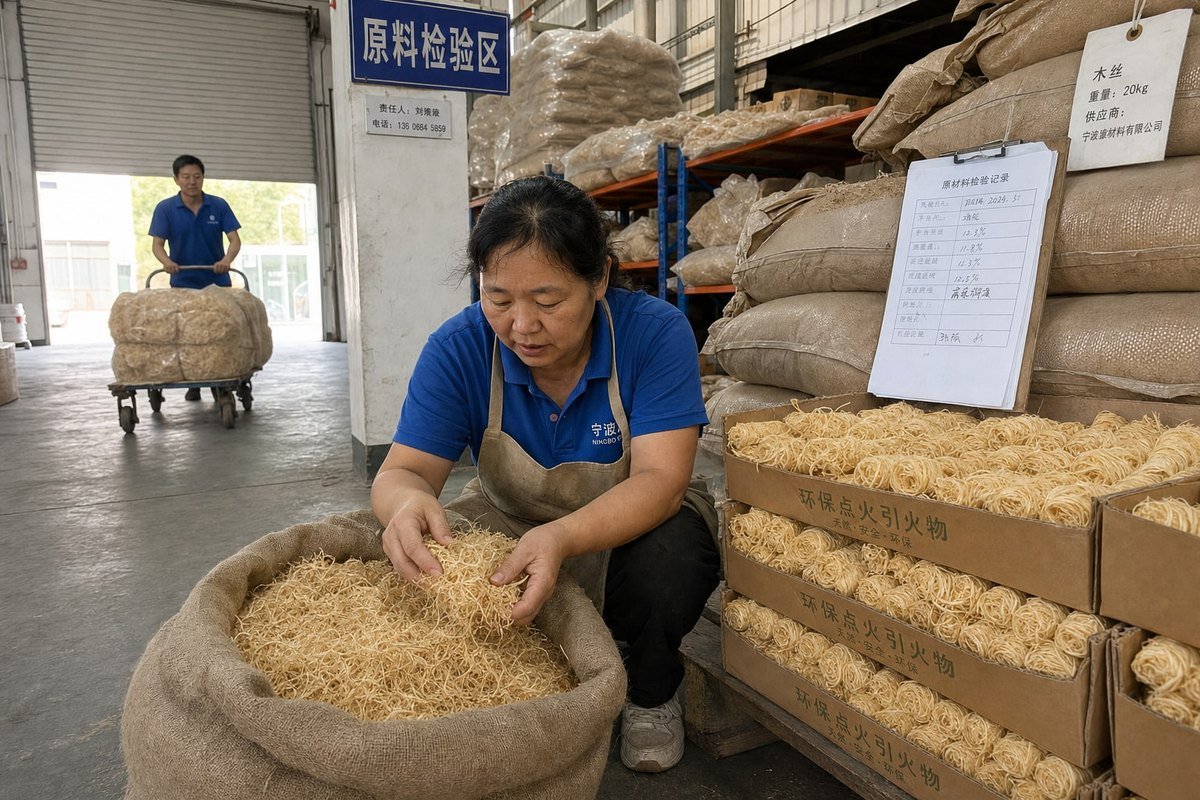
Raw material supply stability makes or breaks wood fire starter sourcing. On our production line, one bad wood wool 1 shipment once threatened an entire seasonal export order.
To evaluate raw material supply stability when sourcing wood fire starters, verify certifications like FSC and ISO 9001, confirm multi-source year-round wood access, test batch-to-batch consistency for moisture and fiber quality, and audit the factory's backup supply plan for peak-season disruptions.
That single answer covers the four pillars. Now let me walk you through each one, using what we have learned over 17 years of making wax-dipped wood rolls for buyers in 30+ countries.
What certifications should I verify to confirm a wood fire starter supplier's raw material quality?
A German distributor once rejected a competitor's sample line simply because the paperwork behind the wood could not be traced. That story shaped how we handle documentation at our factory.
Verify FSC or PEFC Chain of Custody certification for the wood, ISO 9001 for quality management, BSCI for social compliance, and SGS or Intertek test reports covering burn performance and harmful substances. Together, these prove both sustainable forestry sourcing and consistent feedstock quality.
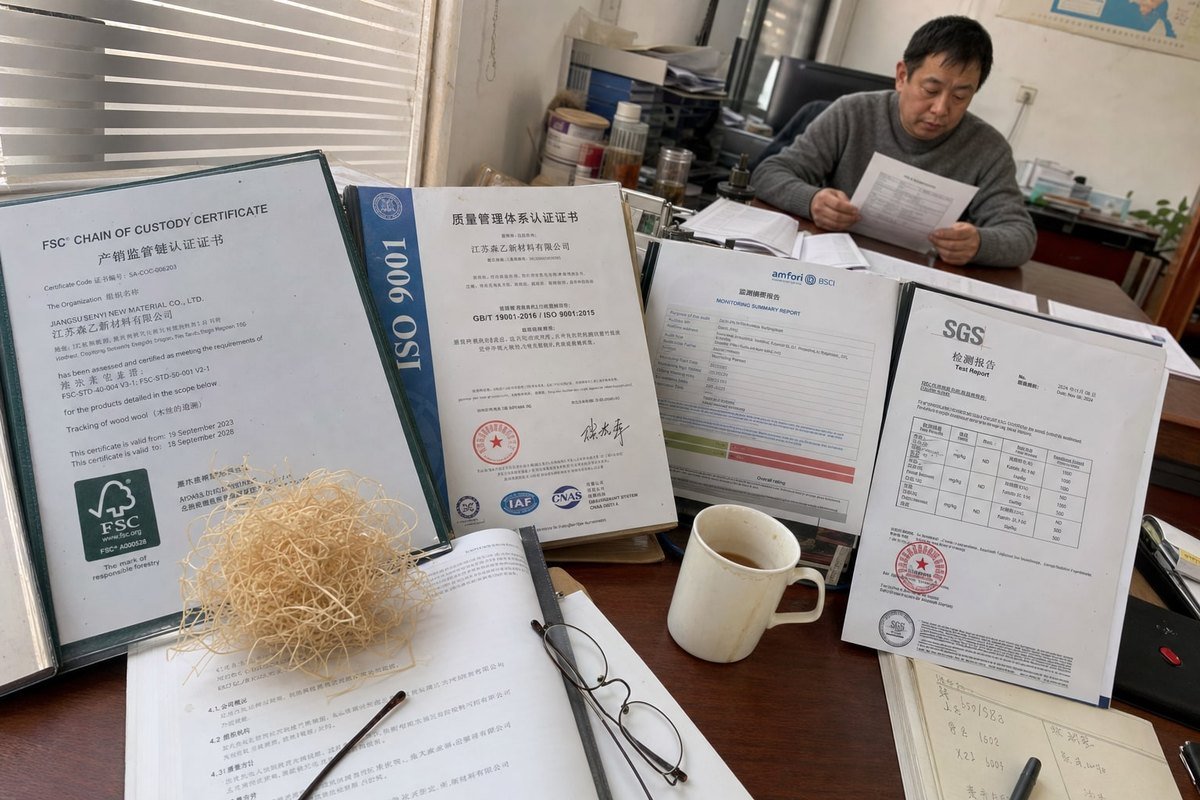
Certifications are not decoration. They are the only scalable way a purchasing manager sitting in Chicago or Rotterdam can verify what happened in a forest and a factory thousands of miles away. In our experience exporting to the US and Europe, buyers who skip this step almost always pay for it later, either through customs delays or retail delisting.
The core certification stack
Here is how I recommend you organize your verification checklist. Each certificate answers a different risk question.
| Certification | What it proves | Supply stability signal |
|---|---|---|
| FSC certification / PEFC | Wood comes from responsibly managed forests | Legal, renewable feedstock unlikely to face sourcing bans |
| Chain of Custody | Traceability from forest to finished product | Supplier knows exactly where every batch originates |
| ISO 9001 2 | Documented quality management system | Batch consistency is process-driven, not luck |
| BSCI 3 | Ethical labor and factory conditions | Lower risk of shutdowns from social audits |
| SGS / Intertek reports | Third-party testing of the finished product | Burn time, ignition, and safety claims are verified |
Watch for new regulatory layers
The EU Deforestation Regulation (EUDR) 4 is changing the game. It requires geolocation-based traceability for wood entering the EU market. Ask your supplier directly: can you provide plot-level origin data? A supplier who cannot answer this today may lose EU market access tomorrow, and your inventory pipeline goes down with them. We hold ISO 9001, BSCI, CE, and SGS/Intertek certification precisely because our buyers treat compliance as a hard requirement, not a nice-to-have. You should treat it the same way. Also request the actual certificates, check the certificate numbers against the issuing body's database, and confirm the scope covers wood fire starters specifically, not just an unrelated product line.
How can I tell if my supplier has consistent access to sustainably sourced wood year-round?
Every winter, we watch raw material markets tighten just as fireplace-season orders peak. Managing that squeeze from our Ningbo production base taught us that global wood abundance means very little at the local level.
Confirm year-round access by asking for at least two independent feedstock sources, reviewing twelve months of delivery records, checking proximity to sawmills or forest residues streams, and verifying long-term supply agreements. Single-source suppliers face seasonal shortages even when wood is globally abundant.
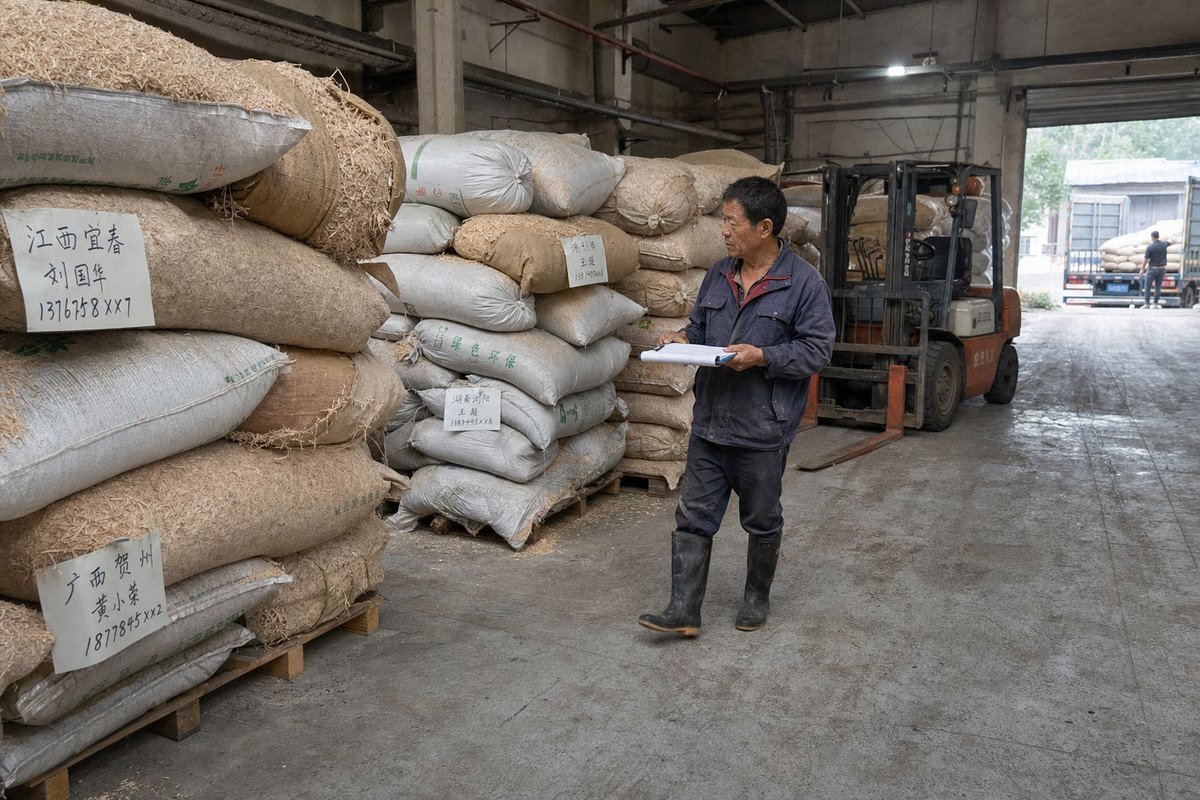
Here is the tension you need to understand. Forestry outlooks show plenty of wood worldwide. Yet fire starter manufacturers still run short. Why? Because we do not buy generic wood. We buy a specific processed form, usually wood wool or excelsior, cut to a specific fiber length, at a specific moisture content 5. That narrows the supplier pool dramatically. Local shortages coexist with surpluses elsewhere, and the biomass supply chain 6 that feeds fire starter production is often fragmented across many small mills.
Questions that reveal true source depth
Ask these five questions and listen for specifics, not slogans:
- How many independent mills or forest areas supply your wood wool?
- What share of your volume comes from your largest single source?
- Do you rely on sawmill residue, forest thinning 7, or primary timber?
- What happens to your supply during the local harvest off-season?
- Who else competes for your feedstock, such as pellet or animal bedding producers?
The competing-demand problem
This last question matters more than most buyers realize. Sawdust, shavings, and forest residues are also inputs for wood pellets, paper, and bedding. During economic peaks, higher-value industries can outbid a fire starter factory for the same residue stream. A supplier with locked-in supply agreements and multi-origin sourcing survives that competition. A supplier buying spot lots does not. We also watch weather risk closely: shortened frozen-ground logging windows and extreme weather events increasingly disrupt harvest and transport schedules, so ask how your supplier's sourcing region has performed over the past few seasons. Strategic procurement means treating wood access like a portfolio, not a single bet.
What questions should I ask about batch-to-batch consistency before placing a bulk order?
Trade-offs are unavoidable here, and I weigh one constantly: looser wood specs lower cost but raise rejection risk. Our QC team samples every incoming wood wool lot before it reaches the wax-dipping line, because one out-of-spec batch changes burn time across thousands of finished pucks.
Ask how the supplier controls moisture content, fiber length, wax absorption, and contamination between batches. Request written specifications, batch traceability records, historical rejection rates, and a comparison of first samples against mass-production output. Consistent answers backed by documents signal real process control.
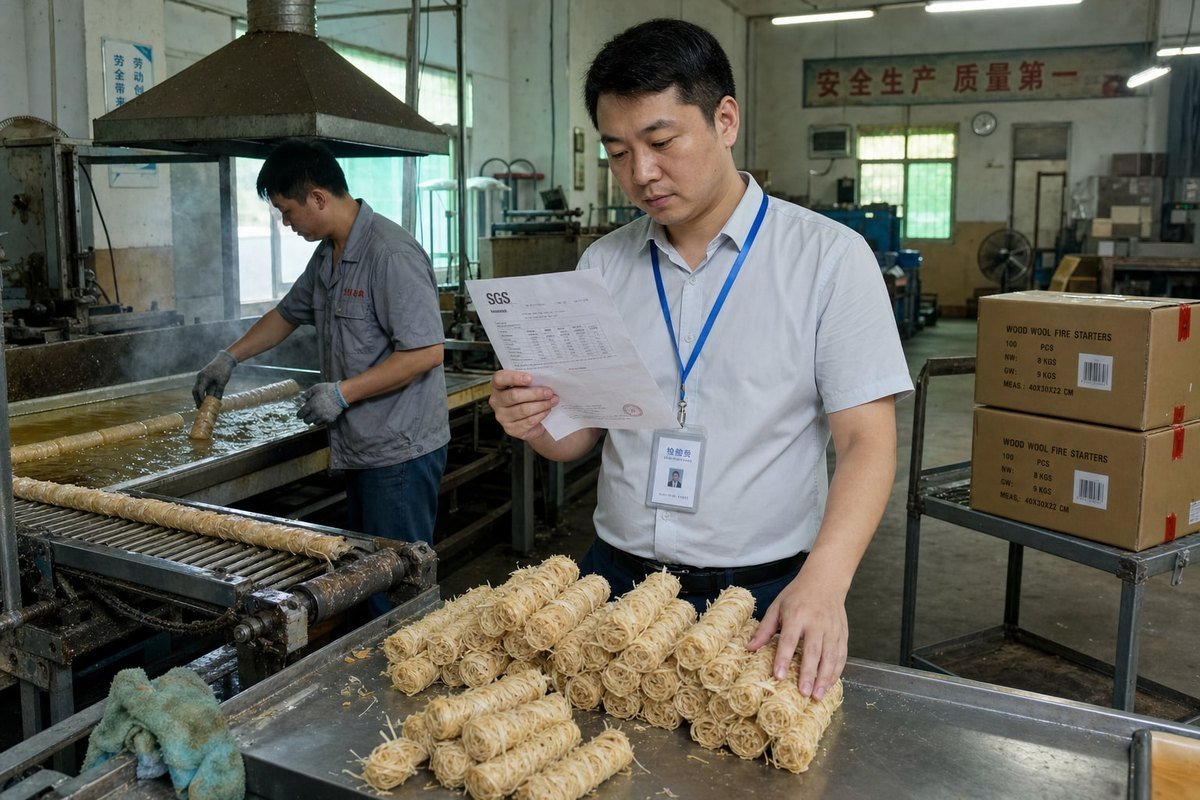
Batch consistency is where trial orders succeed or fail. A great first sample means nothing if lot number twelve arrives with rotten fibers, excess bark, or wet wood that will not hold wax. Studies of firewood raw material streams report exactly these problems: rot, unsuitable dimensions, and dust contamination. Your job before a bulk order is to find out whether the supplier catches those defects before they reach your container.
The specification parameters that drive consistency
| Parameter | Why it matters | What to ask for |
|---|---|---|
| Moisture content | Wet wood resists wax and misfires | Target range and measurement method per batch |
| Fiber length and density | Affects ignition speed and burn time | Written spec with tolerance limits |
| Wax coating weight | Determines burn duration and weather resistance | Coating tolerance and per-lot checks |
| Contamination | Bark, dust, and rot cause quality drift | Incoming inspection and rejection criteria |
| Species mix | Different woods burn differently | Approved species list, ideally kiln-dried wood or controlled-dry stock |
Test the supplier, not just the sample
Ask for units pulled from three different production runs, not one polished sample lot. Compare them side by side. Weigh them. Time the burns. At our factory, we structure batch-to-batch quality control so the first sample reliably reflects mass-production quality, and we tell buyers to hold us to that standard. Also ask how the factory documents each lot. If they can trace a finished carton back to a specific wood delivery, feedstock quality problems get isolated fast. If they cannot, one bad input contaminates weeks of output, and you find out only when customer complaints arrive.
How do I assess a factory's backup supply plan to avoid production delays during peak season?
A US buyer once asked me a blunt question during a video audit: what happens to my October delivery if your main wood supplier floods out in August? I respected the question, because it is exactly the right one.
Assess backup planning by asking for the supplier's documented contingency plan: named alternate wood sources, safety stock levels for wood wool and wax, buffer lead times during Q3–Q4, financial capacity to prepay materials, and logistics alternatives. Then verify each claim with evidence, not promises.
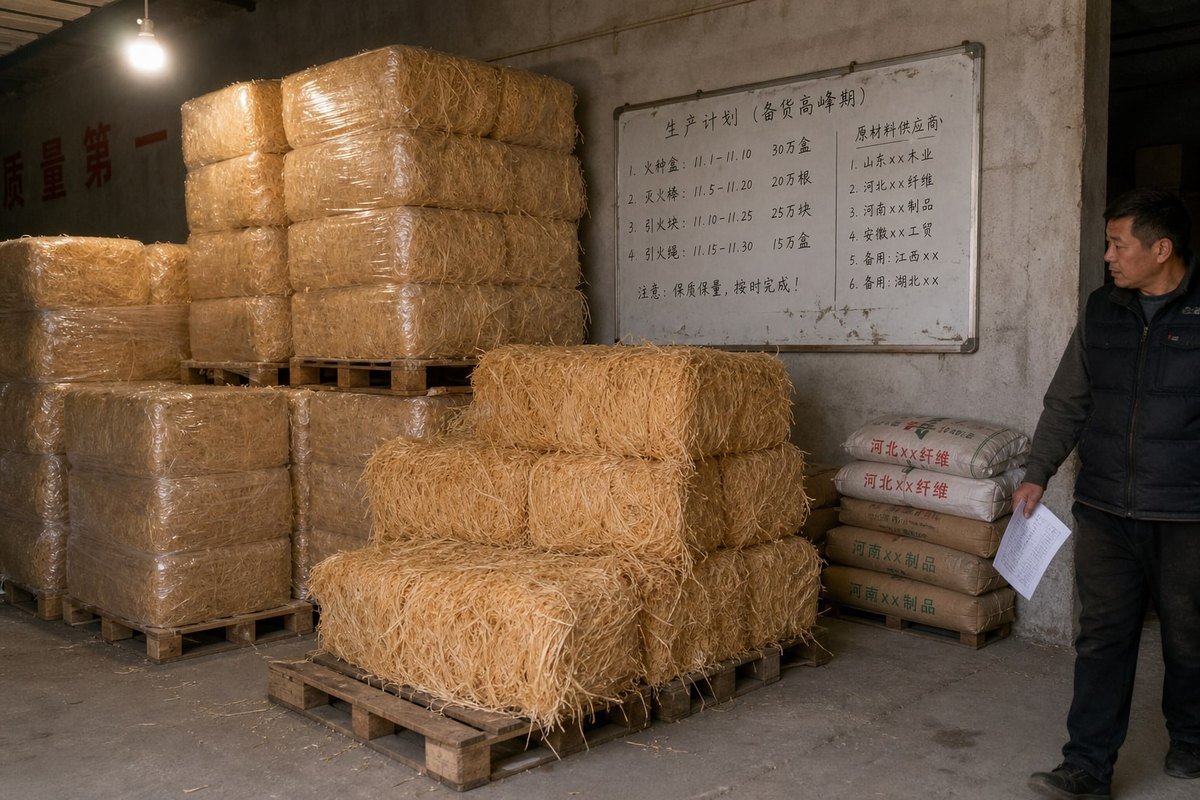
Peak season is where logistics volatility and supply risk collide. Fire starter demand spikes ahead of winter and the grilling season, precisely when harvest delays, port congestion, and freight surcharges hit hardest. A supplier without a written backup plan is running on hope. Having shipped seasonal orders to markets from Canada to Australia for over 17 years, we build our production calendar around this reality, and we expect buyers to audit it.
A practical supplier risk assessment scorecard
Score each factory on these dimensions before you commit peak-season volume:
| Risk dimension | Weak answer | Strong answer |
|---|---|---|
| Source redundancy | One mill, one region | Multiple qualified wood sources across regions |
| Safety stock | Buys just-in-time | Holds buffer stock of wood wool and wax pre-season |
| Financial resilience | Cannot prepay materials | Capital to secure inputs during market downturns |
| Logistics options | Single carrier, single port | Alternate routes and proximity to transport hubs |
| Demand planning | Reactive ordering | Data-driven demand forecasting with safety stock protocols |
| Communication | Vague reassurances | Named contact, defined escalation process in English |
Metrics that expose the truth
Ask for twelve months of history on three numbers: fill rate, on-time delivery rate, and lead-time variability. A factory that tracks these will share them without hesitation. A factory that does not track them cannot manage them. Then stress-test the plan verbally: if source A fails in August, how many days until source B material reaches the wax line? Does the substitute wood require reformulation? Will burn time change? If a supplier can answer with specifics, including how they qualified the backup material, you are dealing with a real manufacturing partner. If they deflect, keep looking, because peak season will find every weakness you ignored in July.
Conclusion
Unstable wood supply quietly destroys margins and retail relationships. Verify certifications, confirm multi-source access, test batch consistency, and audit backup plans, and your fire starter sourcing stays secure.
Footnotes
1. Corrected Wikipedia entry for wood wool (also known as excelsior), replacing the broken redirect. ↩︎
2. Official ISO standard page verifies the quality management certification referenced for supplier vetting. ↩︎
3. amfori runs the BSCI social compliance program cited for ethical labor auditing of factories. ↩︎
4. Official EU page explains the traceability regulation directly affecting wood sourcing compliance. ↩︎
5. Wikipedia entry defines water/moisture content, a key spec for wood fire starter consistency. ↩︎
6. Official .gov page detailing biomass feedstocks and supply logistics for bioenergy production. ↩︎
7. Wikipedia explains forest thinning practices, one of the feedstock sources buyers should verify. ↩︎



 English
  Spanish
  German
  French
  Arabic
  Portuguese
Join the Conversation