







Wood fire starters packaging proofs can look perfect on screen yet fail on press. I have watched buyers approve artwork in minutes, then face a reprint that wiped out their margin. On our production line, one missed dieline note once cost a client three weeks. The fix is a disciplined proofing process — and that is exactly what I will walk you through here.
To ensure wood fire starters packaging proofs meet design specs, verify dieline accuracy, Pantone color matching, barcode scannability, regulatory warning labels, pack count, and material strength against a written prepress checklist. Approve only after reviewing a physical press proof on the final substrate with cross-functional sign-off.
That is the short answer. Now let me break it down step by step, because each of those checkpoints hides details that trip up even experienced buyers.
What Should I Check Before Approving My Wood Fire Starters Packaging Proof?
A few years back, a European distributor sent us artwork built for a 50-piece box. Their purchase order said 100 pieces. We caught it at the proof stage — barely.
Before approving a wood fire starters packaging proof, check the dieline accuracy, internal dimensions against the actual product, exact pack count, substrate specification, bleed and trim marks, safe zone margins, barcode placement, and all mandatory warning text. Lock the structural spec before reviewing any graphics.

A proof is not a design preview. It is a production contract. Everything you approve becomes the standard our press operators and QC inspectors work to. So the review has to cover structure, copy, and print mechanics — not just whether the flames look good.
Lock the Structural Spec First
Wax-dipped wood rolls are bulkier than they look. The fibrous wood wool 1 compresses slightly, but the wax coating adds diameter. If the dieline was drawn from a spec sheet instead of a physical sample, the box may be too tight or too loose. We always recommend a white sample — an unprinted structural mockup — so you can do a real fit test before any ink touches paper.
Pack count matters more than most buyers realize. Fire starters ship in wildly different configurations, from 20-piece trial boxes to 100-piece retail cartons 2 to bulk wholesale packs. In some markets, like Germany, the quantity per pack can even change how the packaging is classified under producer-responsibility rules. So the count on the proof must match the count on the purchase order, the barcode data, and the compliance registration.
The Core Prepress Checklist
| Checkpoint | What to Verify | Common Failure |
|---|---|---|
| Dieline | Matches approved structural sample | Artwork built on an old dieline version |
| Pack count | "100 pcs" text matches PO and barcode | Copy carried over from a different SKU |
| Bleed and trim marks | Minimum 3mm bleed on all edges | White slivers at fold lines |
| Safe zone margins | Text kept clear of folds and glue flaps | Warning text cut off at a crease |
| File quality | High-resolution PDF, fonts outlined | Low-res logos that print fuzzy |
| Substrate | Board grade and coating specified | Assumed stock differs from quote |
Work through this list in order. Structure first, copy second, graphics last. Reversing that order is how expensive mistakes happen.
How Do I Confirm Color Accuracy and Print Quality Match My Brand Guidelines?
Flame orange is deceptively hard to print. Our press team learned this the slow way — recycled kraft board drinks ink very differently from coated white stock.
Confirm color accuracy by specifying Pantone color matching for brand colors, requesting ink drawdowns on the exact production substrate, setting a Delta E tolerance, and reviewing a physical press proof under standard lighting. Never approve final colors from a screen alone.

Screens display color in RGB. Presses print in a CMYK color profile 3, often with spot inks added for brand-critical colors. That conversion is where most color complaints begin. Your brand orange might look vivid on a monitor and muddy on kraft board. So the goal is not "make it look like my screen." The goal is a measurable, repeatable target.
Set a Measurable Color Standard
Ask your printer to measure proofs with a spectrophotometer and report Delta E values 4 against your brand standard. A Delta E of 2 or below is generally imperceptible to most viewers. Agree on the tolerance in writing before production. On our lines, we keep drawdown cards from the approved proof and check them against every batch, because batch-to-batch consistency is the difference between a one-time order and a long-term program.
Substrate Changes Everything
The same ink prints differently on different boards. Fire starter cartons often use recycled or natural-fiber stock 5 to match the eco-friendly positioning of the product itself. Those boards are more absorbent, so colors flatten and darken.
| Substrate | Color Behavior | What to Request |
|---|---|---|
| Coated white board | Bright, accurate, high contrast | Standard press proof |
| Uncoated kraft | Ink sinks in; colors dull and warm | Drawdown test on actual stock |
| Recycled board | Variable absorption between batches | Delta E baseline plus batch checks |
Check the Finishing Too
Finishes shift color. A gloss lamination deepens blacks; a matte film softens everything. Spot UV coating over flame graphics looks premium, but it can change perceived hue and — critically — can ruin barcode scannability 6 if it strays over the code. Review the proof with all finishing applied, not before.
What Compliance and Warning Label Details Should My Proof Include?
Compliance questions land on my desk before price questions ever do. Our US and German buyers treat test reports and label wording as hard gates, and rightly so.
A fire starter packaging proof must include market-correct regulatory warning labels, keep-away-from-children-and-pets statements, usage and ventilation instructions, country-of-origin text, batch and date code placement, and a legible scannable barcode. Warning copy must match the destination market's language and rules.
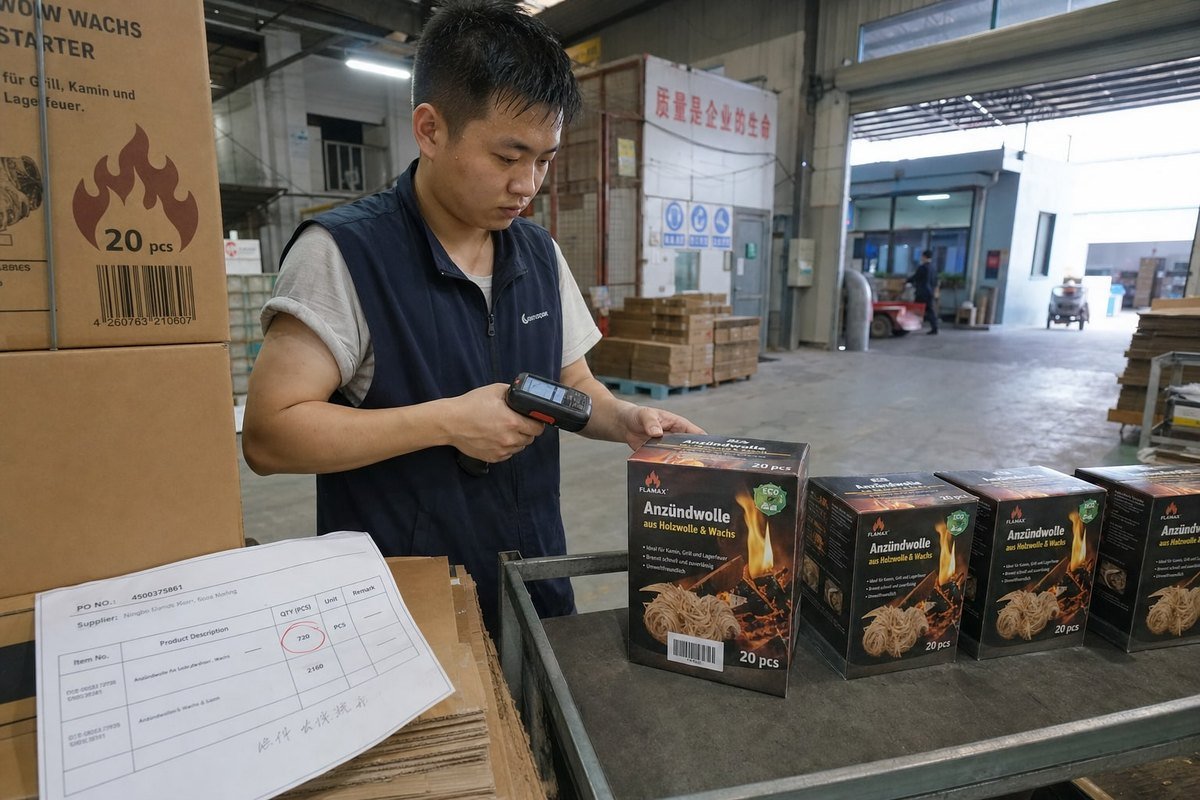
Design specs are not just visual specs. They include legal labeling, and the proof is where legal copy gets locked. If a required warning is missing or too small, the shipment can be rejected at the retailer's dock or blocked at customs. I have seen both happen to brands that treated the proof as a marketing document.
Warnings Are Market-Specific
Generic safety copy is a trap. A warning block written for the US will not automatically satisfy German or French requirements, and some retailers layer their own rules on top of national ones. When we prepare private-label packaging for buyers across the US, EU, and Middle East, we build a copy matrix per market before artwork starts. Your proof review should confirm:
- All mandatory hazard statements appear in the required language(s).
- Flammability and child/pet warnings are prominent and readable at retail distance.
- Usage instructions match the actual product — wax-dipped wood rolls light differently than gel or cube starters.
- Country-of-origin and importer details are present and correct.
- Batch/lot code and manufacture date have a clear, printable position — not buried in a dark graphic area.
Traceability and Barcode Checks
| Element | Proof Requirement | Why It Matters |
|---|---|---|
| Barcode | Correct GTIN, quiet zones clear, tested scan | Retailers reject unscannable cases |
| Batch code | High-contrast placement, legible size | Recalls and QC traceability |
| Warning text | Minimum readable point size | Regulatory and retailer audits |
| Origin statement | Matches customs documentation | Import clearance |
Ask for a scan test on the actual printed proof surface. Varnish, dark backgrounds, and fold seams all kill barcode scannability, and a barcode that scans on paper may fail on laminated board.
How Do I Avoid Costly Packaging Errors Before Mass Production Begins?
One drop test taught a client of ours more than three rounds of artwork revisions. Their beautiful carton crushed under stacking weight, and the wax rolls inside deformed.
Avoid costly packaging errors by requesting a preproduction sample with final artwork on final board, then running fit, scan, drop, stack, and shelf-opening tests. Require written sign-off from brand, compliance, procurement, and operations before releasing the job to press.

The last mile of proofing is physical. A composite proof — real artwork, real substrate, real finishing, real barcodes — is the only honest preview of mass production. At our factory, we insist on this step even when buyers are in a hurry, because a one-week sample delay is always cheaper than a container of rejected cartons.
Run These Physical Tests
First, the fit test. Load the sample carton with actual wax-dipped fire starters at the full pack count. Check for rattling, crushing, and wax rub against the interior print. Wax-coated products can scuff inks, so we sometimes recommend a moisture-resistant packaging liner or coated interior for humid shipping routes.
Second, the durability tests. Stack loaded cartons to simulate pallet weight and confirm the board grade holds without bowing. Wax-based fire starters can compress and even leak if the carton collapses, so a defined crush-resistance target belongs in your spec sheet. Then drop-test from handling height. Then run a scuff test on the warning panel — safety instructions must stay legible after transit friction.
Third, the retail test. If the carton doubles as shelf-ready packaging 7, open the tear strip the way a store clerk would. Does it tear clean? Does the display face stay intact? Retailers increasingly require the shipping case to function as display packaging, so this is now a standard checkpoint, not an extra.
Control the Sign-Off
Errors survive when nobody owns the final approval. Use a simple hierarchy: brand approves visuals, compliance approves copy, procurement approves specs and cost, operations approves structure and logistics. Archive the signed proof, the dieline version, and the color standard together. When we run repeat orders, that archived package is what guarantees batch two matches batch one — which is the whole point of a long-term supply partnership.
Conclusion
A rejected shipment hurts more than a delayed proof. Treat your wood fire starters packaging proof as a compliance and production contract: verify structure, color, warnings, and durability — then sign off with confidence.
Footnotes
1. Provides a definition and overview of wood wool as a sustainable packaging and cushioning material. ↩︎
2. Provides a definition and history of cartons as a primary form of retail packaging. ↩︎
3. Describes the standard subtractive color model used in color printing and the prepress process. ↩︎
4. Explains the technical calculation used to quantify color difference in the printing and packaging industry. ↩︎
5. Provides information on the standards for responsibly sourced wood and natural fiber materials used in packaging. ↩︎
6. Official GS1 global standards for barcode technical specifications and scannability requirements. ↩︎
7. Comprehensive overview of shelf-ready packaging standards and retail efficiency requirements. ↩︎



 English
  Spanish
  German
  French
  Arabic
  Portuguese
Join the Conversation