







Prop 65 requirements for colored pine cones confuse many importers clear and reasonable warning 1. I have watched buyers freeze entire California launches over one unanswered compliance question from our color-flame pinecone line.
Prop 65 requirements for colored pine cones depend on exposure, not category. You must identify every chemical in the dyes, coatings, and packaging, check it against the OEHHA chemical list, compare exposure to Safe Harbor Levels, then add a clear and reasonable warning only if thresholds are exceeded.
That sounds simple, but each step has traps. Below, I walk through the exact process we use with our US buyers, from supplier documentation to label placement.
What Prop 65 Testing and Documentation Should I Request From My Colored Pine Cone Manufacturer?
A few years back, a US distributor asked us for "Prop 65 papers" before a trial order. That vague request taught me buyers often don't know which documents actually protect them.
Request third-party laboratory testing for heavy metals and phthalates, SDS documentation for every colorant and coating, a full bill of materials, and batch-level test reports from labs like SGS or Intertek. These documents support either a no-warning determination or an accurate, chemical-specific warning.

The paperwork you collect before import is your first line of defense. In our experience exporting color-flame pinecones to the US for over a decade, buyers who arrive with a document checklist 2 close deals faster and sleep better. Buyers who rely on a supplier's verbal promise of "no harmful chemicals" carry all the risk themselves.
The Core Document Checklist
Here is what I recommend every California-bound importer request. This is the same package we prepare for our own retail-channel clients.
| Document | What It Proves | Who Provides It |
|---|---|---|
| Full bill of materials | Every input: cone, colorant, coating, adhesive, packaging | Manufacturer |
| SDS documentation | Chemical composition and hazards of each formulation | Chemical supplier via manufacturer |
| Heavy metal testing report | Lead and cadmium content, plus chromium, arsenic, mercury | Third-party lab (SGS, Intertek) |
| Phthalate test report | DEHP, DBP, and related plasticizers in coatings or scents | Third-party lab |
| Exposure assessment (if available) | Whether real-world use exceeds Safe Harbor Levels | Toxicology consultant |
Why Batch-Level Testing Matters
One test report from three years ago is not enough. Pigment suppliers change. Contamination levels drift. At our factory in Ningbo, we run batch-to-batch quality control 3 precisely because a single clean sample does not guarantee the container that follows. Ask your manufacturer how often they retest and whether test reports tie to specific production lots.
Also ask who holds the knowledge burden. Under the California Health and Safety Code 4 framework, manufacturers are expected to know whether their products need warnings. A factory that cannot explain its own formulations is a red flag, no matter how attractive the unit price looks.
Which Chemicals in Color-Flame Pine Cones Actually Trigger a Prop 65 Warning Label?
When we developed our own color-flame pinecone formulation, we rejected two pigment suppliers before finding one whose inputs stayed cleanly below the thresholds our SGS reports needed to show.
The most likely triggers are lead and cadmium in synthetic dyes and metallic coatings, phthalates such as DEHP in fragrance fixatives, and residual arsenic or mercury in mica-based glitters. A warning is required only when consumer exposure exceeds the relevant Safe Harbor Level.

Let me be direct: colored pine cones are not a Prop 65 category by themselves. The raw cone is a natural botanical item. The risk lives in what gets added to it. That is why I tell buyers to think of this product as an ingredient-tracing exercise, not a yes-or-no labeling question.
The Main Chemical Suspects
| Chemical Group | Where It Hides | Prop 65 Concern |
|---|---|---|
| Lead and cadmium | Synthetic dyes, metallic gold or silver accents, glitter | Listed carcinogens and reproductive toxicants; low Safe Harbor Levels |
| Phthalates (DEHP, DBP) | Fragrance fixatives on scented cones, flexible coatings | Reproductive harm listings |
| Chromium compounds | Certain green and yellow pigments | Hexavalent chromium is listed |
| Arsenic and mercury | Mineral impurities in mica or natural pigments | Listed even in "eco-friendly" glitter sources |
| Formaldehyde and brominated compounds | Fire retardants or anti-fungal treatments on raw cones | Listed chemicals from processing, not the cone itself |
Presence Versus Exposure
Here is the distinction that saves importers from over-warning. The OEHHA chemical list contains more than 900 substances, but a warning is only mandatory if daily exposure exceeds the No Significant Risk Level 5 for carcinogens or the Maximum Allowable Dose Level for reproductive toxicants. A trace of lead sealed under a lacquered finish may produce no meaningful exposure during normal handling. That is why a proper exposure assessment matters more than a raw detection result.
One more pathway deserves mention. Pine cones shed particles when handled or broken. Some sellers use the wood dust safe harbor warning 6 as a secondary protection. For a decorative or fire-starting cone, I consider this a judgment call, but it shows how exposure thinking works: you evaluate what actually reaches the consumer, not just what the product contains.
For color-flame products specifically, the flame colorant chemistry matters too. Our Magic Fire formulations use copper and other metal salts chosen to avoid listed chemicals entirely, which is why our test reports come back clean. Not every factory makes that choice.
How Do I Word and Place a Compliant Prop 65 Warning on My Packaging and Displays?
Our packaging team prints private-label warning labels for US clients weekly, and the 2025 short-form changes forced us to redesign several kraft-pouch layouts mid-year.
Use the OEHHA safe-harbor wording with the yellow triangle symbol, and under the 2025 rules, any short-form warning must name at least one specific chemical. Print it in at least 6-point type where consumers see it before purchase, including on e-commerce product pages.
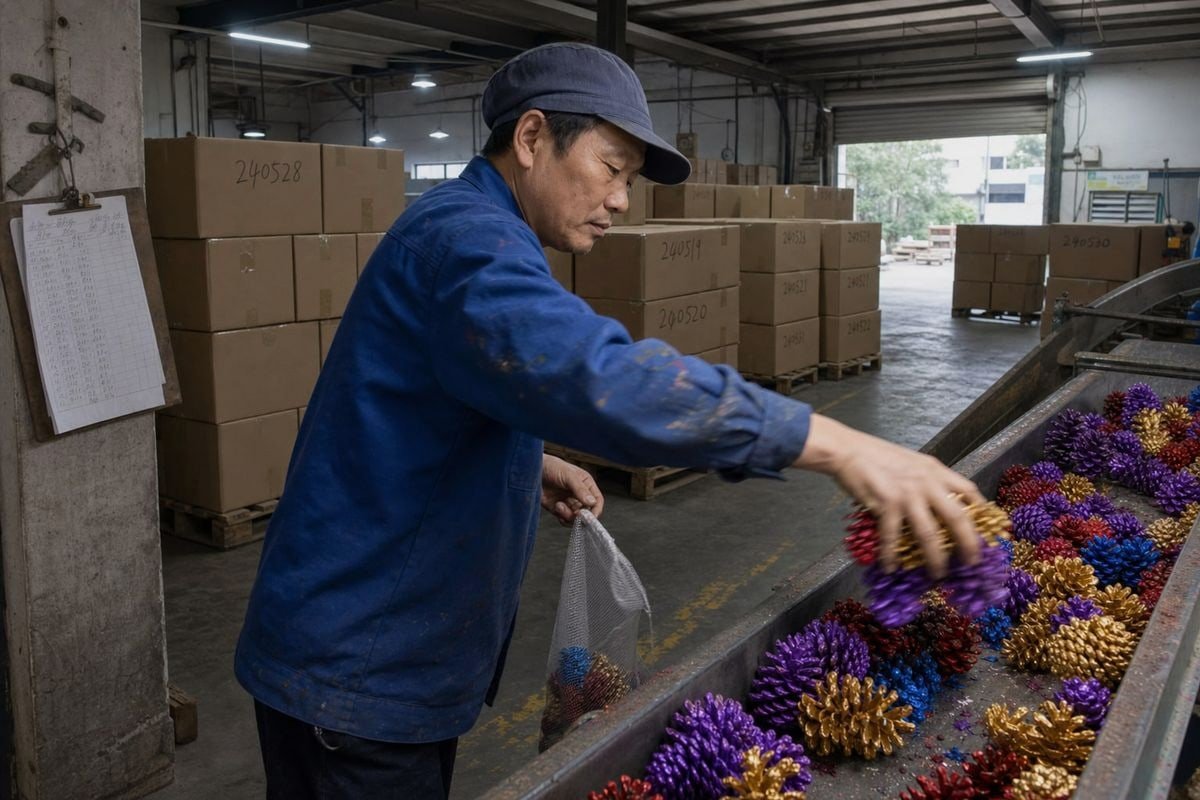
Wording and placement are where technically compliant businesses 7 still get caught. A clear and reasonable warning must reach the consumer before exposure, which in practice means before purchase. Burying it under a fold or inside the pouch does not count.
Choosing Your Warning Format
You have two main safe-harbor options for consumer products:
- Full warning. The yellow triangle, the word WARNING in bold capitals, the named chemical, the harm category (cancer, reproductive harm, or both), and the www.P65Warnings.ca.gov URL.
- Short-form warning. Shorter text, but under the 2025 amendments it must now identify at least one specific chemical and include the triangular symbol. The old generic short-form no longer qualifies.
This change matters for pine cone sellers. You can no longer print a vague catch-all warning. You must know which chemical you are warning about, which loops back to why testing comes first.
Placement by Sales Channel
| Sales Channel | Where the Warning Must Appear |
|---|---|
| Retail packaging | On the label, legible, at least 6-point type for short-form |
| Online store | On the product display page, via a clearly marked hyperlink, or a pop-up before checkout for California buyers |
| In-store display bins | Point-of-sale signage if cones sell loose or unpackaged |
| Catalog sales | Adjacent to the product listing |
The Over-Warning Trade-Off
Some compliance consultants push "warn on everything" as cheap insurance. I understand the instinct, because a 60-day notice of violation from a private enforcer is expensive to fight even when you win. But over-warning has costs too. It implies a hazard that may not exist, triggers consumer fatigue, and can hurt a premium natural-product brand. Our position, shaped by helping clients enter Home Depot-type retail channels, is that targeted compliance backed by test reports beats defensive labeling. When our documentation shows a product sits below Safe Harbor Levels, our clients ship without a warning and hold the evidence to prove that decision was sound.
Can a Certified Manufacturer Help Me Avoid Prop 65 Lawsuits Before I Import Into California?
A German distributor once told me he chose us over a cheaper quote purely because our SGS and Intertek reports arrived before he even asked. That habit came from hard lessons in the US market.
Yes. A certified manufacturer prevents Prop 65 problems at the source by formulating without listed chemicals, providing third-party laboratory testing and SDS documentation, printing compliant warning labels when needed, and maintaining batch consistency so your first tested sample matches every container that follows.

Prop 65 enforcement usually starts with a 60-day notice of violation filed by a private plaintiff. Settlements commonly run into five or six figures once legal fees stack up. The retailer or importer named in the notice bears the immediate pain, even if the root cause was a factory's pigment change nobody disclosed. This is why upstream partner selection is your real Prop 65 strategy.
What Factory Certification Actually Buys You
Certifications are not wall decorations. Here is how each one maps to your California risk:
- ISO 9001 means documented process control, so the formulation tested in month one is the formulation shipped in month twelve.
- SGS and Intertek test reports give you defensible evidence of lead and cadmium content and phthalate levels, the exact data an exposure assessment needs.
- BSCI signals audited, traceable operations, which matters when a plaintiff's lawyer starts asking where your inputs came from.
- CE shows the factory already operates inside a strict regulatory framework for the European market, which usually correlates with cleaner US documentation.
At our Liuyang headquarters, compliance is a hard requirement from our buyers, not a marketing add-on. Our color-flame pinecones are built from eco-friendly materials with no harmful chemicals by design, because reformulating after a violation notice costs far more than formulating correctly from day one.
Questions to Ask Before You Sign a PO
- Can you share current heavy metal testing reports tied to recent production lots?
- Will you disclose the full bill of materials, including colorants and fragrance carriers?
- Do you offer private-label packaging with pre-printed, 2025-compliant warning labels if my exposure assessment requires one?
- What happens if a pigment supplier changes mid-contract?
A factory that answers these quickly, in clear English, with documents attached, is protecting your California business. One that stalls is transferring its risk onto you. And note one practical wrinkle: even if you fall under the 10-employee threshold, major retail platforms often demand Prop 65 documentation anyway, so de facto compliance applies to almost everyone selling at scale.
Conclusion
Prop 65 compliance for colored pine cones comes down to tracing ingredients, testing against Safe Harbor Levels, warning only when required, and partnering with a certified factory that documents everything.
Footnotes
1. Official California government website for Proposition 65 warning regulations. ↩︎
2. Importance of maintaining technical documentation for regulatory compliance and risk mitigation. ↩︎
3. Standard industrial practices for maint



 English
  Spanish
  German
  French
  Arabic
  Portuguese
Join the Conversation