







Magic Fire Powder shipments get flagged, delayed, or rejected over Prop 65 questions more often than buyers expect dioxins 1. I have watched importers lose entire retail programs over one missing label detail on our production line's export paperwork.
Magic Fire Powder needs a California Prop 65 warning label only if it exposes users to a listed chemical above safe harbor levels. Products made with clean, tested fire colorant ingredients and verified by SDS documentation and lab reports typically do not require the warning.
The answer depends on ingredients, not the product name. Let me walk you through how to check your shipment, what triggers warnings, and how to get compliant labels done right.
How do I know if my Magic Fire Powder shipment falls under California's Prop 65 requirements?
A buyer from Texas once asked me this exact question before placing his first trial order with our Ningbo facility. His retailer demanded a written compliance position before listing.
Your shipment falls under Prop 65 if the powder contains, or creates during burning, any chemical on the OEHHA chemical list at exposure levels above safe harbor thresholds. Review the Safety Data Sheet, check combustion byproducts, and compare exposures against OEHHA limits to decide.
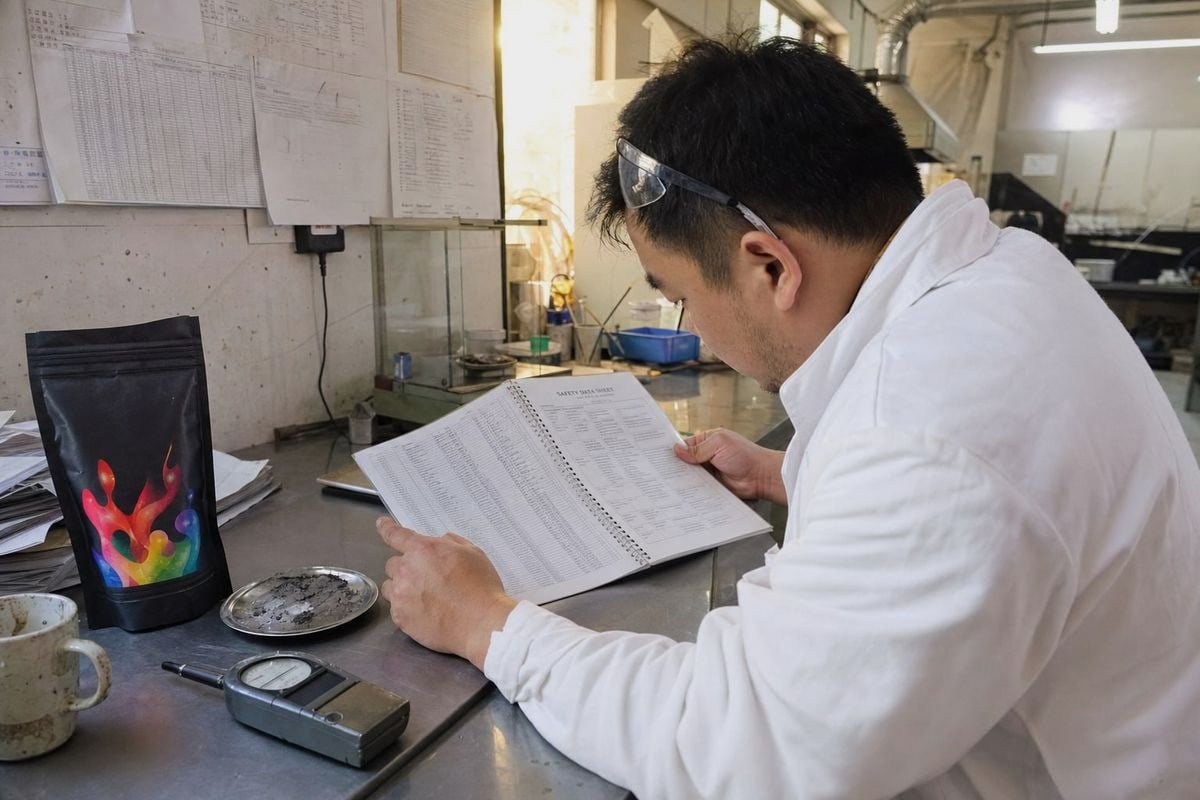
Prop 65 is exposure-based law under the California health and safety code. It does not target product categories or marketing names. A product called "Magic Fire" is not automatically suspect. A product called "Natural Campfire Colorant" is not automatically safe. What matters is chemistry and real-world exposure.
Here is the practical workflow I recommend to every importer we work with:
The four-step compliance check
- Identify every chemical in the formulation. Get the full Safety Data Sheet 2 from your supplier, not just a marketing spec sheet.
- Cross-reference the OEHHA chemical list. The list covers roughly 900 substances known to California as carcinogens and reproductive toxins.
- Consider combustion. Fire products can create toxic combustion byproducts that were never in the raw powder. Your analysis must cover use, not just the sealed pouch.
- Compare exposure to safe harbor levels. If likely exposure sits below the No Significant Risk Level or Maximum Allowable Dose Level, no warning is required.
Who carries the responsibility?
| Role in the chain | Prop 65 responsibility |
|---|---|
| Manufacturer (like us) | Provide formulation data, SDS, and test reports |
| Importer / brand owner | Decide warning strategy; ensure labels are compliant |
| Distributor | Pass warning materials downstream |
| Retailer | Display warnings if notified; liability can shift with knowledge |
One nuance many buyers miss: businesses with fewer than 10 employees are exempt from the warning requirement. But that exemption rarely helps in practice, because large retailers mandate labels contractually regardless of your headcount. In our experience exporting to the US for over 17 years, the retailer's compliance desk is often stricter than the law itself.
What ingredients in color-flame powder typically trigger a Prop 65 warning?
The trade-off I weigh every time we develop a new colorant blend is simple: brighter, cheaper color chemistry versus clean chemistry that passes SGS testing without a warning label.
Common triggers include heavy metal impurities such as lead, arsenic, and cadmium in industrial-grade metal salts, PVC-based chlorine donors that can form dioxins during combustion, and toxic combustion byproducts like carbon monoxide and soot. Purified, tested colorant salts avoid most of these triggers.
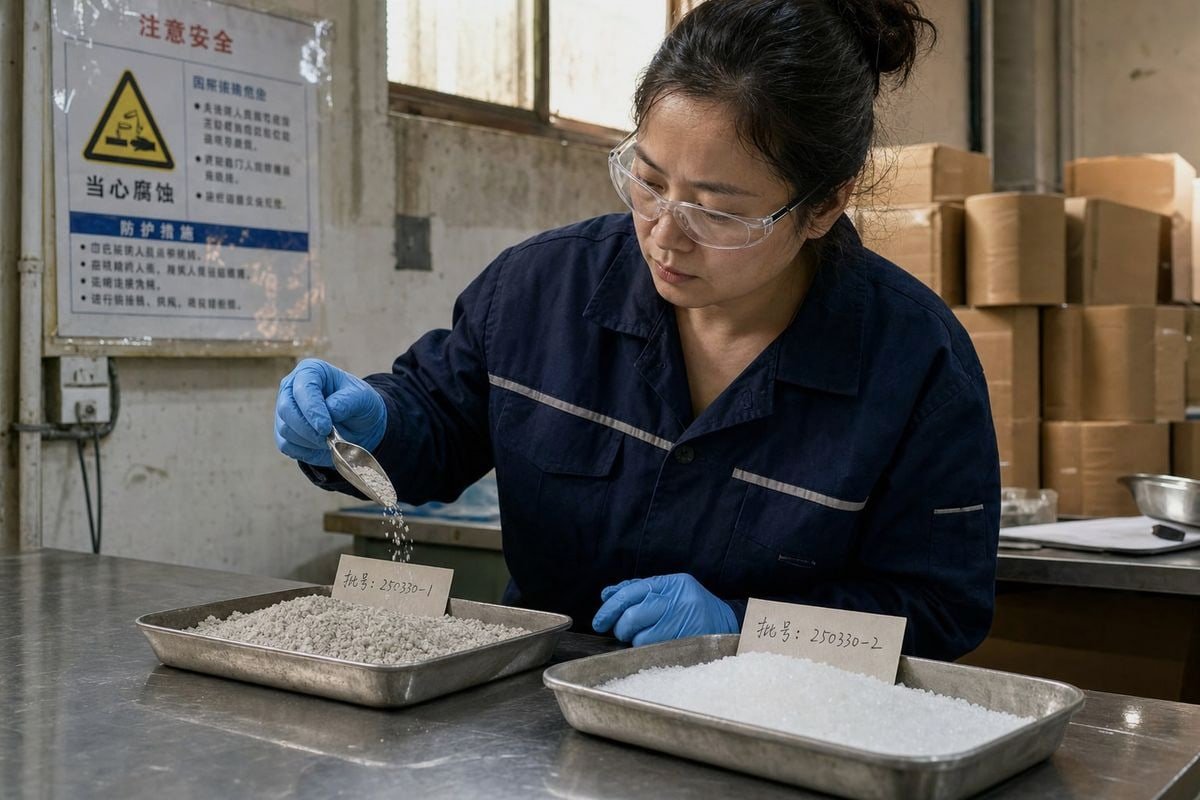
Color-flame chemistry is old science. Metal salts produce specific flame colors when heated. Copper compounds give green and blue. Strontium gives red. Potassium gives violet. The colors themselves are not the problem. The problem is what rides along with cheap raw materials, and what forms in the fire.
The three main risk categories
| Risk category | Example | Why it matters under Prop 65 |
|---|---|---|
| Heavy metal 3 impurities | Lead, arsenic, cadmium traces in industrial copper sulfate | Listed carcinogens and reproductive toxins; trigger warnings even at minute concentrations |
| Chlorine-donor binders | PVC used as fuel or binder | Vinyl chloride 4 is listed; copper plus chlorine-rich PVC can catalyze dioxin formation during low-temperature burning |
| Combustion byproducts | Carbon monoxide 5, soot | Both are explicitly listed; produced by any fire, but relevant to exposure analysis |
Impurity grade is the real battlefield
Here is what most ranking articles gloss over: the listed chemical is often not the colorant itself. Technical-grade copper sulfate can carry trace lead or arsenic from the mining and refining process. A supplier using the cheapest available salts may fail a heavy metal exposure screen even though the label lists only "copper compounds." At our factory in Liuyang and our production site in Ningbo, we source purified-grade salts specifically because trace contamination is what fails third-party tests, not the base chemistry.
There is also an inhalation angle. Fine crystalline powder can qualify as airborne particles of respirable size before it ever reaches the fire. That is why granule size and sealed single-use pouches matter — they reduce inhalation hazards during handling. And once the packet burns, dioxin and furan synthesis becomes possible only if chlorinated plastics are in the mix. Formulations that avoid PVC binders close that pathway almost entirely.
Ash disposal deserves a mention too. Heavy metal residue in campfire ash raises a separate Prop 65 discharge concern near drinking water sources. Clean formulations sidestep this liability as well.
Can my supplier provide test reports or documentation to confirm compliance before I import?
A German distributor once told me he had walked away from three suppliers in a row because none could produce a current test report — only a scanned certificate from years earlier. That conversation shaped how we handle documentation requests today.
Yes, a legitimate factory should provide a current Safety Data Sheet, third-party test reports from labs like SGS or Intertek covering heavy metals and restricted substances, and a full ingredient disclosure. If a supplier cannot produce these before you order, treat it as a red flag.

Documentation is where real factories separate from trading companies. A trading company forwards whatever paperwork its rotating suppliers happen to have. A factory controls its own formulation and can test the exact batch you will receive. That difference decides whether your Prop 65 position survives scrutiny.
The document package to request
| Document | What it should show | Why you need it |
|---|---|---|
| Safety Data Sheet | Full chemical composition, hazard classification, handling guidance | First screen against the OEHHA chemical list 6 |
| Third-party test report | Heavy metal screening (lead, cadmium, arsenic, mercury) with detection limits | Proof that impurities sit below actionable levels |
| Ingredient disclosure letter | Confirmation of no PVC, no listed chemicals intentionally added | Supports a no-warning-required position |
| Factory certifications | ISO 9001 7, BSCI audit results | Evidence of batch-to-batch consistency |
Why batch consistency matters as much as the report
A test report only proves the tested batch was clean. If your supplier swaps raw material sources between orders to chase lower prices, report number two may not match report number one. This is why we run strict batch-to-batch quality control on our production lines — the sample you approve must chemically match the container you receive six months later. Ask your supplier directly how they lock raw material specifications between orders. A vague answer tells you everything.
One more practical point on safe harbor levels: proving exposure is below threshold can require expensive exposure modeling, because quantifying how much chemical a person absorbs at a campfire is genuinely hard. Clean formulation documentation is the cheaper, stronger path. It lets you argue there is no listed chemical to measure in the first place, rather than arguing the dose is small enough.
How do I get correctly formatted warning labels added to my private-label packaging?
Packaging artwork is where I see the most last-minute panic. Our design team has rebuilt label files for buyers whose original artwork left no room for the warning triangle at all.
Provide your OEM manufacturer with the required warning text and symbol specifications, and have them print it directly on the pouch, jar, or box during production. The warning needs the yellow triangle symbol, the signal word WARNING, at least 6-point type, and at least one chemical name if using the short-form version.

The 2018 regulation update made warnings far more specific than the old generic labels. If you are reusing artwork from an older product line, assume it is outdated and rebuild it.
Formatting rules that trip buyers up
- Symbol: a black exclamation point inside a yellow triangle with a bold black outline, placed to the left of the text. On packaging printed without yellow ink, a black-and-white symbol is permitted.
- Signal word: "WARNING" in bold capitals. "CA WARNING" or "CALIFORNIA WARNING" are also acceptable.
- Type size: no smaller than 6-point, and no smaller than the largest type used for other consumer information on the label.
- Short-form warnings: allowed on the product label or immediate container, but current rules require naming at least one chemical for the applicable endpoint.
- Placement: the warning must be conspicuous and likely to be seen and read before exposure — not hidden under a fold or on an inner sachet only.
Placement options across your sales channels
The warning does not have to live only on the pouch. Depending on how you sell, it can appear on the immediate container, the outer display box, accompanying documents, shelf signage, or online product pages before checkout. For a product like a foil sachet inside a flip-top display box, we typically print the warning on both layers, because retailers sometimes break boxes apart and sell sachets individually.
A word on the overwarning tension. Some brands slap a Prop 65 warning on everything as an abundance-of-caution shield against bounty-hunter lawsuits. I understand the fear, but I push back on it with our buyers. An unnecessary warning on a family campfire product suppresses conversion and invites retailer questions. The better route — the one we build into our one-stop OEM service alongside barcodes and display packaging — is clean chemistry, current test reports, and a defensible no-warning position, with a correctly formatted label used only where the analysis genuinely calls for one.
Conclusion
Magic Fire Powder may or may not need a Prop 65 label — chemistry decides. Verify the SDS, demand third-party test reports, and print compliant warnings only where exposure truly requires them.
Footnotes
1. Wikipedia background on dioxins clarifies why PVC combustion is a Prop 65 concern. ↩︎
2. Background explanation of SDS documents referenced throughout compliance workflow. ↩︎



 English
  Spanish
  German
  French
  Arabic
  Portuguese
Join the Conversation