







Smoke from magic fire powder worries many buyers who contact our factory restricted heavy metals 1. One bad batch of toxic fumes can trigger recalls, returns, and damaged brands. After 17 years producing color-flame packets, we know how to prevent that.
Yes, some smoke from magic fire powder is normal because chemical combustion byproducts always form when colorant salts burn. However, smoke from poorly formulated powders containing copper sulfate or heavy metals can irritate the respiratory tract, so ventilation, safe formulas, and clear warning labels matter.
Let me break this down properly. I will explain why the smoke appears, which certifications protect you as an importer, how to audit a formula, and what your labels should say.
What Causes the Smoke When I Use Magic Fire Color-Flame Powder?
A buyer from Germany once burned three competitor samples next to ours in our test fire pit CE marking 2. Two produced thick gray plumes; ours stayed nearly clean. The difference was pure chemistry, and I explained it to him on the spot.
Smoke from color-flame powder comes from combustion byproducts: metallic salt residues, incomplete burning of carrier materials, and particulate matter released as the packet decomposes. Well-designed eco-friendly formulas burn cleaner, while cheap powders with harsh chemicals create heavier, more irritating smoke.
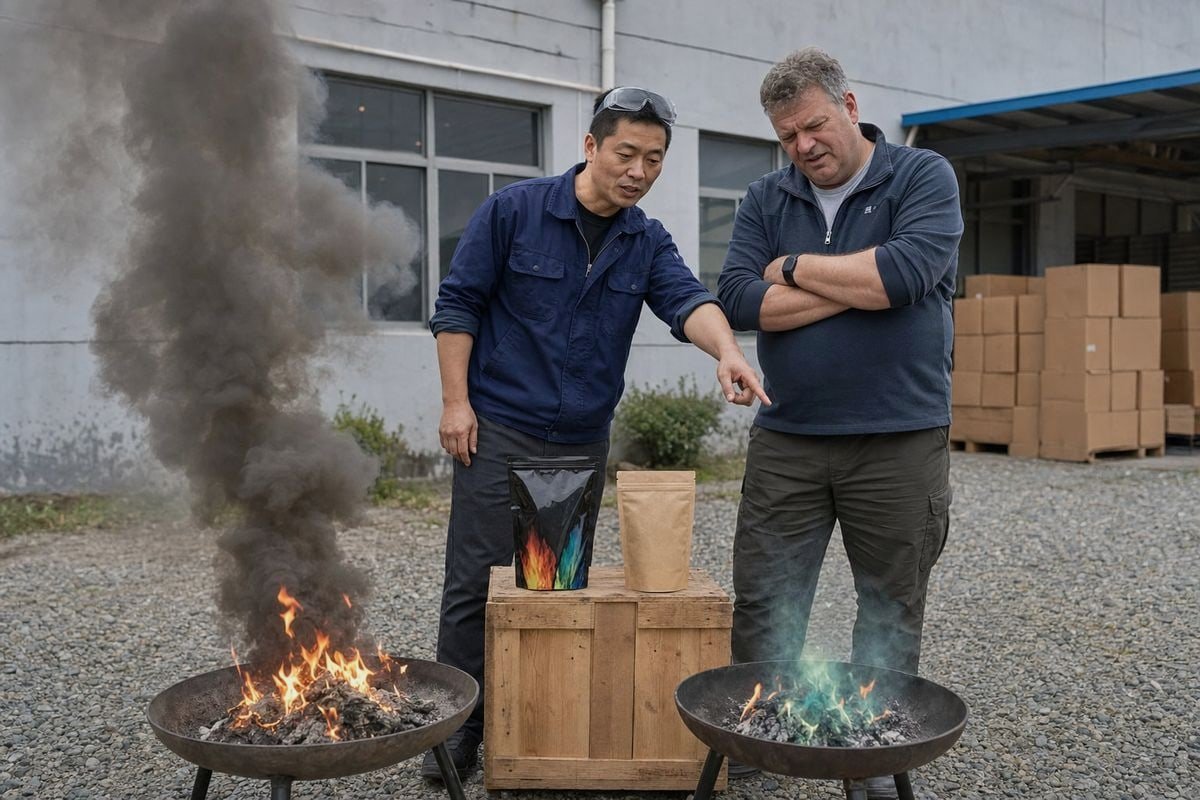
The colored flames themselves are not magic. They come from metal salts that emit specific light wavelengths when heated. Copper compounds give blue and green. Potassium gives purple. The visual effect is the goal, but the smoke is a side effect of how those salts and the surrounding materials burn.
Three Sources of Smoke
In my experience running burn tests on our Ningbo production line, the smoke you see comes from three places. First, the sachet material itself. A film that is not designed to burn cleanly will smolder and release visible smoke. Second, incomplete combustion of the powder. If the fire is too cool or too small, the colorant salts do not fully react, and unburned particulate matter 3 escapes as smoke. Third, thermal decomposition products. Some chemicals break down into gases before they burn, and certain decomposition gases are known irritants.
Why Combustion Conditions Matter
The same powder can behave very differently depending on the fire. A hot, well-ventilated campfire consumes the packet quickly and cleanly. A weak indoor fire with poor fireplace ventilation lets smoke linger and concentrate. This is why we always test our color-flame packets in multiple fire conditions before a batch ships.
| Smoke Source | What You See | Irritation Risk |
|---|---|---|
| Sachet film burning | Brief gray puff at ignition | Low with clean-burn films |
| Incomplete powder combustion | Lingering haze, dull colors | Moderate; more particulates |
| Chemical decomposition gases | Often invisible, sharp smell | Highest; can inflame airways |
| Wet or treated firewood | Thick white or brown smoke | High, but not the powder's fault |
One more point I stress with buyers: the base fire matters too. Burning colorant packets on pressure-treated or painted wood adds volatile organic compounds 4 on top of everything else. No powder formula can compensate for a toxic fuel source underneath it.
Which Safety Certifications Should I Require Before Importing Color-Flame Products?
Compliance questions come up in nearly every first call we take from US and European purchasing managers. Certifications are not paperwork to us — they are the gate that decides whether your shipment clears customs and survives retailer audits.
Importers should require ISO 9001 for quality management, BSCI for factory ethics, CE marking for the EU market, and third-party lab reports from SGS or Intertek confirming the formula is free from restricted heavy metals. Ask for current, verifiable certificates before placing any order.

I have seen buyers lose entire seasonal orders because a supplier's "certificate" turned out to be expired or borrowed from another factory. Fire-effect products sit in a sensitive category. Customs officers, retail compliance teams, and insurers all look closely at them. Your documentation must be airtight.
The Core Certification Stack
Here is the checklist we hand to new B2B clients:
| Certification | What It Proves | Why It Matters for You |
|---|---|---|
| ISO 9001 5 | Consistent quality management system | Batch-to-batch consistency; sample matches mass production |
| BSCI | Ethical factory and labor conditions | Required by many large retail sourcing channels |
| CE | EU safety conformity | Legal requirement for sale in most European markets |
| SGS / Intertek reports | Independent chemical and safety testing | Verifies no restricted heavy metal exposure risks |
How to Verify a Certificate Is Real
Do not just accept a PDF. Check the certificate number directly with the issuing body. SGS and Intertek both allow report verification. Confirm the certificate names the actual factory address, not a trading company office. When buyers visit our Liuyang headquarters or Ningbo production site, we show original documents and live production. A supplier who hesitates at that request is telling you something important.
Also ask for a current Material Safety Data Sheet 6 for each product variant. The SDS reveals the real hazard profile: dust warnings, ventilation requirements, and decomposition gas notes. If a supplier cannot produce an SDS quickly, the formula was probably never professionally assessed.
How Can I Verify a Manufacturer's Formula Is Free From Harmful Chemicals?
Early in our export history, a Canadian distributor asked us to prove — not promise — that our packets contained no restricted substances. That request shaped how we document formulas today, and I recommend every buyer take the same hard line.
Request the full Material Safety Data Sheet, an ingredient disclosure under NDA, and independent lab screening for heavy metals like lead, arsenic, and chromium. Then commission your own burn test measuring smoke composition. Never rely on a supplier's verbal claim of eco-friendly ingredients.

Trust, then verify. That is my honest advice even though we are the manufacturer in this relationship. A safe formula is verifiable; an unsafe one hides behind vague marketing words like "natural" and "harmless."
A Practical Verification Process
- Read the SDS line by line. Look for phrases like "do not breathe dust," "thermal decomposition releases irritating gases," or ventilation requirements. These phrases are not deal-breakers by themselves, but they tell you the true handling profile.
- Screen for restricted substances. Some cheap campfire colorants historically used copper sulfate in crude forms, and copper sulfate inhalation risks 7 are well documented. Ask specifically which copper compound is used and at what concentration.
- Ask about heavy metals. Lead, arsenic, cadmium, and chromium compounds can produce vivid colors cheaply. They also create serious heavy metal exposure risks through smoke and residual ash. A responsible supplier screens raw materials for these at intake.
- Commission an independent burn test. Send retail-ready samples — not hand-picked lab samples — to a third-party lab. Have them analyze smoke particulates and post-fire ash.
- Check batch consistency. Request raw-material traceability records. At our factory, every batch of colorant salt is logged and tested before it enters production, because respiratory tract inflammation complaints almost always trace back to raw-material drift, not the original recipe.
Red Flags Worth Walking Away From
Be cautious if a supplier refuses ingredient disclosure even under NDA, cannot name their raw-material sources, or shows you an SDS that does not match the product name and packaging. Toxic fumes are invisible on a spec sheet; only disciplined documentation and testing expose the risk before your customers do.
What Warning Labels and Usage Instructions Should I Include for My Market?
Label design is where we spend surprising amounts of time with private-label clients. Our OEM team has produced warning panels in English, German, French, Dutch, and Polish, and each market has its own expectations and legal wording.
Labels should warn users not to inhale smoke or dust, never cook food or roast marshmallows over colored flames, use only outdoors or in well-ventilated fireplaces, keep away from children, and dispose of ash safely. Include first-aid guidance and market-specific hazard symbols.

Good labeling protects three parties at once: the end user, your brand, and your liability position. I have watched buyers treat labels as an afterthought, then scramble when a retailer's compliance team rejects the artwork two weeks before shipment.
The Non-Negotiable Warnings
Certain warnings should appear on every color-flame product regardless of market. Cooking over colored flames is the biggest one. Colorant salts can deposit particulates onto food, so the label must clearly prohibit grilling, s'mores, and any food preparation over a treated fire. Inhalation is second: instruct users to stand back, avoid breathing smoke directly, and ensure good airflow or proper fireplace ventilation indoors. Third, child safety. Bright sachets and pastel granules can resemble candy or drink mixes, so accidental ingestion warnings and "keep out of reach of children" text are essential.
Market-Specific Requirements
| Market | Key Label Requirements | Notes From Our Export Experience |
|---|---|---|
| United States | English warnings, clear hazard statements, first-aid text | Large retailers often demand extra pictograms and barcodes |
| EU (Germany, France, NL) | CLP-aligned hazard symbols, local-language text | Multi-language panels are standard; CE reference expected |
| UK | UKCA considerations, English warnings | Post-Brexit rules differ slightly from EU artwork |
| Australia / Canada | Bilingual (Canada) or local standards | Canada requires English and French warning text |
Instructions That Reduce Complaints
Beyond warnings, clear usage steps cut support tickets. Tell users to place the unopened sachet on an established fire, never to open the packet, and never to add powder by hand. Advise disposing of cooled ash in household waste rather than garden soil, since concentrated colorant residues should not leach into the ground. We print these steps as numbered icons on our retail boxes because pictograms survive translation better than paragraphs.
Conclusion
Some smoke is normal; irritating smoke is not inevitable. Demand verified certifications, audited formulas, and proper labels — and partner with a factory that treats safety as the product itself.
Footnotes
1. EPA authoritative source on heavy metal exposure risks referenced in formula verification ↩︎
2. Wikipedia explains the EU conformity marking required for European market imports ↩︎
3. Wikipedia background on particulate matter released during combustion of colorant powders ↩︎
4. EPA resource on VOCs mentioned as risk from burning treated wood under colorant packets ↩︎
5. Official ISO page for the quality management certification importers are told to require ↩︎
6. Wikipedia background on SDS documents used throughout formula safety verification process ↩︎
7. PubMed is authoritative source for documented health risks of copper sulfate inhalation ↩︎
 English
  Spanish
  German
  French
  Arabic
  Portuguese
Join the Conversation