







Shipping wood fire starters looks simple until the freight quote arrives. On our production line in Ningbo, I have watched buyers underestimate the true landed cost — and lose their margin before the goods even sailed.
To calculate cost and delivery time for shipping wood fire starters, add product cost, packaging, freight, duties, and fees to get landed cost, then combine supplier processing time with carrier transit time and customs clearance to get total delivery time.
That formula sounds easy. The hard part is filling in each number correctly. Below, I walk through the exact process our export team uses with buyers in the US and Europe.
How do I get an accurate cost breakdown for shipping wood fire starters in bulk?
A German distributor once asked me why two quotes for the same 100-piece fire starter box differed by 22%. The answer was hidden in the freight line, not the product line. Our team sees this constantly.
Get an accurate breakdown by itemizing seven costs: unit product price, export packaging, inland haulage, ocean or air freight, customs duties and taxes, destination handling, and last-mile delivery. Then divide the total by unit count to reveal your true landed cost per starter.

The biggest mistake I see is comparing suppliers on FOB price alone. Wood fire starters are bulky relative to their value. Our wax-dipped wood rolls are light, but a master carton still takes real container space. That means volume, not just weight, drives your freight bill.
The landed cost formula, step by step
Here is the sequence we walk buyers through during quoting:
- Confirm the unit price at your quantity tier (EXW or FOB).
- Add packaging costs — retail boxes, display packaging, barcodes, warning labels.
- Add freight from factory to port, then port to port.
- Add insurance, typically a small percentage of cargo value.
- Add import duties and taxes for your HS code and country.
- Add destination port fees, customs brokerage, and inland trucking.
- Divide by total units.
A worked example
The numbers below are illustrative, but the structure mirrors real quotations we prepare for US buyers.
| Cost Item | Example Amount (per 1,000 boxes) | Share of Landed Cost |
|---|---|---|
| Product cost (FOB) | $2,800 | ~58% |
| Export cartons and pallets | $180 | ~4% |
| Ocean freight (LCL) | $950 | ~20% |
| Duties and import taxes | $420 | ~9% |
| Destination handling and brokerage | $260 | ~5% |
| Inland trucking to warehouse | $200 | ~4% |
| Total landed cost | $4,810 | 100% |
Notice that non-product costs make up over 40% of the total here. A supplier quoting $0.10 less per unit but shipping in oversized, half-empty cartons can easily cost you more overall. Also remember dimensional weight 1: for air shipments, carriers charge on length × width × height divided by a divisor, so loose packing inflates your bill. This is why we standardize carton sizes and pack density during OEM projects — freight efficiency is engineered at the packaging stage, not negotiated afterward.
What factors affect delivery time when importing wood fire starters from China?
Every October, our Liuyang office fields the same urgent emails: buyers who ordered too late for the winter season. After 17 years of exporting to 30+ countries, I can map the delays before they happen.
Delivery time is driven by five factors: production lead time, booking and port congestion, ocean or air transit time, customs clearance speed, and final inland delivery. For a typical China-to-US ocean shipment, expect 35–60 days door to door, including production.
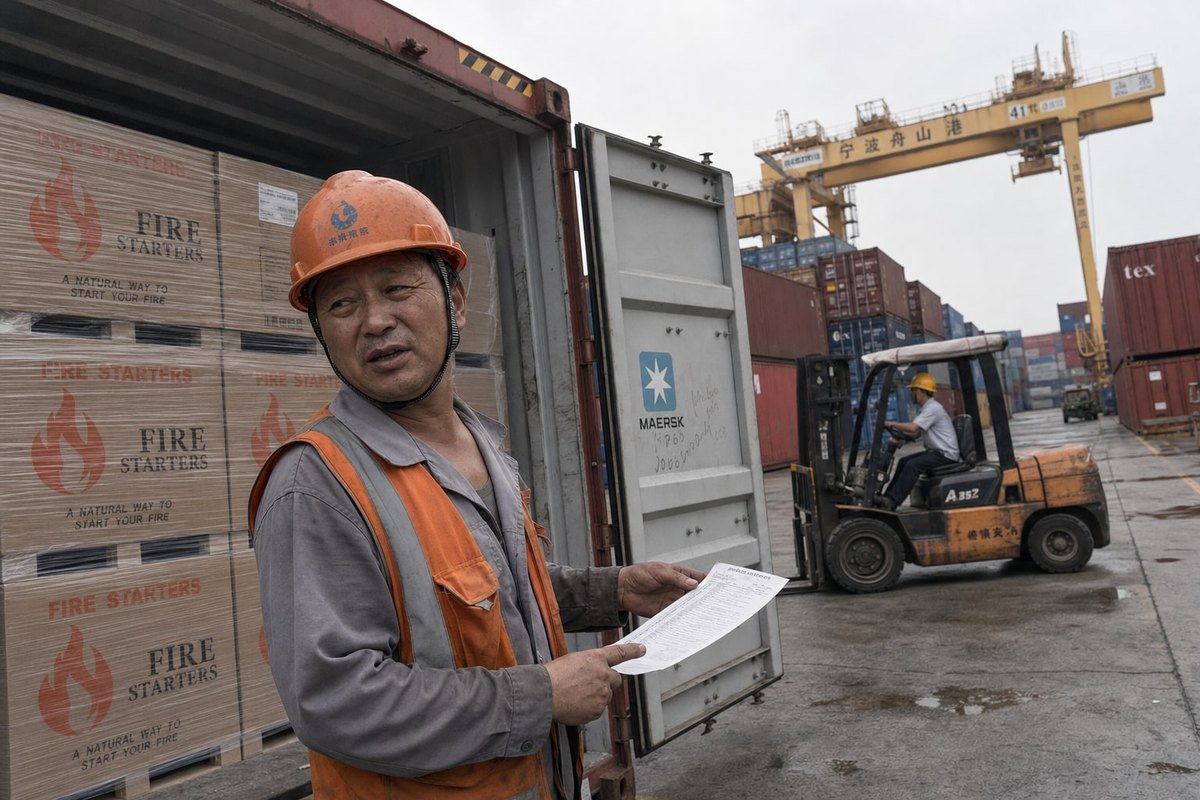
Total delivery time is a chain, and the slowest link sets your schedule. Let me break the chain into its parts, because each one behaves differently.
Production and order lead time
For standard wax-dipped wood rolls, our order lead time runs roughly 15–25 days depending on quantity and customization. Private-label packaging adds time for artwork approval and printing. If you need CE marking 2, SGS or Intertek test reports for a new market, build in review time before production even starts. First-time OEM orders always take longer than repeats.
Transit time by shipping method
| Route and Method | Typical Transit Time | Best For |
|---|---|---|
| Ocean FCL, China to US West Coast | 15–20 days | Full container seasonal stock |
| Ocean LCL, China to US East Coast | 30–40 days | Mid-size trial and repeat orders |
| Ocean, China to EU (Rotterdam/Hamburg) | 30–40 days | European distributors |
| Air freight | 5–10 days | Urgent top-ups, samples |
| Rail, China to EU | 18–25 days | Balanced cost and speed |
Most forwarders publish transit time maps by lane, but treat them as best-case estimates. Port congestion, vessel rolling, and peak-season backlogs stretch them.
Customs and compliance delays
Wood products draw extra scrutiny. Fire starters made from processed wood fiber and paraffin generally avoid the phytosanitary issues 3 raw timber faces, but customs still checks classification and documentation. Incomplete test reports or wrong HS codes 4 are the most common causes of clearance delays we see. Because our products ship with full certification files, our buyers rarely hit documentation holds — but I have seen shipments from uncertified suppliers sit in customs for weeks.
Finally, do not forget last-mile delivery. Once cleared, drayage, warehouse appointments, and trucking add another 3–10 days inland.
How can I reduce shipping costs without compromising compliance or quality?
There is a trade-off I weigh on every OEM project: pack density versus retail presentation. Squeeze more units per carton and freight drops, but crush the display box and you damage sell-through. Getting both right is the craft.
Reduce costs by optimizing carton dimensions to cut dimensional weight, consolidating orders to reach pallet or container thresholds, shipping ocean instead of air, booking outside peak-season surcharge windows, and choosing certified suppliers whose documentation prevents costly customs holds and rejections.

Cost cutting fails when it touches compliance. I have seen importers strip warning labels or skip test reports to save pennies, then lose entire shipments at inspection. The savings below are the safe kind.
Where the real savings hide
Packaging engineering. Void space is the silent freight killer. We design master cartons around container dimensions so buyers pay for product, not air. A carton redesign alone can cut per-unit freight noticeably — no product change required.
Order consolidation. Small parcel rates punish bulky goods. Once your shipment weight climbs past roughly 150 pounds, palletized LTL freight beats parcel pricing, and freight classification for compressed wood-fiber goods is generally favorable. Consolidating fire starters with other hearth or BBQ products in one container spreads fixed fees across more units.
Timing. Fuel surcharges float with energy markets, and peak-season surcharges hit hardest from late summer through the holidays. Ordering winter stock in spring, when rates soften, is the cheapest lever most buyers never pull.
Rate discipline. For domestic distribution after import, flat rate pricing works for small heavy packs, while zone-based rates favor light regional shipments. Understanding your shipping zones — and using shipping software integration to rate-shop carriers automatically — keeps last-mile costs honest.
Compliance as cost control. One customs seizure erases years of penny-pinching. Our ISO 9001 5, BSCI, CE, and SGS/Intertek documentation exists precisely so shipments clear smoothly. Compliance is not a cost center; it is delay insurance.
Quick reference: savings levers ranked
| Lever | Typical Impact | Risk Level |
|---|---|---|
| Carton and pallet optimization | High | None |
| Ocean instead of air | Very high | Longer lead time |
| Off-peak booking | Medium | Requires forecasting |
| Order consolidation / FCL | High | Higher upfront capital |
| Cutting compliance documentation | Negative | Shipment seizure |
Which shipping method should I choose for a trial order versus a full container load?
A Canadian buyer recently placed her first trial order with us — a few cartons by air to test retail response before committing to a container. That two-step approach is exactly what I recommend to new partners.
For trial orders, use air freight or express courier for small volumes and LCL ocean for a few pallets. For full container loads, book FCL ocean freight, which delivers the lowest per-unit cost and full control over loading, scheduling, and packaging.

The right method depends on volume, urgency, and cash flow. Here is a decision comparison first, then the reasoning behind it.
| Scenario | Best Method | Cost per Unit | Speed | Notes |
|---|---|---|---|---|
| Samples (1–5 cartons) | Express courier | Highest | 5–8 days | Fast market testing |
| Trial order (5–30 cartons) | Air freight or LCL | High / Medium | 7–35 days | Balance urgency and budget |
| Repeat mid-size order (1–8 pallets) | LCL ocean | Medium | 30–45 days | Watch LCL handling fees |
| Seasonal stock (15+ pallets) | FCL 20ft/40ft | Lowest | 30–50 days | Best unit economics |
Why trial orders justify higher freight
A trial order's job is learning, not margin. You are testing burn performance, packaging appeal, and sell-through. Paying more per unit for air freight is acceptable because volumes are small and speed compresses your decision cycle. This is why we keep flexible MOQs for trial orders — a buyer should not need a container commitment to validate a product.
One caution on air: check HAZMAT shipping regulations 6 before booking. Pure wood-fiber and paraffin starters like ours typically ship as general cargo, but starters containing chemical accelerants can fall under Class 4.1 flammable solids 7, forcing ground-only or restricted transport. Ask your supplier for the MSDS and transport classification in writing before you quote freight.
Why FCL wins at scale
Once demand is proven, FCL changes the math. You avoid LCL consolidation fees, reduce handling damage, and control the loading plan. A 40ft container of efficiently packed fire starters can drop freight to a small fraction of unit cost. Many of our long-term distributors run one to two containers ahead of each winter season, then top up by air only if sales outpace forecast.
Conclusion
Cheap fire starters can hide expensive shipping. Calculate full landed cost, plan total delivery time realistically, optimize packaging, and match shipping method to order size — that is how margins survive the voyage.
Footnotes
1. Background explanation of dimensional weight pricing carriers use for bulky, light cargo. ↩︎
2. Official EU page explaining CE marking requirements mentioned for compliance testing. ↩︎
3. Background on phytosanitary certification requirements affecting wood-based product imports. ↩︎
4. World Customs Organization page on the Harmonized System used for HS code classification. ↩︎
5. Official ISO standard reference for the quality management certification cited by the exporter. ↩︎
6. US DOT agency page regulating hazardous materials transport relevant to flammable fire starters. ↩︎
7. Background on UN dangerous goods classification system referenced for flammable fire starter formulations. ↩︎



 English
  Spanish
  German
  French
  Arabic
  Portuguese
Join the Conversation